Outsourcing Software Development
Software Vendor Accountability: Name Your Engineers

Table of Contents
- Quick answer: catching vendor team swaps
- The Team You Interviewed Is Not the Team Shipping Your Code
- Why Vendor Accountability Frameworks Never Catch a Team Swap
- Three Sprint-Level Tripwires That Surface Substitution in Weeks, Not Months
- What the Swap Has Already Cost You by the Time You Notice
- Vendor-Side Attrition Drives the Swap More Often Than Dishonesty
- Make Team Composition a Contractual Object, Not a Sales Promise
- Reporting Cadence That Makes Rotation Visible Instead of Invisible
- Continuity as a Delivery Model: Why Nexa’s Teams Stay
- FAQ
Software vendor accountability usually means SLA penalties, uptime percentages, and a quarterly business review deck. Not one of those catches the failure that wrecks mid-market engagements: a quiet swap of the people doing the work. The senior engineer who sat in your kickoff call and the senior engineer writing your code six months later are often two different people, and most contracts never say they have to be the same one.
We’ve tracked this pattern across enough engagements to put a clock on it. Somewhere between four and eight weeks into the engagement, a named senior engineer gets pulled onto another account or leaves the vendor outright. A mid-level engineer inherits the senior title, the invoice doesn’t change, and nobody calls you. By month three, the drop shows up in code review, in sprint velocity, and in the volume of questions your product team is suddenly fielding that used to answer themselves.
Engineering teams call this vendor bait and switch software development, usually in private, and the vendor doing it almost never frames it as dishonesty. It’s a structural outcome of how staffing works inside outsourcing firms. Fixable, too, but only once team composition becomes something your contract actually governs.
Quick answer: catching vendor team swaps
- Vendor accountability frameworks govern the company, not the engineers on your account, so a swap slips past every SLA.
- The senior who sold the deal is often gone within eight weeks, with quality erosion visible by month three.
- Three sprint signals expose it early: commit authorship drift, who’s approving pull requests, and delivered points against contracted commitments.
- The cause is usually vendor-side attrition, not deception. A vendor can’t keep a promise about a person it can’t retain.
- The fix is contractual: name engineers in the SOW, require written notice before any swap, and commit to a ratio, not headcount.
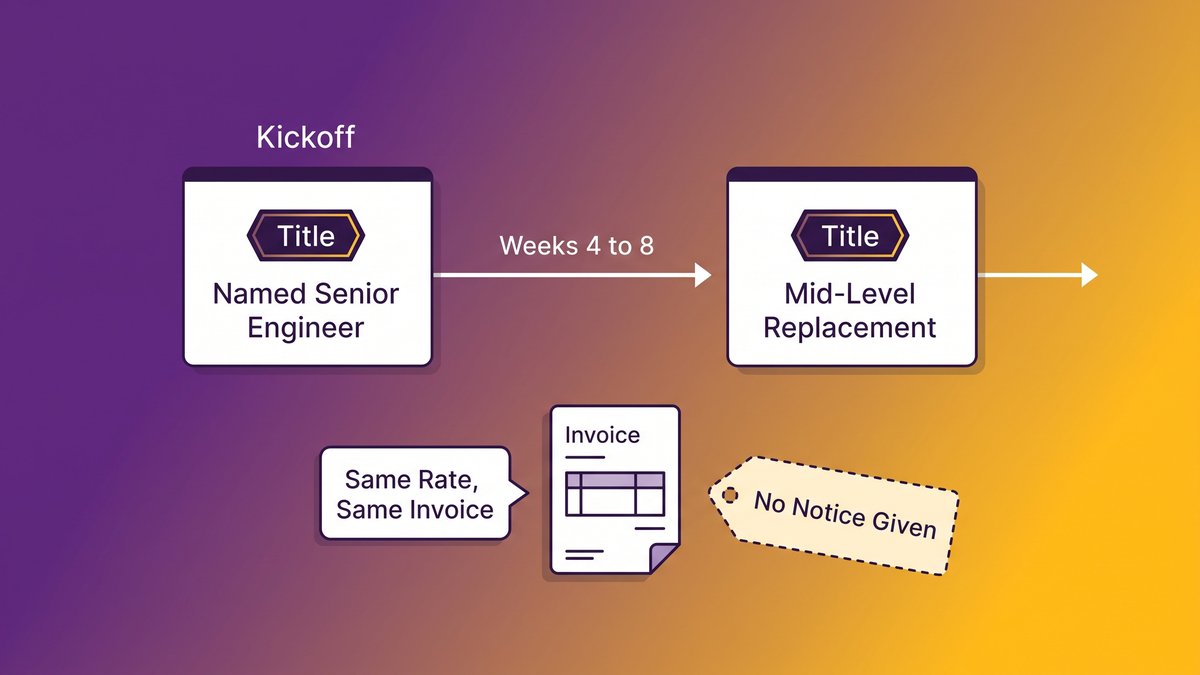
A kickoff-call senior engineer gets swapped for a less experienced hire a few weeks into the engagement.
The Team You Interviewed Is Not the Team Shipping Your Code
The senior engineer from your kickoff call typically stays on the account four to eight weeks before a mid-level engineer quietly inherits both the senior title and the senior rate.
Both your CTO and your CEO sat in that pitch meeting. They met the same senior architect, heard the same confident answers about your stack, and signed off on the same roster. Neither of them was in the room six weeks later when that architect got reassigned to a bigger account, or handed in notice, and a different engineer with two fewer years of experience started pushing commits under the same job title.
Blended-rate staff augmentation produces this outcome by default, and Team Topologies has written at length about why team stability, more than individual skill alone, is what determines delivery outcomes over time. A roster that changes without your knowledge breaks the exact thing that made the original team credible.
The bigger problem is that nothing in a standard vendor accountability model is built to catch the swap. SLAs track uptime and response time, KPIs track story points closed, and neither one asks whether the person doing the work is the person you were sold.
Why Vendor Accountability Frameworks Never Catch a Team Swap
Software vendor accountability, as most contracts define it, measures the vendor as an organization, never the roster that vendor staffs you with. That gap is the whole problem. Until you see it, you’ll keep paying for governance aimed at the wrong object.
What your SLA actually measures
Service level agreements measure uptime, response time, and bug resolution windows. They were built for infrastructure vendors, where the question was always whether the system stayed up, never whether the same engineer was still on your account. Google’s Site Reliability Engineering book is explicit that SLOs measure system behavior, not team composition. Importing that framework wholesale into a staff augmentation or dedicated team contract leaves the one variable that matters completely ungoverned: who is actually writing the code.
Why activity metrics hide a seniority downgrade
Story points closed, tickets resolved, hours logged: every one of those can hold steady while the seniority of the person generating them drops. Deloitte’s research on outsourcing failures found that 59% of failed engagements cite skill mismatch, exactly the kind of gap a quiet seniority downgrade produces. A mid-level engineer working hard can close a similar ticket count to a senior engineer working efficiently, at least for a few sprints. The difference shows up later, in architecture decisions nobody questioned and edge cases nobody caught, not in this week’s burndown chart.
The blended rate problem: same invoice, different engineer
Blended rate staff augmentation prices the hour, not the person. Our breakdown of the blended rate arithmetic covers this in more detail, but the short version matters here: when your contract specifies a dollar figure per hour instead of a named individual, the vendor can swap a senior for a mid-level engineer without touching a single line of the invoice. You keep paying the same rate for less experience, and the contract has no language that says that’s a breach.
Three Sprint-Level Tripwires That Surface Substitution in Weeks, Not Months
Thirty seconds with a git log will tell you whether the roster you were sold still matches the hands on your codebase.
You don’t need your vendor’s cooperation for any of the three signals below. You can run all three inside your own sprint cadence this week, using data you already have access to.
Tripwire 1: commit authorship drift against the named roster
Pull the git log and compare author distribution against the roster named in your statement of work. If the senior engineer named in your SOW has authored a shrinking share of commits over the last three sprints, relative to engineers who were never named as seniors, you’re looking at a swap in progress, not a staffing rumor.
Tripwire 2: review depth and who is approving the pull requests
Open the last twenty merged pull requests and look at two things: who approved them, and how substantive the review comments are. A senior engineer who’s genuinely present will leave comments about architecture and edge cases. A senior title with nobody senior behind it tends to produce approvals with little more than “LGTM” attached. Atlassian’s guide to code review is a useful baseline for what healthy review depth looks like if you need a reference point for your own team.
Tripwire 3: delivered velocity against contracted sprint points
Compare what your contract specifies as a sprint-point commitment against what ships, sprint over sprint. A gap that opens gradually and never closes is what a seniority downgrade looks like when you measure it in points instead of people, and it is rarely explained away by one unlucky sprint.
Run these three checks together and you can surface a substitution within two or three sprints, against a degradation that otherwise takes six to eight weeks to become visible and another month to get named out loud. Sprint-level measurement is what buys you that head start.
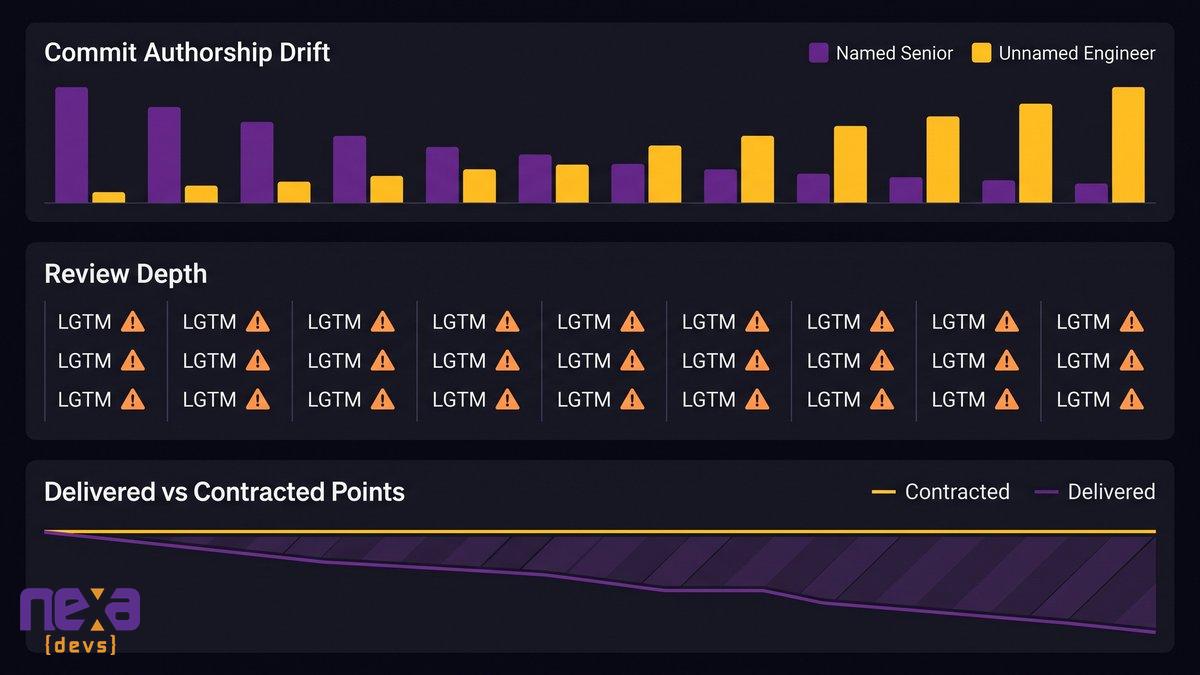
A sprint dashboard flagging a drop in commits from the named senior engineer alongside falling delivered story points.
What the Swap Has Already Cost You by the Time You Notice
Quality degradation starts six to eight weeks before anyone notices it, which means the invoice you’re disputing today reflects a problem that’s already a month and a half old.
In Deloitte’s 2024 Global Outsourcing Survey of more than 500 business and technology leaders, 55% named a lack of benefit realization tracking and reporting as a challenge in their outsourcing programs, ahead of inadequate organizational change management (53%) and poor integration of vendor services with the operating model (47%). A silent team swap sits underneath all three: you can’t track a benefit you never measured against the right baseline, and you can’t manage a change nobody told you was happening.
That lag gets paid for in rework, and the bill arrives long after the engineer does. James Rose, Founder of Content Snare, describes his own version of it: “The code took around six months using a mix of our in-house dev team and an agency, though the latter introduced technical debt that plagued us for years.”
For a mid-market organization, the downside isn’t abstract. The direction is consistent: the later you catch a seniority downgrade, the more expensive the fix becomes, and “later” is the default outcome when nothing in your contract is watching for it.
Vendor-Side Attrition Drives the Swap More Often Than Dishonesty
Most vendors aren’t lying to you when they introduce you to a senior engineer. They’re describing someone who, statistically, is unlikely to still be assigned to your account a year from now.
Nearshore and offshore engineering markets both run on recruiter churn. Senior engineers get pulled by a bigger account, a competitor’s offer, or an internal promotion, and vendors with thin senior benches backfill with whoever is available rather than leave a seat empty. We’ve worked alongside enough vendors with under two years of average senior tenure to do the arithmetic plainly: a senior who ships your sprint three is routinely gone by sprint nine, rotated out on something close to a nine-month cycle.
The distinction changes what you do next. If dishonesty were the problem, the fix would be finding an honest vendor, and you’d be back here in eighteen months with a different logo on the same complaint. Because the problem is structural (attrition that no single vendor fully controls), the fix is contractual: write the contract so attrition on the vendor’s side never arrives as a surprise on yours.
A vendor cannot promise you a person it cannot keep. SHRM’s research on turnover costs is written for general hiring contexts, but the underlying mechanic is identical: when the market for a skill is competitive, retention is never guaranteed, and any contract that assumes otherwise is building on sand.
Make Team Composition a Contractual Object, Not a Sales Promise
The team composition you were sold should be a contractual object. Most mid-market buyers never make it one, and that omission is why a silent swap stays silent.
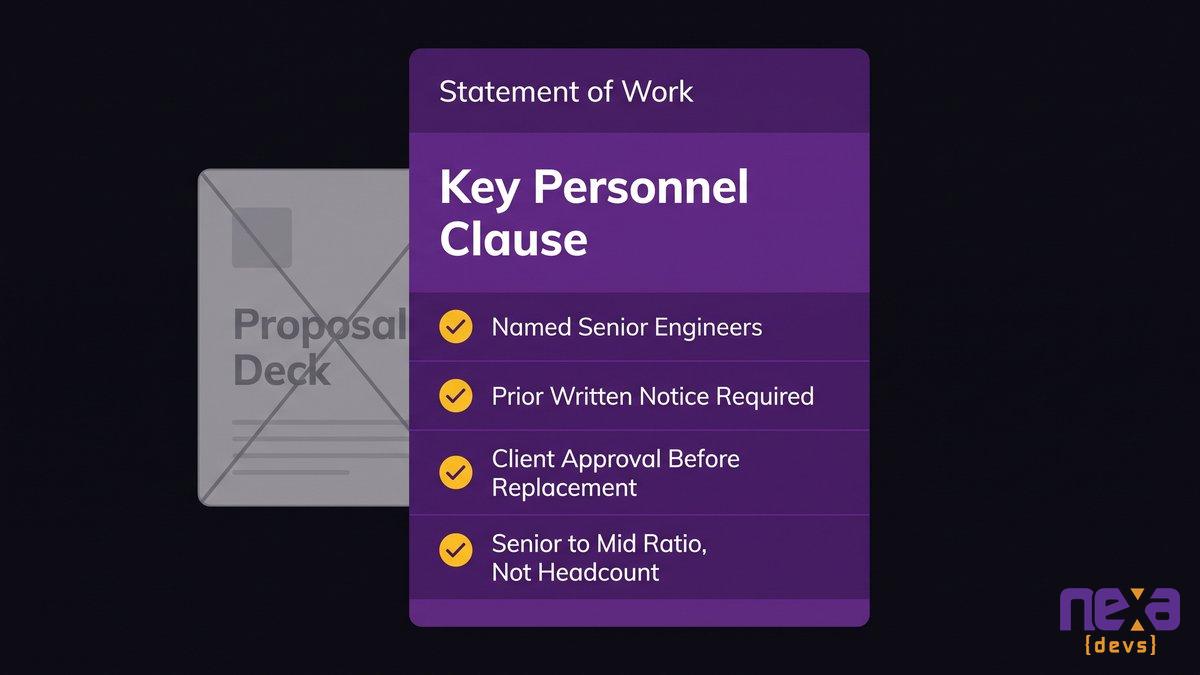
A sample SOW clause naming senior engineers and requiring written notice before any replacement.
Name the senior engineers in the SOW, not the proposal deck
A proposal deck is marketing. A statement of work is the only document that actually binds anyone. If your senior engineers are named in the pitch but not in the SOW, what you have is a sales promise, and sales promises don’t survive the vendor’s own staffing pressure. Put the actual names into the contract itself. A named senior engineer in SOW language is the difference between a commitment and a courtesy.
Replacement notice and client approval rights
Add a clause close to this: replacement of a named senior engineer requires prior written notice, with fourteen days as a reasonable default, and requires your approval before the swap takes effect. This single clause converts a silent rotation into an event you see coming, and it costs the vendor nothing if the vendor was planning to keep its promise anyway.
Commit to a senior-to-mid ratio, not a headcount
Headcount tells you how many people are on the account and nothing at all about seniority. Specify a minimum senior-to-mid engineer ratio in the contract, and require the vendor to maintain it across the life of the engagement, not just at kickoff. That closes the blended-rate loophole: the vendor can still staff flexibly, just not in a way that erodes the seniority mix you’re paying for.
What it means when a vendor refuses to name anyone
If a vendor pushes back hard on naming individuals, treat that as information, not negotiation friction. A vendor confident in its retention will name its people without much resistance. A vendor that resists naming anyone is often telling you, indirectly, that it doesn’t expect those people to still be there in six months. World Commerce & Contracting publishes extensively on key personnel clauses as standard practice in professional services contracting, and there’s no real reason a software vendor should be the exception.
Reporting Cadence That Makes Rotation Visible Instead of Invisible
A contract clause only works if someone checks it. Make the check a standing agenda item, not a reaction to a bad sprint.
Roster attestation as a standing agenda item
Add one line to every sprint review or monthly business review: confirm, by name, who is currently assigned to the account at senior level. This costs five minutes. It also means a swap becomes something your vendor has to actively disclose in a recurring meeting. You stop having to discover it on your own, months after the fact.
Outcome KPIs that break when seniority drops
Pair the attestation with at least one KPI that degrades when seniority drops: defect escape rate, code review rejection rate, or rework hours per sprint. Activity metrics stay flat through a downgrade, while outcome metrics move. Project Management Institute publishes guidance on vendor performance monitoring cadence that applies directly here: monitoring only works when it’s scheduled and specific, never ad hoc.
Continuity as a Delivery Model: Why Nexa’s Teams Stay
Contracts and tripwires manage the risk without removing it. The durable answer to outsourcing team substitution is a vendor whose model doesn’t generate the rotation in the first place, and that’s a harder thing to build than a clause.
Per-deliverable IP and documentation transfer
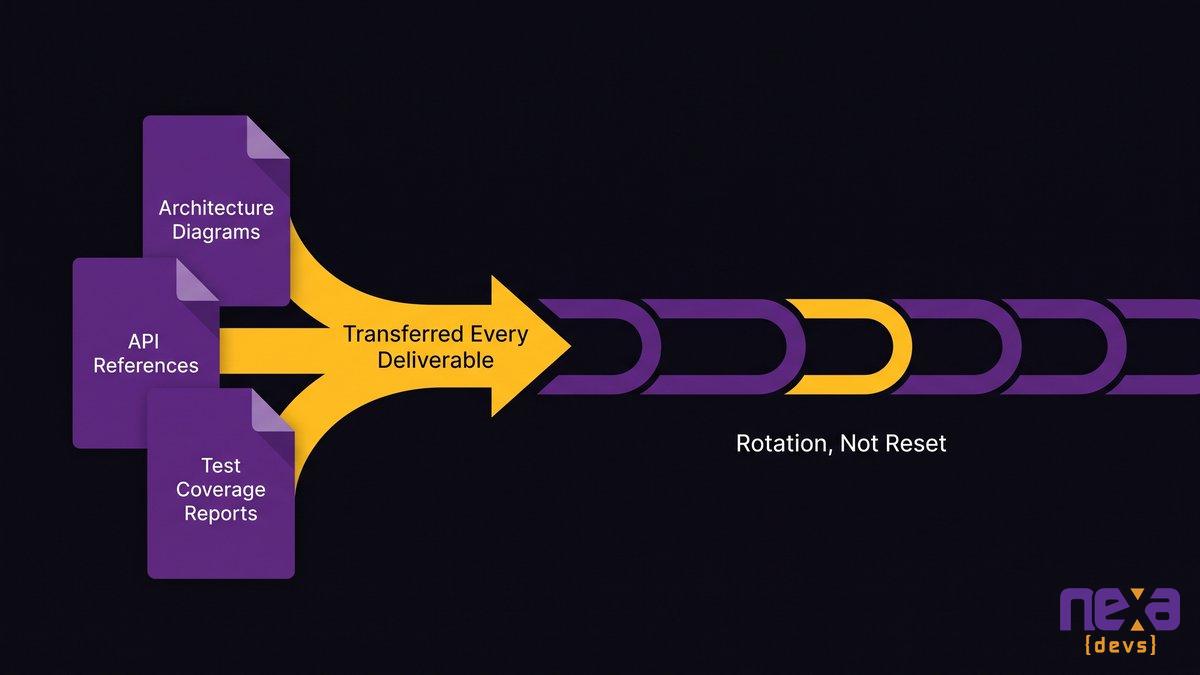
We transfer complete documentation at every deliverable, not just at project close: architecture diagrams, API references, test coverage reports. That practice is what makes a personnel change survivable. When a senior engineer does leave an engagement, for whatever reason, the replacement inherits a documented system they can actually read instead of a blank codebase and someone else’s half-remembered decisions.
AI-assisted documentation and codebase consistency shorten onboarding
AI-augmented delivery matters here as plumbing, never as a headline: it keeps documentation current without spending a senior engineer’s week to maintain it. Google’s DORA research found that teams with higher-quality internal documentation are 2.4 times more likely to see better software delivery and operational performance, and that only about 25% of teams had good-quality documentation to begin with. Continuity does not survive on individual knowledge retention. AI-assisted documentation is what makes that standard achievable on every sprint, including the ones where nobody has slack to write it up. The difference between a rotation and a reset is almost always whether the documentation existed before the person left.
Ten years at UCLA, eight at TSB, eight at FrontStream
Continuity shows up in a vendor’s record or it doesn’t exist at all. Nexa has supported UCLA’s David Geffen School of Medicine for more than ten years, TSB for eight, and FrontStream for eight. Those aren’t renewal statistics pulled from a sales deck. They’re what development partner team continuity looks like when named engineers, documented handoffs, and a ratio instead of a headcount get honored for a decade at a time.
If the swap already happened and the relationship is past saving, that’s a different problem with its own playbook. Everything above is about catching it earlier: amending the SOW and instrumenting the sprint on the engagement you’re already running, rather than starting over with someone new.
A long-tenured engineering team working through documentation and planning materials, representing multi-year account continuity.
If your current engagement has a roster you can’t verify, that’s worth fixing before the next sprint review, not after the next quarterly one. Schedule a call and we’ll help you build the contract language and sprint instrumentation this piece describes, for the team you already have.
FAQ
How do you hold a vendor accountable?
Name the specific engineers in the contract, not just the proposal, and require written notice and your approval before any of them get swapped out. Pair that with a sprint-level check on commit authorship, review depth, and delivered points, so you catch a change in weeks rather than months.
What are the best ways to monitor vendor performance?
Combine outcome KPIs such as defect escape rate and rework hours with a standing roster attestation at every sprint review. Activity metrics alone (tickets closed, hours logged) can hold steady while the seniority of your team quietly drops.
What is a key personnel clause in a software development contract?
A key personnel clause names specific individuals in the statement of work and requires the vendor to get your written approval before replacing any of them, turning team composition into an enforceable contract term.
How do you know if your outsourcing vendor swapped your senior engineer?
Check whether the named senior still authors a meaningful share of commits, still approves substantive pull requests, and whether delivered sprint points match your contract. A gap in any of the three is a strong signal.
Why do vendor-side engineers rotate off mid-market accounts so quickly?
Senior engineers get recruited away by bigger accounts or better offers, and vendors with thin senior benches backfill with less experienced staff. It’s usually vendor-side attrition, not a deliberate attempt to mislead you.