Switching Development Vendors: A Transition Playbook
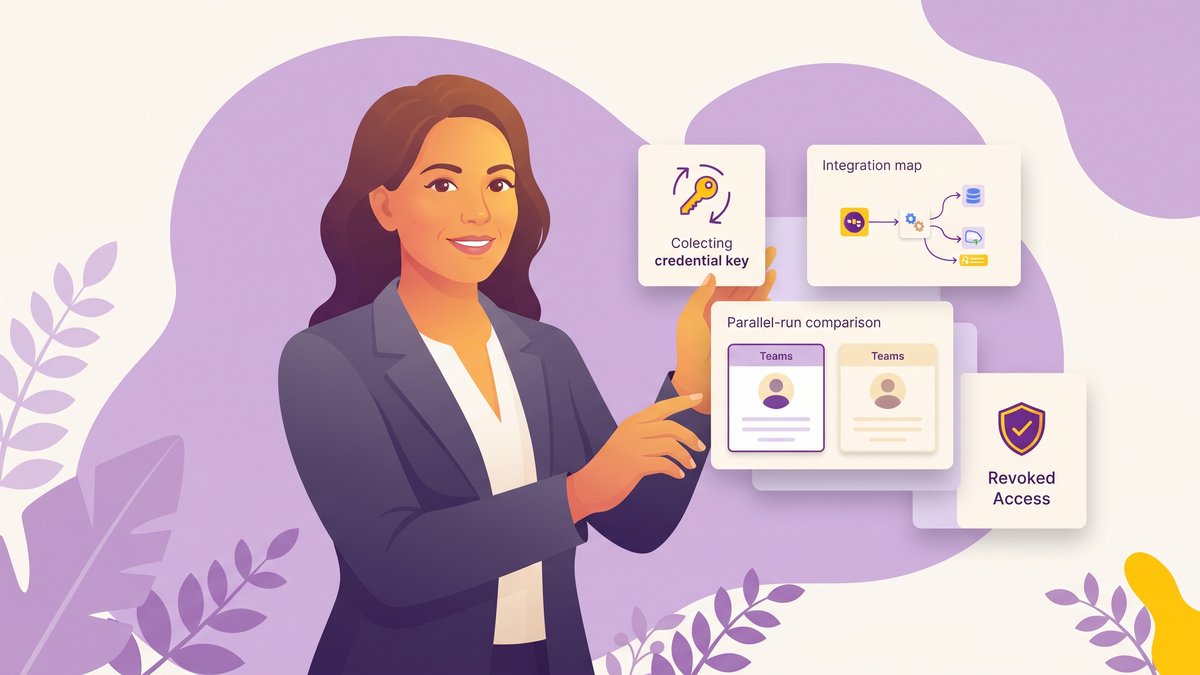
Table of Contents
- Quick answer: switching development vendors safely
- What Actually Breaks When You’re Switching Development Vendors (Hint: It Isn’t the Repository)
- Establish Governance and Ownership From Day 0
- Stabilize Access and Secure the Codebase in the First Two Weeks
- Commission an Independent Codebase Audit and Capture a Baseline
- Run Structured Knowledge Transfer With Mandatory Live Walkthroughs
- Prove the New Team Can Ship With a Parallel Run Before Cutover
- Execute a Clean Cutover and Revoke the Outgoing Vendor’s Access
- Maintain Compliance Continuity Throughout the Transition
- FAQ
Switching development vendors rarely goes wrong because the new team can’t read the code. The code is the easy part. Projects come apart when nobody owns the transition, access stays scattered for weeks, and the incoming team inherits a system nobody can fully explain. If you’re planning to switch development vendors, the repository is the part you don’t need to worry about. Everything it doesn’t say is where the risk lives.
A controlled vendor transition follows a specific sequence: assign ownership before you give notice, stabilize access and integrations in the first two weeks, commission an independent audit to set a baseline, run knowledge transfer through live walkthroughs instead of a document dump, prove the new team can ship with a parallel run, and only then cut over with the old vendor’s access fully revoked. Skip a step and you’re no longer running a transition; you’re gambling with a system your business runs on.
This is different from a project rescue, where a vendor has already failed or disappeared. This playbook covers a proactive vendor transition plan you control from the start, including the compliance continuity work regulated mid-market teams can’t afford to skip.
Quick answer: switching development vendors safely
- Assign one transition owner and secure documentation, IP, and access before you give notice.
- Stabilize every credential, repo, and integration in the first two weeks; missed integrations fail silently.
- Commission an independent audit and capture a performance baseline before day one.
- Run live knowledge-transfer walkthroughs, not document dumps, and require a parallel run before cutover.
- Cut over only after the parallel run succeeds, then revoke the outgoing vendor’s access completely.
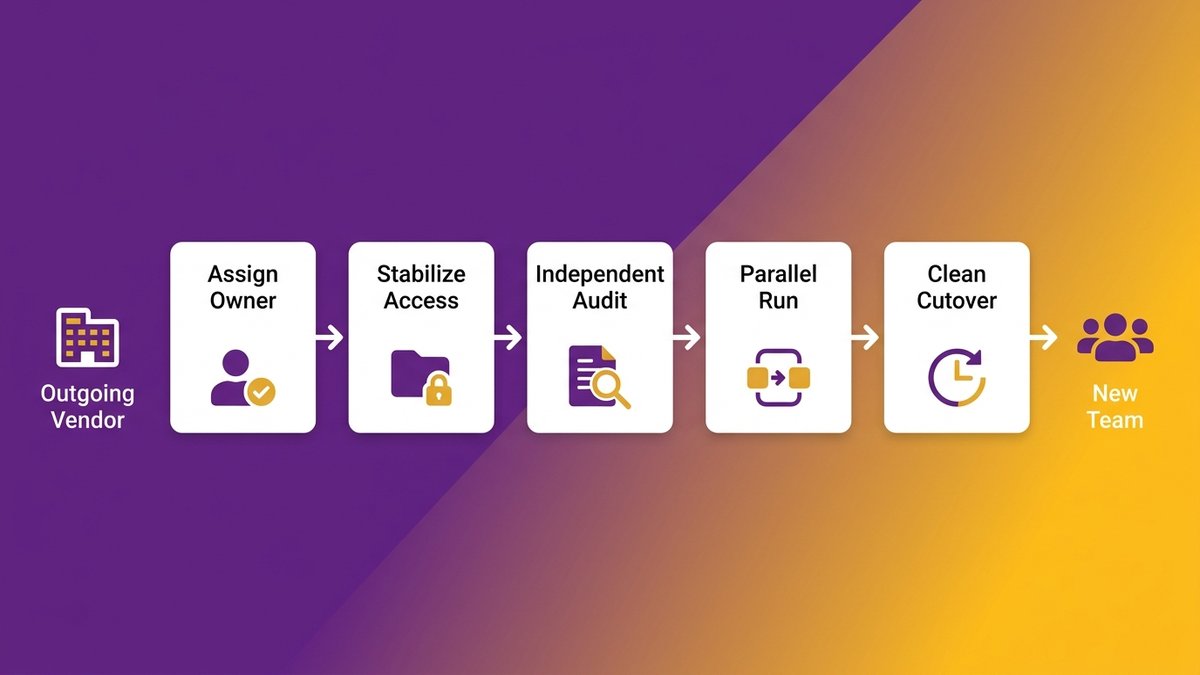
A structured transition plan turns a vendor switch from a gamble into a sequence you can verify.
What Actually Breaks When You’re Switching Development Vendors (Hint: It Isn’t the Repository)
A mid-market healthcare accreditation platform switched vendors in 2025. The outgoing firm handed over a complete code export within a day of the notice period ending. Three weeks later, certificate generation started producing documents the client’s own regulators rejected, and a document-management integration was failing silently while nobody noticed until customers complained.
The repo transfers cleanly; the undocumented operational context does not
Every switching-development-vendors project treats code handover as the asset worth protecting. It’s actually the piece that moves with the least friction. A configuration value buried in a deploy script, a rate limit negotiated verbally with a vendor two years ago, the reason a batch job runs at 3 a.m. instead of 9 p.m., none of that ships with a git clone. A transition plan that only accounts for the codebase is planning for the easy 20 percent of the risk.
The failure modes: stalled workflows, silent integration breaks, rejected outputs
Three failure patterns show up again and again in a bad vendor transition: a workflow stalls because nobody knows which service owns a step, an integration breaks quietly because nobody mapped it before cutover, or an output gets rejected downstream (a claim, a certificate, a compliance report) because a validation rule never made it into anyone’s documentation. DemandSage’s 2026 research puts a number on how often this goes wrong: 20 to 25 percent of outsourcing relationships fail within their first two years, and a mismanaged transition is a common thread behind that figure.
As Ashwin Ballal, Chief Information Officer at Freshworks, states: “Legacy systems have become so complex that companies are increasingly turning to third-party vendors and consultants for help, but the problem is that, more often than not, organizations are trading one subpar legacy system for another.” A poorly run vendor switch does exactly that. It replaces one black box with a different one, just with a fresh contract.
If your vendor has already gone dark instead of giving notice, this playbook won’t cover that scenario in full; see vendor handoff checklist for a disappeared vendor for the recovery-specific version.
Establish Governance and Ownership From Day 0
Ownership isn’t something you negotiate at the end of a vendor transition. It’s the first decision, made before you send the notice email, or you’ll spend the next 90 days negotiating for things you already own.
Who owns documentation, IP, and access the moment the transition begins
Name one person internally, not a committee, who owns the transition from day zero. That person confirms the client, not the outgoing vendor, holds the source repository, the documentation, the deployment credentials, and the IP assignment on file. The Deloitte Global Outsourcing Survey found that 55 percent of failed vendor engagements never tracked benefits against the original goal at all, and an ownerless transition is usually where that gap starts.
Pragmatic Coders’ research on vendor lock-in makes the distinction sharp: legal ownership of IP and practical operational control are not the same thing. A contract that says you own the code means nothing if the outgoing vendor is the only one who can deploy it.
What to require from the incoming partner in writing
Before the incoming partner starts work, put a transition-out clause in the contract itself: unconditional documentation transfer regardless of whether the engagement continues, a client-owned repository from day one, and a named point of contact accountable for the timeline. This clause is what answers the fear every CTO and COO carries into a vendor switch: trading one black box for another. Nexa Devs runs every engagement this way by default: complete documentation transfer to the client at project completion, with no dependency on renewal.
For the deeper legal mechanics of ownership versus access, see vendor lock-in and IP ownership.
Stabilize Access and Secure the Codebase in the First Two Weeks
Fourteen days. That’s the window before scattered credentials turn into a security incident, and it’s the first real deadline in any vendor transition plan.
Inventory credentials, repos, environments, and third-party integrations
Build a single inventory in the first week: every repository, every environment (dev, staging, production), every API key, every third-party service account, and who currently holds the password. Most mid-market teams find at least one credential nobody remembers issuing. Rotate every credential the outgoing vendor touched, not just the obvious ones, and confirm the new owner is your named transition lead, not the incoming vendor by default.
Following NIST’s guidance on credential lifecycle management during this window keeps the rotation defensible if a regulator or auditor ever asks who had access and when.
Protect IP and map every integration before anything moves
Integration mapping is the step most transition plans skip, and it’s the one that produces the silent failures. List every system the outgoing vendor’s code talks to: payment processors, EHR systems, CRM platforms, reporting tools, and any middleware nobody remembers building. For each one, confirm who owns the credential, what the failure mode looks like, and who gets paged if it breaks during cutover.
A vendor transition that maps integrations before day 15 catches the failures a document review never would. This is also where source code escrow earns its keep as a fallback, not a substitute for the inventory itself.
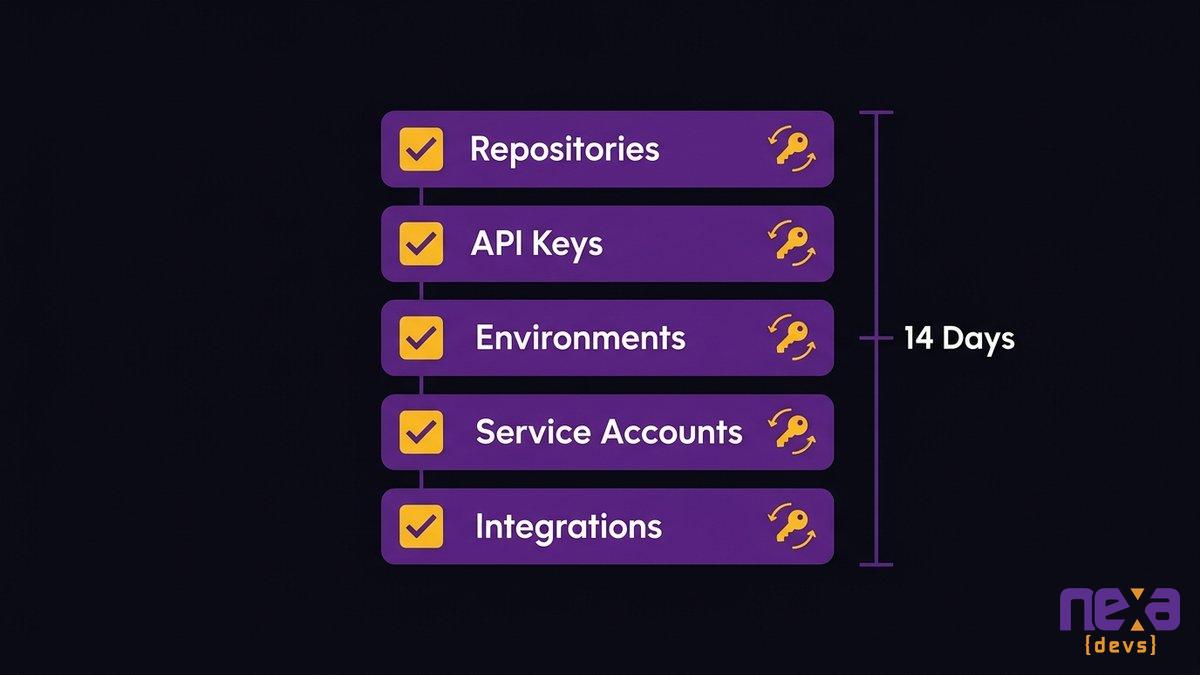
Every credential, repo, and third-party integration gets inventoried and rotated in the first two weeks.
Commission an Independent Codebase Audit and Capture a Baseline
You cannot prove a new vendor is performing without a number to measure against. An independent codebase audit, run before day one, gives you that number: test coverage, deployment frequency, defect rate, and a documented list of what’s actually broken.
What a usable audit must include
A usable audit covers four things: architecture and dependency mapping, test coverage by module, security exposure (outdated packages, exposed credentials, unpatched CVEs), and a prioritized list of known defects with severity ratings. Skip any of the four and the incoming vendor inherits blind spots the outgoing one already knew about and never disclosed. Run the audit independently, not through either vendor, so the findings don’t get shaped by whoever benefits from a rosier picture.
Setting velocity and quality targets before Day 1
Capture baseline numbers before the new team touches a single line: current deploy frequency, mean time to resolve a production incident, and defect escape rate. ClearlyAcquired’s research on key-person risk in technical transitions found that replacing high-level technical talent typically costs 150 to 400 percent of salary and delays projects six to twelve months. A documented baseline is what keeps that delay from becoming indefinite.
This is also where a partner’s willingness to take on a system in rough shape matters. Not every vendor will commission an honest audit of a codebase it didn’t write, especially a degraded one. Nexa runs this audit process on systems it didn’t build, including ones in poor condition, because the point of the exercise is an accurate baseline, not a sales pitch.
Run Structured Knowledge Transfer With Mandatory Live Walkthroughs
A document dump is not knowledge transfer. It’s a PDF nobody reads until the first outage, by which point the person who could have explained it is already gone.
Live walkthroughs and recorded audits, not a document dump
Structured knowledge transfer means scheduled, recorded sessions where the outgoing team walks the incoming team through the system live: here’s why this workaround exists, here’s the integration that breaks if you touch it wrong, here’s the report nobody documented because everyone just knew how to run it. Record every session. The incoming team will need to rewatch the fifth one after the first three make sense. A single handoff document, however thorough, can’t answer a follow-up question. A live walkthrough can.
AI-assisted documentation reconstruction to accelerate capture
AI-assisted documentation tools can speed up the capture side of this process: transcribing walkthrough sessions, mapping dependencies from the codebase itself, and drafting a first-pass architecture document the incoming team edits instead of writing from scratch. Skylar Roebuck, Chief Technology Officer at Solvd, frames the broader point well: “AI capability is compounding rapidly, and the real risk for mid-market companies is delay.” The same logic applies here. AI speeds up the mechanical part of documentation capture, but it doesn’t replace the live walkthrough where someone explains why a system works the way it does.
For a deeper methodology on reconstructing documentation for a system that was never properly documented, see AI-assisted documentation reconstruction for black-box systems.
Prove the New Team Can Ship With a Parallel Run Before Cutover
A parallel run answers one question the sales deck can’t: can this team actually ship on your system, under your constraints, before you’ve cut off the only team that still can?
Parallel-run structure and exit criteria
Run the new team alongside the outgoing one for two to six weeks, working real tickets, deploying to a staging environment that mirrors production, with the outgoing team available for questions but not doing the work. Set exit criteria before the parallel run starts, not during it: a minimum number of successful deployments, a defect rate at or below baseline, and at least one incident handled independently. Vague criteria like “feeling comfortable” get replaced by a slipping deadline every time.
The evidence that says you are ready to cut over
Cutover readiness comes from evidence, not a gut feeling. Score it against the baseline the independent audit captured: deploy frequency at or above baseline, defect rate at or below it, and every priority-one workflow tested end to end by the new team without help. If the new team hasn’t hit those numbers, extend the parallel run. A short delay here costs far less than a cutover that fails in production while the old vendor’s access is already gone.
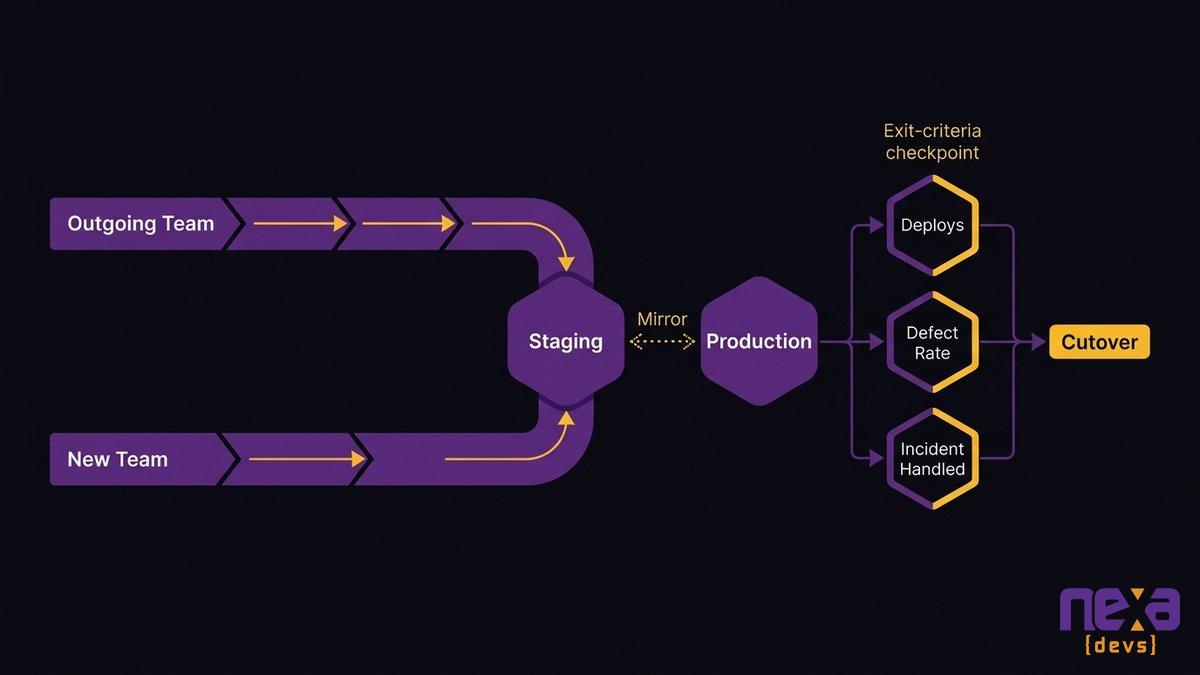
A parallel run gives you evidence the new team can ship before the old one leaves.
Execute a Clean Cutover and Revoke the Outgoing Vendor’s Access
Cutover day has one job: make the new team’s access permanent and the old vendor’s access gone, in that order, on the same day.
Cutover readiness checklist
Think of the following as your vendor offboarding checklist, the list that has to be complete before the old vendor’s access disappears:
- Every parallel-run exit criterion met and documented
- Documentation package handed over and confirmed readable by the incoming team, not just delivered
- DNS, deployment pipelines, and monitoring alerts pointed at the new team
- A rollback plan in case cutover reveals a gap the parallel run missed
- A named person on call for the first 72 hours post-cutover
Revoking access and closing out the old engagement
Revoke every credential the outgoing vendor held on cutover day, not the following week. Rotate API keys, remove repository access, disable service accounts, and confirm nobody outside your organization can deploy to production. Get written confirmation the outgoing vendor has deleted any copies of your code, data, or credentials outside your systems.
Mid-market teams skip this step most often, usually because the relationship ended amicably and revoking access feels unnecessary. Do it regardless. A clean cutover means the client owns everything and depends on nobody outside the organization to keep the system running.
Maintain Compliance Continuity Throughout the Transition
Compliance doesn’t pause for a vendor transition. Auditors don’t care that you switched development vendors mid-cycle. They care whether your controls stayed documented the entire time.
HIPAA, SOC 2, and PCI-DSS continuity during handover
If the system you’re transitioning touches protected health information, cardholder data, or falls under a SOC 2 report, name a compliance owner alongside the transition owner, and confirm they’re the same conversation, not two separate ones. According to the U.S. Department of Health and Human Services, HIPAA’s security rule requires documented access controls and audit logging regardless of who operates the system, which means the outgoing vendor’s access needs to be logged as revoked, not just assumed gone.
Documenting controls so an audit never lapses
Map every control in your current compliance scope to a named owner before the transition starts, and update that mapping the day each control’s ownership changes hands. The PCI Security Standards Council’s requirements for access control and vendor management don’t pause for an internal staffing change, and an auditor reviewing the transition period will ask who owned each control on any given day. A gap in that mapping is the difference between a clean audit and a finding that costs months to remediate.
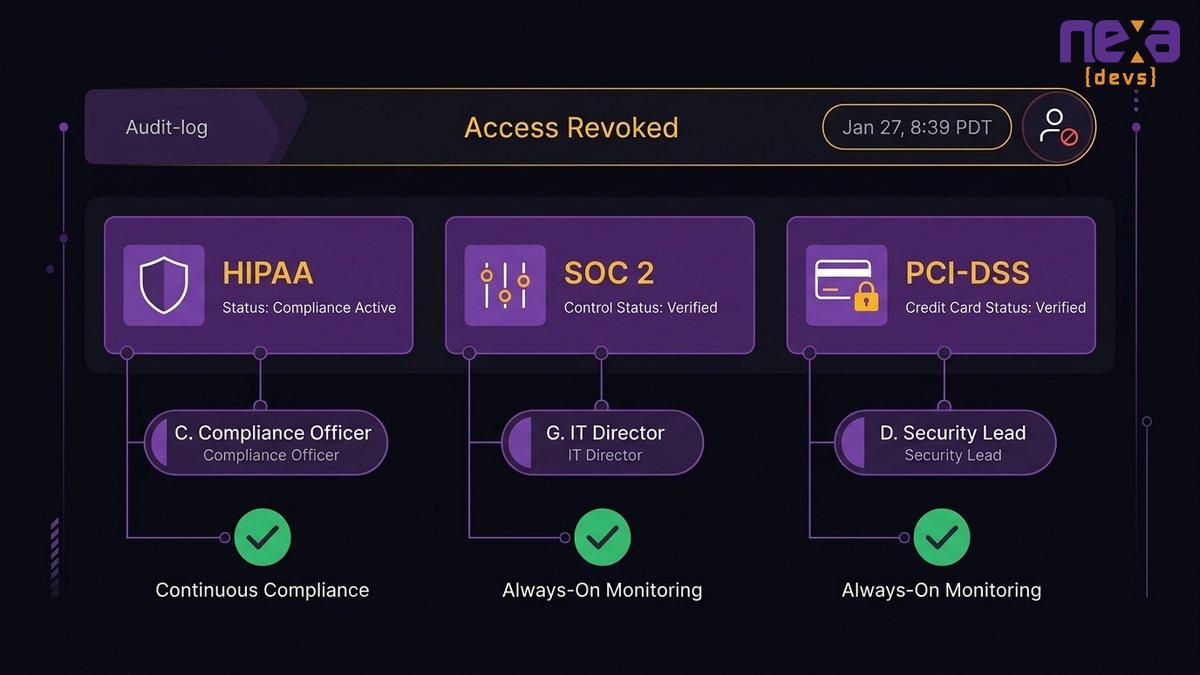
Compliance controls need documented continuity, not just a handoff email, when vendors change.
Switching development vendors carries real risk, but the risk is manageable with the right sequence: governance from day zero, stabilized access, an independent audit, live knowledge transfer, a parallel run that proves capability, and a cutover that revokes every outside credential. Handled in that order, a vendor switch stays a controlled project you can verify at every step. Handled out of order, it becomes the outage you didn’t see coming.
Nexa Devs runs this exact playbook for mid-market teams switching vendors, including teams inheriting systems in poor condition with degraded documentation. Complete documentation transfer happens on day one, not at project close, and it stays yours whether or not the engagement continues. For a deeper look at what complete documentation transfer actually includes, see outsourcing software development documentation.
If your current vendor relationship has already gone sideways rather than reaching a clean end, talk to our team about running an independent audit and a transition plan built around what your system actually needs.
FAQ
What should be included in a transition plan?
A vendor transition plan should name a single owner, inventory every credential and integration, set an independent audit baseline, schedule live knowledge-transfer walkthroughs, define parallel-run exit criteria, and include a cutover checklist that revokes the outgoing vendor’s access completely.
Can you provide an example of a transition plan?
A typical 90-day transition plan runs like this: days 1 to 14 lock down governance and access, days 15 to 45 run the independent audit and knowledge-transfer walkthroughs, days 46 to 75 run a parallel run against baseline metrics, and days 76 to 90 execute cutover and revoke the old vendor’s access.
How long does a vendor transition take?
Most mid-market vendor transitions take 60 to 90 days from notice to full cutover. Complex systems with multiple integrations or compliance requirements, like healthcare or fintech platforms, often need the full 90 days to run a proper parallel run before cutting over safely.
Do I need source code escrow when switching vendors?
Source code escrow protects against a vendor disappearing without warning, but it doesn’t replace an active transition plan. Escrow gives you a static code copy. It doesn’t give you the operational knowledge, documentation, or working access a live knowledge transfer provides.
What’s the difference between a vendor transition and a project rescue?
A vendor transition is planned: you choose the timing and run each phase in sequence. A project rescue happens after a vendor has already failed or disappeared, so the audit and access recovery happen under pressure, often without the outgoing vendor’s cooperation.