
Outsourcing Software Development
Hidden Costs of Outsourcing Software Development

Table of Contents
- Quick answer: hidden outsourcing costs, priced
- What the Bid Is Actually a Price For
- The Failure List Has Almost No Engineering On It
- Cost One: Transition
- Cost Two: Change Requests
- Cost Three: Coordination
- Cost Four: Exit
- Why Comparing Hourly Rates Compares the Wrong Variable
- The Four-Line Worksheet
- What a Proposal Looks Like When All Four Lines Are Priced
- Hidden Costs of Outsourcing Software Development: FAQ
- The Question to Take Back to the Table
Two numbers sit side by side on a slide. The vendor’s bid is lower than the in-house estimate, by enough that nobody in the room argues. The decision feels made before the meeting ends.
The hidden costs of outsourcing software development sit in the gap between what the bid covers and what the engagement actually contains. A bid is a price for writing software. An engagement is writing software plus learning your systems, absorbing the changes your business will make, staffing the relationship on your side, and eventually ending. Those extra jobs rarely show up on an invoice until year three. By then the comparison slide is gone, and you may be the only person who remembers it.
This post names the four costs, uses Deloitte’s data to show they dominate the failure list, answers the “but the rate is lower” objection, and ends with a worksheet you can fill in from records you already have.
Quick answer: hidden outsourcing costs, priced
- A software bid prices construction against scope as understood in month one. It leaves out four costs: transition, change requests, coordination and exit.
- Deloitte’s 2024 survey found only 1% of leaders reported no outsourcing challenges. The leading causes are operational, not engineering.
- An hourly rate prices one of the four lines and says nothing about the other three.
- Fill in a four-line worksheet from your own records before you sign.
- Ask which of the four costs each proposal has priced and which it left on your side.
What the Bid Is Actually a Price For
A bid prices one thing: building the scope you described in month one. An engagement contains four other jobs besides, and each one lands on a budget line the proposal never mentions.
Software is among the most outsourced scopes there is. Deloitte’s Global Outsourcing Survey 2024 found that 72% of organizations outsource application and software development. So the choice feels routine, and that familiarity is what keeps anyone from auditing the exposure.
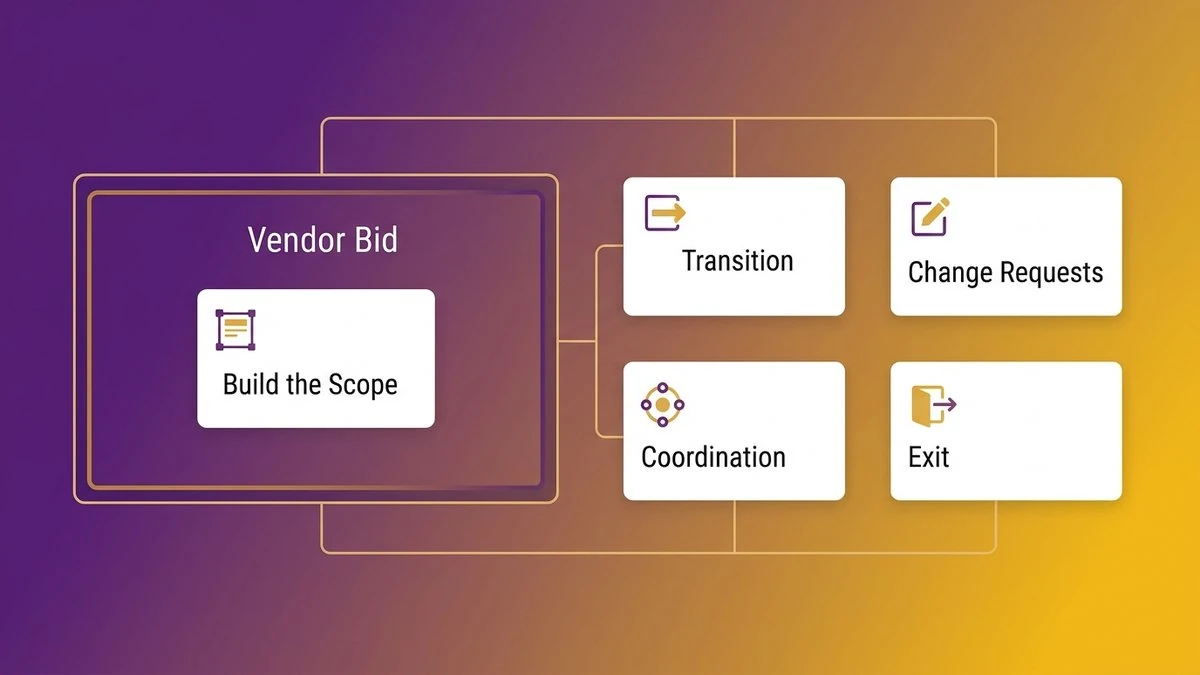
A bid covers the build; four other cost lines sit outside it.
The scope the bid prices
The vendor reads your requirements, estimates the effort and quotes a number. That number is honest about one thing: what building this specific scope costs if the scope never moves, the vendor already understands your systems, and nobody ever leaves.
Three assumptions in one sentence, and none of them is written on the proposal.
Pressure on the number makes it worse. As Rita Gunther McGrath, a professor at Columbia Business School, told Computerworld in 2013: “The CIO says, ‘That’ll be $5 million.’ The CEO says, ‘Do it for $3 million.’ So it’s patch, patch, patch.” Patches resurface later, on the four lines below.
The work the engagement contains
The four costs, one sentence each:
- Transition: the months a vendor spends learning systems nobody documented, a cost you pay twice if the engagement ever changes hands.
- Change requests: the bid prices scope as understood in month one, and your business won’t hold still.
- Coordination: someone on your payroll quietly becomes the full-time interface between the vendor and the business.
- Exit: every contract ends, and the cost of the ending is set by what you agreed at signing.
Why year three? Year one is transition, when the vendor is learning and the bill looks fine. Year two is accumulation, when change orders and coordination hours build up unnoticed. By year three your original champion has moved on, the coordinator is stretched thin, and renewal forces the exit question. The worksheet later in this post lets you price each line.
The Failure List Has Almost No Engineering On It
Tracking, change management, integration and contract handling lead the outsourcing failure list, and coding barely appears on it. Deloitte surveyed more than 500 business and technology leaders, and read aloud, its list sounds like a governance audit.
What more than 500 executives said goes wrong
Deloitte’s Global Outsourcing Survey 2024 covered more than 150 C-suite executives across industries. These were the most-cited challenges from outsourcing programs:
| Challenge (Deloitte’s wording) | Share citing it |
|---|---|
| Lack of benefit realization tracking & reporting | 55% |
| Inadequate organizational change management | 53% |
| Poor integration of vendor services with your operating model | 47% |
| Poor vendor performance during transitions of services | 46% |
| Inadequate financial management | 40% |
| Poor contract and contract change management | 38% |
| Poor vendor performance management | 38% |
| Poor vendor relationship management | 36% |
Read the table as a CEO would. Over half of respondents never tracked whether the promised benefit arrived. Nearly half said the vendor’s work didn’t fit how the business really operates. Almost nothing on the list is engineering skill. Pick the vendor with the best developers and you have still done nothing about the problems that fill it.
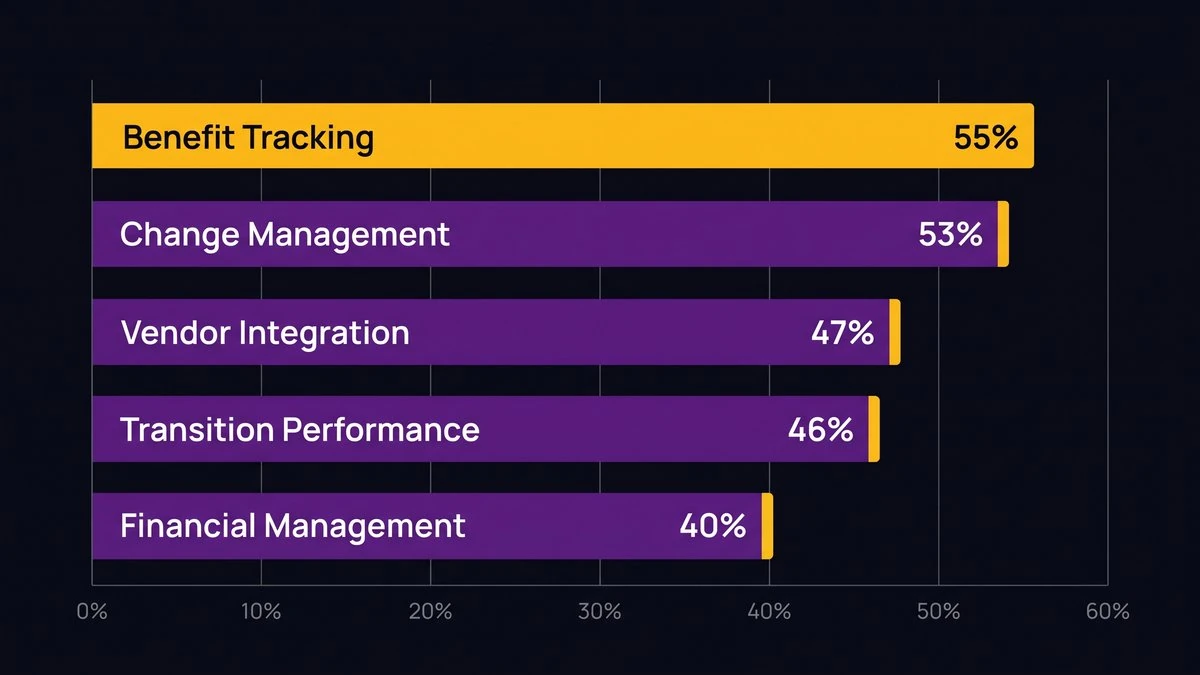
The most-cited outsourcing challenges are operational, not technical.
Why only 1% said nothing went wrong
Only 1% of respondents selected “none of the above.” A budget owner should hold on to that number. Outsourcing problems are the normal condition of these programs, not a run of bad luck. Price them in advance and you beat the model that discovers them later.
Cost One: Transition
Month two, and the vendor’s lead developer asks your finance manager why invoices reconcile on a three-day lag. Transition cost covers those months of learning systems nobody documented, billed to you by the vendor and absorbed by your own staff.
Deloitte’s respondents put poor vendor performance during transitions of services at 46%. Look at what buyers say they’ll do about it, though. Just 35% plan to budget additional time and effort for the transition phase in future programs, according to the same survey. That figure describes intentions rather than proven results, but it does show the line gets left out of the original budget as a matter of routine.
The months spent learning systems nobody documented
Count the real cost in weeks and calendars, not just vendor hours. How many weeks until the new team ships something unassisted? Which of your people answer questions in the meantime? What do they stop doing? A software vendor transition cost is the sum of the vendor’s ramp-up billing and the lost output of your own experts.
Why you pay this one twice
Whatever the vendor learned stays with the vendor unless it was written down in a form you own. Engagements change hands for ordinary reasons: a merger, a missed quarter, a better offer. The second vendor starts the same learning curve, and you’re billed for it again. Knowledge loss when a vendor leaves is the most expensive version of this line.
If you’re already living this, vendor handoff checklist covers what to demand before the first vendor goes, and switching development vendors playbook covers running the second transition.
Cost Two: Change Requests
Change requests are the most predictable line in any software budget, and a fixed bid quietly converts a closed number into an open one. The vendor priced the scope as it stood in month one.
Poor contract and contract change management shows up as a challenge for 38% of Deloitte’s respondents. Most writing on the subject files change orders and scope creep under annoyances. Treat them as a forecastable budget line instead. A new regulation, a reorganization or a customer demand will change the scope, and each change reopens the price.
The bid prices month one; the business will not hold still
Ryan Leirvik, CEO at Neuvik, described the effect in CIO.com (December 2025): “There’s this huge maintenance tail that we weren’t expecting because the initial price point was one cost and the maintenance is 1X.”
A fixed bid feels like certainty, and it is, about the starting scope only. After the first change order you’re negotiating a rate for work the vendor understands better than you do, and you have no leverage in that conversation.
What share of your current spend is change orders
Your CFO can audit this line from existing invoices this afternoon. Pull the last four quarters. Separate what was billed against the original statement of work from what was billed as change requests or change orders. Divide the second by the total. There’s no industry benchmark we’d trust here. Your own trend is the signal. If the share rises each quarter, the original bid priced a system your business no longer runs.
Cost Three: Coordination
A vendor sells you engineers. Somebody on your payroll ends up running the relationship, and neither proposal lists that person’s salary. Coordination is the line budget owners find hardest to look at once somebody points it out.
Of Deloitte’s respondents, 47% cite poor integration of vendor services with your operating model, and nearly 70% of organizations acknowledge their vendor management office function isn’t fully mature. Those are enterprises with the staff to build a VMO. Mid-market buyers mostly have no vendor management office at all, so the function lands on one person’s calendar by default. In practice, that person is often an operations director or a senior engineer who already had a full-time job.
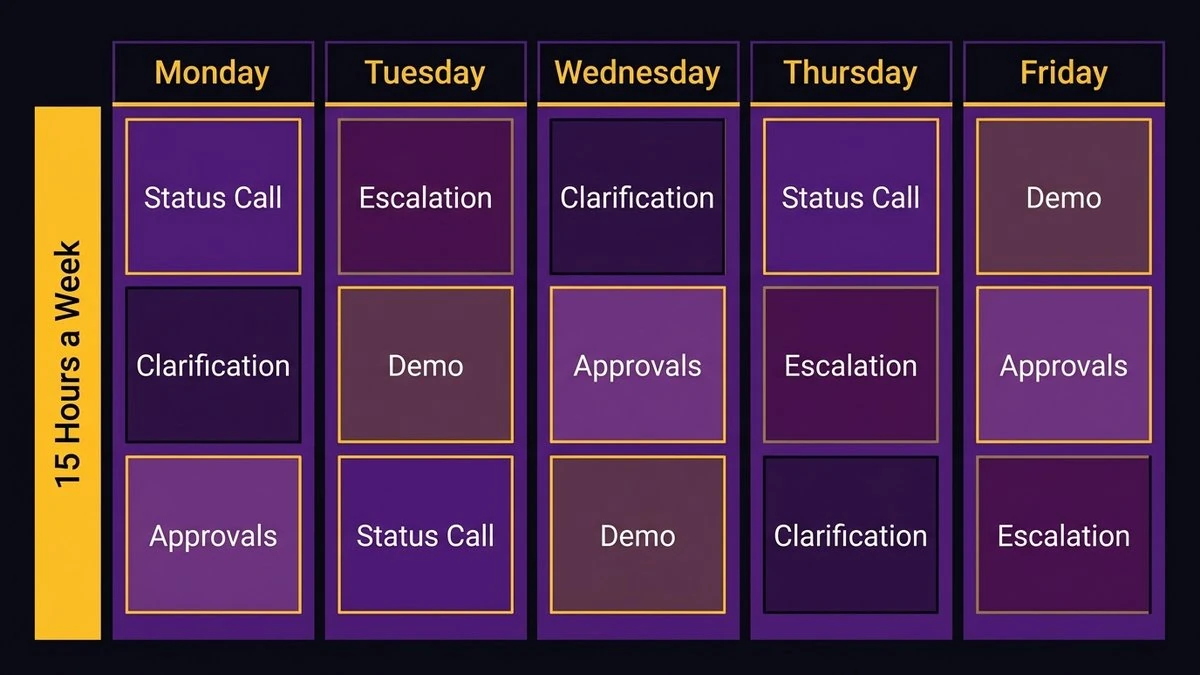
Vendor coordination overhead tends to land on one internal person’s calendar.
Someone internal quietly becomes the full-time interface
Nobody assigns this role. It accumulates: status calls, requirement clarifications, approvals, escalations, demos, the weekly “can you look at this” thread. Each one is small. Together they’re project management overhead the vendor’s proposal assumed you’d supply.
The salary that appears in neither column
Take a hypothetical. Your operations director spends 15 hours a week on vendor coordination. At a loaded cost of $90 an hour, that’s $1,350 a week, or $70,200 over 52 weeks. Neither the vendor’s bid nor your in-house estimate includes that figure. It never reaches the comparison slide. Replace the example with your own hours and your own loaded rate. The number is usually larger than people expect, and the in-house column has its own version of it too, in the managers who supervise engineers.
Cost Four: Exit
Every software contract ends, and the price of the ending is set the day you sign. By the time you terminate, you’re negotiating without leverage, and the terms you accepted earlier decide the cost.
You price insurance while you can still walk away, and exit works the same way. Five questions set the software development contract exit cost:
- Who owns the code, the designs and the documentation on the day the contract ends?
- Can you reach repositories, cloud accounts and credentials without the vendor’s permission?
- What notice period and minimum term apply, and does the contract auto-renew?
- How much of the system’s logic lives in documents versus in individual heads?
- Who would you hire to take over, and how long until they were productive?
A client-owned documentation package, transferred whether or not the engagement continues, is the cheapest way to shrink this line, though it only shrinks one line of the four.
What you hold on the last day
Picture a Friday when the vendor’s last invoice clears and the team is gone. What do you hold? If the honest answer is “a working system and nobody who can explain it,” the exit line is large, and you chose its size at signing.
Why these terms are cheap now and expensive later
Ownership, access and handover terms are cheap to write into a contract before work starts and expensive to extract after a dispute. Ask for them in the proposal stage, when the vendor wants the deal.
Why Comparing Hourly Rates Compares the Wrong Variable
An hourly rate prices one of the four lines and is silent on the other three. Compare proposals on rate and you’re measuring the variable least connected to where the money actually goes.
The obvious objection runs like this: fine, but the cheaper rate still wins on a five-year model. It does only if the other three lines are equal, and you have no evidence they are. An outsource vs in-house 5 year cost model needs all four lines in both columns. A lower rate that brings more change orders, more of your coordinator’s time and a harder exit can easily cost more over five years than a higher rate that doesn’t.
The market data points the same way. The ISG Index reported that full-year 2025 combined market annual contract value reached a record $127.4 billion, up 18%, while managed services ACV grew just 1.3% to $43.4 billion. Headline market growth says nothing about what a development engagement will cost you.
ISG’s 1H26 recap adds a structural detail: enterprises are consolidating providers through larger, longer cost-takeout deals while engaging smaller, niche providers for project-based work. The market is sorting itself by engagement shape rather than by price per hour. Our own position: a bid that prices one line out of four isn’t cheaper, just incomplete.
The Four-Line Worksheet
Four questions, each with a unit and a place to find the answer, let you score proposals instead of trusting them. A CFO can fill this in from existing records without asking the vendor anything.
Deloitte’s most-cited challenge, at 55%, was the lack of benefit realization tracking and reporting. Nobody measured whether the promised benefit arrived. This worksheet is that measurement, built before the contract instead of after.
| Line | Question | Unit | Where to find it |
|---|---|---|---|
| Coordination | How many internal hours go to vendor coordination? | Hours per week x loaded hourly cost | Calendars, timesheets, interviews |
| Transition | What did the last transition cost, and who still holds the knowledge? | Weeks of ramp, internal hours, a named person | Past invoices, project records |
| Change requests | What share of spend is change requests against original scope? | Percent of billed amount | Last four quarters of invoices |
| Exit | What would an exit cost if the engagement ended Friday? | Weeks and dollars to a productive replacement | Contract terms, access audit |
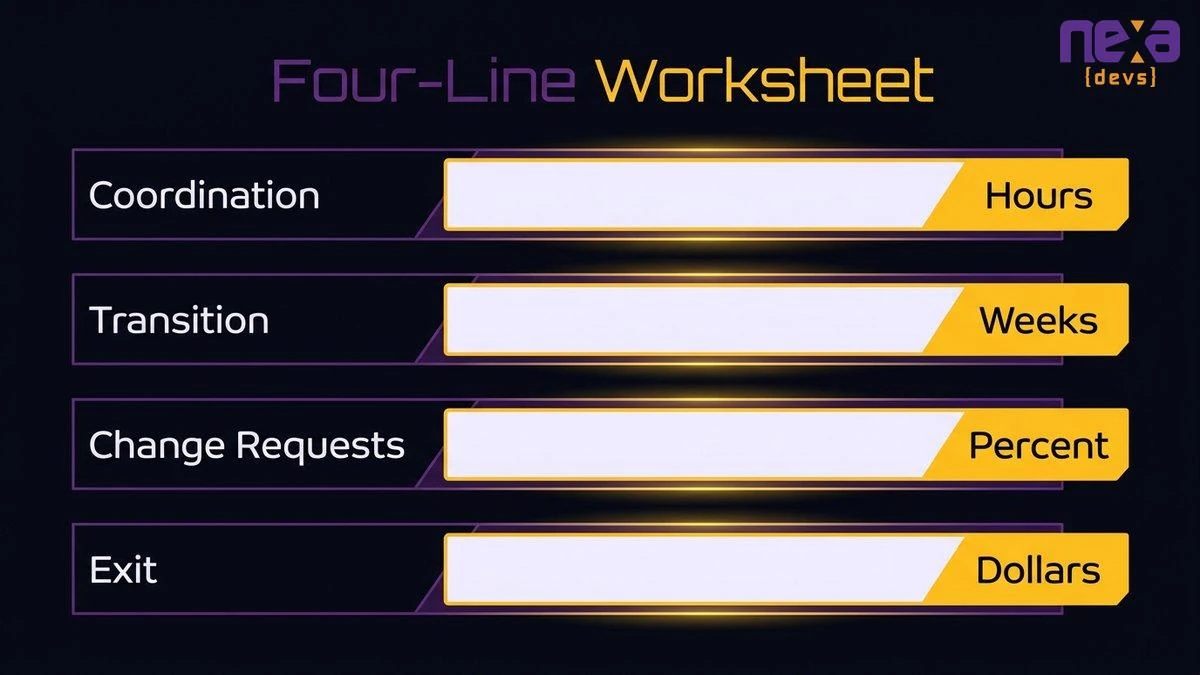
The worksheet scores each proposal on the four cost lines.
How many internal hours a week go to vendor coordination
Ask the person doing it, then check their calendar. Multiply hours by loaded hourly cost by 52. Include anyone who joins the recurring calls, since vendor management mid-market costs spread across several people.
What did the last transition cost, and who still holds the knowledge
Total the vendor’s ramp-up billing, then add the internal hours spent answering questions. Then name the person who holds the knowledge from that transition today. If you can’t name one, or the name is a contractor, mark the line as exposed.
What share of current spend is change requests against original scope
Use the invoice split from Cost Two. Record the percentage for each of the last four quarters, and note which changes came from your side and which from the vendor’s misreading of the original scope.
What would an exit cost if the engagement ended Friday
Answer it as if the notice arrived this morning. List what you’d hold, what you’d need to request and who would take over. Estimate the weeks until a replacement is productive, then convert to dollars. Score each proposal on this worksheet, not each vendor. The same vendor can price three lines well and leave the fourth on your side.
What a Proposal Looks Like When All Four Lines Are Priced
A proposal that prices all four lines answers the worksheet before you ask it. Nexa Devs maps to each line in the same order.
Transition. Nexa runs AI-assisted requirements analysis and system specification before development begins, surfacing ambiguities and design risks earlier than manual review does. The learning happens in a structured phase up front instead of as open-ended questions to your staff in month two. And when an engagement runs a decade, as the one with UCLA’s David Geffen School of Medicine has, the transition line is paid once.
Change requests. AI-accelerated sprint planning produces user stories, task breakdowns and effort estimates faster, so re-planning after a scope change costs less of a sprint. The aim is to compress the line rather than bill for it.
Coordination. Every engagement gets a dedicated project manager as primary client contact. The interface role you’d otherwise staff from your own payroll sits on the vendor’s side of the table.
Exit. The standard documentation package covers UML architecture diagrams, system design documents, user story libraries, Swagger/Postman API references and test coverage reports. It transfers unconditionally and you own it whether or not the engagement continues, so this line sits near zero before work starts.
Be careful about claiming too much for AI here. In Deloitte’s survey, 49% of executives reported efficiency and productivity gains from vendors’ AI and GenAI use, yet only 26% reported a reduction in the cost of vendor services. The gains land on throughput and cycle time. The invoice stays where it was. That’s why the compression described above lands as fewer billable weeks on the first two lines. If you want the full model applied to your own situation, start with how Nexa Devs structures engagements.
Hidden Costs of Outsourcing Software Development: FAQ
How much does it cost to outsource software development?
The bid is only part of the answer. The full cost adds four lines proposals rarely price: transition, change requests, your internal coordination time and the cost of exit. Add your own estimates for those four to the quoted number before comparing it with any in-house estimate.
What are the top 3 most important things in outsourced software development?
Three things matter most, and none is raw coding skill. Know who coordinates on your side, how scope changes get priced, and what you’d receive if the engagement ended tomorrow. Deloitte’s failure list is dominated by operational issues like these.
Is IT outsourcing dead?
No. Deloitte’s 2024 survey found 72% of organizations outsource application and software development. The shape is changing, though. ISG reports enterprises consolidating providers into larger, longer deals while hiring niche providers for project work.
What are the hidden costs of outsourcing software development?
Four costs sit outside most bids: transition, when a vendor learns your undocumented systems; change requests; coordination, the internal salary spent managing the vendor; and exit, the cost of ending the engagement.
How do I calculate the internal cost of managing a software vendor?
Multiply the weekly hours your people spend on vendor coordination by their loaded hourly cost, then by 52. Include everyone on recurring calls, approvals and escalations, not just the one named contact.
Does a lower hourly rate make outsourcing cheaper over five years?
Only if the other three cost lines are equal. A rate prices one line. More change orders, more of your coordinator’s time or a harder exit can make the cheaper rate cost more.
The Question to Take Back to the Table
The question isn’t which bid is cheaper. It’s which of the four costs each proposal has priced and which it has quietly left on your side of the table.
Run the worksheet on your current vendor first. Then put the same four lines in front of every proposal you’re holding. The vendor who answers them plainly, with numbers and with terms in writing, has already done more to protect your budget than the one with the lowest rate.
If you’d like to see how those four lines would look for your systems, book a call with Nexa Devs. We’ll walk through the worksheet with you, whether or not you end up working with us.