
Growth Without Adding Headcount: Who Is the Constraint?

Table of Contents
- Quick answer: growth without adding headcount
- Growth without adding headcount is a reasonable plan
- A headcount model counts people, not coverage
- Two failure modes, and the famous one is the lesser one
- Growth does not break the dependency, it loads it
- The people inside a concentration point do not call it a documentation problem
- A productivity tool raises the volume through the constraint, it does not remove it
- The concentration map, and why it is fifteen lines and not forty
- Sometimes the right answer is to accept the concentration
- Where the knowledge sits when the work is done by a partner
Last updated: 2026-11-23
Growth without adding headcount works only if the people you already have can absorb the extra volume. No headcount plan will tell you which of them can’t. The weak point is rarely total hours. Far more often it’s the one job that exactly one named person knows how to run.
You’ve approved a 2027 operating plan, or you’re about to. Revenue climbs, the team stays roughly the same size, and productivity closes the gap. Most of your peers are running a version of the same sensible plan.
The trouble sits one layer down. Somewhere in your company is a billing cycle, a month-end close, a carrier reconciliation or a pricing-exception queue that one person runs. The plan counted that person as one head and never asked what happens when it hands them more work, or what’s happening to everyone waiting on them today. The binding constraint in a plan like this is capacity concentration. Fifteen lines on a page are enough to find it.
Quick answer: growth without adding headcount
- A plan that grows revenue on a flat team is a bet on specific named people, not on total hours.
- Headcount models count people. They never record which jobs only one person can run.
- The cost is paid daily: decisions that wait, deferred vacations, new volume routed to the same bottleneck.
- Build a concentration map: 10 to 15 recurring functions, who runs each, who has done it unsupervised, and how long before absence is felt.
- Accept a concentration only as a named, dated decision with a trigger to revisit.
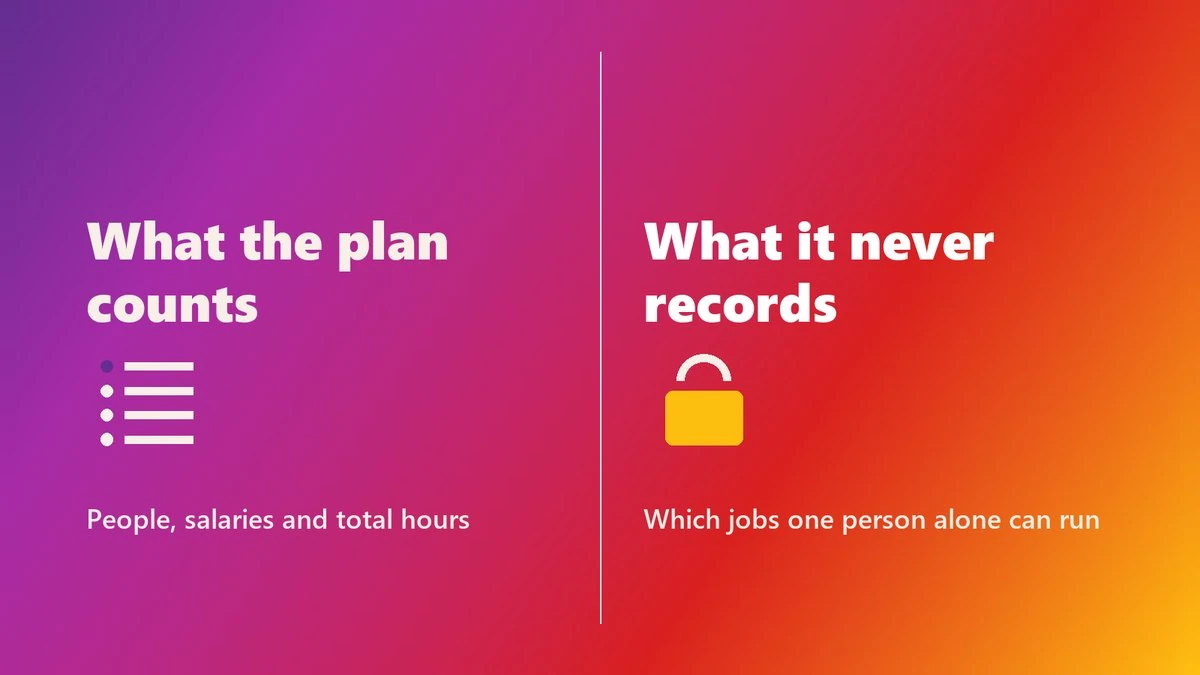 What the plan counts, beside the thing it never writes down.
Growth without adding headcount is a reasonable plan
The survey data backs the shape of it. Gallagher’s 2026 US Workforce Trends Report, drawn from 3,717 US employers of all sizes, found that 61% expect revenue growth by 2027 while only 50% expect headcount to rise.
Mid-market numbers point the same way. The National Center for the Middle Market’s mid-year 2026 indicator reports that workforce growth declined slightly to 7.2%, while 53% of companies still reported expanding. The indicator’s summary line is blunt: “Instead of simply adding headcount, many firms are investing in productivity.”
Finance has usually booked that productivity already. Anyone who wants to justify a headcount increase now argues against a number that’s sitting in the plan.
Nothing here is reckless. Productivity gains are real and hiring into a tight market isn’t free. But a plan to absorb more volume with the same people is a bet on the capacity of named individuals. Nobody checked which of them is the only one who can do a particular job.
A headcount model counts people, not coverage
Your headcount model has one row for the person who runs the billing cycle and one for the person who answers the general support inbox. Both cost a salary and both count as one head. Only one of them can’t be covered by anyone else on the team.
Why the line item for the only person who can run the billing cycle looks like everyone else’s
Because a model that counts heads has no column for coverage, the constraint is invisible by construction. Nobody was careless. Headcount forecasting asks how many people the plan needs, not how many of them are the only one who can do a given job.
Revenue per employee, the cleanest ratio in most plans, quietly assumes that an employee is an employee. The capacity expansion formula works the same way. Hours available, minus the hours productivity will save, equals capacity. That arithmetic suits a pool of interchangeable work, and breaks on a function with one operator.
The standard advice on this topic shares the blind spot. Of the four top-ranking guides we read for this piece, all four map tasks, rank them by volume and propose automating the high-volume repetitive ones to escape the linear growth trap. None asks who performs the work. The National Center for the Middle Market found that workforce costs touch the cost structure of 66% of companies. Leaders in the same report are answering with process improvements (51%) and technology and automation investment (46%).
Total hours are fungible, concentrated knowledge is not
Picture a 250-person distributor with six people in finance operations. Productivity tooling frees a few hours from each of them, and on paper weekly capacity rises. But the freight accrual run on the second business day has only ever been done by one of the six. The other five have never run it, and no amount of freed-up time changes that.
Capacity adds up across a team. Coverage doesn’t. A plan can show spare capacity everywhere and still have no room where it matters, since what breaks is always the minimum.
Two failure modes, and the famous one is the lesser one
Everyone knows the famous failure mode, where one person leaves and the function stops. You’ve already discounted that risk. The second mode is a toll you’re paying this quarter.
The departure you have already quietly discounted
Every article you’ve read on this subject was about the departure. The star engineer resigns, the controller retires, the person with the passwords has a bad week and nobody can log in to the carrier portal. Fair enough, and probably why you stopped reading. You’ve priced the risk in somewhere between an insurance premium and a vague intention to write things down.
In Gallagher’s 2026 report, nearly two-thirds of employers, 63%, reported annual turnover of 10% or higher in 2025. You know that already. The same survey also shows who owns retention, which is a top HR priority for 57% of employers and a top operational priority for 39%, so HR carries it and the operating plan mostly doesn’t.
The toll you are paying this quarter
Even if the departure never happens, the toll is being paid today by everyone queued behind one person’s calendar. A single point of failure in a business process doesn’t have to fail to cost you.
Key person dependency in operations rarely announces itself, so look for it in small places:
- A pricing exception sits until the one person who can approve it is back from a trip.
- A vacation gets quietly deferred a second year because nothing would run without that person.
- A second shift can’t start until someone answers a question the shift lead already knows is coming.
- New volume lands on that person first; they handle it without mistakes.
None of this appears as a line in the plan, only as lead time and as a very good employee who looks tired.
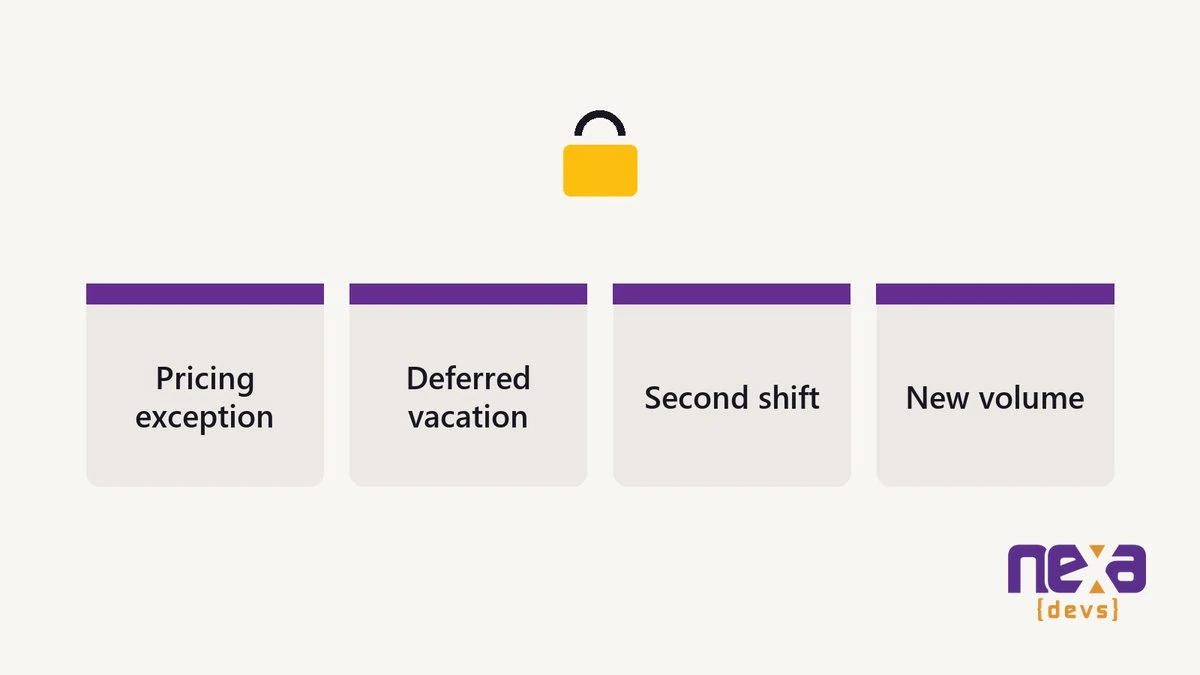 Four separate queues, all waiting on the same person.
Growth does not break the dependency, it loads it
New volume goes to whoever can absorb it without error, which means it lands on the person who is already your constraint.
A manager with a deadline asks who can do this without mistakes. Same name as last time. Nobody decides to deepen the dependency; it happens one reasonable assignment at a time.
Gallagher’s 2026 report shows employers expecting revenue to outgrow headcount. That gap lands on someone. Your plan describes the exact condition under which the person who’s already the constraint receives the most new volume.
The people inside a concentration point do not call it a documentation problem
Ask the person at the center of a concentration point what makes their job harder and they’ll talk about priorities, coordination and time. Documentation barely comes up. Stack Overflow’s 2026 Developer Survey shows the same pattern, with documentation ranked seventh of eight answers at 7.1%.
Asked what had made their job harder, developers put unclear priorities or requirements first at 16.6%, inefficient processes or coordination second at 14.6%, and not enough time, staffing or resources third at 14.1%. Together those three make 45.3%. Poor documentation or knowledge sharing drew 7.1%, and more respondents said nothing had made their job harder (9.6%) than named documentation.
It’s a developer survey, so treat it as evidence from a technical workforce. The respondents weren’t the people who run your month-end close. The same survey’s knowledge chapter adds the part that matters here: “The most trusted source of information is still the people you work with (72%), followed by the code (63%), and documentation (60%).”
Knowledge routes through individuals, who feel the problem as a queue and as interruptions. They’ve got no time to write anything down. Nobody above them sees a gap to fund. So a documentation initiative never wins budget in an operating plan. Skip it. The quarter’s real work wins that fight every time, leaving a half-finished binder that looks like coverage.
A productivity tool raises the volume through the constraint, it does not remove it
The volume flowing through a concentration point goes up. The one person who understands the process now has a second job, validating whatever the tool produces.
The plan’s substitution leans on exactly this move. The National Center for the Middle Market reports that among companies using AI, 39% are reskilling existing employees and 36% are redesigning roles to work alongside AI. Both figures cover only that subgroup, not the middle market as a whole.
Reskilling and role redesign both need someone who knows the process well enough to redesign it. The only person who qualifies is the one you already can’t cover. Automating high-volume, repetitive tasks works well for work anyone can do. Exception handling that lives in one head gets much less from it, and picks up the new duty of checking the output. The load went up while the number of people who can carry it stayed at one.
The concentration map, and why it is fifteen lines and not forty
A concentration map is one table of fifteen lines or fewer listing your recurring operational functions. Each line records who performs the function, who else has done it unsupervised, and how long the business runs before its absence is felt.
Building it takes no PMO and no architecture function. You need the COO, two or three team leads and a few working sessions. MGMA’s operations guidance for medical practices recommends “10 to 15 entries, reviewed twice a year and whenever the practice changes shape” and warns that “An inventory running to 40 lines will not be maintained.” Though MGMA writes for practice administrators, the sizing logic carries to any company without a dedicated process office.
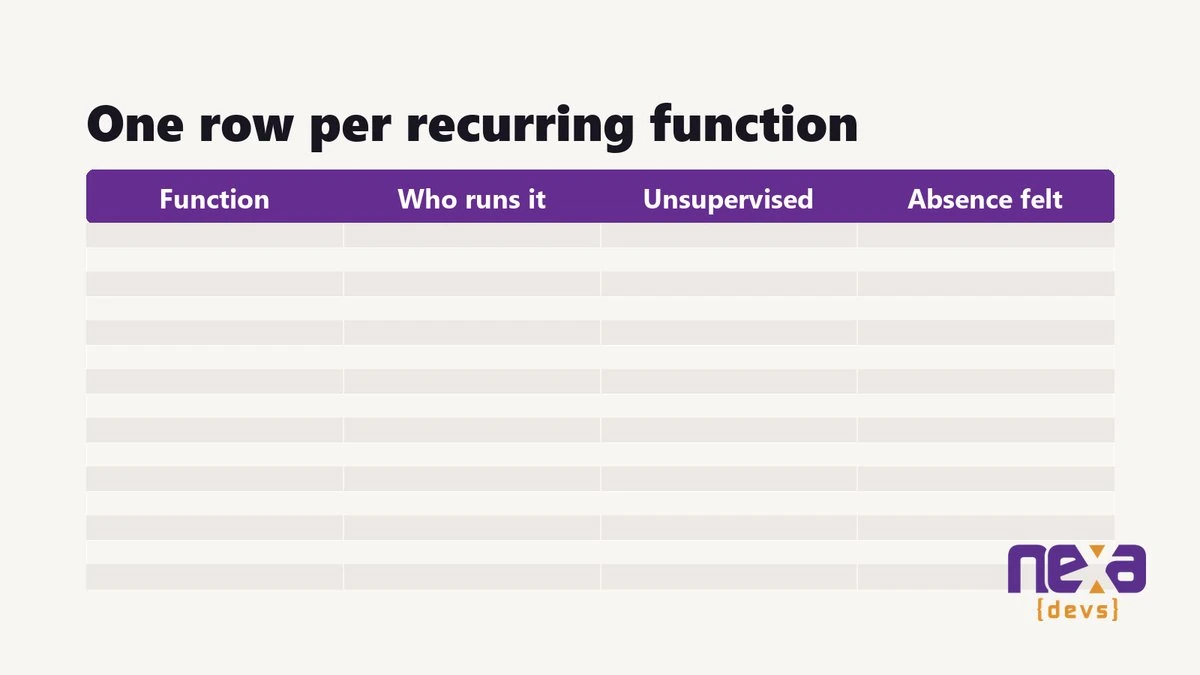 A fifteen-line concentration map, one row per recurring function.
The four things each line records
- The function. Name it in operational terms so that “Weekly carrier reconciliation” counts and “Finance” doesn’t.
- Who performs it today. Write one name here, and if you’re tempted to write two, check whether the second person has ever run it alone.
- Who else has performed it unsupervised. Write a name, or write the word “nobody.”
- How long the business runs before the absence is felt. Some functions can slip a week without anyone outside the team noticing. Others stop a shipment by Thursday. Record the real gap, the number that sets the priority of every line above it.
You’ll write “nobody” on more lines than you expect, which is where the map earns its keep.
What counts as coverage, and what only looks like it
MGMA’s coverage test is plain: “The test is whether the backup has done the work unsupervised in the past two quarters.” By that standard, shadowing isn’t coverage, and neither is a written procedure nobody has executed or a cross-training session that stopped after one afternoon of “let me show you.”
One question goes on every line. Who else can do this job, today, without calling the first person? If the honest answer needs the word “probably,” write “nobody.”
If one of your lines turns out to be a system rather than a spreadsheet, the two-week handover problem covers what the technical version of this looks like.
Sometimes the right answer is to accept the concentration
Cross-training a rare function sometimes costs more than the risk it removes. Acceptance is legitimate only when it’s a written decision with a name on it, a date and a trigger for reconsideration.
An omission looks identical on the map, where both lines say one person runs it and only one of them was a choice. A decision reads like this: “Annual statutory filing, controller only. Accepted by the COO on 15 January 2027. Revisit if filing complexity changes, if a second entity is added, or if the controller’s load on other functions grows.” An omission reads like nothing because nobody wrote it down.
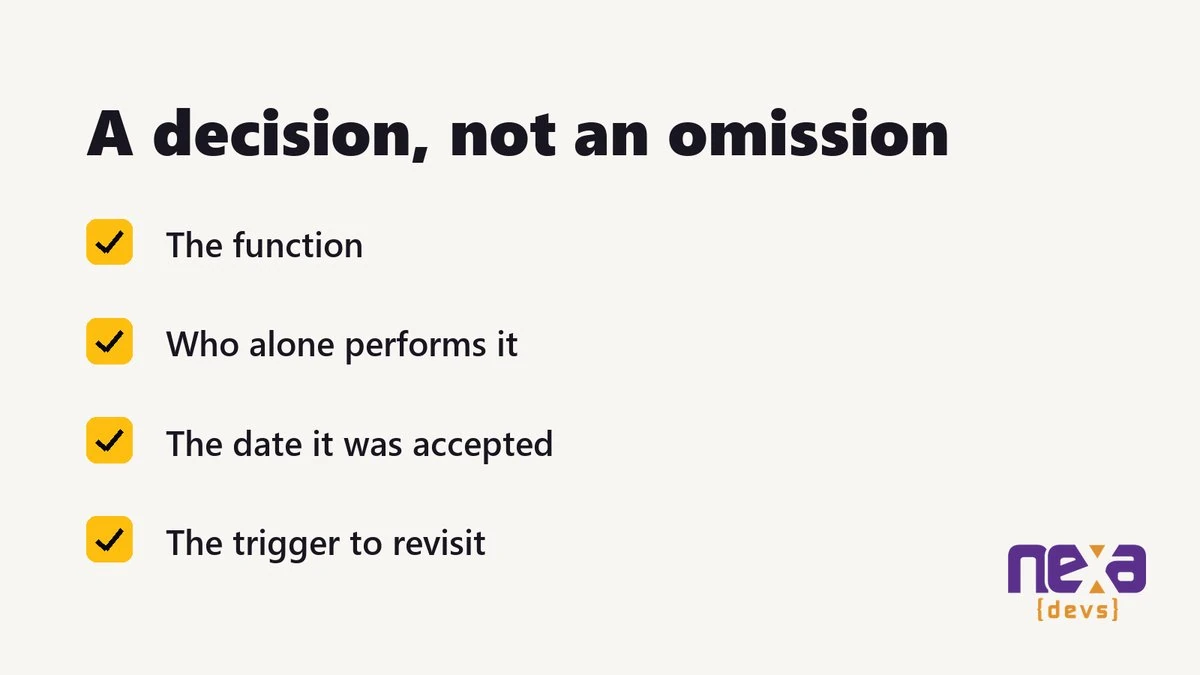 An accepted concentration written as a decision, with an owner, a date and a trigger.
For your next operations meeting, borrow MGMA’s review question: “if this person gave notice tomorrow, what could we not do two weeks from now?” Ask it about every name on the map. Where the answer is “nothing important,” accept and move on. An answer like “close the books” is your first line to fix.
Where the knowledge sits when the work is done by a partner
When a partner does the work, system knowledge ends up either with you or with them. On every Nexa engagement, system design documents, UML architecture diagrams, API references and architecture decision records are standard deliverables that transfer to the client unconditionally.
The choice is structural. A project vendor that ships and leaves hands you a working system and a new concentration point, this time outside your building. Nexa’s embedded engagements run long for the opposite reason. UCLA David Geffen School of Medicine has been a client for 10+ years and TSB for 8+. The point of that tenure is that system knowledge doesn’t sit in one head on either side of the relationship.
If the lines on your map that worry you most are systems, book 30 minutes. We’ll tell you what we see.