
Table of Contents
Institutional Knowledge Loss: The Two-Week Handover Myth
Institutional knowledge loss is what happens when the people who understand how your systems actually work leave, and nobody else can explain the decisions buried in the code. Two weeks of notice feels like plenty of time to hand things off. It seldom is. The knowledge that keeps your internal systems running lives inside one person’s head, accumulated over years of decisions that went undocumented as they were made. So when that person resigns, the clock that matters runs on a different question than fourteen days: how much of that knowledge you can still reconstruct once they’re gone. For most companies the honest answer is: not much.
This piece walks through why the standard handover fails as a matter of structure rather than effort, and what actually closes the gap: documentation your business owns from day one, paired with a partner accountable for keeping it current.
Quick answer: institutional knowledge loss risk explained
- A two-week notice period cannot transfer years of undocumented decisions. The timeline itself is the structural problem, not the effort behind it.
- Most critical system knowledge is tacit, meaning it’s the “why,” not the “what.” Handover sessions capture task lists, not reasoning.
- Bus factor of one, where one person’s exit could stall the system, is a board-level risk, not an IT inconvenience.
- Owned documentation, including UML diagrams, ADRs, API references, and test coverage, delivered on day one removes the single point of failure.
- Long-term embedded partnerships accumulate knowledge continuously, so it never depends on any one person’s exit timeline.
What Really Leaves When Your Key Developer Gives Notice
Your best engineer just gave notice. She built the order-routing system three years ago, patched it through two acquisitions, and is the only person who knows why a specific validation rule exists. In fourteen days, that reasoning walks out with her, whether or not she runs a handover session.
Every mid-market company carries at least one version of this story, and there’s usually no villain in it. An ordinary technical hire becomes the sole owner of critical context, without anyone ever deciding it should work that way. The system runs. The dashboards look fine. Then the resignation letter lands, and the company discovers it doesn’t actually understand what it depends on.
The code stays on the server. What walks out the door is the reasoning behind it: why the team chose that database over the obvious alternative, why a workaround exists for a vendor bug from three years ago, why a particular integration has a retry loop nobody remembers writing a ticket for. That reasoning lives in one head, recorded in no commit message, and that head just handed in a resignation letter.
So what does that actually cost the business?
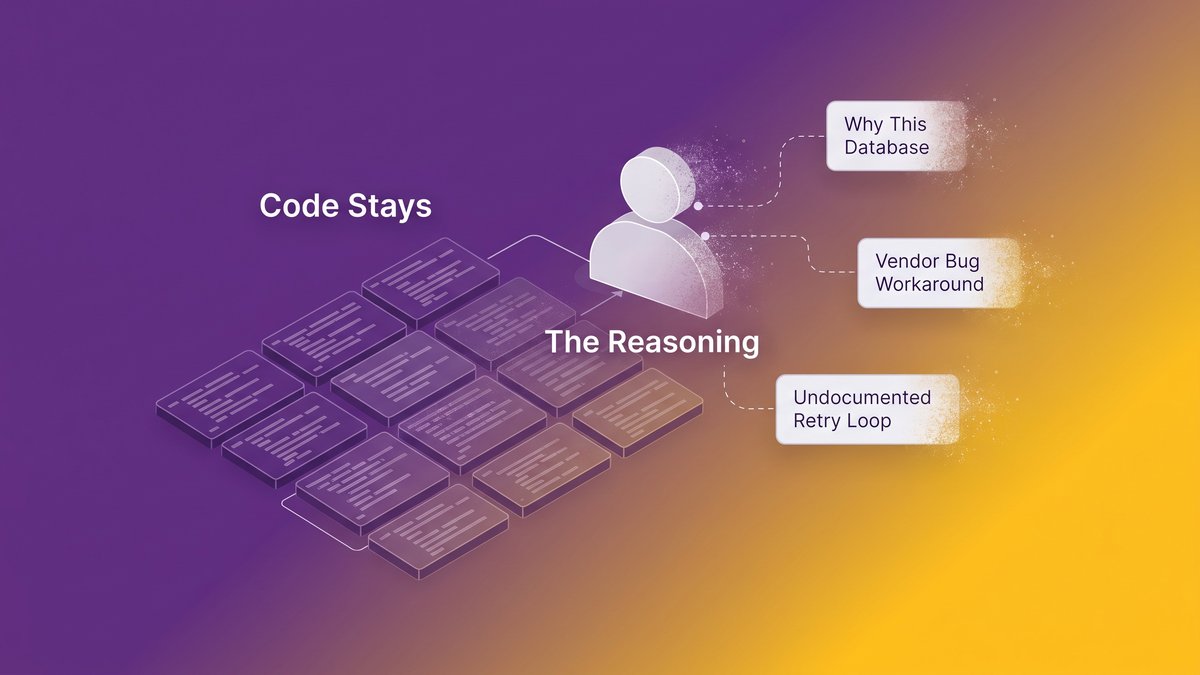
A single resignation can strand years of undocumented system context overnight.
The True Cost of Losing the Only Person Who Understands Your System
Replacing a senior technical hire costs more than the recruiting fee. ClearlyAcquired’s analysis of key-person risk puts the full cost, including lost productivity and delayed projects, at 150% to 400% of the departing employee’s salary, and new hires typically need 16 to 20 weeks to reach full productivity on a system they didn’t build.
The replacement and rehiring bill
That range holds up for most mid-market companies. SHRM found in 2023 that 72% of organizations have at least one employee whose sudden departure would meaningfully disrupt operations. That’s nearly three out of four companies running on a dependency nobody has priced. A CFO can calculate the cost of a data breach or a missed SLA. Few have calculated the cost of one resignation letter arriving on the wrong Tuesday.
The rehiring bill itself is the easy part to model: recruiting fees, signing bonuses, the six-figure total agencies quote for senior engineering talent in a competitive market. Boards ask about it because it shows up on an invoice.
The productivity drag while the system sits half-understood
The harder cost to model is what happens between the departure and the new hire’s full ramp-up. Delivery slows. Bug fixes take longer because nobody’s certain what a change might break elsewhere. Feature work gets deprioritized in favor of keeping the lights on. Projects on a six-week timeline stretch to four months. The new team is competent; they’re just rebuilding understanding from scratch, one production incident at a time.
Nearshore staffing, retention bonuses, and better exit interviews all treat symptoms. Each leaves the actual mechanism untouched: knowledge concentrated in one person with no second copy anywhere.
Why Two Weeks Can’t Move Years of Tacit Knowledge
A handover session captures what a system does. It struggles to capture why. That gap, more than any lack of effort, is the real reason two weeks falls short.
Tacit vs. documented knowledge: what a handover session actually captures
Knowledge researchers split what people know into two buckets: explicit knowledge, the kind you can write down, and tacit knowledge, the kind that lives in judgment and experience. Some call it tacit knowledge. Others call it tribal knowledge. Either term points at the same gap. Analysis from docs.bswen.com puts roughly 90% of organizational knowledge in the tacit category, with only about 10% ever making it into a document, wiki, or code comment. A handover session is built to transfer explicit knowledge: task lists, credentials, a walkthrough of the deployment pipeline. It was never designed to transfer judgment.
Ask a departing engineer why the checkout flow retries a payment call three times instead of once, and you’ll get a story rather than a spec: a vendor outage from eighteen months ago, a support ticket, a Slack thread that no longer exists. That story is the actual knowledge. It’s also exactly what a fourteen-day countdown has no room for. Skip the transfer entirely and what’s left behind is a documentation black hole: a system nobody can safely change without archaeology first.
The math of the notice window: why the timeline itself is the problem
Do the arithmetic honestly. A system built over three years represents roughly 750 working days of accumulated decisions. A two-week notice period offers ten. Even a motivated, well-organized departing employee working eight focused hours a day on nothing but knowledge transfer cannot compress a 75-to-1 ratio into something coherent. And most departing employees spend only a fraction of those ten days on handover anyway. They’re finishing sprints, closing tickets, and, understandably, checking out mentally before their last day arrives.
This is arithmetic at its core, and no offboarding checklist, however thorough, changes the ratio. how tacit knowledge becomes a business continuity risk covers the mechanics of that gap in more depth if you want the fuller picture.
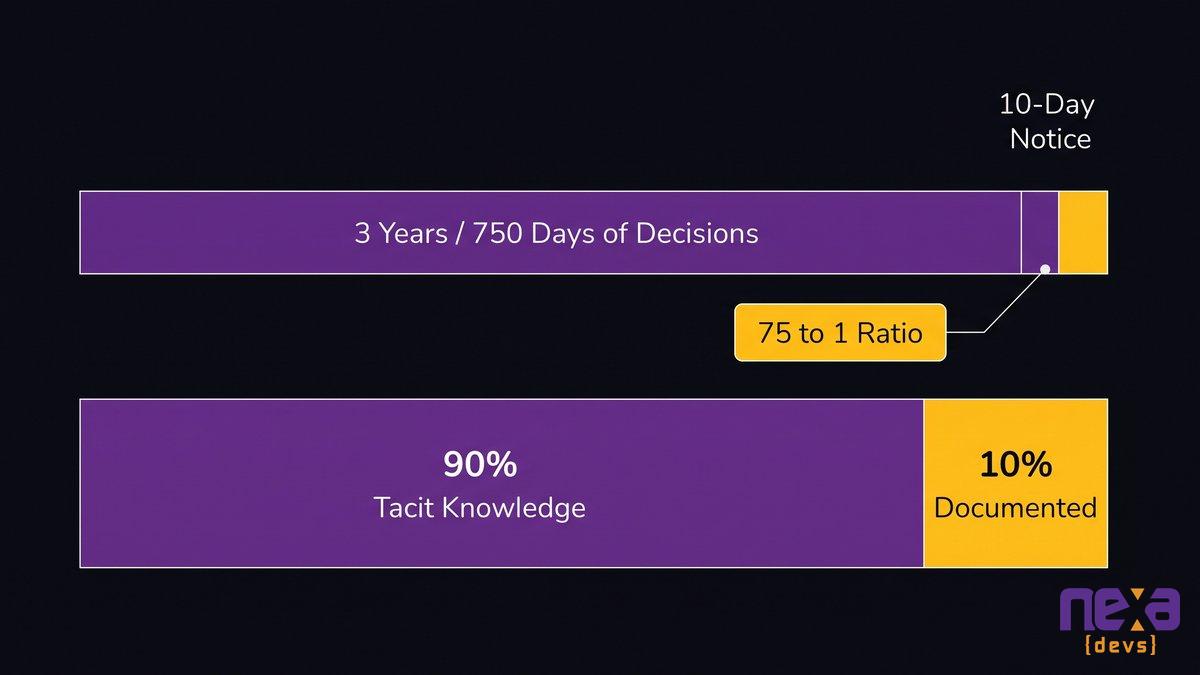
Years of accumulated decisions cannot compress into a ten-day countdown.
Why Offboarding Checklists and Handover Sessions Fall Short
Offboarding checklists are underpowered for the problem they’re being asked to solve.
A good checklist recovers credentials, transfers domain ownership, and documents where the deployment scripts live. That matters. What it reaches is the slice of knowledge that was already explicit and recoverable. The Dreamix team, which studies vendor and team transitions, found that documentation gaps, undocumented dependencies, and lost configuration details create expensive problems months after a transition looks complete on paper. The checklist gets signed off, everyone moves on, and the actual cost shows up later, during an incident nobody can diagnose quickly.
Mentorship programs and pairing sessions run into the same ceiling from a different direction. They shine at onboarding new hires over months. Compressing years of context into ten working days under deadline pressure sits well outside what they can do, especially with the departing employee mentally already at their next job.
So keep the checklist; just treat it as hygiene rather than insurance. Succession planning for a codebase is a different job entirely.
Bus Factor of One: Naming the Real Risk on Your Balance Sheet
Bus factor measures how many people could disappear from a project before it stalls completely. For most internal systems at mid-market companies, that number is one, and almost nobody has put it on a risk register.
Engineers use the term casually, but it maps cleanly onto a concept every CEO already understands: single point of failure. A single point of failure in your data center gets a redundancy plan and a line item in the infrastructure budget. A single point of failure sitting in one engineer’s head usually gets nothing, because it’s invisible until the resignation letter arrives.
The JetBrains Bus Factor Explorer, tracked by LinuxSecurity.com in March 2026, found that even mature, heavily used open-source databases like MySQL and PostgreSQL carry a bus factor of just two. Those are projects with corporate backing, thousands of contributors, and decades of documentation discipline. If a bus factor of two is worth publishing research about at that scale, a bus factor of one on your internal claims-processing system belongs on the board agenda, not buried in a line nobody mentions during the quarterly review.
As Kamila Hankiewicz, Founder and CEO, states: “Your mission as a founder should be to make yourself replaceable, company progress should not depend on you being present. We all know terror corporate stories of backbone architecture written in the ’80s and ’90s in a language nobody uses anymore, so nobody dares to change anything in it.”
That instinct applies just as directly to whoever built your internal order system in 2019. Irreplaceable knowledge concentrated in one head, however talented that person is, represents a structural decision your business made without ever choosing to make it. This kind of single-developer risk rarely gets named out loud until it’s already a crisis, which is exactly why it deserves a name before that happens.
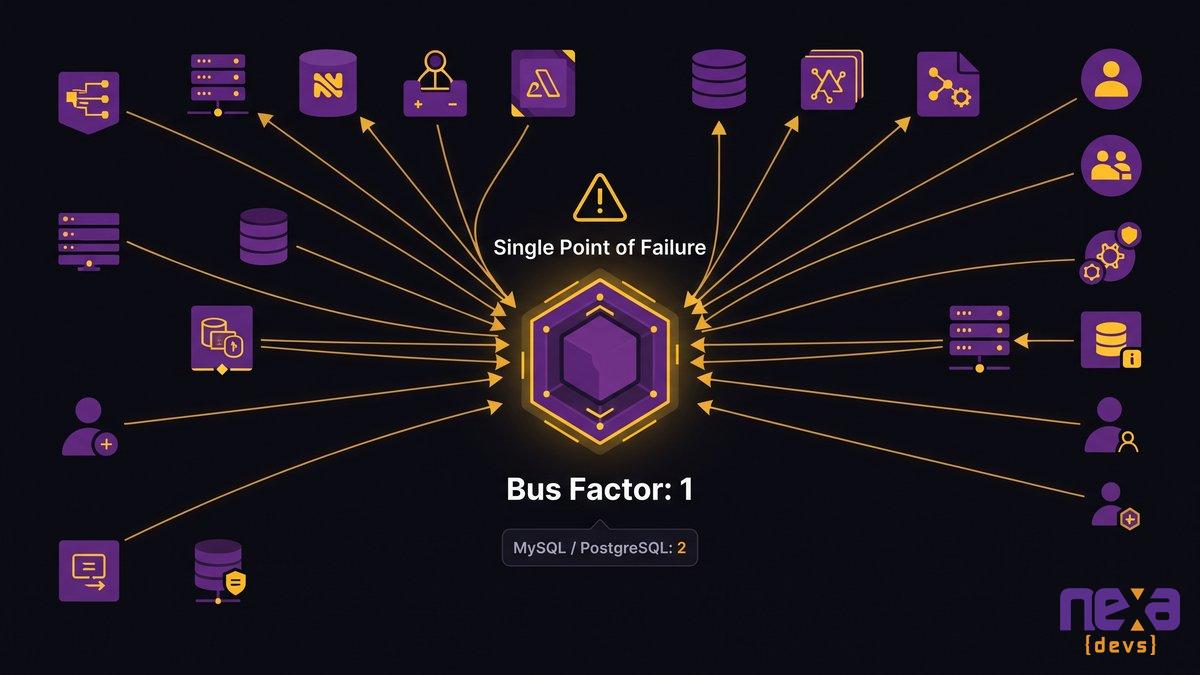
A bus factor of one means one departure is enough to stall the entire system.
The Structural Fix: Knowledge That Lives in Owned Documentation
The fix removes the handover from the critical path entirely, rather than trying to run it better, so no single resignation can take institutional knowledge with it.
What complete documentation includes: UML diagrams, ADRs, API references, test coverage
At Nexa Devs, complete documentation is a standard deliverable on every engagement, not an add-on billed separately or produced only when a client asks. That means UML architecture diagrams showing how the system actually fits together, Architecture Decision Records explaining why specific technical choices were made and what alternatives were rejected, API references built from Swagger and Postman so integrations stay traceable, and test coverage reports showing what’s actually verified versus assumed to work.
An ADR is the piece most internal teams skip, and it’s the one that matters most. A diagram shows you the system’s shape. An ADR shows you the reasoning: why the team picked a message queue over direct calls, what tradeoff they accepted, what would have to change for that decision to stop making sense. That’s the tacit knowledge from earlier in this piece, captured while the reasoning is still fresh instead of reconstructed under deadline pressure after someone’s already gone.
Why day-one, client-owned documentation changes the equation
Timing is the whole point. Documentation produced on day one, as the system is built, captures decisions while they’re being made. Documentation attempted during a two-week exit tries to reconstruct decisions from memory, under pressure, from someone who’s mentally already gone. One approach is a contemporaneous record. The other is an oral history assembled in a hurry.
Ownership matters just as much as timing. We’ve written before about why documentation is the real competitive advantage in outsourced software development, and the same principle holds here: at Nexa, documentation transfers unconditionally to the client, regardless of whether the engagement continues afterward. That single condition changes what the documentation actually is. A file a vendor can revoke access to was never really an asset. A file the company owns outright, one that survives any person’s departure, any vendor relationship ending, any reorganization, is the real thing.
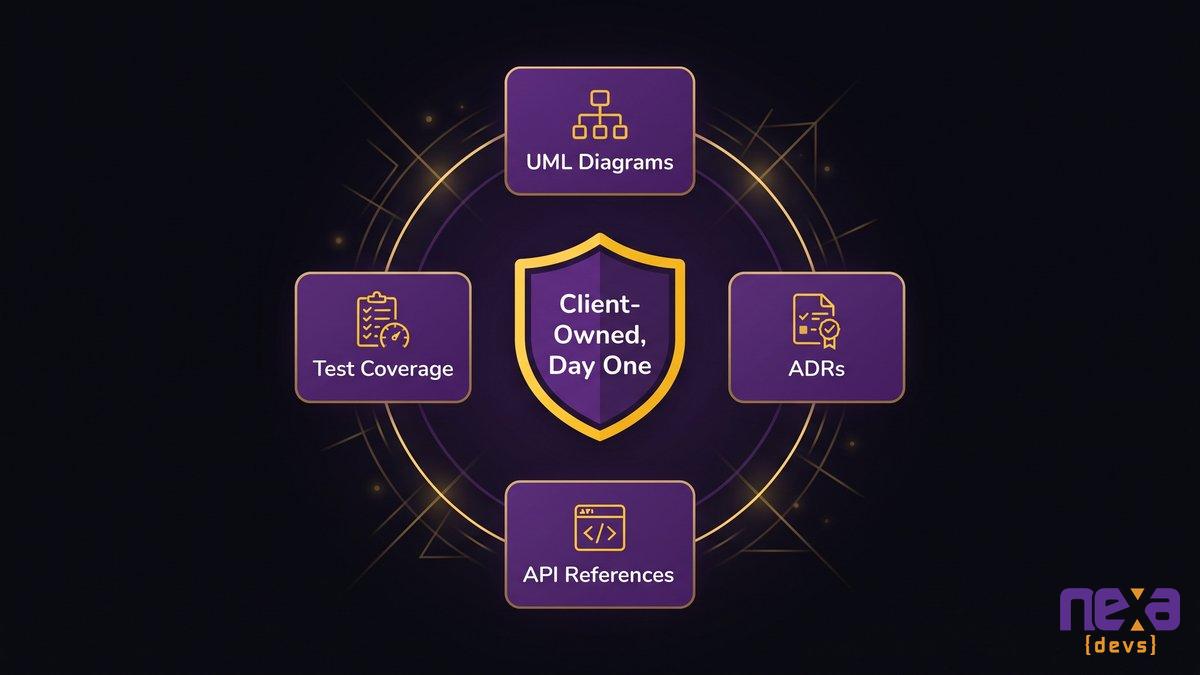
Day-one documentation captures system reasoning before anyone has a reason to leave.
From One Head to an Accountable Partnership
Documentation solves the knowledge problem. On its own, it leaves the accountability problem open, because a document doesn’t answer the phone when something breaks at midnight.
That’s why the structural fix needs a second half: an embedded partner accountable for the system over years, not a vendor who delivers and disappears. Nexa Devs has maintained an embedded engineering relationship with UCLA’s David Geffen School of Medicine for more than 10 years, supporting research and clinical systems in one of the more demanding compliance environments in the country. That kind of tenure reads as more than a testimonial line. It’s evidence that knowledge can accumulate inside a partnership the same way it once accumulated inside a single employee, except the partnership doesn’t resign, retire, or get recruited away by a competitor offering more money.
An SLA-based relationship changes the incentive structure completely. A project vendor gets paid at delivery and has little ongoing reason to keep documentation current. A staff-augmented contractor gets paid by the hour and has every incentive to make themselves indispensable rather than replaceable. An accountable long-term partner gets paid to keep the system healthy and legible for as long as the relationship runs, which puts current documentation squarely in their financial interest.
Ten years at a single institution doesn’t happen by accident. It’s what you get when documentation and accountability are both built into the model from the start, instead of bolted on after the first key-person crisis.
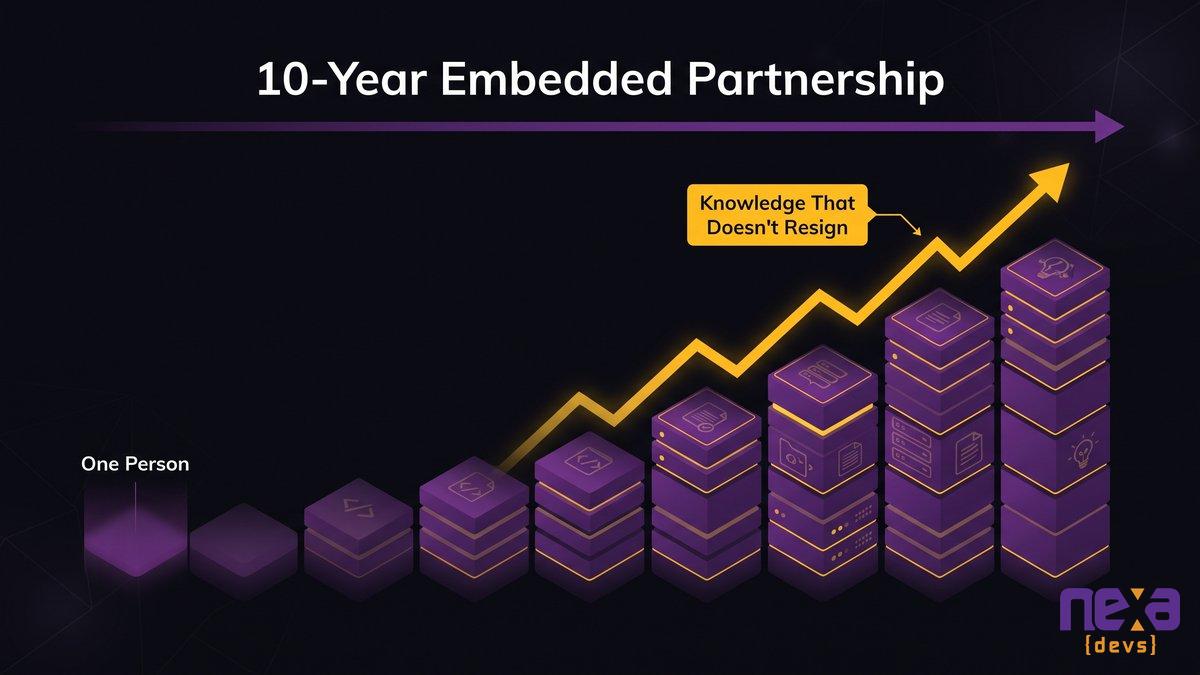
A decade-long partnership accumulates knowledge the same way an employee once did.
Making Knowledge an Owned Asset, Not a Personal Liability
Institutional knowledge is either an asset your company owns or a liability sitting in someone else’s head with an unknown expiration date. There’s no third option worth planning around.
Every company in this piece’s opening scenario made the same unconscious choice: they let critical knowledge accumulate in a person instead of in a system the business controls. Call it a default, the thing that happens when nobody deliberately architects against it. Fixing it starts from a simple refusal: the business’s continuity should not depend on any one person’s decision to stay, however good that person is at their job.
The reframe is simple to state and genuinely hard to execute without a partner built for it: documentation is IP, not paperwork. An ADR explaining a five-year-old architecture decision has real value the day someone needs to change that system. A UML diagram that reflects reality, not the plan from two years ago, has real value the day a new team member needs to get productive fast. Test coverage reports have real value the day someone asks whether a change is safe to ship. None of that value depends on any specific person still being at the company. Researchers who study key-person dependency risk describe exactly this exposure, and pricing it before it becomes a crisis is the whole point.
The two-week handover was never built to save you, whatever anyone hoped it would do. What actually protects a mid-market company gets built in from day one: documentation the business owns outright, and a partner accountable for keeping that knowledge current long after any individual person, including any one Nexa engineer, moves on.
If your business depends on one person’s willingness to stay, that dependency is a risk you haven’t priced yet. Book an architecture assessment and we’ll show you exactly where it’s concentrated.
FAQ
What does loss of institutional knowledge mean?
Institutional knowledge loss happens when the accumulated experience, context, and decision-making history inside an organization disappears because the people who held it leave without transferring it. It’s the “why” behind how systems and processes work, not just the “what,” and it rarely gets written down before someone walks out the door.
How to transfer knowledge from one person to another?
Effective knowledge transfer happens continuously, not at exit: pair the person with a colleague early, document decisions as they’re made through tools like Architecture Decision Records, and record the reasoning behind choices, not just the steps. Waiting until someone resigns to start is already too late for most of what matters.
How to give handover after resignation?
Start immediately, prioritize the highest-risk systems first, and record explanations on video or in writing rather than relying on a single meeting. Accept that a resignation-triggered handover will only capture a fraction of what the person knew. That’s a limitation of timing, not effort, so plan for the gap it leaves.
What are the four stages of knowledge transfer?
Most knowledge transfer models move through four stages: identifying who holds critical knowledge and where the risk concentrates, capturing that knowledge in documented form, transferring it through mentoring or structured review, and validating that the receiving person or system can actually apply it correctly under real conditions.
What is an example of institutional knowledge?
A common example is a senior engineer knowing why a specific workaround exists in a payment system, tied to a vendor outage years earlier, even though no documentation records it. Another is knowing which client relationships require manual exceptions to standard process. Neither shows up in a manual until someone writes it down.