
Exception Rate Operations: The Work No System Captures

Table of Contents
- Quick answer: measuring your exception rate operations
- Exceptions Are a Category of Work, Not a Defect in the Process
- The Exceptions Every Mid-Market Operation Already Runs On
- What a Manageable Exception Rate Actually Costs
- Your Exception Rate Is Arithmetic That Nobody Has Run Yet
- You Are Not Failing at Automation. You Were Sold Someone Else’s Standard Path.
- The Two Fixes Worth Refusing
- What a Designed Exception Path Looks Like
- Watch the Rate, Then Build the Top Two
- FAQ
- Where This Actually Starts
Last updated: October 3, 2026
A non-standard order lands on Tuesday. The catalog doesn’t have it, and the lead time your ERP expects is wrong for it besides. Three Slack messages and one phone call later, somebody makes a judgment call and the order ships. By the following week nobody can find a record of that decision, because it never touched a system that keeps records.
That’s exception rate operations in one sentence: the share of your total work volume, the orders, approvals, and prices, that leaves your standard process and gets resolved by a person instead of a platform. Most operations teams have never measured it, and not because they’re careless. The software they bought was demoed and sold as if that work barely existed.
What follows is a way to count that volume and a design for the path that isn’t there. First, the reason you were set up to miss it.
Quick answer: measuring your exception rate operations
- Exception rate operations is the share of orders, approvals, and prices that leave your standard process and get resolved off-system by a person.
- Most operations software assumes that work is rare. Published benchmarks say otherwise.
- Produce a first defensible number in a week: count what your system rejected, plus what never entered one at all.
- The fix is a designed path rather than harder automation or a new platform: a front door, a decision rule, a judgment route, and a record.
- Watch the rate monthly. The two or three exception types dominating your queue are your real build spec.
Exceptions Are a Category of Work, Not a Defect in the Process
An exception is any order, approval, or price that leaves your standard operating path and gets resolved by a person instead of a system. Exception rate operations is the practice of measuring how much of your volume does exactly that, and for most mid-market companies nobody is measuring it.
Worth pinning the definition down, because “exception rate” means three other things in search results right now: a freight surcharge, an access-control anomaly, an audit sampling figure. None of those apply here. This is about work your operations team routes through Slack and phone calls because no system you own has a place to put it.
What actually counts as an exception: the non-standard order, the out-of-band approval, the negotiated price
A customer wants a configuration your catalog doesn’t list. Someone with signing authority waves through a discount above the authorized threshold, because the deal is too important to lose over policy. A salesperson agrees to a price on a call that never gets entered anywhere a second person can see. All three are routine, and all three are invisible to whatever platform is supposed to be running your operation.
Why it never enters a system: no field to hold it, no status to show it, no route to move it
Your ERP, CRM, or order management platform was designed around a standard path: a known catalog, a known approval chain, a known price book. The demo showed you the share of volume that fits. What happens to the rest never came up, because there’s no screen for it. So that work goes to the only place flexible enough to hold it, which is a person’s judgment, worked out in a thread and stored nowhere.
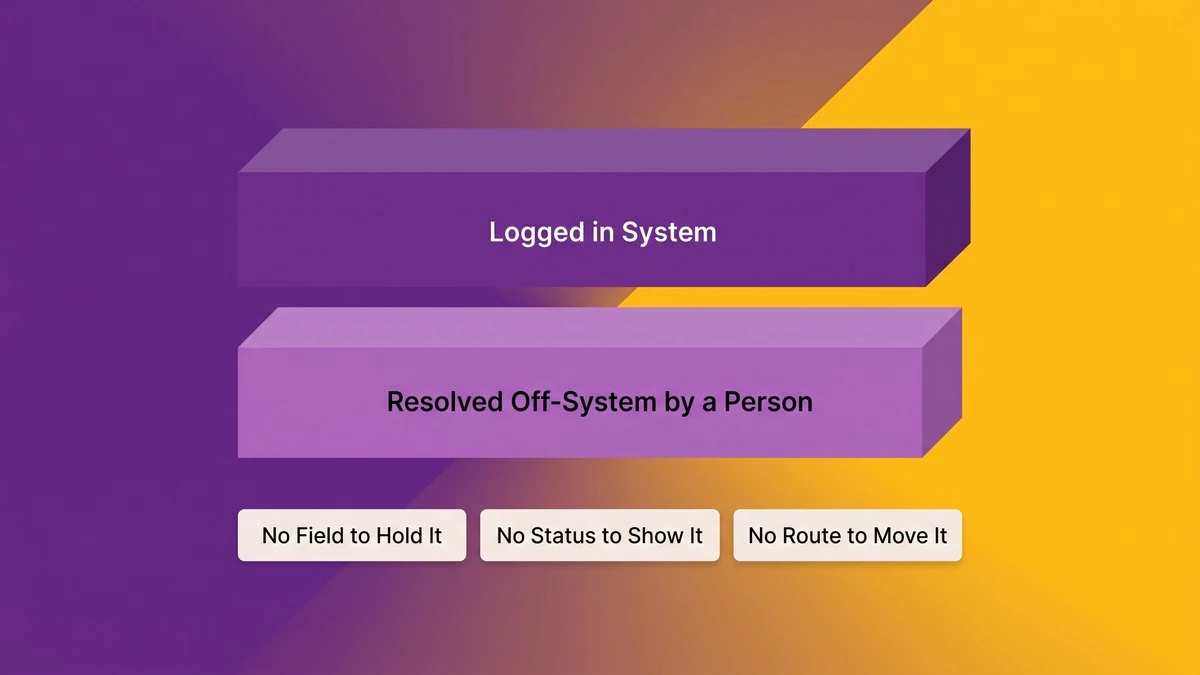 A gap between logged transactions and the real volume of work resolved off-system
The Exceptions Every Mid-Market Operation Already Runs On
Picture the Tuesday order again. It isn’t hypothetical, it’s the fourth one this month, and anyone on the team could describe their own version of it unprompted.
The order that does not fit the catalogue, the configuration or the lead time
A customer needs ten units of a configuration you stopped offering two catalog revisions ago. Production can build it. Nothing in the order system lets a rep key it in that way, so someone emails engineering, gets a nod, and types the order into a free-text field that nothing downstream reads.
The approval that goes around the workflow because the workflow has no branch for it
Your approval chain has three steps for a standard discount. It has zero steps for a customer who wants net-60 terms instead of net-30. A regional manager approves it by replying to an email thread, and the system that’s supposed to track approvals never learns the decision happened.
The price that was agreed on a call and exists nowhere a buyer can see it
Sales agreed to a volume price that undercuts the list price by 12%. It lives in a calendar note and a verbal agreement. Finance only finds out at invoicing, and only if the rep remembers to mention it.
The commitment made to keep a customer that no system was ever told about
Somebody promised a rush delivery, a fee waiver, or an exception window to stop a churn conversation from becoming a cancellation. It worked, and the customer stayed. The commitment itself was never written down.
Four decisions, four people, four channels, and a week later none of them exist anywhere you could search, audit, or hand to a new hire. That isn’t a training gap. It’s an architecture decision nobody made on purpose.
What a Manageable Exception Rate Actually Costs
Who’s actually paying for a “manageable” exception rate? Almost always, it’s your most expensive people, not your budget line.
The judgment tax: your most expensive people are the routing layer
Every exception needs someone with enough authority and context to make a call fast. In most mid-market operations, that’s a senior ops manager, a department head, or the COO personally. Their week fills with decisions a junior analyst could make, if the rule for making them had ever been written down.
The invisibility tax: no record means no reporting, no handover, no pricing history, no audit trail
An exception that never enters a system also never leaves a record behind. The next negotiation on that account starts from zero, because no pricing history exists. A new hire inherits years of accumulated context with none of it written down. And leadership can’t see a category of risk that nobody has ever sized, because nothing ever counted it.
Why none of this appears on a dashboard, and why that is the reason it survives
Dashboards show what gets logged. Exception work doesn’t get logged, so it never earns a line item, a KPI, or a budget conversation. It survives on being invisible, and nobody has built the thing that would make it otherwise.
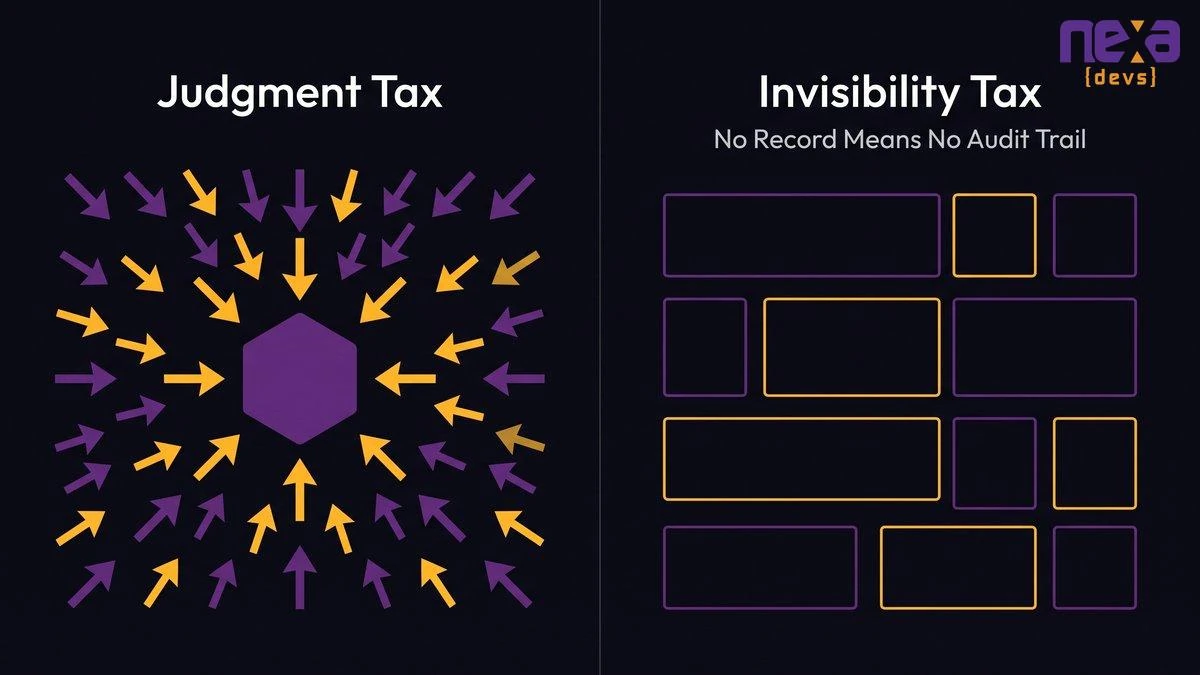 The judgment and invisibility costs of exception work that never becomes a record
Your Exception Rate Is Arithmetic That Nobody Has Run Yet
Your exception rate is the share of total work volume that leaves the standard path. It’s one division problem, and almost nobody in a mid-market operation has ever run it on their own numbers.
The definition and the arithmetic, stated plainly enough to run on a whiteboard
Exception rate equals the number of orders, approvals, or price decisions that left the standard path, divided by the total over the same period. Pick one transaction type to start, and orders are usually easiest because they’re the most visible. No new software is required for this. What’s required is a week of somebody’s attention and an honest count.
Where to count the easy half: everything the standard path rejected, kicked back or queued
Start with what your system already shows you: orders that failed validation, approvals that bounced back for rework, prices that triggered an override. Most ERPs log these as errors, exceptions, or holds somewhere, even if nobody has ever pulled that report. This half takes an afternoon.
Where to count the hard half: the volume that never entered a system at all
This is the harder and larger half, and it’s the actual reason the rate is unknown. Take one week and go through it three ways: Slack threads tagged to order numbers, approval emails that never touched your workflow tool, and sales calls that produced a price nobody logged. Count every instance where a person resolved something a system should have captured as data.
How to produce a defensible first number in a week without starting a project
Add the two piles, divide by total volume for the same period, and you have a working number. It won’t be perfect, but it beats zero, which is the figure most operations leaders are currently working with. Run it again next quarter and you have a trend instead of a snapshot.
That’s the number a COO can take into a leadership meeting and defend, because it was built from the company’s own records instead of a vendor’s average.
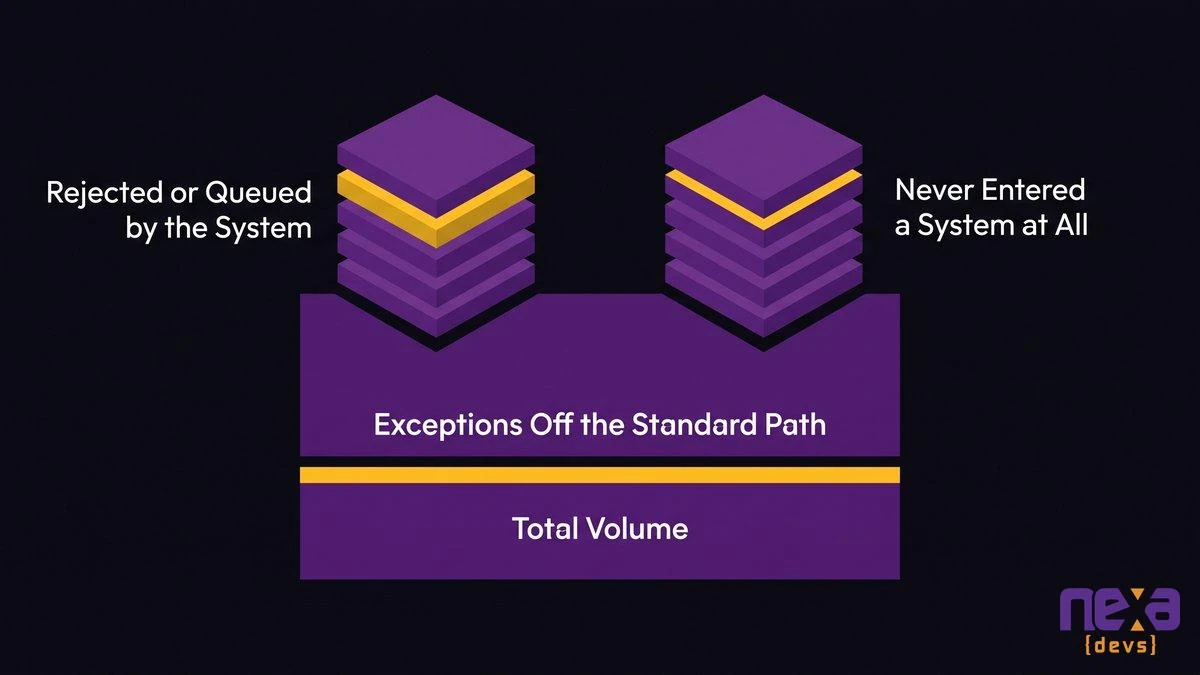 Combining logged exceptions with off-system work to produce a defensible first number
You Are Not Failing at Automation. You Were Sold Someone Else’s Standard Path.
Ardent Partners’ AP Metrics that Matter in 2025, a survey of 212 accounts-payable and finance professionals, puts real straight-through processing at 32.6%, with best-in-class teams reaching only 49.2%. That’s the baseline your systems were actually built against, not the 80% the industry currently markets as the standard.
The benchmark split: what independently measured straight-through rates actually are versus what is being marketed as the 2026 baseline
Vendors and automation consultancies tell the market that 80% or more touchless processing is the expected 2026 benchmark, with accounts payable rates pushed past 85%. The independently measured figure for actual straight-through processing sits in the low thirties, with top performers approaching fifty. The gap between what’s marketed and what’s measured is the gap you’re standing in. You didn’t fail to reach 80%. Almost nobody reaches 80%, outside of a sales deck.
Why the ceiling is structural, not a configuration failure you have yet to fix
A standard path, by definition, can only cover standard cases. The moment a meaningful share of your real volume is non-standard, which is true of every mid-market operation we’ve seen, the remaining share is structurally excluded from full automation, no matter how well the software gets configured. That isn’t a critique of your implementation team. It’s a description of what a standard path can and cannot do, and no vendor puts that sentence in a pitch deck.
The Two Fixes Worth Refusing
There are two fixes you’ll be pitched for this problem, and both of them are wrong, for different reasons.
Automating harder: what happens to the last fifth of volume when you build only for the first four
A growing category of automation vendors argues that the answer to exception volume is removing the person from the decision entirely: let an AI agent read the context and resolve the exception on its own. Part of that critique is fair. Robotic process automation and native ERP exception queues genuinely don’t scale past a certain volume, and adding headcount to absorb exceptions just grows the invisible layer instead of fixing it.
Replacing a person’s judgment with an agent’s judgment doesn’t solve the design problem, though. It just moves who’s making an undocumented call. The exceptions that matter most, the ones involving a relationship, a negotiated term, a read on risk, are exactly the ones you don’t want resolved by a model with nobody accountable for the outcome. We’ll take the opposite side of that pitch: the judgment in these exceptions is a feature of the work, not a cost to engineer away.
Replacing the platform: a new standard path with the same missing branch
The other pitch is a platform swap: a new ERP, a new CRM, a new order management system, configured properly this time. It won’t be. Every standard path, including whatever you buy next, gets built around a defined set of standard cases. The branch for your non-standard orders, your out-of-band approvals, and your negotiated prices will still be missing on day one of the new system, because no platform ships pre-built for your specific exceptions. You’ll spend six figures and eighteen months to land back at the same gap, inside a newer interface.
What a Designed Exception Path Looks Like
The alternative to both of those is to build the path that was never there, in four concrete pieces.
A front door, so the request arrives as data instead of a side conversation
Replace the Slack message with a structured intake: what’s being requested, why it’s non-standard, who’s asking. Once a request is a record instead of a conversation, you can route it, report on it, and look it up a year later.
A rule for what can be decided by whom, and above what threshold it moves
Most exceptions aren’t actually novel. They’re variations your team has seen before, with a known answer and a known decision-maker. Writing that down, even informally, turns a Slack ping into a rule: under this threshold, a supervisor decides; above it, the request escalates automatically.
A route to the person who actually holds the judgment
Some exceptions genuinely need a person holding context no rule can encode: how the relationship got here, what the risk actually looks like, what was promised in March. Route those fast, to the right name, with the context already attached, instead of another round of tag over Slack.
A record that feeds the next version of the process
Every resolved exception becomes a data point. Enough data points in the same category stop being an exception and start being a feature request for the standard path itself.
This is where Nexa’s work lives: extending the system you already run with the workflow logic your business actually uses, rather than replacing it. We hand over the architecture documentation and the decision rules themselves, so the exception path doesn’t quietly become its own undocumented layer five years from now. why adding another tool rarely closes the gap
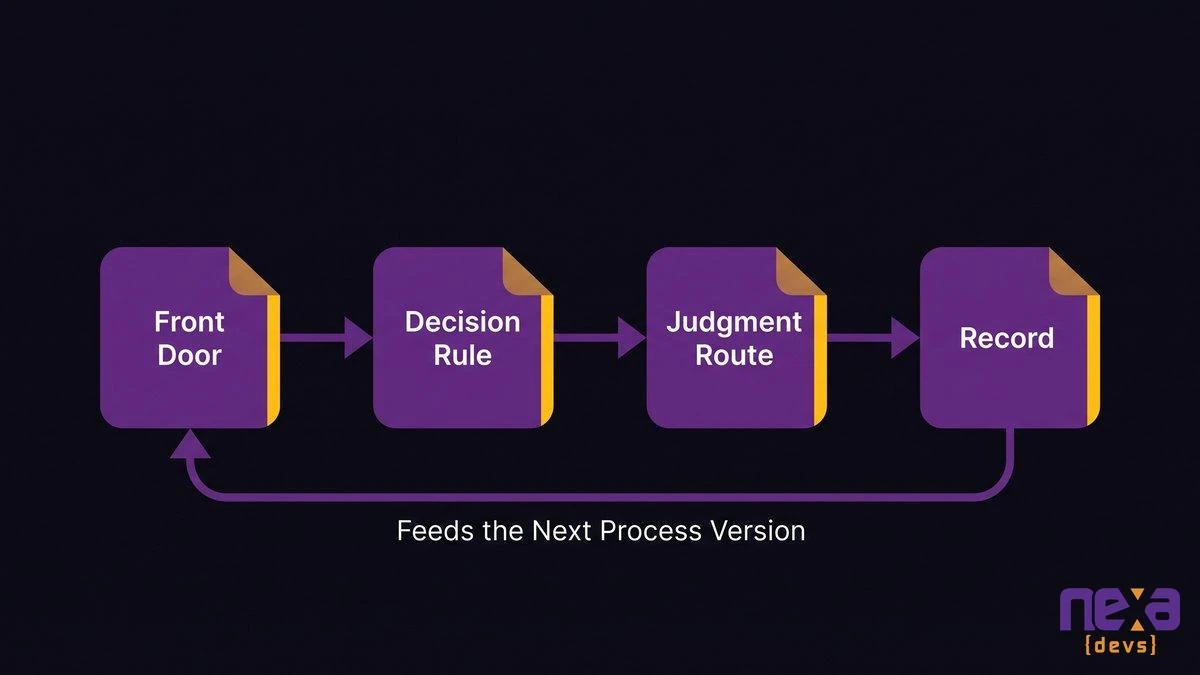 The four components of a designed exception path: front door, decision rule, judgment route, and record
Watch the Rate, Then Build the Top Two
A number that shows up in a monthly review starts moving down. One that nobody looks at stays where it is, or grows.
The loop: a rate that gets reviewed on a cadence is a rate that falls
Once you have a number, review it monthly. Not to assign blame, but to see which categories are shrinking and which are growing as the business changes. The review itself creates pressure to fix the biggest categories, because now there’s a number attached to leaving them alone.
Why the two or three exception types that dominate your queue are the specification for whatever gets built next
Exception volume is rarely spread evenly, and a handful of categories usually accounts for most of it. Process-benchmarking research from organizations like APQC has identified quantity and configuration mismatches as consistently among the top exception categories in order management specifically. Whatever dominates your own queue is your real build specification. Not the wish list, and not the vendor’s roadmap: the two or three things your operation needs captured as data first.
Skip the harder automation, and skip the platform swap. how to build a system for the work that currently enters none What you need is your number, and a path built for the work that number represents.
FAQ
What is an exception rate?
An exception rate is the share of your total work volume, orders, approvals, or price decisions, that leaves your standard process and needs a person to resolve it instead of a system. In operations, it’s usually measured as a percentage over a set period, like a month or a quarter.
What is the exception management process?
Exception management is the structured way a company captures, routes, and resolves work that falls outside its standard process. Done well, it includes an intake point, a decision rule, a routing path to the right person, and a record of what was decided and why.
What is the best way to handle exceptions?
Treat exceptions as a category of work worth designing for, not a problem to automate away entirely. Build a front door that captures the request as data, a threshold rule for who decides, a route to the person with real judgment, and a record that feeds future process design.
What are the stages of the order management lifecycle?
A standard order lifecycle moves through intake, validation, fulfillment, invoicing, and closure. Exceptions happen when an order needs something outside one of those stages, like a non-standard configuration or a negotiated price, and most systems have no stage built to hold that deviation.
Where This Actually Starts
It starts with a number you can produce this week and a path you can design this quarter, not with a new platform and not with an AI agent making the call instead of your team. If your operation currently routes this work through Slack threads and nothing that keeps a record, talk to us about mapping what a designed exception path would look like in your environment. book an architecture assessment