

Table of Contents
SaaS Sprawl: The Real Cost of Mid-Market Tool Overload
Pull up your software subscription report, then count how many of those logins your team actually touched last month. When the first number embarrasses the second, you’re looking at SaaS sprawl: a mid-market company paying for far more software than any team uses, adopted app by app until nobody in the building can name the full list.
The average mid-market company manages 291 SaaS applications, according to SuccessKnocks’ spend-management research, and roughly half of those licenses sit unused month after month. Finance flags the wasted spend first, and that framing understates the damage. What all those redundant apps quietly replaced was one coherent way of working, now split into dozens of disconnected pieces held together by manual handoffs and spreadsheets nobody fully trusts.
For a COO, that gap is more than a procurement nuisance. It’s why your ops team burns hours a week moving data by hand, why a straightforward report takes three people and two afternoons, and why the numbers in Monday’s deck don’t quite match Thursday’s. Trimming a few unused seats fixes none of that. Fixing SaaS sprawl for real means asking why the stack got this tangled in the first place, then building something that fits how your team actually works instead of layering on one more app.
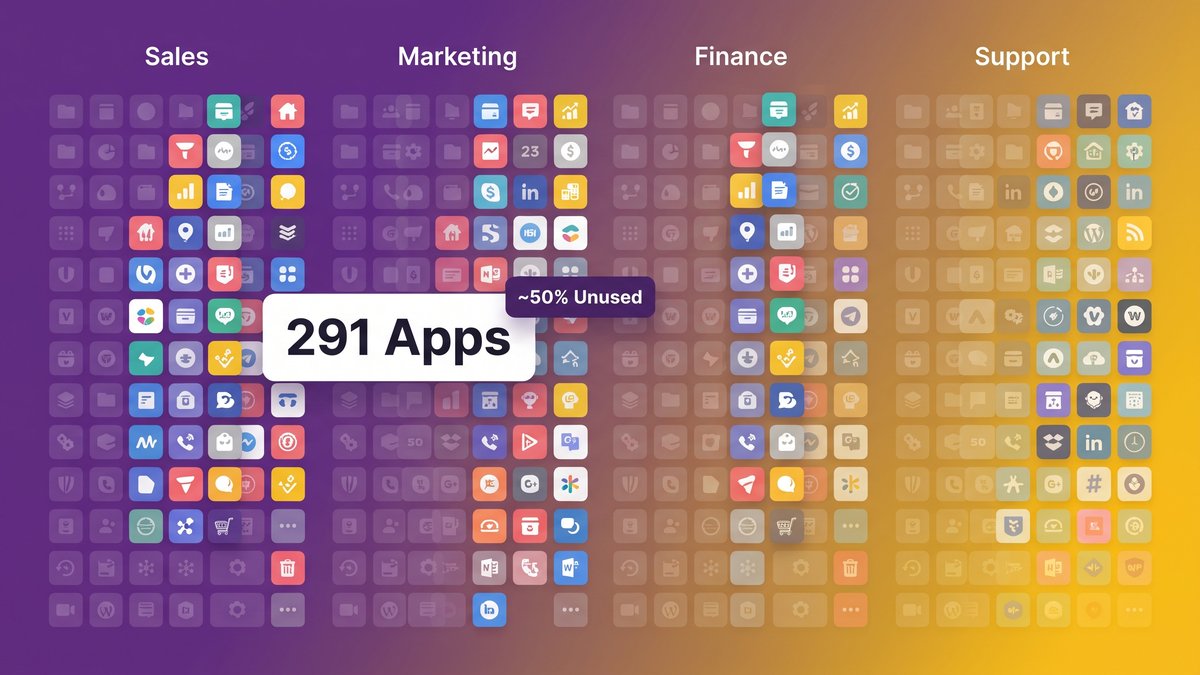
Overlapping software icons across departments illustrating how SaaS sprawl accumulates in mid-market operations
The 291 figure that opened this piece deserves a closer look before we get to the fix.
You’re Licensing 291 Apps and Running Your Operation on a Fraction of Them
Mid-market companies license an average of 291 SaaS applications and use meaningfully fewer than half of them day to day, according to SuccessKnocks’ spend-management research. That gap is too wide to write off as a rounding error. It’s an entire shadow stack your team pays for and rarely opens.
Ask a COO how many tools their organization runs, and you’ll get a number that’s confidently wrong. Finance sees the invoices. IT sees whatever routes through single sign-on. Neither one sees the trial someone in marketing started in February and forgot to cancel, or the project tracker one team adopted because the company-wide tool never fit how they plan their work. Repeat that pattern across every department for a few years, and 291 stops sounding like an outlier.
The uncomfortable part isn’t the count. It’s how few of those apps the operation actually depends on. If your team could lose 150 licenses tomorrow and nobody would notice for a week, the stack was never really designed. It accumulated, one reasonable purchase at a time, until reasonable stopped describing the whole.
How a stack accumulates like that is worth understanding on its own terms, and it points at where the real fix has to land.
What SaaS Sprawl Actually Is (and Why the Usual Definition Misses the Point)
SaaS sprawl is the accumulation of software subscriptions across an organization until nobody, IT included, has a complete or current picture of what’s running, who owns it, or whether it’s still needed. That’s the definition every vendor blog on the subject repeats.
Most explanations stop there and treat sprawl as a governance lapse: too many people with a company card, not enough policy, too little oversight from IT. The framing isn’t wrong, exactly. It just quits one layer too shallow, and quitting there leads straight to a fix that doesn’t hold.
Every app in a sprawling stack was purchased on purpose, by someone solving a real problem right in front of them. Sales needed a way to track deals that the CRM made painful. Ops needed a lightweight tool for vendor onboarding that the ERP module never handled well. Nobody sets out to create sprawl. They buy software because the system they already have doesn’t fit the job in front of them.
That distinction matters because it changes where you go looking for the fix. A governance problem gets solved with a stricter approval policy. A fit problem gets solved by building something that matches how the work actually happens, which is the argument the rest of this piece makes.
Why the Stack Keeps Ballooning: It’s Not Lax Procurement, It’s That No System Fits the Work
The stack didn’t grow because your team ignored the rules. It grew because no single system covered how three different departments needed to work, so each one solved its own gap on its own schedule with its own tool.
Freemium and Trial Entry Make Every New Tool Feel Free
A lot of sprawl starts at zero dollars. Someone signs up for a free tier to solve an immediate problem, no procurement conversation required and no invoice to justify. Three months later the free tier isn’t enough, a card gets added, and a tool nobody formally approved is quietly billing every month.
Multiply that across a workforce with company cards and self-serve signup, and the stack grows one small, individually reasonable decision at a time. Torii’s 2026 SaaS Benchmark research, reported by CIO Dive, found that more than 61% of applications discovered inside organizations were never formally approved by IT, out of an average enterprise footprint of 2,191 applications. Mid-market stacks run smaller, but the same pattern shows up at every scale. Sprawl comes from hundreds of small decisions nobody tracked, never a single big one.
Every Team Buys the Tool That Fits Its Slice, and the Seams Multiply
Marketing needs campaign tracking. Support needs a ticketing system. Finance needs a forecasting tool the ERP handles badly. Each purchase makes sense in isolation, solves a genuine gap, and gets approved because it’s cheap relative to the value it delivers to that one team.
What nobody evaluates is the seam it creates: the manual export from the ticketing tool into the spreadsheet finance uses for revenue forecasting, the copy-paste from the CRM into the project tracker because the two were never built to talk. Individually, every purchase is a rational decision. Collectively, they produce an operation where information moves between systems by hand, and the person doing that moving is the real cost nobody priced into the buying decision.
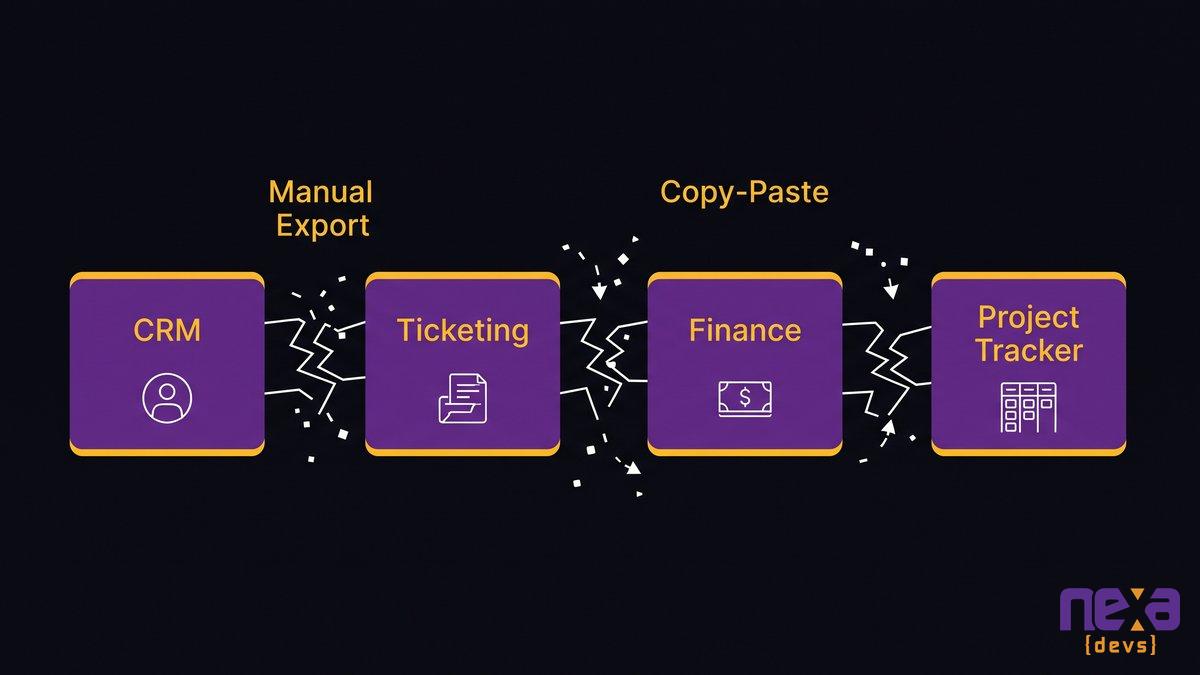
Diagram showing how department-by-department SaaS purchases create disconnected seams across a mid-market operation
The Real Cost Isn’t the Wasted Licenses
Redundant licenses are the cost your finance team can see on a spreadsheet. The cost they can’t see as easily, fragmented workflows and manual handoffs between systems that don’t talk, is usually bigger and always more expensive to keep ignoring.
Redundant and Unused Spend: The Visible 25-40%
Start with the number everyone quotes. For mid-market companies, 25% to 40% of SaaS spend goes toward tools that are redundant or sitting idle, the highest waste rate of any company size segment, per SuccessKnocks’ analysis of mid-market spend patterns. On a stack running six or seven figures a year in subscriptions, that range is real money.
It’s also the easiest part of the problem to fix, which is exactly why most companies stop there. Cancel the unused seats, fold two overlapping project tools into one, and call the sprawl problem handled. But it isn’t solved. It’s trimmed.
Fragmented Workflows and Manual Handoffs Between Disconnected Tools
Every disconnected pair of tools in your stack needs a human being to bridge the gap between them. Someone exports a report from one system and imports it into another. Someone else checks two dashboards every Monday because neither one shows the whole picture. And somewhere a third person re-keys the same customer record into three places, because the CRM, the billing tool, and the support platform were never built to share it.
None of that shows up as a subscription line item. It shows up as hours, spread across a team that could be doing something the business actually needs instead.
As Jesper van den Bogaard, CEO at Factor Blue, states: “We need to process manufacturing, but the invoice is here, the order data is there, and we’re manually passing information around, with data scattered across different systems.” That description fits far more mid-market operations than the vendors selling into them tend to admit.
Data Scattered Across Systems That Don’t Integrate
When the same customer or transaction lives in five systems that don’t sync, nobody trusts a single version of the truth. Reports pull from whichever system is easiest to export from, not the one that’s most accurate.
So the numbers in Monday’s leadership deck sometimes contradict the numbers in Thursday’s board update, not because anyone made a mistake, but because two people ran two exports from two systems that were never reconciled. This is the cost that never earns a line item. It’s also the one that erodes trust in every operational decision built on top of the data, which for a COO is close to the whole job.
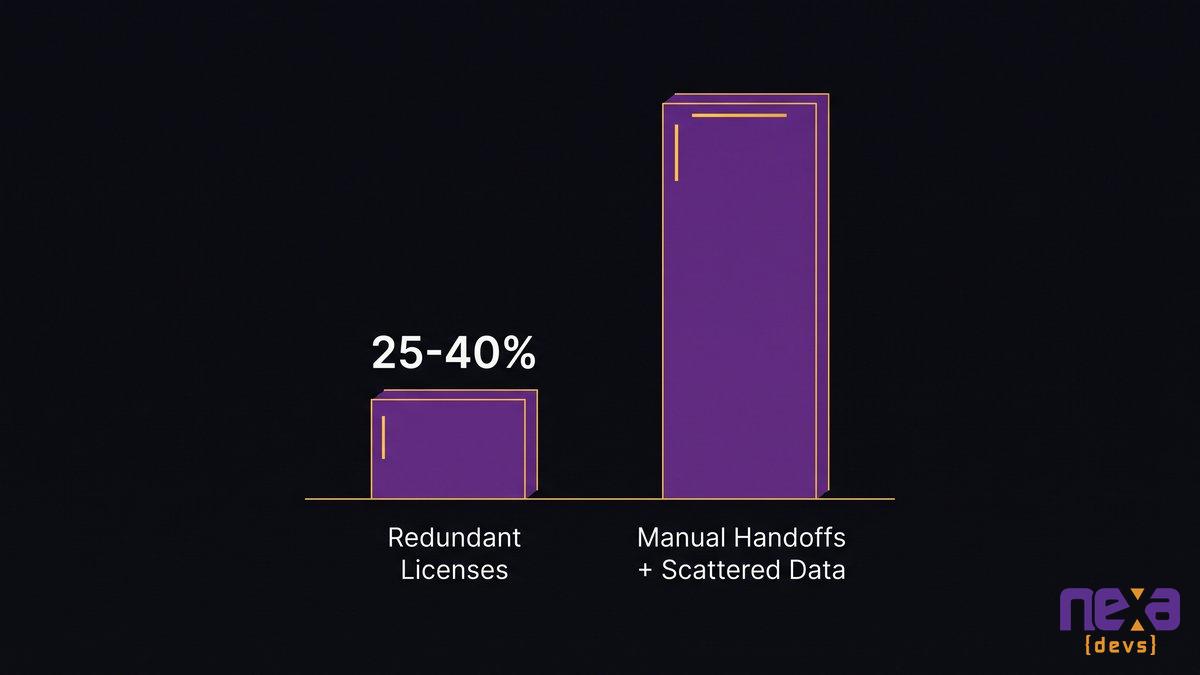
Chart contrasting the visible cost of redundant SaaS licenses against the larger, unmeasured cost of manual handoffs and scattered data
Why a Consolidation Audit Only Trims the Edges
A SaaS audit is worth running. On its own, though, it solves less than it looks like it solves.
The standard playbook is well established: inventory every app, flag the duplicates, cut what nobody logged into last quarter, negotiate better terms on what’s left. Every step is useful. None of it touches why the duplicates existed in the first place.
Six months after a successful audit, the license count usually creeps back up. Not because anyone got careless, but because the underlying condition that produced the sprawl, no single system fitting how the team actually works, never went away. The audit removed the symptoms. The condition that generates them keeps producing new workarounds the moment the old ones get cut.
As Ashwin Ballal, CIO at Freshworks, states: “Legacy systems have become so complex that companies are increasingly turning to third-party vendors and consultants for help, but the problem is that, more often than not, organizations are trading one subpar legacy system for another. Adding vendors and consultants often compounds the problem, bringing in new layers of complexity rather than resolving the old ones.” Ballal was describing legacy infrastructure specifically, but the pattern applies just as cleanly to a stack rebuilt through consolidation alone. Swap five overlapping tools for two slightly less overlapping ones, and you’ve bought time, not a structural fix.
The same logic runs through The hidden tax of accumulated technical debt, where patching a system’s symptoms without touching its root cause produces the same relapse pattern a year later.
The Fix Is One Fitted System, Not One More App
Buying one more platform to unify the others just adds a subscription to an already crowded stack. What actually holds is a system built around your specific workflow, one your team owns outright instead of renting piece by piece.
That’s the difference between adding a vendor and replacing the layer that made vendors necessary in the first place. It’s also the argument most SaaS-sprawl advice skips entirely, because most of that advice comes from companies selling the next subscription.
Scope the System to the Real Workflow, Not the Org Chart
Most software, whether it’s an off-the-shelf SaaS tool or an internally commissioned build, gets scoped around departments: a finance module, a sales module, an ops module. Real work doesn’t move that way. An order travels from sales to fulfillment to finance to support, crossing every department boundary the software was organized around.
Scoping a system to the actual path work takes, rather than to the org chart that approved the budget, is what eliminates the handoffs sprawl created. It’s also why a generic platform struggles here: it was built for a department, not for your specific sequence of steps. The ERP implementation failure pattern runs on the same mismatch, packaged software forcing your workflow to bend around its structure instead of the other way around.
Replace the Workaround Layer Instead of Adding to It
Ask what your team is actually doing in that spreadsheet nobody officially owns, or in the manual weekly export three people dread. The workaround exists because something the team needs isn’t available anywhere in the current stack.
A fitted system replaces that workaround directly. The report that took an afternoon becomes a dashboard that updates itself. The data re-keyed by hand becomes a single record every connected tool reads from. This is the difference between consolidation, which removes duplicate tools, and replacement, which removes the reason the duplicates and the workarounds existed at all.
The market is already moving this direction. Retool’s 2026 Build vs. Buy Report found that 35% of teams have already replaced at least one SaaS tool with a custom build, and 60% had shipped software outside their own IT department’s formal oversight in the past year. Mid-market operations aren’t choosing between SaaS and nothing anymore. They’re choosing between more disconnected subscriptions and one system built to fit.
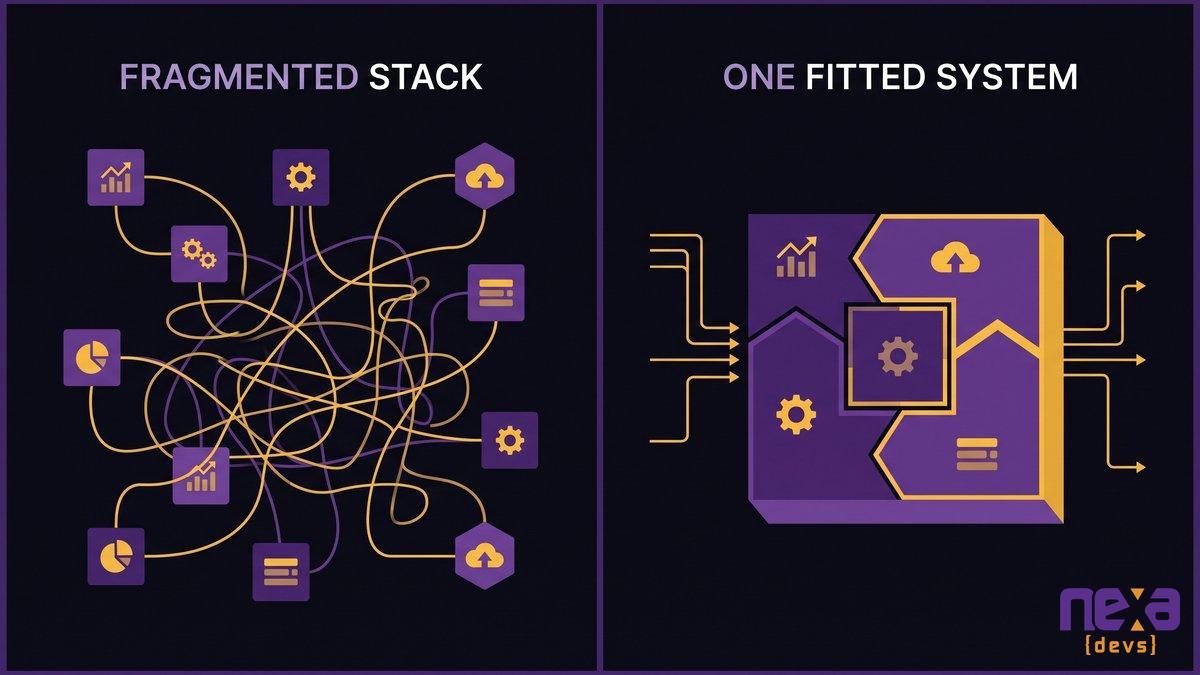
Comparison showing a fragmented multi-app workflow next to a single fitted system covering the same operational process
Owning the System You Run On
Every SaaS app in your stack comes bundled with someone else’s decisions, documentation you’ll never see, and a renewal date you don’t control. Owning your own system flips all three.
Nexa Devs delivers full documentation on every engagement: architecture diagrams, system design records, API references, and test coverage reports, transferred unconditionally at project close. That’s the antidote to the version of sprawl nobody talks about, which isn’t too many apps so much as too many black boxes you’re paying to run and still can’t fully see inside.
Ownership, in practice, means:
- Complete documentation transferred at delivery, not held as leverage for future change requests
- A system scoped to your actual workflow, not a department template you have to work around
- Ongoing support under an SLA, so evolution doesn’t require finding a new vendor every time priorities shift
None of that eliminates every third-party tool from your stack. Payroll, email, and a handful of specialized platforms will keep making sense to rent. What it eliminates is the default reflex: buying another app every time a workflow doesn’t fit, instead of asking whether the operation deserves a system built for it the first time.
The spreadsheet-run operations that break at scale problem and the SaaS sprawl problem are the same story told from opposite ends. One is too little tooling stretched too far. The other is too much tooling that never quite fit. Both get solved the same way, with a system built around the work rather than the other way around.
Stop Renting Workarounds. Build the System That Fits.
SaaS sprawl isn’t a discipline problem you fix with a stricter approval process. It’s what happens when the tools available never quite matched how your team works, year after year, purchase after purchase.
Nexa Devs builds custom internal systems scoped to your actual operational workflow, backed by AI-augmented delivery across the full development lifecycle and complete documentation your team owns from day one. We support systems we didn’t build too, so a fitted replacement doesn’t require starting from zero.
If your stack has grown past what anyone can fully account for, talk to us about what a system built for your actual workflow would look like. ,Schedule a consultation
FAQ
What is SaaS sprawl?
SaaS sprawl is when a company accumulates far more software subscriptions than its teams actually use, spread across departments with no single system tracking what’s active, who owns it, or whether it duplicates something already in the stack.
Is SaaS really dead or just evolving?
SaaS as a category isn’t disappearing, but buying patterns are shifting. Mid-market companies are moving away from adding a new point solution for every workflow gap and toward fewer, better-integrated systems, including custom-built ones designed around their actual operations.
How much SaaS spend goes to waste in mid-market companies?
Industry estimates put redundant or underused SaaS spend at 25% to 40% of the total software budget for mid-market companies, the highest waste rate of any company size segment. On a stack running into six or seven figures annually, that range represents real, recoverable money.
How do you fix SaaS sprawl?
Start with an inventory audit to cut clearly unused licenses, but treat that as a first step, not the fix. The lasting fix replaces the fragmented tools your team relies on with one system scoped to your actual workflow.
What causes SaaS sprawl in growing companies?
Sprawl grows because individual teams solve individual problems with individual tools, and no single system covers the full workflow that crosses departments. Freemium and trial signups add tools without a procurement conversation.