Nonprofit Technology Project Failure Isn't About Budget

Table of Contents
- Quick answer: nonprofit technology project failure
- The Approval Was the Easy Part
- A Technology Budget Buys Two Different Things and Is Priced for One
- More Money Raises the Number of Projects Started, Not the Number Finished
- The People Who Have to Answer the Questions Also Run the Programs
- Charters and Kickoffs Don’t Prevent Nonprofit Technology Project Failure
- The Two-Question Diagnostic You Can Run This Week
- What to Require From a Delivery Partner
- Reframing the Ask to Your Board
Last updated: 2026-11-23
Nonprofit technology project failure usually isn’t a money problem. The budget buys the build. It doesn’t buy the staff hours needed to specify, decide, test and own the result. Those hours belong to the same few people who run your programs. Raise the budget and you’ll start more projects without finishing more of them.
You’ve probably lived the scene. The increase was approved in the spring and a vendor was selected over the summer. Twelve months later the project is 70% done, and nobody can say what the remaining 30% depends on.
Why that happens is a capacity problem you can test against your own portfolio this week for nothing. What to require from a delivery partner, and what to ask your board for instead, comes after that.
Quick answer: nonprofit technology project failure
- A technology budget pays for the build. It doesn’t pay for the staff time needed to specify, decide, test and own the result.
- More money starts more projects. It doesn’t finish them, because completion runs through a few program leaders with no spare hours.
- For each active project, name who can approve a scope decision without a meeting and who maintains it after launch.
- Ask your board for a smaller budget, a named owner and a funded second year.
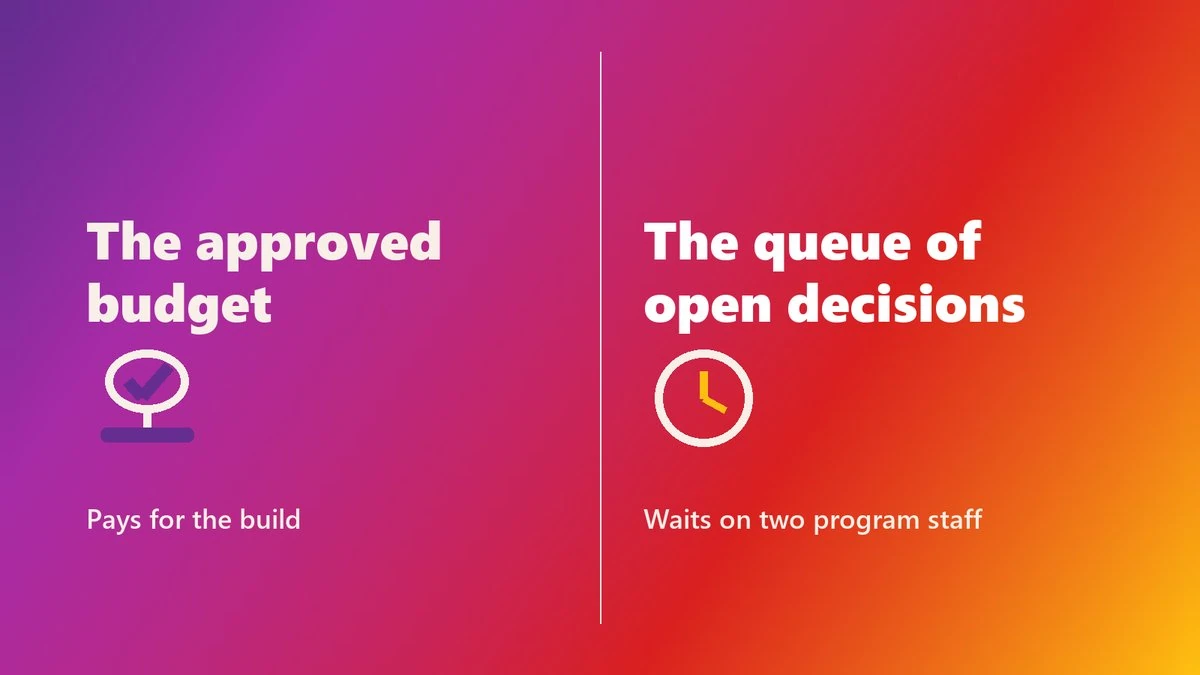 The budget pays for the build. The decisions wait on the two people who already have jobs.
The Approval Was the Easy Part
The increase got approved in March and the vendor signed in May. It’s now the following spring, the status report shows green, and your executive director can’t say what finishing depends on. None of that turns on how much you spent.
What 70% done actually describes
Seventy percent done usually means seventy percent of the work the vendor can do alone. The remaining thirty needs an answer from someone inside your organization, whether that’s a rule nobody wrote down, a sign-off, or a test run against real client records.
India Development Review published a version of this scene in October 2026. Pradeep Kaushik, who leads engineering at Dalgo, opens his article with two nonprofits that asked funders for a technology grant in 2025. One was told no. The other was told yes and, in his words, “spent more than a year building a tool that the team did not adopt because the programme had ended by the time it was launched.” His next line: “Both nonprofits are now back to maintaining paper registers and copying data into Excel.”
Two unnamed cases from an Indian nonprofit context, reported by one author who works in the sector. They illustrate the problem without measuring it, and they shouldn’t be read as US data.
Why nobody can say what the last 30% depends on
Because nobody wrote the dependency list. A vendor’s status report tracks tasks and says nothing about the questions waiting on you, how old they are, or which of them blocks the rest.
Advice aimed at this problem tends to blame unrealistic timelines. Sometimes that’s right. Often the timeline was fine for the vendor and slipped anyway because it assumed answers would take a day when they took three weeks. One senior tech leader on an engineering-leadership forum described the pattern in a single sentence: a 2-year project turns into a 4-year project, and “they are stuck at 70% migrated for months while new requirements roll in.”
A Technology Budget Buys Two Different Things and Is Priced for One
A budget line buys the build. It doesn’t fund the capacity to specify, sequence, decide, integrate, test and own what gets built. One of those is a purchase order; the other is staff time that nobody priced.
What the line item covers
Developer hours, licenses, hosting, the vendor’s project manager. Everything a nonprofit IT budget puts on the invoice is something a vendor can deliver without asking you anything. It’s easy to approve for that reason, since the scope is legible, the price is fixed and a board member can read the line in one pass.
What it does not cover: specify, sequence, decide, integrate, test, own
Six jobs sit outside the invoice, each landing on a named person inside your organization.
- Specify. Someone has to write down what the system must do, in words a developer can build from. In practice that’s a program director, working evenings.
- Sequence. When four things all feel urgent, someone chooses what ships first and what waits.
- Decide. The vendor hits a case the scope didn’t anticipate. Someone with authority picks an answer. Today.
- Integrate. The new tool has to fit how staff actually work and connect to the systems around it. Nobody outside your organization can map either one for you.
- Test. Correct means something specific in your programs. Only staff who run those programs can tell a right result from a plausible one.
- Own. After launch, somebody fixes it, changes it and answers the phone when it breaks.
A lack of in-house IT expertise gets blamed for all of this. The lack is real. But a single hire doesn’t absorb the six jobs, because four of them need program knowledge more than engineering knowledge. Nonprofit modernization stalls at exactly this seam, where a budget that covers only the invoice has funded a queue of waiting decisions.
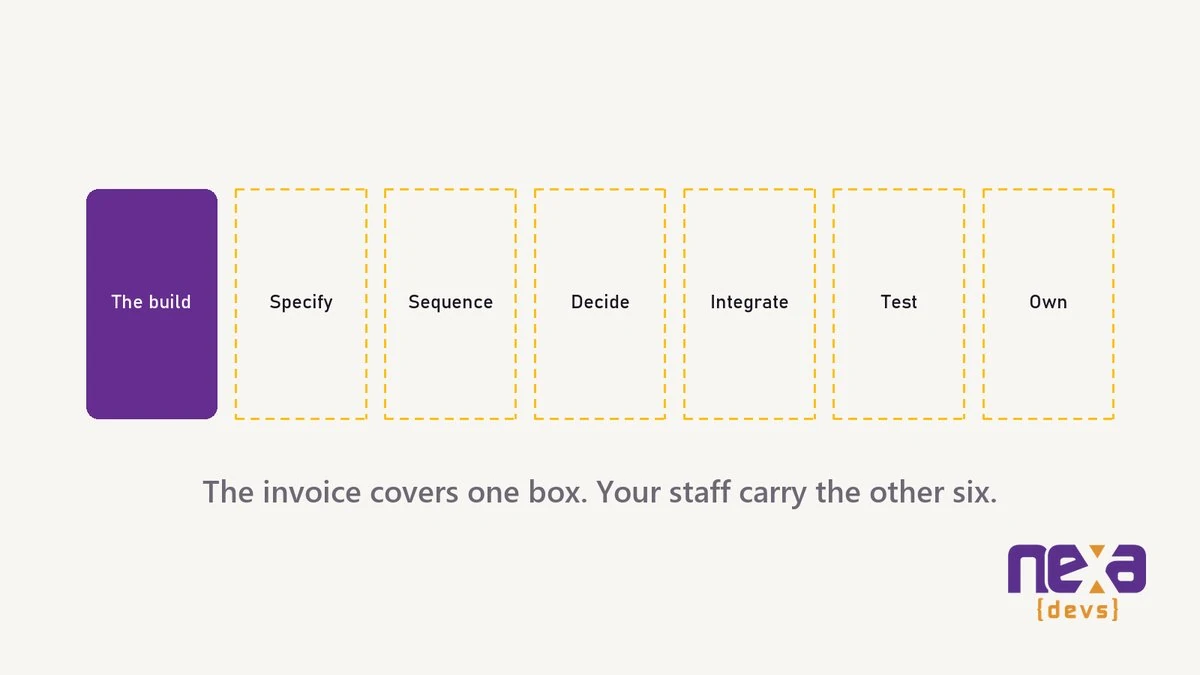 The invoice covers one box. Your staff carry the other six.
More Money Raises the Number of Projects Started, Not the Number Finished
Extra budget lets you start another project. Finishing one still depends on a handful of internal people whose hours don’t expand when the grant does.
Where the queue actually forms
Picture a 150-person youth services organization, a hypothetical built from the pattern rather than a client. It approves three projects at once: a case management rebuild, a volunteer scheduling tool and an outcomes dashboard. Three vendors start work. All three need answers from the same director of programs and the same operations manager. The budget tripled the work in flight without adding anyone who can answer questions.
The queue forms at two desks. Every project in the portfolio waits there, invisible to the vendors.
Why the budget line and the finish line are not connected
The budget line belongs to finance and the executive director. Whoever gets a project across the finish line usually isn’t in that conversation at all. Nothing in the approval process asks whether they have the hours.
A widely read Stanford Social Innovation Review essay from 2014 reaches the opposite conclusion, that nonprofits need more capital, more staff and more expertise. We disagree with that standard prescription on one point. More capital buys more build. Nonprofit delivery capacity, meaning the attention of the people who must accept the work, is what’s actually scarce.
We haven’t found a credible published completion rate for nonprofit technology projects at your size, so we won’t quote one. The figures that circulate came, in the ones we checked, from vendors who sell the remedy. This argument rests on mechanism. An afternoon with your own portfolio will tell you whether it holds.
The People Who Have to Answer the Questions Also Run the Programs
Your program director approves the vendor’s scope question on Thursday night, after the intake rush. Thursday daytime belongs to clients. Multiply that by every open question across every project, and you have a decision queue nobody tracks.
The decision queue nobody tracks
Ask your vendor for one number: the age of the oldest question waiting on your side. Vendor status reports rarely show it. If that question is three weeks old, the delayed technology project has a cause you can name, and it isn’t the vendor’s velocity.
What over-capacity looks like before it looks like failure
A nonprofit software rollout rarely fails in one dramatic week. Questions get answered in batches during standing meetings. User testing slides past grant reporting season, then past the holidays. The same two staff members are cc’d on every thread.
Popular practitioner advice treats a team over capacity as one person’s workload problem, to be settled in a talk with their boss. That works once. When five projects share three people, no individual conversation fixes it. The limit belongs to the organization and has to be managed at that level. Change management gets prescribed as the cure, yet it presumes someone has hours to run it.
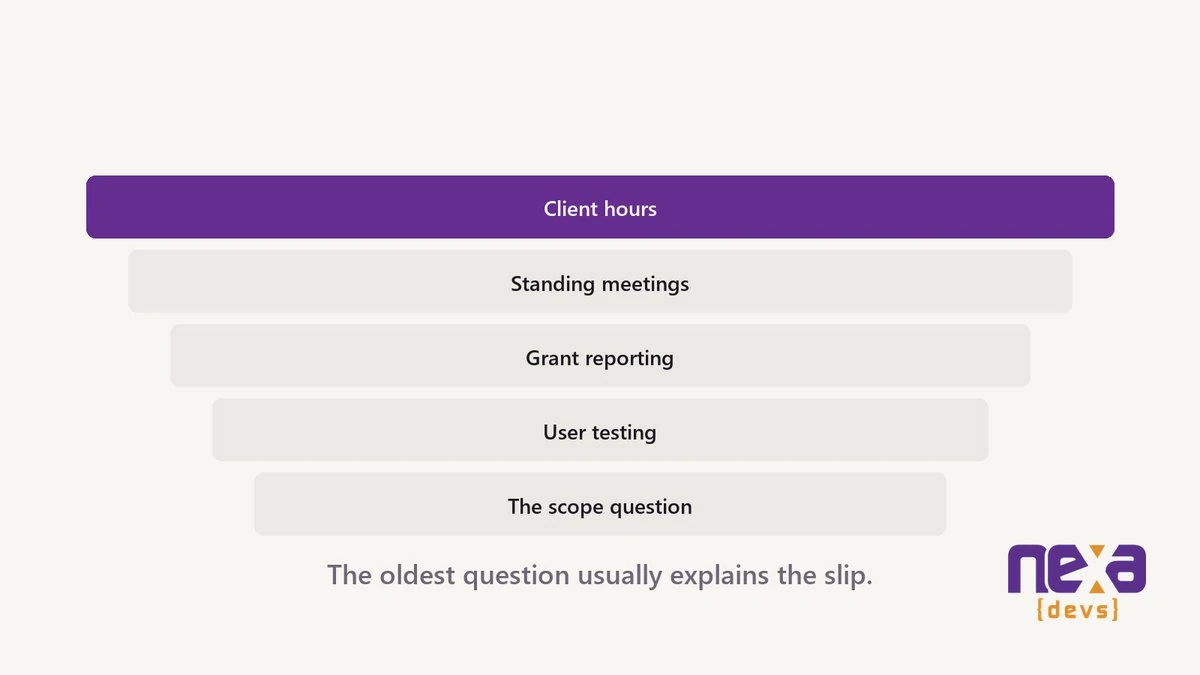 The oldest question usually explains the slip.
Charters and Kickoffs Don’t Prevent Nonprofit Technology Project Failure
A project charter earns its keep, but it has two blind spots. It can’t say who decides when the charter itself is silent, or who owns the result after launch.
Write one anyway. A good charter puts scope, budget and roles and responsibilities on a single page before work starts. That alone prevents arguments later. Kickoffs build momentum, and a tighter scope shrinks the specification job.
None of that settles what happens in week fourteen, when the vendor finds a case the charter never mentioned. The roles field lists names, but a name in a template carries no authority to say yes. Likewise a strategic technology plan or a nonprofit technology roadmap tells you what to build and in what order. Neither one names who maintains it in year two. Add the two names to the charter, then run the two-question test on every project you have in flight.
The Two-Question Diagnostic You Can Run This Week
For every active technology project, write down two names. Who can approve a scope decision without a meeting, and who maintains it after launch? A blank, a committee or a vendor doesn’t count as a name.
It costs nothing and takes an hour. Projects with no answer to either question are the ones that will slip. That’s a judgment built on the mechanism described here, and not a measured rate.
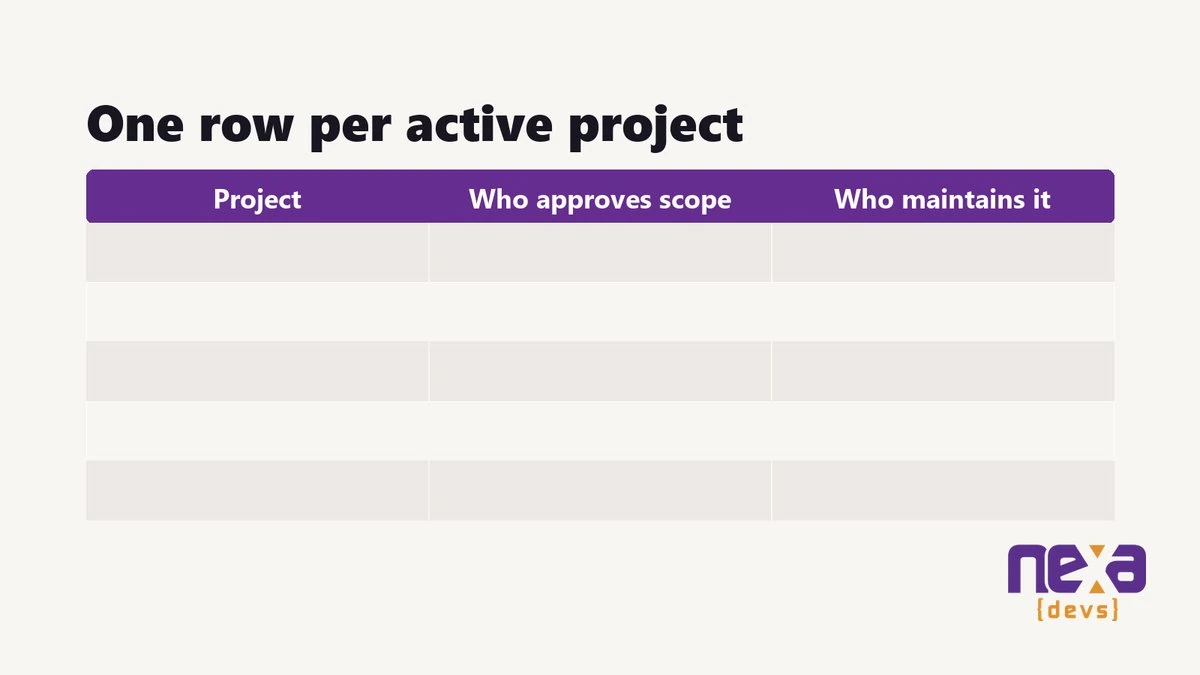 One row per project. Any blank in either column marks a project that’s likely to slip.
Question one: name the one person who can approve a scope decision without a meeting
Could that person say yes on a Tuesday afternoon with no calendar invite? If approval needs the executive director, the finance director and the program lead in one room, then the answer is nobody and every scope question costs a full meeting cycle.
Use a person’s name. A role fails the test, because roles don’t answer email.
Question two: name who maintains it after launch
Think of the system as it’ll exist in eighteen months, with a bug nobody scoped and a field the funder has added to its reporting. Who fixes it?
One executive director, quoted on EffectiveDatabase.com, described her answer for her data systems this way: “If she gets hit by a beer truck, we’re in big trouble!” She meant the one staff member who held it all. If your answer is a vendor who has already left, or a staffer with a full program load, you’ve found the gap before it found you.
What to Require From a Delivery Partner
Three requirements separate a partner who finishes your project from one who waits on you. Put them in your request for proposals, and hold every vendor to them, including us.
Specification and integration work carried, not queued behind your staff
Your staff shouldn’t author the specification, only confirm it. Confirming a drafted requirement takes ten minutes; writing one from a blank page takes a week the program doesn’t have.
Nexa Devs runs AI-assisted requirements analysis before development starts. Ambiguities surface early and the questions reach you as a short list instead of a drip across months. A dedicated team assembled and managed by Nexa carries the specification and integration work, with a dedicated project manager as your single point of contact. That’s how the six jobs shrink to the two that only you can do, deciding and accepting.
Documentation and architecture decision records transferred unconditionally
Ask what you’ll hold on the last day. At Nexa, it’s UML architecture diagrams, system design documents, user story libraries, API references and test coverage reports, plus architecture decision records. All of it belongs to you whether or not the engagement continues.
This is how you answer question two yourself. Any competent engineer can pick up a system that comes with its own explanation. If you want the full handover list, see what a complete documentation handover includes.
Support that exists after launch rather than ending at it
Technology project rescue firms exist, and some are good, but rescue is repair after the stall. You want the relationship that prevents it. Nexa’s SLA-based monthly support covers bug resolution, system evolution and continuity, with one month of free post-launch support on every project. It also covers systems other vendors built.
Look at how long the relationships last. UCLA David Geffen School of Medicine has been a client for 10+ years and FrontStream for 8+, because the relationship was built to outlast the launch.
Reframing the Ask to Your Board
Stop asking your board for a bigger project budget. Ask instead for a smaller one with a named owner and a funded second year, a number attached to a project that can actually finish.
A smaller budget with a named owner
Size the budget to what the named owner can absorb. A nonprofit tech implementation goes best at one or two projects at a time, sequenced. Boards tend to hear “smaller” as less ambition. Tell them it’s sequencing. Finishing one project and owning it beats starting three and maintaining none.
The owner also gives the board something to hold. A named person can answer for a project, whereas a committee can only schedule a discussion of it.
A funded second year
According to India Development Review (2026), Pradeep Kaushik writes that “Generating code was never as expensive as running and maintaining the software from year two onwards.” It’s one engineer’s argument from the Indian nonprofit sector, not research. He works for an organization in the same space. Test the logic against your own books, and ask what your last system costs to run in year two.
If you receive federal awards, one mechanism already exists. Under 2 CFR 200.414(f), recipients and subrecipients without a current negotiated indirect cost rate may elect a de minimis rate of up to 15 percent of modified total direct costs. It requires no documentation to justify and may be used indefinitely, and agencies and pass-through entities may not require a lower rate unless federal statute or regulation does.
It’s narrow. It covers federal awards and subawards only, you aren’t required to use it, and it doesn’t apply to cost reimbursement contracts issued directly by the federal government under the FAR. Whether system upkeep belongs in your indirect pool is a question for your finance lead and your auditor. For foundation or private funding, put year two into the original proposal.
If a project on your list failed the two-question test, book 30 minutes. We’ll tell you what we see.