

Table of Contents
Staff Augmentation vs. Dedicated Team: Who’s Accountable When Something Breaks?
There’s a scenario every mid-market CEO eventually lives through. The details vary. The outcome doesn’t.
A software contractor joins the team for a project. They’re good. Really good. They build the payment processing module, the API layer, and the integration with your CRM. Six months in, they leave for another opportunity. No notice. You’re left with a codebase that works mostly and a team that can’t touch it without breaking something. The logic lives in one person’s head, not in yours.
This isn’t a contractor management failure. It’s a structural property of staff augmentation. The staff augmentation vs. dedicated team decision turns on exactly that: not which model is cheaper in month one, but who is accountable when something breaks at 11 pm in month fourteen.
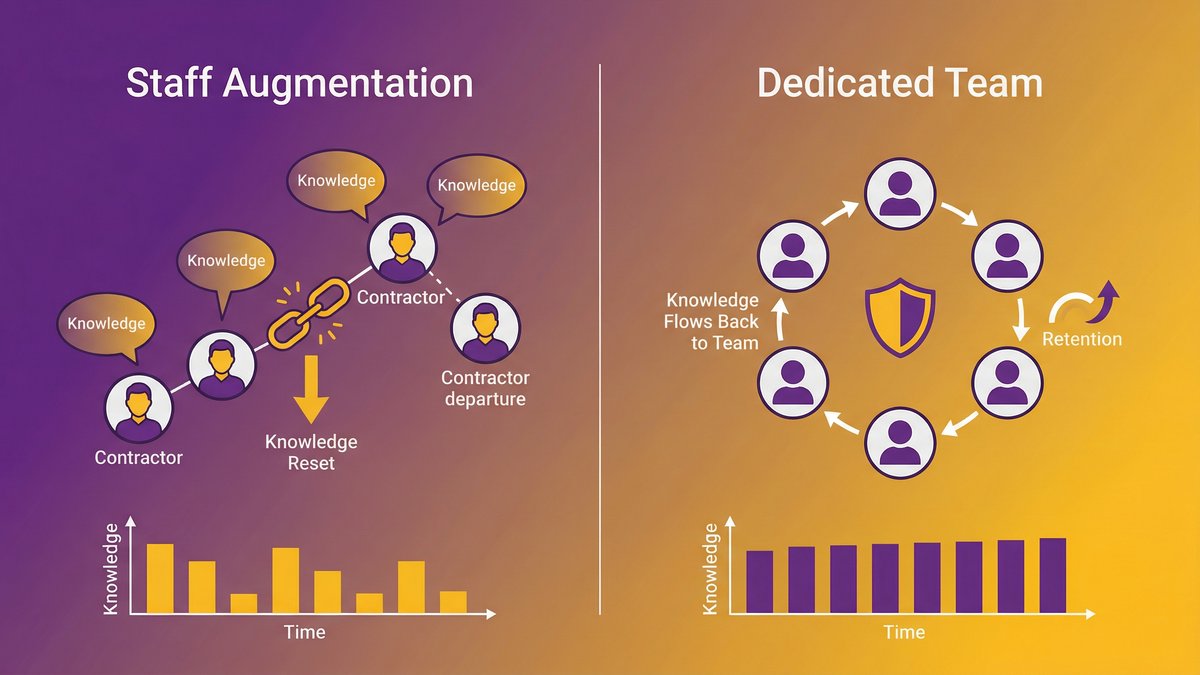
Accountability comparison: how staff augmentation and dedicated teams differ when something breaks
The Contractor Who Took the Codebase With Him
Staff augmentation, by design, gives you capacity. The contractor shows up, does the work you direct them to do, and leaves when the engagement ends. That’s the model. Nothing went wrong. Nobody broke a promise.
The problem is that “capacity” and “accountability” are not the same thing. When the contractor leaves, the knowledge leaves with them. The codebase stays, but the institutional understanding of why it works the way it does doesn’t transfer automatically. Dreamix, a software development consultancy, documented exactly this: “documentation gaps, undocumented dependencies, and lost configuration details create expensive problems months after transition completion.” That describes what happens when the engagement model doesn’t require knowledge transfer, regardless of how good the contractor was.
The dedicated team model is structured differently. The team is accountable for outcomes, not just outputs. When someone leaves the team, knowledge transfer is the vendor’s problem. When something breaks, the team owns the fix, not because you’ve negotiated a service credit, but because the model is built around continuity, not throughput.
Once you see that difference, the cost comparison looks completely different.
Staff Augmentation vs. Dedicated Team: What Each Model Actually Promises
Staff augmentation vs. a dedicated team isn’t a question of quality. It’s a question of what each model is designed to deliver, and what it’s designed to leave to you.
What you get with staff augmentation
Staff augmentation means you hire individual contractors, typically senior engineers, who integrate into your existing team. You manage them directly. You own the architectural decisions. You run standups, set priorities, and handle QA. The contractor delivers work product. Accountability for what gets built and how it holds up sits with your internal team.
The tradeoff is explicit in how these engagements are scoped: you pay for hours, not outcomes. According to Statista’s Global IT Workforce Trends 2025, over 70% of tech companies now use remote or hybrid teams, and staff augmentation is the model that makes individual remote contributors available quickly. Speed and flexibility are real. Continuity is not guaranteed.
What you get with a dedicated team
A dedicated team is an external engineering group assembled and managed by a vendor, integrated with your organization’s goals and workflows. The vendor is responsible for team composition, knowledge continuity, process discipline, and delivery accountability. You set the direction; they manage the execution.
You’re not paying for hours. You’re paying for a team that remains responsible for the outcome past the end of the billing period. That’s a different contract in every sense of the word.
| Factor | Staff Augmentation | Dedicated Team |
|---|---|---|
| Who manages the work | You | The vendor |
| Who owns outcomes | You | The vendor |
| Knowledge continuity | Contractor-dependent | Vendor-managed |
| Management overhead | 15-25% per developer | 5-10% overall |
| Short-term flexibility | High | Moderate |
| 12-month TCO | Higher (hidden costs) | Lower at scale |
More at nearshore staff augmentation
The Question Nobody Asks Before They Sign: Capacity or Accountability?
Most mid-market CEOs ask the wrong question: “Which model costs less?” The question that actually matters: “Which model makes someone else accountable for outcomes?”
Capacity: what you control, what you own
Capacity means individual contributors doing work you direct. You control the priorities, the architecture, the sprint contents, and the code review process. You also own every decision made and every gap left uncovered. If the contractor builds something fragile, you own the fragility. If they leave, you own the knowledge gap.
None of that is a criticism. Staff augmentation is a labor market transaction: skilled people, short timeline, maximum control. For the right situation, that’s exactly what you need.
Accountability: what gets guaranteed, and by whom
Accountability means a vendor that is contractually and operationally responsible for what gets delivered and how it performs. The dedicated team model shifts who picks up the phone at 11 pm. It’s not you, scrambling to reach a contractor who may or may not respond. It’s the vendor, whose business depends on the system running.
Stratagem Systems noted in their 2026 analysis that “choosing the wrong model costs 30-50% more and delays your project by months.” Under staff augmentation, the delay is your problem. Under a dedicated model, it’s the vendor’s.
For a mid-market CEO running a 50- to 500-person organization whose operations depend on internal software, the accountability question matters more than the hourly rate. If the system breaks, you can’t call the contractor and make it their problem. You can call the dedicated team vendor and do exactly that.
The Hidden Costs of Staff Augmentation Over 12 Months
Staff augmentation looks cheaper on a line-item basis. It stops looking cheaper when you account for what you’re actually paying for.
Management overhead: 15-25% of a manager’s time per developer
Staff augmentation requires 15-25% of a manager’s time per augmented developer. For a team of 4 developers, that’s 25 to 40 hours per week of internal management capacity consumed by oversight, coordination, code review, and context-setting. A dedicated team cuts that to 5-10% of a manager’s time, since the vendor handles the coordination layer.
Those 25 to 40 hours aren’t free. It’s an internal salary cost your budget model didn’t include.
The knowledge reset: what you lose every time a contractor leaves
Every contractor departure is a knowledge reset. The code stays. The understanding of why it’s built the way it is leaves with them. You pay ramp time for the next hire. You pay for the bugs that only surface three weeks after the handoff. You pay for the architectural decisions that can’t be explained to a new engineer without rebuilding half the context from scratch.
The hidden cost of re-onboarding is the one cost that no staff augmentation vendor will include in the proposal. It should be.
Ramp time multiplied across a revolving door
A new contractor takes 4 to 8 weeks to reach full productivity on a mature codebase. If your contract terms allow turnover, and most do, you pay ramp time every time someone rotates out. In a 12-month engagement with even one turnover event, you’ve absorbed one to two months of reduced throughput you never budgeted for.
Dedicated teams, because the vendor owns continuity, absorb that cost themselves. You don’t pay ramp time when someone on their team is replaced. That’s part of the accountability model.
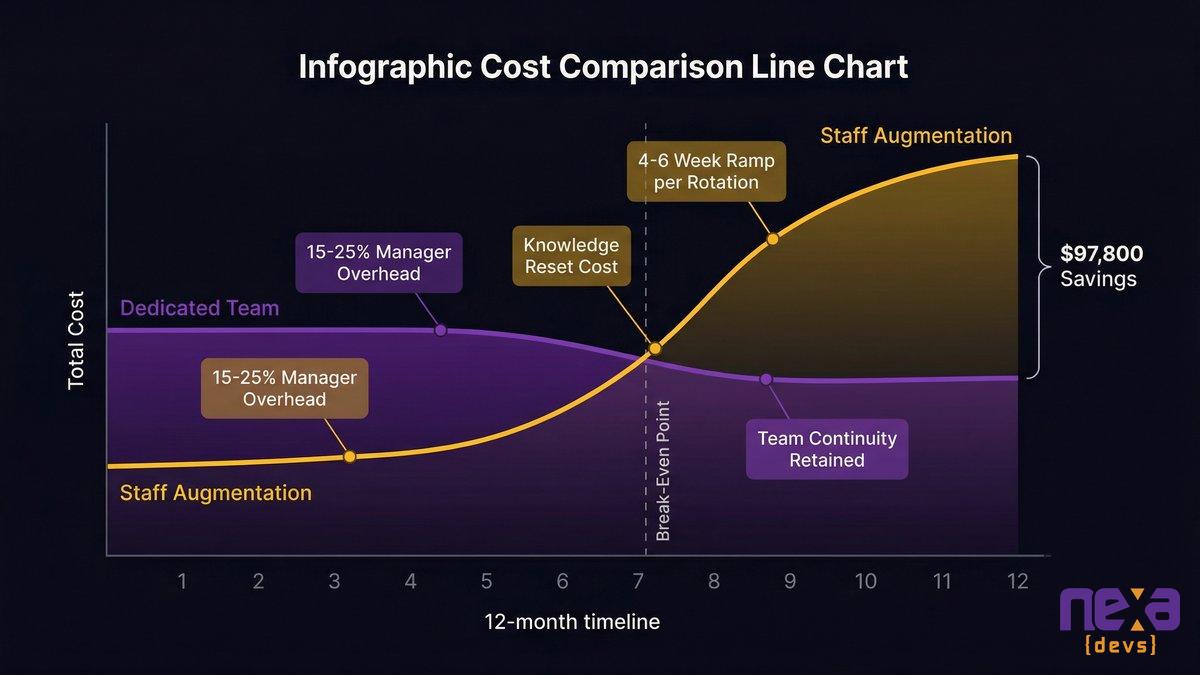
Total cost of ownership over 12 months: where staff augmentation and dedicated teams cross over
The Break-Even Point: When Dedicated Teams Start Winning on Cost
Staff augmentation wins at month one to three. After that, the math inverts. That’s not a sales pitch, it’s what the total cost of ownership data shows.
Months 1-3: Staff augmentation has the cost advantage
At the start of an engagement, a staff augmentation model is faster and cheaper to stand up. There’s no team assembly process, no scoping phase, no onboarding to the vendor’s delivery model. You post a rate, you find contractors, they start. For a 3-month burst of capacity, a specific feature, a temporary backfill, staff augmentation is the right answer.
Months 6-12: the crossover
In a total cost of ownership analysis, a dedicated team model saves approximately 18%, roughly $97,800 over 12 months, compared to an equivalent staff augmentation engagement for a 4-developer team. The gap comes from three sources: management overhead absorbed by the vendor, knowledge continuity that eliminates ramp-time losses, and the reduced cost of defect resolution when one team owns the codebase end to end.
The crossover point sits somewhere between months 6 and 9. Before that, staff augmentation looks cheaper. After that, the dedicated model wins on total cost, and the risk gap is just as wide.
If your software initiative runs longer than 6 months, and most mid-market software systems run for years, the question of which model is “cheaper” already has an answer.
Decision Framework: Which Model Fits Your Situation
The decision comes down to two variables: how long the initiative runs, and how much internal management capacity you actually have.
Choose staff augmentation if…
- You need to backfill a specific skill gap for less than 4 months
- You have strong internal engineering leadership with the capacity to manage additional contributors
- The work is well-scoped and discrete, not architecturally dependent on tribal knowledge
- You’re comfortable owning outcome accountability and have the technical bench to exercise it
Staff augmentation at Nexa works well for this scenario: senior Latin America-based engineers, U.S. timezone alignment, and embedded directly into your team’s workflow. For the right situation, it’s exactly what it’s designed to be.
Choose a dedicated team if…
- Your initiative runs 6 months or longer
- You don’t have internal engineering leadership with the bandwidth to manage contractors
- The work involves systems your business depends on operationally
- You want a vendor who is accountable for outcomes, not just outputs
- You’re building something that will need to live, evolve, and be maintained past the delivery date
The hybrid trap: why splitting the difference often gives you the worst of both
The hybrid approach, which uses a dedicated team for core work and augments with contractors for specific pieces, looks clean on paper. In practice, it almost always underdelivers. The coordination overhead between an accountable core team and unaccountable augmented contributors degrades the accountability you paid for. The dedicated team gets pulled into managing the contractors. The contractors operate without the context that the dedicated team holds. When something goes wrong, accountability diffuses across both engagement types.
Pick a model and commit to it. For any initiative lasting 6 months and running on systems your business depends on, the dedicated team is the right answer. Staff augmentation is not a compromise position. It’s the right tool for a specific, shorter-horizon job.
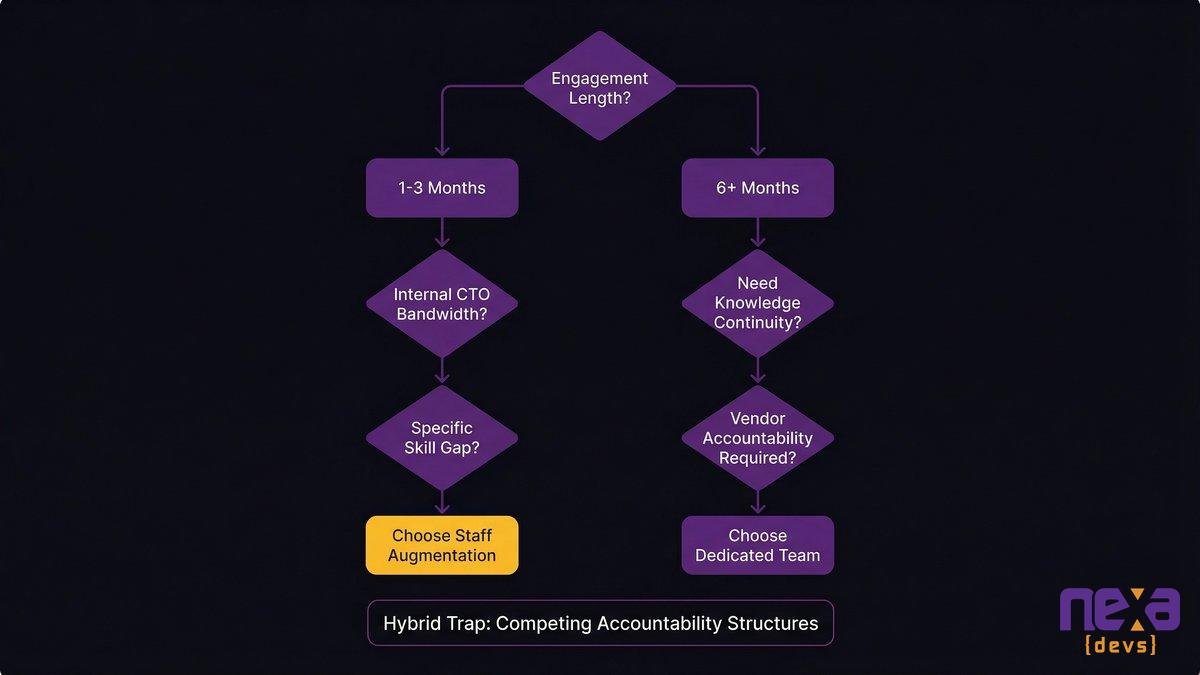
How to choose: key questions that point toward staff augmentation or a dedicated team
What 10-Year Client Relationships Look Like and What They Prove
No Nexa client has maintained a 10-year staff augmentation relationship. That’s not an accident.
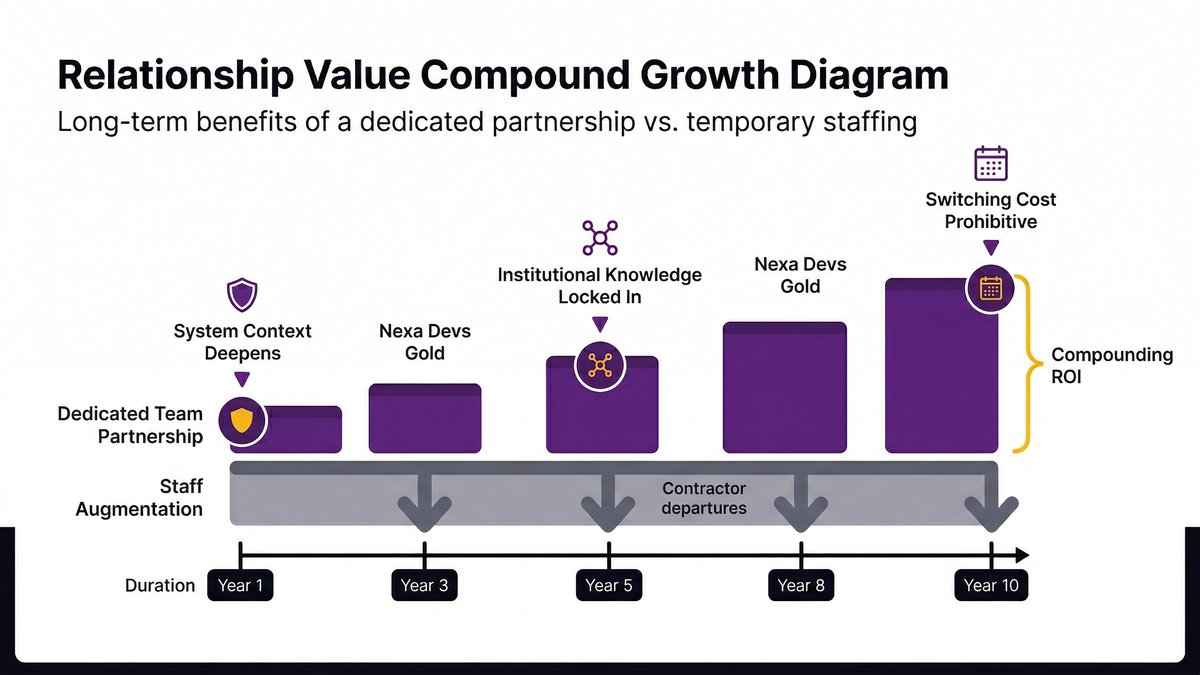
Nexa’s longest client relationships, UCLA David Geffen School of Medicine at 10+ years, TSB at 8+ years, and FrontStream at 8+ years, are all dedicated team engagements. They continue not because the contract auto-renews, but because the accountability model creates compounding value on both sides.
The client ends up with a vendor that knows their systems in depth. The vendor builds institutional knowledge that can’t be replicated from scratch with new staff. After a few years, you can’t easily replace that team with a fresh set of contractors; the knowledge gap would cost you more than the contract savings.
The cost comparison misses the bigger picture. Staff augmentation relationships are transactional by design. Dedicated team relationships, when the model is working, get better over time. The break-even point, roughly month 6 to 9 on cost, is just the start. Past that, the ROI keeps building in ways a contractor rate never captures.
When a client has worked with the same engineering partner for 10 years, that’s evidence of accountability, not loyalty. They stayed because the model delivered on outcomes. They kept renewing because the team knew the system and kept it running.
If you’re making a vendor decision today, think about what year five looks like. If the honest answer is “we’d need a new vendor in 18 months when this project ends,” you’re not picking a partner. You’re renting capacity.
Read long-term software development partnership
The Five Questions to Ask Any Vendor Before You Choose a Model
Before you sign with any vendor, staff augmentation, or dedicated team, use these five questions. They’re designed to surface accountability gaps fast.
1. If a critical engineer leaves your team mid-project, what happens to knowledge continuity, and who pays for it?
A staff augmentation vendor will tell you they’ll find a replacement. They won’t tell you who absorbs the 4 to 8-week ramp time. A dedicated team vendor should tell you exactly how knowledge transfer is handled internally, because it’s their problem.
2. Who is accountable if the delivered system fails in production 60 days after launch?
Under staff augmentation, the answer is usually: you. The contractor delivered what you directed. Under a dedicated team model with SLA-based ongoing support, the answer should be: us.
3. What documentation do you deliver at project close, and who owns it?
This question separates vendors who deliver documentation as a standard deliverable from those who treat it as optional. Any answer that involves “we can provide that for an additional fee” is a red flag.
4. What is your longest active client relationship, and what drove the renewal?
A staff augmentation firm will struggle with this question. Contractors don’t create long-term relationships; they fill short-term gaps. A dedicated team vendor should be able to name clients and describe what accountability produced the renewal.
5. Can you support systems you didn’t build?
This tells you whether the vendor is in the accountability business or the billing business. A vendor who only supports their own work is one who won’t be there when you need to migrate away from a previous bad engagement. A vendor who supports any system, including systems built by others, is signaling genuine accountability.
5 questions to ask any vendor before signing — regardless of which model you choose
Before You Sign Anything
Nearshore beats offshore for most mid-market teams. Not because the rates are always lower, but because timezone alignment turns a staff augmentation or dedicated team engagement from a coordination tax into a working relationship. U.S. timezone overlap means real-time standups, same-day code reviews, and a vendor you can actually reach when something breaks.
But timezone proximity doesn’t solve the accountability gap. That’s solved by the model you choose and the contract terms you negotiate.
Six months or longer, operationally critical systems, no internal engineering leadership with bandwidth to manage contractors, that combination points clearly to a dedicated team. It’ll cost less, break less, and build in value rather than expiring at launch.
The contractor who takes the codebase with them when they leave is a cautionary tale every mid-market CEO has either lived or heard. The way to avoid it isn’t to find better contractors. It’s to choose the model where institutional knowledge is someone else’s responsibility to maintain and transfer.
Accountability, in this context, is a structural choice, not a clause you negotiate into a contract after the fact.
Ready to think through the right model for your situation? Contact Nexa Devs for a conversation about which engagement model fits your initiative and what a 10-year version of that relationship looks like.
FAQ
What is the difference between team augmentation and staff augmentation?
Staff augmentation adds individual contractors to your team under your direct management. Team augmentation can mean adding a pre-formed group. In practice, most vendors use both terms for the same model: you manage the work, they supply the people. Neither term implies vendor accountability for outcomes.
What does a dedicated team mean?
A dedicated team is an engineering group assembled by a vendor and integrated into your project, but managed by the vendor. The vendor is accountable for team composition, knowledge continuity, delivery process, and outcomes. You set direction; they own execution, unlike staff augmentation, where you manage the work directly.
What is one key risk of outsourcing in capacity planning?
The biggest capacity planning risk in outsourcing is knowledge concentration. When critical systems knowledge lives with one or two contractors, their departure creates an immediate capacity crisis that takes months to rebuild, not just a headcount gap.
How does outsourcing increase accountability?
Outsourcing increases accountability when the engagement model ties the vendor’s business outcomes to your system’s performance. A dedicated team with SLA-based ongoing support has a financial reason to keep the system running. Staff augmentation creates no such alignment; the contractor is accountable for hours, not outcomes.
What is another word for staff augmentation?
Common alternatives include contractor placement, extended workforce, nearshore staffing, IT staffing, resource augmentation, and talent augmentation. All describe the same model: third-party individuals integrated into your team under your management, with no implied accountability for outcomes.