

Table of Contents
Sidecar Core Banking: Modernize Without Rip-and-Replace
A mid-market bank’s core system runs the general ledger, the teller platform, and every regulator’s audit trail. Pull it out wrong, and thousands of accounts go dark for a weekend. That fear is exactly why so many banks keep patching a core built in the 1990s instead of touching it.
Sidecar core banking exists to take that fear off the table. Instead of asking whether to rebuild the whole core or swap it in one cutover, it asks a better question: what if the new core ran next to the old one? A sidecar core is a modern banking core deployed in parallel with the legacy system, migrating one product line or customer segment at a time while the old core keeps running everything else. No weekend blackout, and no single date the whole institution has to ride on.
You can’t order sidecar core banking as a Nymbus feature or a Temenos SKU off a price sheet. It’s an engineering discipline: build new core services around what already works, prove each migration segment with production data, and expand only once the last phase held. Rip-and-replace earned its reputation as a career-ending bet, and the sidecar model is what grew up to replace it.
Quick answer: sidecar core banking modernization explained
- A sidecar core is a modern banking core built and run next to your legacy system, so daily operations stay live while new capability comes online.
- It’s an engineering discipline, not a packaged product: banks migrate one product line or segment at a time and prove results before scaling further.
- The strangler-fig approach avoids both failure modes at once: a multi-year rebuild that bets the institution, and permanent lock-in to a single vendor.
- Staying core-agnostic through the transition means you can still switch vendors later without a rebuild.
- Complete documentation transfer at every phase means the bank owns every new component, not the vendor.
The Rip-and-Replace Trap: Why Full Core Replacement Bets the Whole Institution
Full core replacement asks a bank to bet three to five years of stability on a single cutover date. Miss that date and you’ve spent millions with nothing shippable to show for it. Hit it and you still have to migrate every account, every integration, and every regulatory report in one irreversible move. This is the incremental-modernization-versus-full-transformation debate playing out with real money on the table, and for a community bank, core conversion risk is existential in a way it simply isn’t for a top-20 institution with a spare balance sheet.
The IBM Institute for Business Value studied banks that attempted full core modernization and found less than half reported meaningful gains on the business benefits they set out to achieve. Worse, 73% said managing costs actually got harder after the attempt, not easier. For a program meant to make costs more predictable, that is the exact opposite of the promised result.
Jouk Pleiter, CEO and founder of Backbase, described pitching incremental transformation on stage and hearing the same reaction for over a decade: “Love the vision. Feels like boiling an ocean.” He was right. Full replacement is boiling an ocean, and mid-market banks don’t have the budget, the bench, or the risk tolerance for a multi-year boil. Every quarter the project runs, the bank is also running its old core in full, doubling maintenance cost and audit surface with zero customer-facing improvement until the very end.
What Sidecar Core Banking Actually Is (And What It Isn’t)
A sidecar core is a new, modern core banking platform that lets you run legacy and modern core in parallel, handling a defined slice of business instead of the whole institution at once. Picture a second engine bolted to the side of the first rather than swapped in for it. The legacy core keeps processing everything it always has: existing accounts, existing statements, existing regulatory reporting. The sidecar core takes on new accounts, a new product line, or a specific customer segment, built on modern, API-first, composable core architecture from day one.
Running the New Core Alongside the Legacy System in Parallel
Money and data move between the two systems through defined integration points, not a single flag-day cutover. If the sidecar handles digital-only checking accounts, every new account for that product opens on the modern core while every existing account keeps running on the legacy platform, until and unless the bank decides to migrate it. Both systems stay live and both stay auditable. The bank controls exactly how much risk it’s carrying at any given moment, because it can stop expanding the sidecar’s scope at any phase without disrupting anything already running.
A Di:,scipline, Not a Product: Why the Sidecar Is an Engineering Approach
Most vendor pitches get this part wrong. They sell the sidecar as a piece of software you install, when it’s really a sequencing discipline: a set of engineering decisions about which components move first, how they integrate with what’s already there, and how each phase gets proven before the next one starts. You can build a sidecar core on almost any modern technology stack. The platform is close to beside the point. What carries the whole thing is the discipline of moving in small, provable, reversible increments instead of one enormous irreversible one.
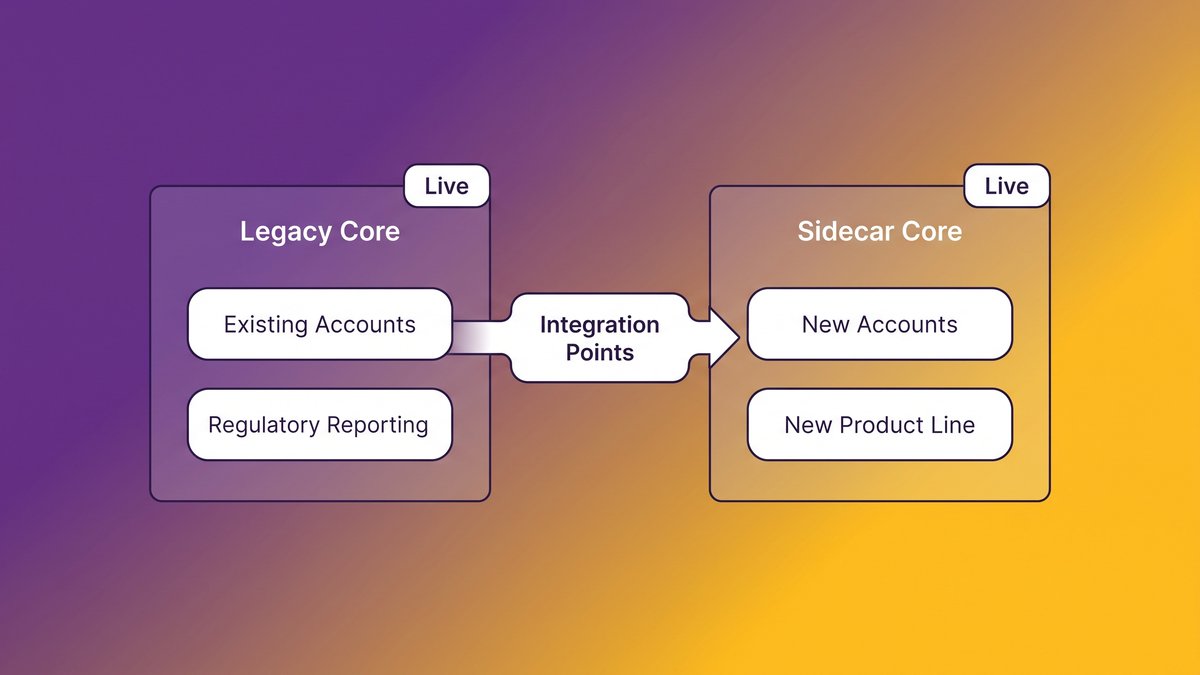
Diagram showing sidecar core banking architecture running in parallel with a legacy core system.
The Real Cost of Standing Still: What Legacy Cores Quietly Take From You
A legacy core bleeds money quietly. Its share of the budget creeps up year after year, and leadership usually spots the pattern too late to get ahead of it. Accenture found that 70% of the average bank’s IT budget now goes to keeping existing technical debt alive rather than building anything new, according to reporting from The Financial Revolutionist.
The CEO View: Budget Drain and Lost Competitiveness
For the CEO, this shows up as a budget that keeps growing without growing capability. Every dollar spent keeping a 1990s core alive is a dollar that doesn’t go to a new product line, a new market, or the AI-powered service your competitors already shipped last quarter. Boards notice when the technology budget rises every year and the product roadmap doesn’t move, and that’s a harder conversation than any single project failure. For a deeper breakdown of how that budget drain compounds over time, see the hidden tax technical debt is costing you.
The CTO View: No Real-Time Rails, Blocked AI and Integration Work
For the CTO, the cost is architectural. Legacy cores built for nightly batch processing can’t support real-time payments, real-time fraud detection, or the API calls a modern AI agent needs to check a balance or flag an anomaly. Every integration turns into custom middleware bolted onto a system that was never designed to be queried in real time. According to the Open Mainframe Project, the average COBOL programmer maintaining that system is 58 years old, and roughly 10% of that workforce retires every year. The talent that understands the old core is aging out faster than most banks are modernizing around it.
The Strangler-Fig Path: Migrating One Product Line at a Time
Strangler fig modernization works one product line at a time. It starts with whichever line is causing the most operational pain today, often retail deposits or a digital-only account product, and moves that single slice onto the new core first. Commercial lending and treasury management stay put until their turn earns its way up the list.
The pattern takes its name from the vine that grows around a host tree until it can stand on its own, and it works the same way here. The new core wraps around one function of the legacy system, proves it can carry that function reliably under real transaction volume and real audit scrutiny, and only then takes on the next one. A bank might migrate new digital account openings in month one, move existing low-balance checking accounts in month six, and leave commercial lending on the legacy core for another two years, because the risk-to-reward ratio doesn’t justify touching it yet.
Each phase produces its own data: transaction volumes, error rates, customer complaints, regulator questions. That data becomes the business case for the next phase instead of a consultant’s slide deck. If a phase underperforms, the bank stops there. Nothing downstream breaks, because nothing downstream depended on that phase completing.
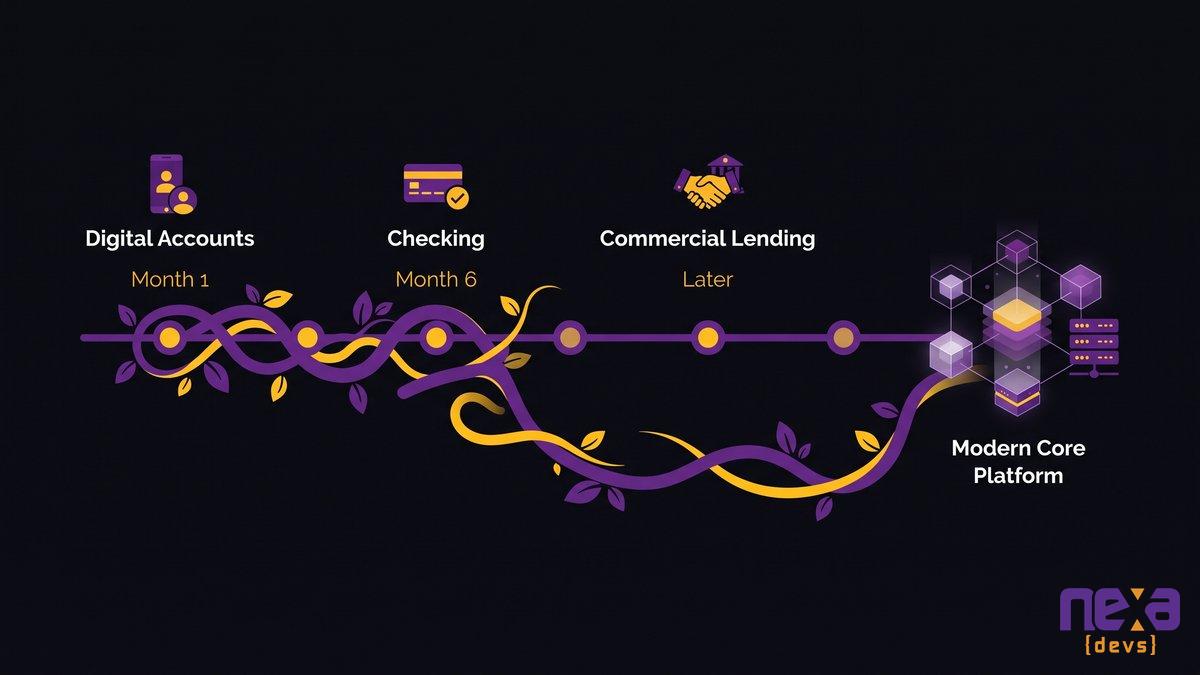
Strangler-fig migration timeline showing one banking product line moving onto a modern core at a time.
Staying Core-Agnostic: Escaping the Packaged-Vendor Lock-In Trap
Nobody feels locked in on signing day. The trap springs about two years later, once switching costs more than staying, no matter how bad staying has gotten. A core-agnostic strategy is how a sidecar migration avoids repeating that mistake with a new vendor instead of the old one.
Staying core-agnostic during a sidecar migration means choosing integration standards and data formats that don’t need a specific vendor’s proprietary tooling to read or move. It means every new component gets built so it could, in theory, be swapped for a competing product without a rebuild. Most packaged core vendors don’t want that flexibility built in, because flexibility is exactly what erodes their renewal position.
As Ashwin Ballal, CIO at Freshworks, states: “Legacy systems have become so complex that companies are increasingly turning to third-party vendors and consultants for help, but the problem is that, more often than not, organizations are trading one subpar legacy system for another.” A sidecar built around one vendor’s closed stack simply relocates the lock-in. Build it on open standards and documented integration points instead, and the bank gets real negotiating power the next time a renewal comes up, because leaving is actually possible.
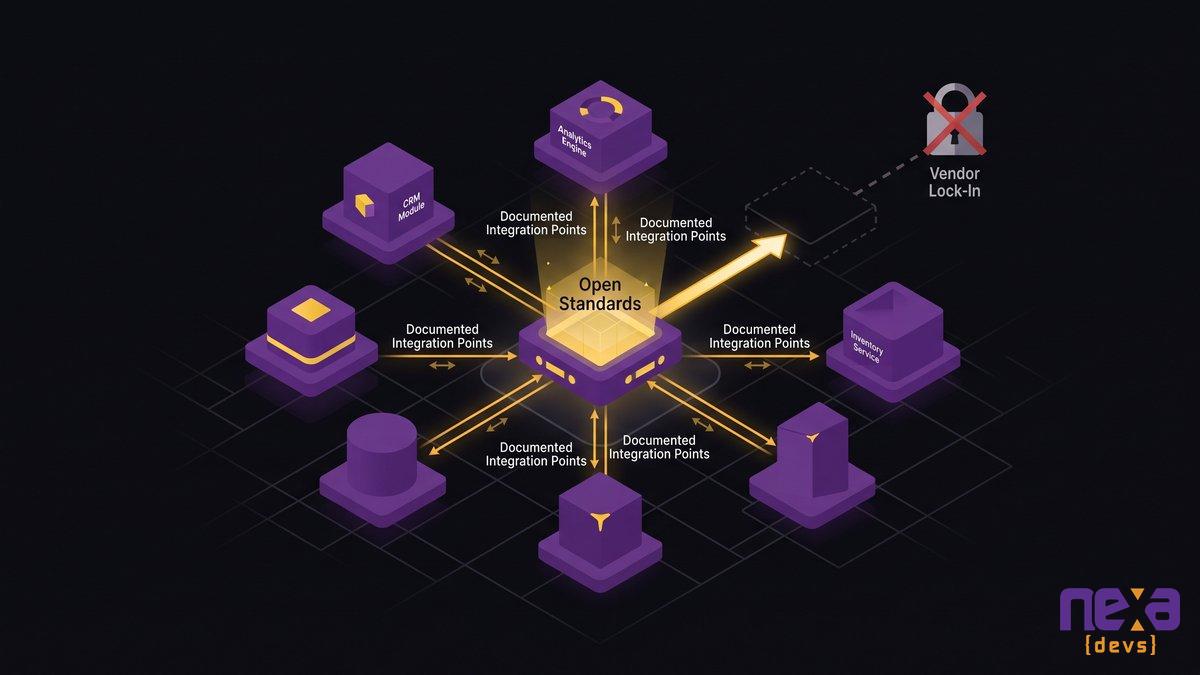
Core-agnostic architecture diagram showing open integration standards replacing single-vendor lock-in.
Prove It With Data Before You Scale: The Digital-Brand-First Playbook
PeoplesBank proved a modern core could work without ever touching its main system. It launched ZYNLO, a digital-only brand, on modern infrastructure first, and let the results speak before committing the whole institution. Nymbus, the vendor behind ZYNLO’s platform, reports the digital brand gathered more than $163 million in deposits before PeoplesBank committed to a fuller core transition. That figure comes from vendor marketing material rather than an independent audit, so treat it as directional, not a benchmark to build a business case on.
The pattern matters more than the exact number. Launch the new core on a contained, lower-stakes surface first: a new digital brand, a new product line, a new customer segment, somewhere failure is recoverable and success is measurable. Track the metrics that actually predict readiness for a wider rollout, like transaction error rate, customer onboarding time, integration latency, and support ticket volume. If those numbers hold for two or three quarters under real production load, you have a genuine business case for expanding scope. If they don’t, you’ve contained the damage to one product line instead of the whole bank.
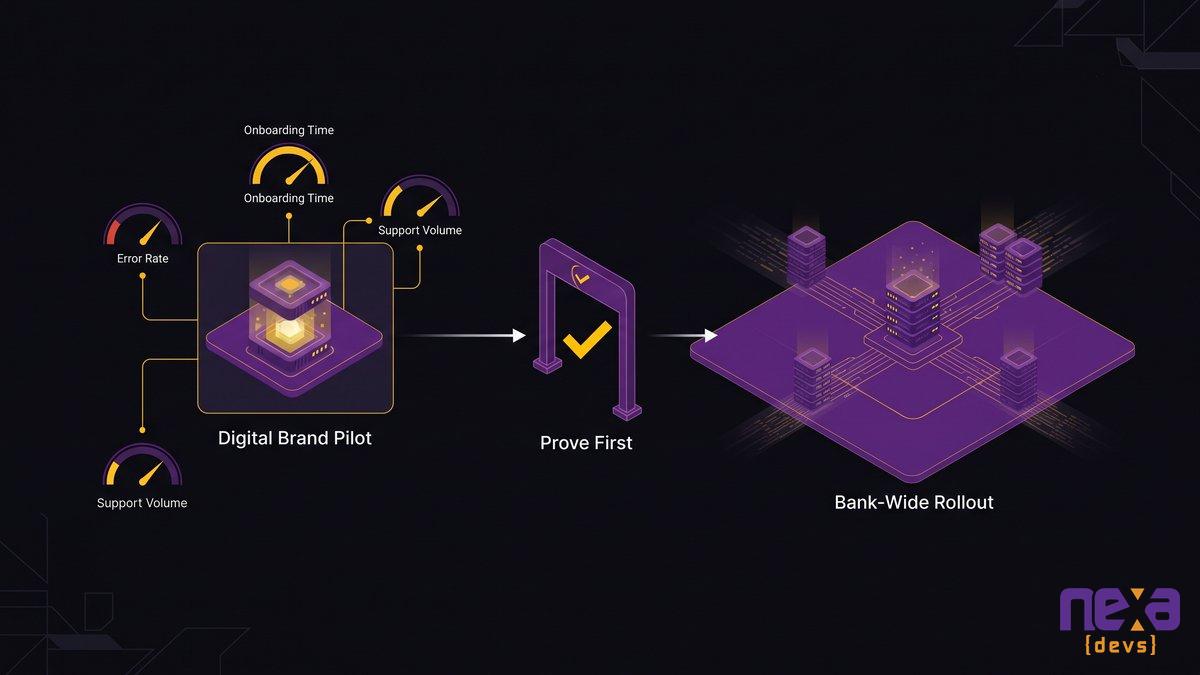
Digital-brand pilot launching on a modern sidecar core before a full bank-wide rollout.
Owning What You Build: Documentation Transfer and Long-Term Independence
Every sidecar migration produces new architecture diagrams, new API references, and new integration logic. One question determines whether this modernization solves the lock-in problem or just relocates it: who owns that documentation when the project ends?
Plenty of vendors and system integrators treat documentation as a professional courtesy, something you get if you ask nicely during the handoff meeting. Complete documentation transfer, meaning UML architecture diagrams, API references, test coverage reports, and sprint records, needs to be a contractual deliverable rather than a favor. Without it, the bank has traded a legacy black box for a modern one with better marketing.
This is where a long-term embedded partner earns its keep. When the same team that built the sidecar phase in year one is still accountable in year three, institutional knowledge doesn’t evaporate the way it does when a project-based vendor delivers, invoices, and moves on to the next client. The documentation exists because the relationship outlasts any single phase, not because a contract clause forced a one-time export.
How to Begin a Sidecar Modernization Without Disrupting Live Operations
Start with an architecture assessment, not a vendor RFP. Map the legacy core’s dependencies, integration points, and data flows before deciding what moves first.
A useful first phase is small enough to fail safely and specific enough to produce real data: a single new product, a single customer segment, a single geography. Set the success criteria before you build anything, not after. Define what “this phase held” actually means in numbers, an acceptable error rate, acceptable latency, acceptable support volume, and give yourself a real decision point instead of quietly expanding scope because the team is already there.
Assign a single accountable owner for the sidecar program, someone who reports both the wins and the failures to the same audience, so the board sees an honest picture instead of a curated one. Mid-market banks that get this right treat the first sidecar phase as a pilot with a hard stop-or-scale decision, not the opening move of an open-ended rebuild. If you’re weighing this against a specific FedNow, real-time payments, or compliance deadline, our core banking modernization roadmap walks through how to sequence that decision.
The rip-and-replace era sold banks on speed. What most institutions actually needed was control. A sidecar core hands that control back, one product line at a time.
Rip-and-replace still sounds decisive in a board meeting. It’s also how banks end up three years and eight figures into a project with nothing live to show for it. If you’re weighing a sidecar approach against your own core’s constraints, schedule an architecture assessment with Nexa Devs and we’ll map the first phase that’s actually worth building.
FAQ
What is a sidecar core?
A sidecar core is a modern banking core that runs next to your existing legacy system instead of replacing it. New accounts or a single product line move onto the sidecar while everything else keeps running on the old core, so nothing goes offline during the transition.
What is progressive modernization in banking?
Progressive modernization means upgrading a bank’s technology in small, sequenced phases instead of one large rebuild. Each phase gets tested in production before the next one starts, so risk stays contained and the bank can stop or adjust at any point without losing what it already built.
What is composable core banking?
Composable core banking breaks the core into independent, interchangeable components, like payments, deposits, and lending, that connect through open APIs. Banks can swap or upgrade one component without touching the others, which is what makes a sidecar strategy technically possible in the first place.
What is the difference between monolithic and composable architecture?
A monolithic core bundles every banking function into one tightly coupled system, so changing one part risks breaking others. A composable architecture separates functions into independent services that connect through APIs, so you can update, replace, or scale one piece without touching the rest.
Are banks still using COBOL?
Yes. Most large and mid-size banks still run core functions on COBOL systems built decades ago. The programmers who maintain that code average 58 years old, with roughly 10% retiring every year, which is turning COBOL dependency into a real staffing risk, not just a technical one.
What is core modernization?
Core modernization is the process of upgrading a bank’s central operating system, the platform that handles accounts, transactions, and ledgers, to modern technology. It can mean a full replacement, but for most mid-market banks it means an incremental approach like a sidecar or strangler-fig migration instead.
What is an EMR integration?
An EMR integration connects your electronic medical record system to other clinical systems, like a lab, radiology, or referral platform, so data moves automatically between them. It typically uses HL7 or FHIR interfaces to send orders out and bring results back without staff manually re-entering information.
How does EMR integration with a lab system work?
An order placed in the EMR is sent through an HL7 or FHIR interface to the lab’s LIS. The lab processes the test and sends the result back through the same interface, where it posts directly into the patient’s chart. No manual re-entry is needed if the interface is built correctly.
What is the difference between HL7 and FHIR for lab integration?
HL7 v2 is an older, message-based standard most labs and EMRs still use for day-to-day order and result traffic. FHIR R4 is a newer, API-based standard built for real-time data access. Most hospitals run both together. FHIR doesn’t replace HL7 v2, it adds a modern layer on top of it.
Do we have to replace our EMR to fix a broken lab integration?
No. Most lab integration problems live in the interface layer, not the EMR itself. Incremental middleware or an interface engine can connect your existing EMR to the LIS, radiology, and referral systems without a full replacement, at a fraction of the cost and disruption.
What causes duplicate patient records in healthcare systems?
Duplicate records usually happen when systems can’t automatically reconcile patient identity across an integration gap. Staff create workaround records to keep care moving, and those records diverge over time. Clean, well-built interfaces with consistent patient matching logic are the fix, not manual reconciliation after the fact.