Table of Contents
Nonprofit CRM Integration: Connect What You Already Own
Your donor database and your fundraising platform run your organization’s most important relationships, and most days, they don’t agree with each other. Nonprofit CRM integration is the fix: connecting the systems you already depend on into one accurate donor record, instead of replacing software your staff has spent years learning.
So much for the short version. The harder question is why the disconnect happens in the first place, and what it costs your organization while it sits unaddressed. Picture a development director at a mid-size nonprofit spending two hours before every board meeting reconciling numbers that should already match. Two hours a month sounds survivable. Multiply it across a finance director, a database manager, and every program coordinator pulling their own donor list, and the real number gets uncomfortable fast.
Quick answer: fixing nonprofit donor data silos
- Nonprofit CRM integration connects your existing donor database and fundraising platform through APIs, not by replacing either system.
- Disconnected systems cost staff hours in manual reconciliation, produce duplicate donor records, and undermine board reporting accuracy.
- Silos form because each tool in your stack treats itself as the master record instead of sharing one.
- Owning the integration layer, including documentation, avoids per-connector subscription costs and consultant dependency over time.
- A connected donor record is also the prerequisite for any future AI-powered donor analytics or predictive giving models.
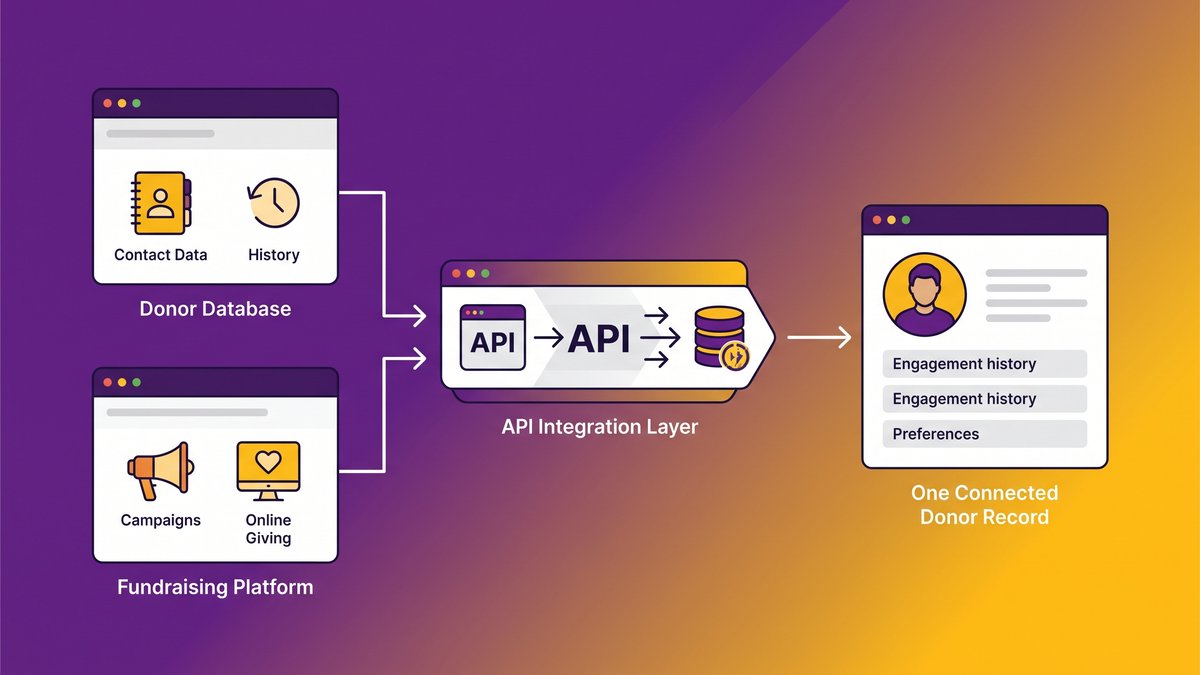
A visual overview of how nonprofit CRM integration links donor and fundraising systems into one connected record
What the disconnect between your donor database and fundraising platform is really costing you
The disconnect costs three things: staff hours, data integrity, and board confidence. All three compound month over month, and none of them show up as a single line item on your budget.
Staff hours lost to manual reconciliation and re-keying
Every donor management tool wants to own the master record. Your CRM has one version of a gift. Your fundraising platform, if it’s separate, has another. Your accounting system might have a third. Someone has to sit in the middle and make them agree.
That someone is usually your database manager or a development associate, and the job never ends. A gift comes in through an online donation form, gets recorded in the fundraising platform, then gets manually entered into the CRM so donor history stays current. Multiply that across every channel: direct mail, events, monthly giving, matching gifts. The re-keying work scales with your fundraising success, which means your best campaigns generate the most silo cleanup.
Duplicate and conflicting donor records
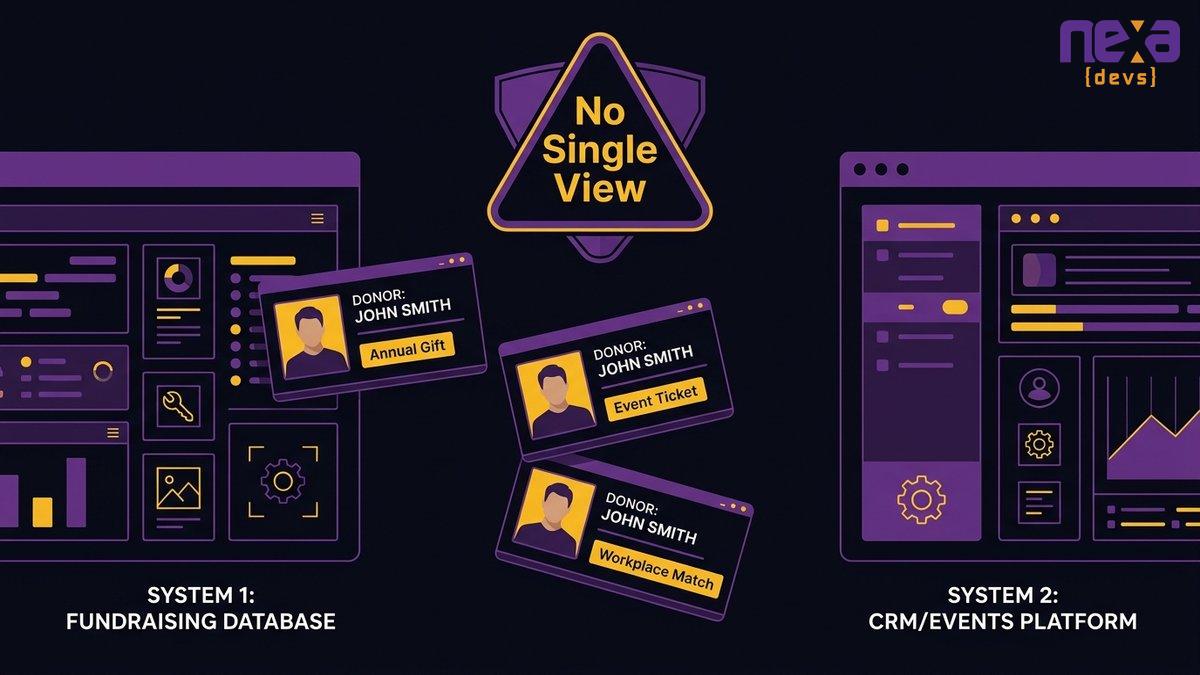
Treat duplicate records as a data hygiene nuisance and you miss the real problem: they put donor relationships at risk. A major donor who gives through three channels, an annual gift, an event ticket, and a workplace giving match, can end up as three separate profiles across your systems. Nobody sees the full relationship.
That donor gets a form thank-you letter for a $50 event ticket the same week your executive director should be calling to discuss a planned gift. The systems didn’t fail loudly. They failed quietly, and the cost is a relationship your organization spent years building.
Board reports you can’t fully trust
Only 20% of membership organizations have a formal data strategy in place, according to MemberWise’s 2026 Digital Excellence Report, and the figure barely improves among larger organizations. That gap shows up first in board reporting, where two systems produce two different fundraising totals and someone has to explain the discrepancy before the meeting even starts.
A board that questions your numbers stops trusting your strategy. At that point you have a governance problem, not a data hygiene one, and it follows directly from running a fundraising operation on systems that don’t reconcile themselves.
What “nonprofit CRM integration” actually means (and what it isn’t)
Integration is not a product on your shopping list. It’s the layer that lets the software you already have exchange accurate data automatically, in both directions, without a staff member acting as the manual bridge.
Most nonprofits already run two to five separate systems: a CRM or donor database, a fundraising or online giving platform, an email marketing tool, sometimes a separate events or peer-to-peer platform, and an accounting system. Integration means building the connective layer between them, usually through APIs, so a gift recorded in one system updates every other system that needs to know about it.
It gets confused with a few things it isn’t. Not a data migration, where you move everything into a single new platform and retire the old ones. Not a manual export-and-import routine dressed up as automation, and not a temporary workaround that breaks the moment one vendor changes its interface. Real integration is a maintained connection between systems your organization controls, built to survive a platform update on either end.
Nonprofit technology communities like NTEN increasingly treat this as a sustainability question rather than a purely technical one: a resource-constrained team can’t afford to re-platform every time a vendor releases a shinier product.
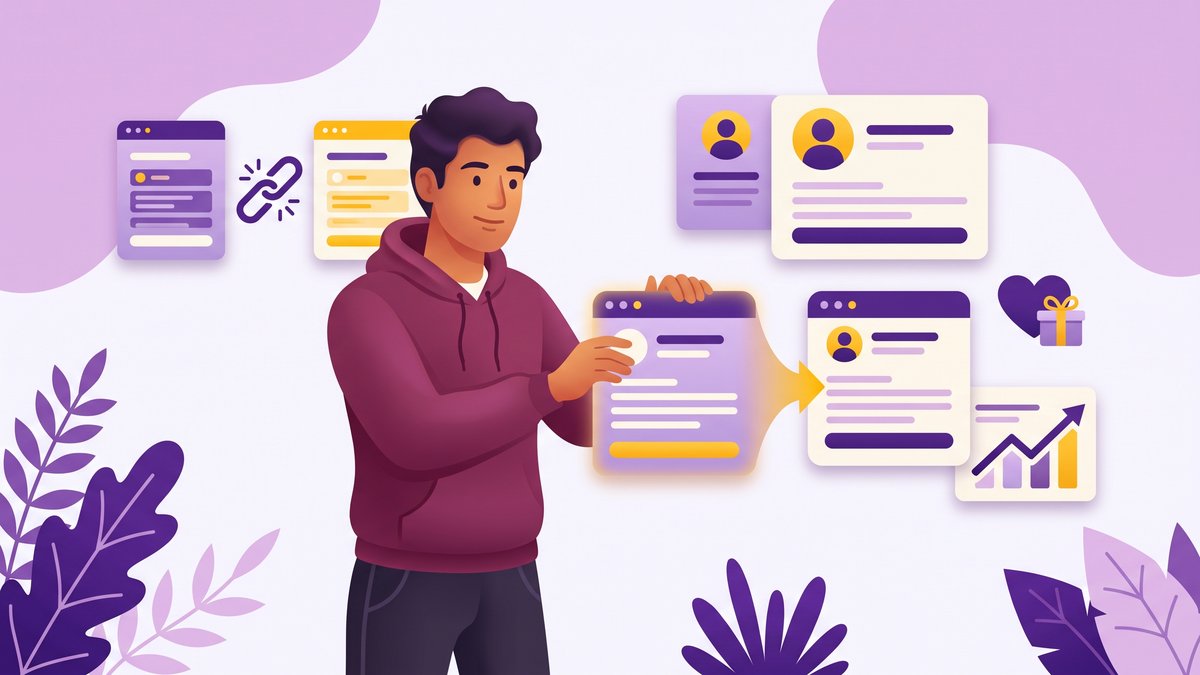
A staff member manually cross-checking donor records between two disconnected systems
The warning signs your donor systems are working against each other
Five signs tend to show up before anyone calls it a crisis. If two or more sound familiar, the silo is already costing you more than it looks like it is.
- Your development team keeps a shadow spreadsheet to track what the CRM “should” say.
- Two staff members give different fundraising totals for the same reporting period, and finance catches it before anyone else does.
- A donor complains about receiving duplicate mail, duplicate asks, or being thanked twice for one gift.
- New staff take weeks to figure out which system holds the real donor history.
- Grant compliance or board packet reporting requires someone to manually stitch data from three separate exports.
- Nobody remembers who set up the last export process, or why it runs the way it does.
The last one deserves attention. When the person who built the workaround leaves, the workaround usually leaves with them, and whoever inherits it starts from zero.
Why the silo happens: every tool owns its own copy of the truth
Each tool in your stack is built to assume it holds the master record. That assumption, multiplied across five systems, is the entire mechanism behind the silo.
How point-to-point tools each become a source of record
Vendors design each product to be self-sufficient. Your fundraising platform assumes it’s the authoritative record of every gift processed through it. Your CRM assumes the same thing about donor history. Neither one is wrong on its own. The problem starts when you connect them with a one-time export, a manual CSV upload, or nothing at all, because none of those methods designate who wins when the records disagree.
Nobody assigned that job on purpose. It fell to whoever was available, and it stayed there.
The per-connector subscription trap
The average organization runs 897 applications, but only 29% are actually integrated, MuleSoft’s 2025 Connectivity Benchmark found. Nonprofits run a smaller stack than the average enterprise, but the same math applies: most of what you own doesn’t talk to the rest of what you own.
Plenty of vendors will sell you a pre-built connector to close that gap, usually priced per connection, per month. It works until the vendor on either end changes its API, at which point the connector breaks and you’re back to manual re-entry while you wait for a fix you don’t control. You end up renting a bridge you don’t own between two systems you do.
What one connected donor record actually unlocks
A single donor record means your database manager, your finance director, and your executive director look at the same number, at the same time, without someone translating between systems first.
A single, trustworthy source of truth
When a gift updates automatically across every system that touches it, “which number is right” stops being a weekly question. Staff spend less time verifying and more time doing the work that actually moves the mission forward.
Faster reporting your board can rely on
Board packets and grant reports pull from one connected data set instead of three manual exports stitched together the night before a deadline. Your team gets fewer late nights, and fewer awkward moments explaining a discrepancy nobody can trace.
A better, more consistent donor experience
A major donor who also volunteers and attends events should show up as one person with a complete history. Right now they surface as three unrelated records, each getting its own set of communications. Integration is what makes that recognition automatic instead of dependent on someone remembering to check.
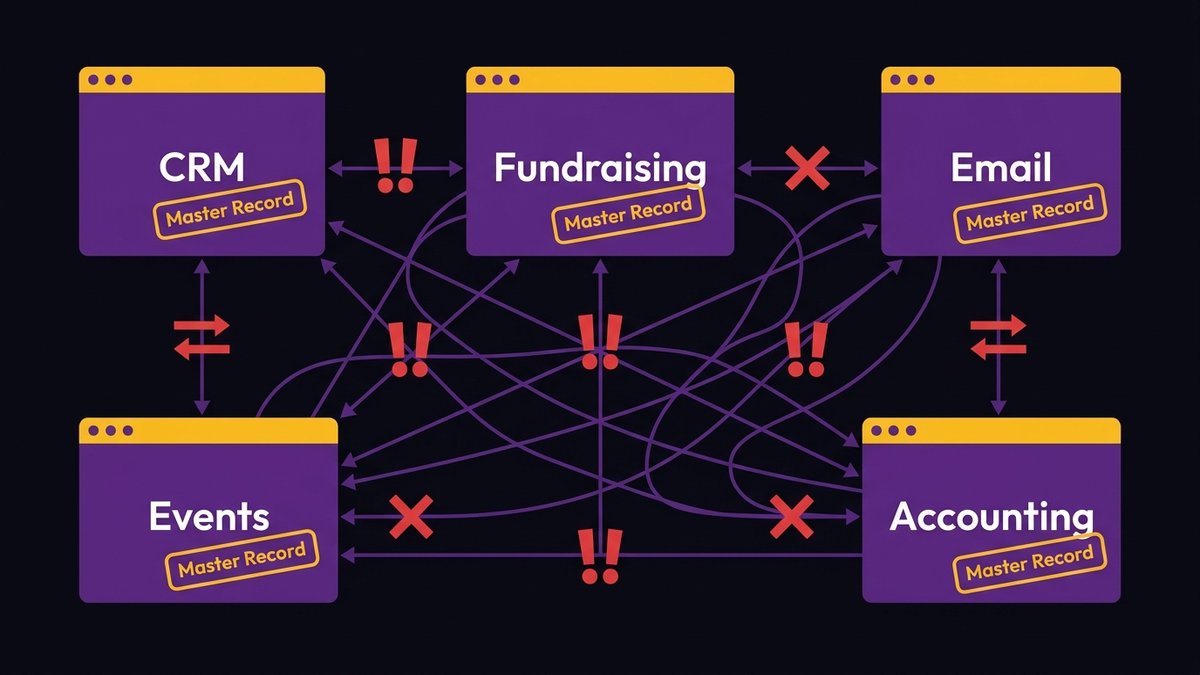
A diagram showing how disconnected point-to-point tools each act as their own source of truth
All-in-one suite or connect what you already have? The decision, reframed
Should you replace everything with one all-in-one platform, or connect what you already run? Most vendor content skips straight to the first option, because that’s the option they’re selling.
Mordor Intelligence puts the nonprofit software market at $4.95 billion in 2026, growing to $7.24 billion by 2031, a 7.9% compound annual growth rate. That growth means a steady stream of vendors telling you the fix is another purchase. Sometimes it genuinely is: a very small organization with minimal donor history and no staff investment in existing tools might be better off consolidating onto one platform from the start.
For most mid-size nonprofits with an established donor base, the math rarely works out. Ripping out working systems to chase a unified platform means retraining your entire team, migrating years of donor history with real risk of data loss, and re-learning workflows everyone already knows by muscle memory. The switching cost usually outweighs what a single vendor promises to simplify.
As Ashwin Ballal, CIO at Freshworks, puts it: “Legacy systems have become so complex that companies are increasingly turning to third-party vendors and consultants for help, but the problem is that, more often than not, organizations are trading one subpar legacy system for another.” Swapping platforms doesn’t remove the disconnect risk. It relabels it and hands you a new contract.
An integration layer your organization owns outright
Ownership is the difference between a fix and a new dependency. An integration layer you own outright means your organization controls the code, the documentation, and the decision to change vendors later, on your own timeline.
Complete documentation the nonprofit keeps
An integration built for you and handed over with nothing but a login isn’t really yours. It’s someone else’s system you’re allowed to use until that person becomes unreachable. Complete documentation, including API references and architecture diagrams, is what turns a built integration into an owned one. why documentation ownership prevents vendor lock-in
No per-connector tax, no single-consultant dependency
Owned integration means you’re not paying a recurring fee per connection, and you’re not one departure away from nobody understanding how your systems talk to each other. When your team, or a partner with a documented handoff process, can maintain the connection, you’ve eliminated the single point of failure that makes so many nonprofit tech stacks fragile.
The prerequisite for any future donor AI analytics
Organizations with strong system integration see a 10.3x return on AI investments, compared with 3.7x for those with poor connectivity, MuleSoft’s 2025 Connectivity Benchmark found. Predictive donor scoring, lapsed-donor identification, and gift-capacity modeling all depend on clean, connected data. None of that works if your donor history is still split across three exports and a shadow spreadsheet.
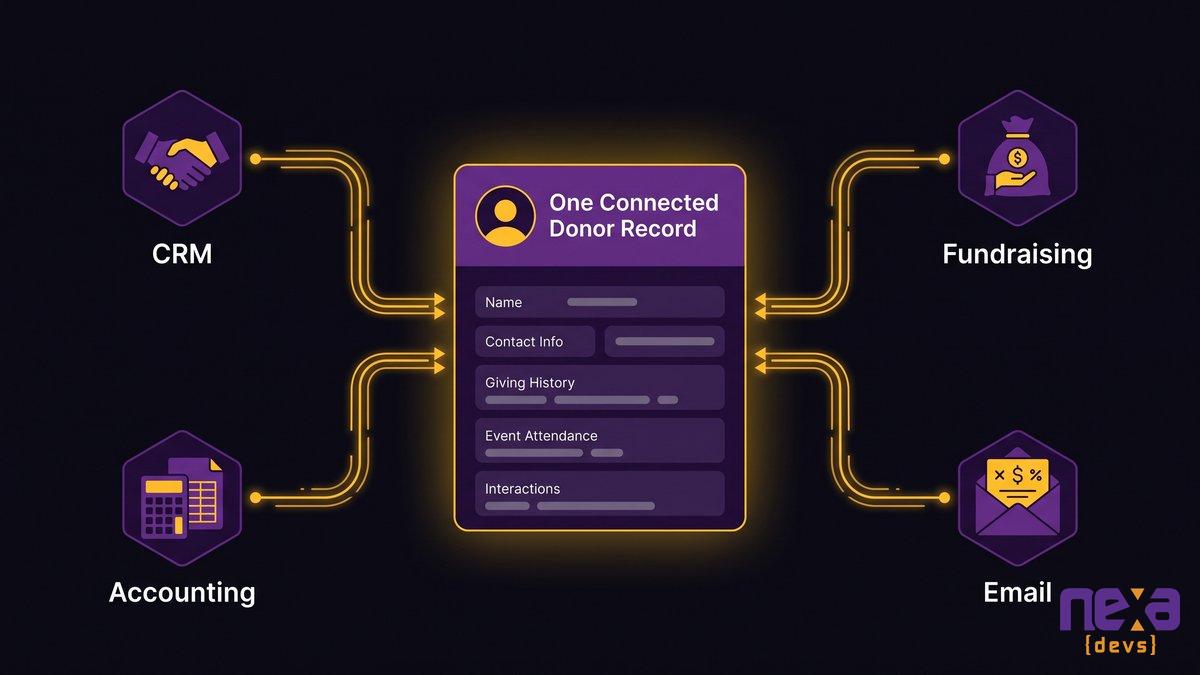
A unified donor profile view pulling data automatically from every connected nonprofit system
The fix isn’t a bigger platform. It’s a connected one, and one your team can actually maintain without waiting on a vendor’s support queue every time something breaks.
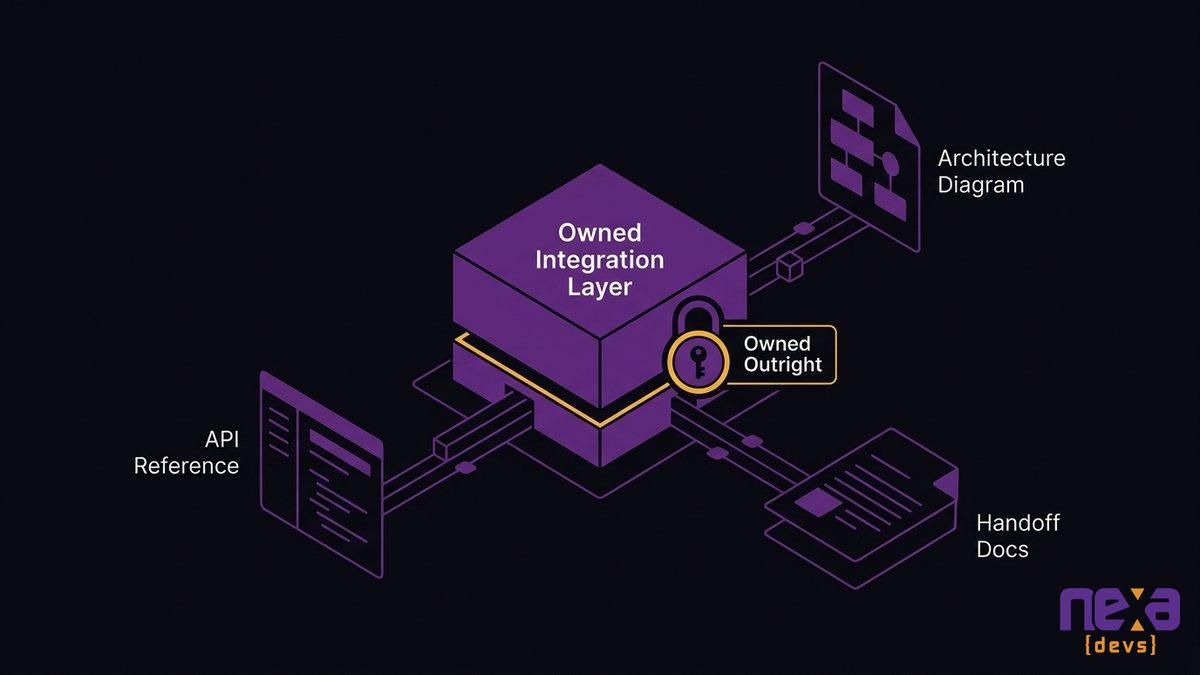
An operations team reviewing documentation for a nonprofit CRM integration they own outright
If your donor database and fundraising platform have been fighting each other for longer than anyone wants to admit, an integration audit is the place to start. schedule a systems audit Nexa Devs builds the APIs and middleware that connect the nonprofit software you already run, and hands over documentation your team owns from day one, not documentation locked inside a consultant’s head.
FAQ
What is the best CRM for nonprofits?
There’s no single best nonprofit CRM. The right choice depends on your size, giving channels, and existing systems. What matters more is whether it integrates cleanly with your other donor and fundraising tools, since most nonprofits run several systems, not one.
Is there a free CRM for nonprofits?
Yes. HubSpot for Nonprofits and Zoho CRM offer free tiers, and Salesforce provides discounted nonprofit licenses. Free tiers often cap contacts or automation, so growing organizations tend to outgrow them and still need integration with other systems.
What is nonprofit CRM integration?
Nonprofit CRM integration connects your donor database with your fundraising platform, email tool, and accounting system so donor data updates automatically across all of them, replacing manual re-entry with one shared donor record.
How do I stop donor data duplication between systems?
Stopping duplication requires an integration layer, not just better data entry habits. Connect your systems through APIs so a gift or contact update propagates automatically, instead of relying on staff to manually copy and reconcile records.
Can I integrate my existing donor database with a new fundraising platform without switching CRMs?
Yes. You don’t need to replace your CRM to add a new fundraising platform. Custom API integration lets both systems share donor and gift data automatically, so your team keeps the tool it already knows.