Nonprofit AMS Customization Problems: When Nobody Owns the System
Table of Contents
- When Your AMS Stopped Being Software and Became a Mystery
- What AMS Over-Customization Actually Looks Like
- The Real Cost: It’s Not the Software, It’s the Staff Hours
- Why This Happens: The Customization Ratchet
- The NPSP Problem Is a Preview
- How to Know If Your Data Can Be Trusted Right Now
- Three Paths Forward: Reset, Stabilize, or Replace
- What Owning Your System Again Actually Looks Like
- FAQ
A nonprofit COO once described her organization’s AMS to me this way: “It does something different every time I click the same button.” She wasn’t joking. Three rounds of consultants had modified the platform over six years, each one solving the immediate problem in front of them and leaving the next person to inherit something they didn’t fully understand. Nobody documented what was changed or why. The original vendor’s support team told her the instance had “diverged from standard configuration” and couldn’t help. She needed a paid consultant just to pull a donor report.
That’s not a technology failure. It’s an ownership failure. And it’s far more common in mid-sized nonprofits than anyone publicly admits.
Nonprofit AMS customization problems compound quietly for years before they become a crisis. The platform still technically works. Donations process. Events register. But the gap between what the system should do and what it actually does keeps widening, and the only people who can bridge that gap charge by the hour and take their knowledge with them when the engagement ends.
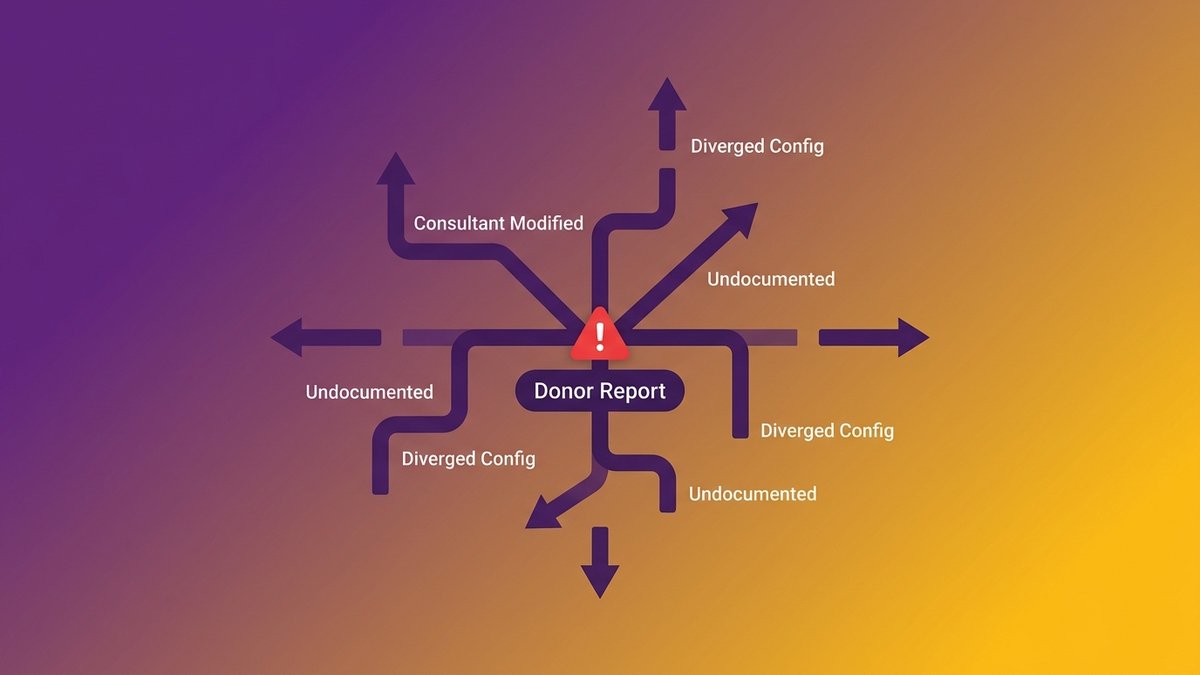
The gap between what an AMS should do and what a heavily customized one actually does keeps widening with every consultant engagement.
When Your AMS Stopped Being Software and Became a Mystery
Your AMS crossed the line from product to mystery; at the moment, no one on your staff can explain why it behaves the way it does. The distinction matters because products come with documentation, vendor support, and a user community. Bespoke systems don’t. Once yours became bespoke, you inherited all the maintenance responsibility of custom software without any of the institutional knowledge that should come with it.
This usually doesn’t happen with a single decision. Nobody sits down and says, “Let’s make this system undocumented.” It happens through accumulation.
A consultant modifies a donation workflow to match a board requirement. Another adds a custom object to track grant compliance. A third one builds a workaround for the membership renewal process because the standard one didn’t fit your fee structure. Each change is reasonable in isolation. Collectively, they create a system that only makes sense if you were in every one of those rooms.
The consultant who made the changes understood it at the time. But that understanding lived in their head, not in your system documentation. When they left, they left it with them.
What you’re left with is software that behaves like institutional memory: opaque, irreplaceable, and completely dependent on someone who is no longer on payroll.
What AMS Over-Customization Actually Looks Like
The signs are usually operational before they’re technical. You’re not getting error messages. You’re getting workarounds that became standard procedure.
Your staff has a list of “things to do before running reports” that nobody fully understands but everyone follows. Your finance team exports data to spreadsheets before doing anything meaningful with it. Your fundraising team and your programs team have never shared a database view that both of them trust. New staff take months to learn the system, and the training is mostly oral – one person showing another person what buttons to click in what order.
The consultant-as-manual-page problem is the clearest symptom. When your team can’t answer a basic operational question without calling someone who charges $150 an hour, the knowledge has left the building. Dependency doesn’t feel like a crisis until it is one. But it’s already costing you.
A few specific tells:
You can’t pull a reliable donor report without help. Not because the data isn’t there, but because nobody on staff fully understands which records map to which query logic after years of customization.
Your vendor support team has stopped being useful. When you call for help, their first question is “what version are you on?” and their second is “have there been any customizations?” Both of you already know the answer to the second one.
Staff treat the system as a black box. They enter data and trust that something will happen on the other end. When it doesn’t, they escalate to whoever seems to know the most, which is usually the person who’s been there longest, not the person whose job it actually is to manage the system.
Onboarding takes months. Not because the platform is complex in theory, but because your specific instance is.
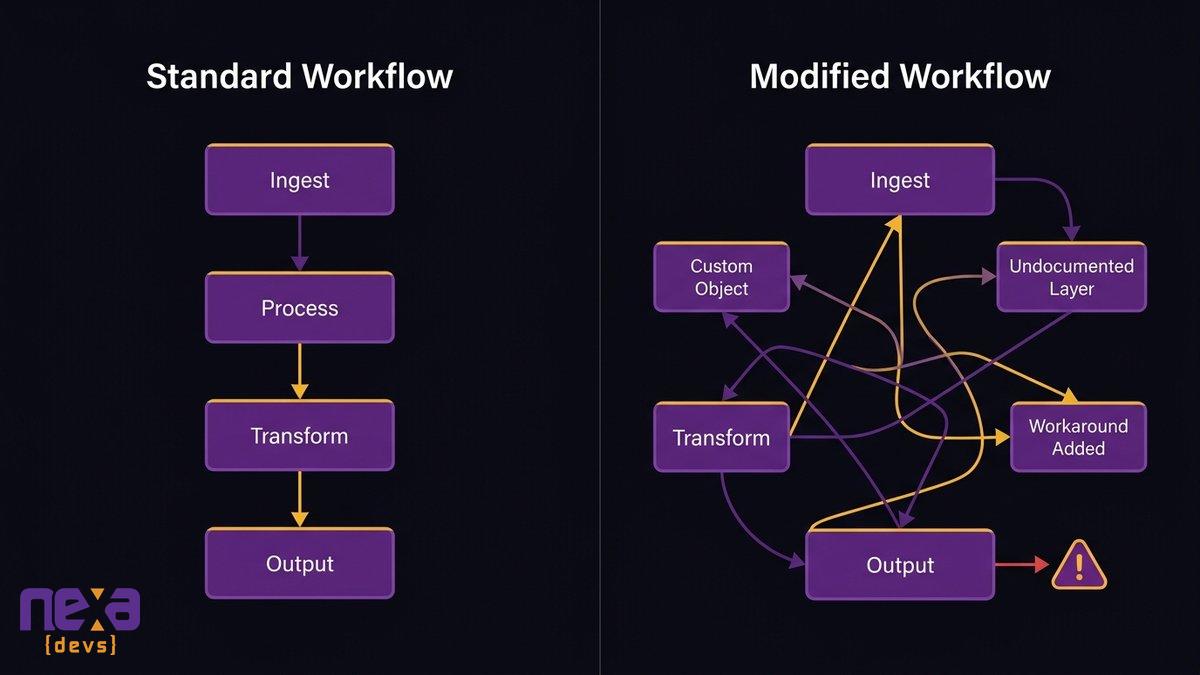
A standard AMS workflow versus one that has accumulated years of consultant modifications without documentation.
The Nonprofit Database Trap: Why You Can’t Leave and Can’t Stay
The Real Cost: It’s Not the Software, It’s the Staff Hours
Consultant fees are the cost everyone notices. Staff time is the cost that actually runs higher.
When your database can’t be used directly, your team compensates. They export, reformat, cross-reference, and reconcile. They build parallel tracking systems in spreadsheets because the AMS can’t give them the view they need. They spend hours each week doing work that a functioning system would handle automatically.
Roundtable Technology’s data on nonprofit database dysfunction puts this in concrete terms: when a team spends 10 hours per week on data cleanup, that’s 520 hours per year diverted from donor cultivation and operational work. For a development team, that’s a significant portion of the annual calendar.
The staff time cost compounds in a second way. Your Director of Development chasing bad data is not cultivating major gift prospects. Your operations coordinator, reformatting exports, is not doing program support. The operational drag of a broken database doesn’t show up as a line item. It shows up as stagnant fundraising and overburdened staff.
And the consultant fees aren’t trivial either. At standard nonprofit technology consultant rates, three or four engagements per year to handle tasks that should be routine can easily run $15,000 to $30,000 annually, money being spent not to improve the system but simply to use it.
The question to ask your leadership team isn’t “how much does our AMS cost?” It’s “how much does it cost us because of how it works?”
Why This Happens: The Customization Ratchet
The over-customization cycle follows a predictable pattern, and recognizing it early is the key to stopping it.
Most AMS platforms offer two types of modification: configuration and customization. Configuration is what you’re supposed to do. It means adjusting settings, templates, and workflows within the bounds the vendor designed. Customization is something else entirely. It means writing code, creating custom objects, building integrations, or modifying the underlying data structure in ways the vendor didn’t anticipate.
Configuration is reversible and documentable. Customization is often neither.
The line gets crossed gradually. An initial implementation includes some custom work because the out-of-the-box version doesn’t fit your membership structure. A year later, a consultant adds a custom object for grant tracking because it’s faster than building the process around what’s available natively. Two years later, someone adds a workaround because the custom object from the last engagement conflicts with a standard feature.
Taken one at a time, each step seemed pragmatic. Together, they produced what amounts to custom software built on top of a product, with no documentation of the underlying logic.
The vendor exits at the end of each engagement. The documentation doesn’t arrive. The scope wasn’t written to include it, and nobody asked for it because everyone assumed someone else would handle it. The next consultant inherits a system they didn’t build, makes the best decisions they can with incomplete information, and the ratchet clicks forward one more notch.
Scope creep in implementation plays a role. The deeper problem is that knowledge transfer was never treated as a deliverable. It was an afterthought, and afterthoughts don’t get written into contracts.
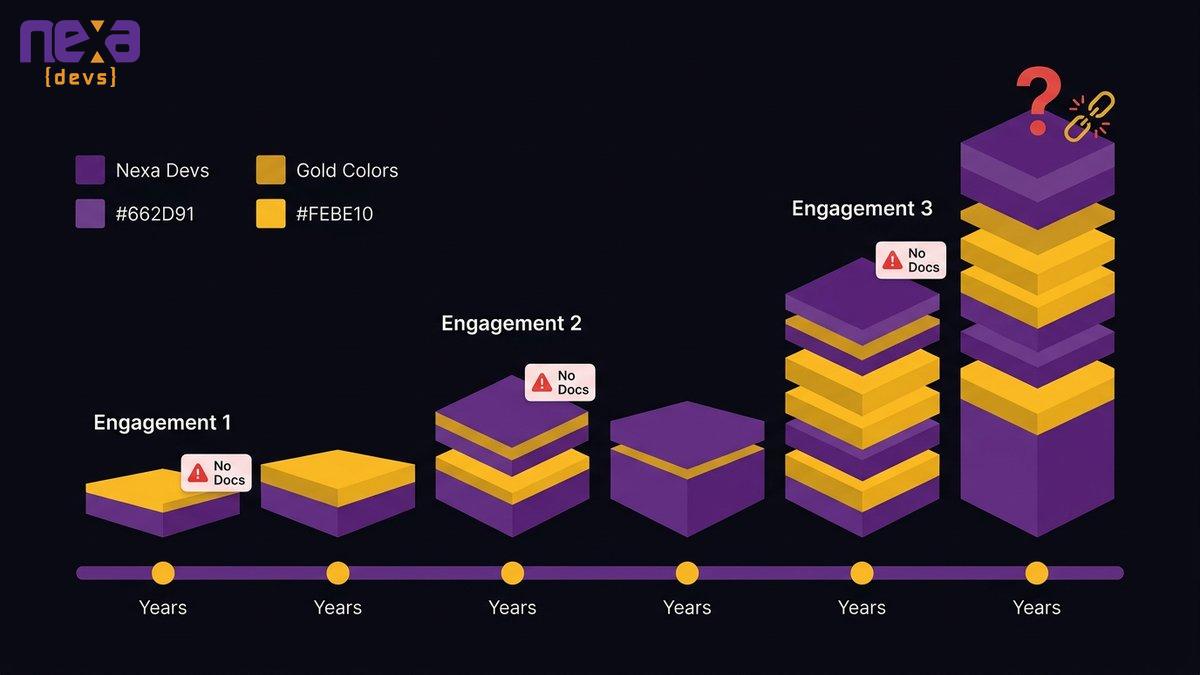
Three rounds of consultant engagement without documentation transfers – the customization ratchet in practice.
The NPSP Problem Is a Preview
If your nonprofit runs on Salesforce, you’ve almost certainly heard about the NPSP situation. If you haven’t, now is a good time to pay attention, because it’s a live demonstration of what happens when platforms diverge from their user base.
Salesforce’s Nonprofit Success Pack has been the default choice for nonprofits running on the Salesforce platform for over a decade. Its ubiquity is remarkable: roughly 90% of nonprofits on Salesforce still run on NPSP. But Salesforce has repositioned NPSP as “heritage technology,” with active development investment shifting to Nonprofit Cloud instead.
Migration to Nonprofit Cloud is a significant project if you’re running standard NPSP. If your instance is heavily customized, it may be a crisis.
Every layer of customization your team or your consultants added to NPSP needs to be mapped, evaluated, and either rebuilt or discarded during migration. If nobody documented those customizations, that mapping process requires paid discovery time just to figure out what you’re working with. The migration quote goes up. The timeline extends. And you’re paying to undo work you already paid someone to do.
This isn’t unique to Salesforce. The same dynamic plays out with Blackbaud, iMIS, Wild Apricot, and virtually every other platform that allows meaningful customization. The platform’s vendor makes product decisions. Your consultants made customization decisions. When those two sets of decisions conflict, you’re holding the gap.
The NPSP situation is a useful forcing function if your organization is still early in the over-customization cycle. It makes the cost of accumulated undocumented changes visible before the actual migration invoice arrives.
How to Know If Your Data Can Be Trusted Right Now
Before deciding on a path forward, you need an honest assessment of where you actually stand. The question isn’t philosophical: it’s operational.
The reporting test is the most direct one. Can someone on your staff, without calling a consultant or going through an elaborate export process, pull an accurate list of donors who gave in the last 12 months, segmented by gift size? If not, why not? Is the data wrong, or is the query logic broken, or is the data structure too complex to navigate without specialized knowledge?
The answer to that question tells you more about the state of your system than any audit report.
The 2025 CCS Philanthropy Pulse Report found that 54% of nonprofits identify incomplete or inaccurate data as a major obstacle to maximizing their donor information. That’s not a technology problem in isolation. It’s a data stewardship problem that technology makes worse when the system is too complex for staff to use confidently.
Nonprofits are managing more platforms than ever. According to a NonprofitPro report on sector technology trends, 70% of nonprofits now run five or more core technology platforms simultaneously, up from 62% the year before. Each additional platform adds a potential data sync failure point. When the AMS is the hub and the hub is broken, everything downstream suffers.
You don’t need a formal audit to get an initial read. You need honest answers to three questions:
- Can your staff run the reports leadership needs without outside help?
- Do your fundraising team and your program team see consistent data?
- If your primary AMS contact left tomorrow, would anyone on staff know how to get help?
If the answer to any of these is no, you have an ownership problem, not just a technology problem.
Three Paths Forward: Reset, Stabilize, or Replace
The right path depends on the system’s actual state, the existing documentation, and what your organization can absorb operationally. Three options exist, each suited to a different situation.
Stabilize and document. If your core data is structurally sound but the knowledge of how the system works lives only with people who no longer work for you, a documentation project may be the right first move. This means engaging someone to reverse-engineer what your current customizations actually do, document it in plain language, and build internal training materials your staff can use without calling for help. It won’t fix structural problems, but it gives you a foundation. It buys time and reduces dependency. For organizations with limited budgets and a system that still mostly works, it’s often the right first step before deciding on a larger intervention.
Controlled reset. This is the right path when the customizations have made the system genuinely dysfunctional, but a full platform replacement isn’t feasible in the near term. A controlled reset means stripping back the unnecessary customizations, rebuilding the core workflows using native platform features where possible, documenting everything, and training staff on what they can do themselves. It’s painful, and it requires budget and organizational will. But it leaves you with a system your team actually owns, on a platform you’ve already paid for and trained people on.
Full replacement. When the gap between what the customized system does and what a modern platform does natively is large enough, replacement becomes the cheaper long-term option. This is especially true if your current system is on a sunset product (like NPSP), if your data is significantly compromised, or if the consultant dependency has become so entrenched that a reset would cost nearly as much as starting clean. Replacement is not a decision to make lightly, and it should never be driven by vendor enthusiasm alone. But when the math favors it, avoiding it costs more every year you wait.
The key to any of these paths is treating documentation transfer as a non-negotiable deliverable, not an afterthought. Whether you’re stabilizing, resetting, or replacing, the exit condition should be the same: someone on your staff can answer the question “how does this system work?” without picking up the phone.
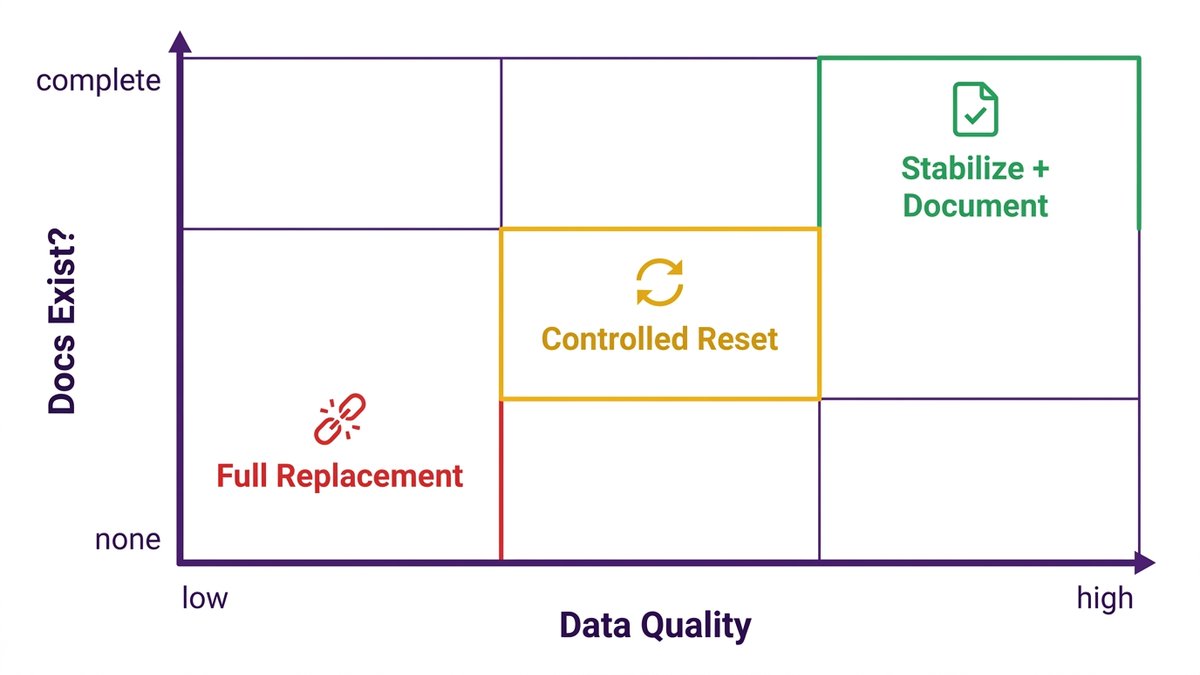
Three paths forward for a nonprofit AMS in an over-customization crisis, mapped against documentation state and data quality.
What Owning Your System Again Actually Looks Like
Ownership isn’t about technical expertise. Most nonprofit COOs and Executive Directors aren’t engineers, and they shouldn’t need to be.
Ownership means your staff can run the system’s core functions without external help. A new operations coordinator gets trained in a reasonable timeframe using the documentation your organization controls. When something breaks, you know who to call and what to tell them. Your vendor or support partner is a resource, not a gatekeeper.
The practical criteria for owned vs. unowned:
Your team can run standard reports without consultant help. Onboarding new staff means providing them with written documentation, not asking them to shadow someone for a month. When you contact vendor support, you can describe your configuration accurately. And when a consultant engages with your system, they leave a record of what they changed and why.
Documentation transfer must be a contractual requirement, not a goodwill gesture. Any engagement that modifies your AMS should specify, in writing, what documentation is expected at the end. Architecture notes. Explanation of custom logic. Plain-language descriptions of any new workflows added. If a vendor won’t commit to documentation as a deliverable, that’s an indication of how the engagement will end.
The goal is a system your team can actually use, explain, and maintain, and a partner who builds toward that rather than away from it.
Is there a version of your AMS that works for your organization rather than against it? Yes. But getting there requires treating knowledge transfer as seriously as you treat feature delivery. One without the other just creates the next consultant dependency.
Nexa Devs works with mid-market nonprofits and associations whose internal systems have outgrown the people managing them. If your AMS has crossed the line from product to black box, contact us to talk through what a documentation audit and controlled reset could look like for your organization.
Before publishing, verify:
- AI bots (GPTBot, PerplexityBot, ClaudeBot, GoogleOther) are NOT blocked in robots.txt – Cloudflare recently changed its default to block AI crawlers, check your dashboard
- Page content is server-side rendered, not hidden behind JavaScript
- Content is not behind a login or paywall
If any of these apply, AI platforms cannot index or cite this post regardless of optimization.
FAQ
What are common AMS problems that nonprofits face?
The most common nonprofit AMS problems are data quality issues, consultant dependency for routine tasks, poor platform integration, and a
lack of internal documentation. Over-customization makes all of these worse: when a system has been modified too many times without documentation, staff can’t use it confidently,
and reports become unreliable.
What is the difference between AMS configuration and customization?
Configuration adjusts the system within vendor-designed bounds: settings, templates, and
standard workflows. Customization means writing code or building structures that
the vendor didn’t anticipate. Configuration is generally reversible and documentable. Customization often isn’t. The problem isn’t customization itself – it’s customization without documentation.
When should a nonprofit replace its AMS vs. fix what it has?
Replace when accumulated customization costs exceed the cost of starting clean, especially if the platform is on a sunset roadmap like NPSP. Fix what you have when core data is structurally sound, and the problem is primarily undocumented logic. In both cases, treat documentation transfer as a deliverable, not an afterthought.
What are the signs your nonprofit database needs an upgrade?
Staff can’t run standard reports without consultant help, new team members take months to learn the system, fundraising and programs teams work from separate data views, and vendor support can’t help because the instance has diverged from standard configuration. Anyone signals an ownership problem.
Why do nonprofits become dependent on consultants for their CRM?
Consultant dependency develops when system modifications aren’t accompanied by documentation. Each engagement leaves a slightly more complex system for the next person to inherit. When knowledge transfer isn’t written into contracts as a deliverable, it doesn’t happen – and over the years, institutional knowledge lives entirely outside the organization.