Institutional Knowledge Loss: Beating the Gray Tsunami

Table of Contents
- Quick answer: engineer retirement and knowledge loss
- The Retirement Cliff Is a Date on Your Calendar, Not a Surprise
- What Actually Walks Out the Door When an Engineer Retires
- The Real Cost of Losing Institutional Knowledge
- Why Last-Minute Knowledge Capture Fails
- Make Documentation a Byproduct of How the System Is Built
- What AI Can and Cannot Capture
- Turning a Retirement Into a Scheduled Transition
- FAQ
Institutional knowledge loss is what happens when the people who understand how your systems actually work leave before that understanding gets written down anywhere else. In 2026, the biggest driver of that loss isn’t a resignation or a layoff. It’s a birthday. Roughly 10,000 Americans turn 65 every day, a wave that’s been building since 2011 and won’t crest until around 2030. Your senior engineers are part of that wave, and unlike a surprise departure, you already know when most of them plan to go.
Most leaders miss that. A retirement is a date you can put on a calendar, plan around, and prepare for months in advance, as long as your organization treats documentation as something the system produces continuously instead of something one person tries to reconstruct in their final two weeks.
Quick answer: engineer retirement and knowledge loss
- Roughly 10,000 Americans turn 65 every day through 2030, so engineer retirements are demographic math, not sudden surprises.
- Institutional knowledge loss costs U.S. companies an estimated 1.3 trillion dollars a year, according to Deloitte’s 2024 research.
- Knowledge captured in a departing engineer’s final two weeks is almost always incomplete and arrives too late to be useful.
- Documentation has to be a byproduct of how you build and maintain systems, not a scramble triggered by a resignation letter.
- AI can encode what’s written or observable in code, but someone still has to document the tacit reasoning behind past decisions.
The Retirement Cliff Is a Date on Your Calendar, Not a Surprise
Your longest-tenured systems engineer already knows their retirement date. HR probably knows it too, from a pension conversation or a benefits enrollment question dropped months ago. The only person consistently caught off guard is the executive who finds out when the two-weeks notice hits their inbox.
That gap is the actual problem. Organizations plan for retirement in every department except engineering, where the loss is hardest to see and most expensive to recover from.
Pew Research Center’s demographic work on the aging U.S. workforce has tracked this shift since the early 2010s, and by 2030 every remaining Baby Boomer will have crossed 65. For a mid-market company running internal systems built fifteen or twenty years ago, that means the engineers who wrote the original code, made the early architecture calls, and know why a particular workaround exists are retiring on a schedule you can see coming.
Treat it that way. A CEO who reviews engineering tenure alongside retirement eligibility, the same way finance reviews vendor contract renewals, gets six to eighteen months of runway most companies throw away by pretending the date isn’t already set.
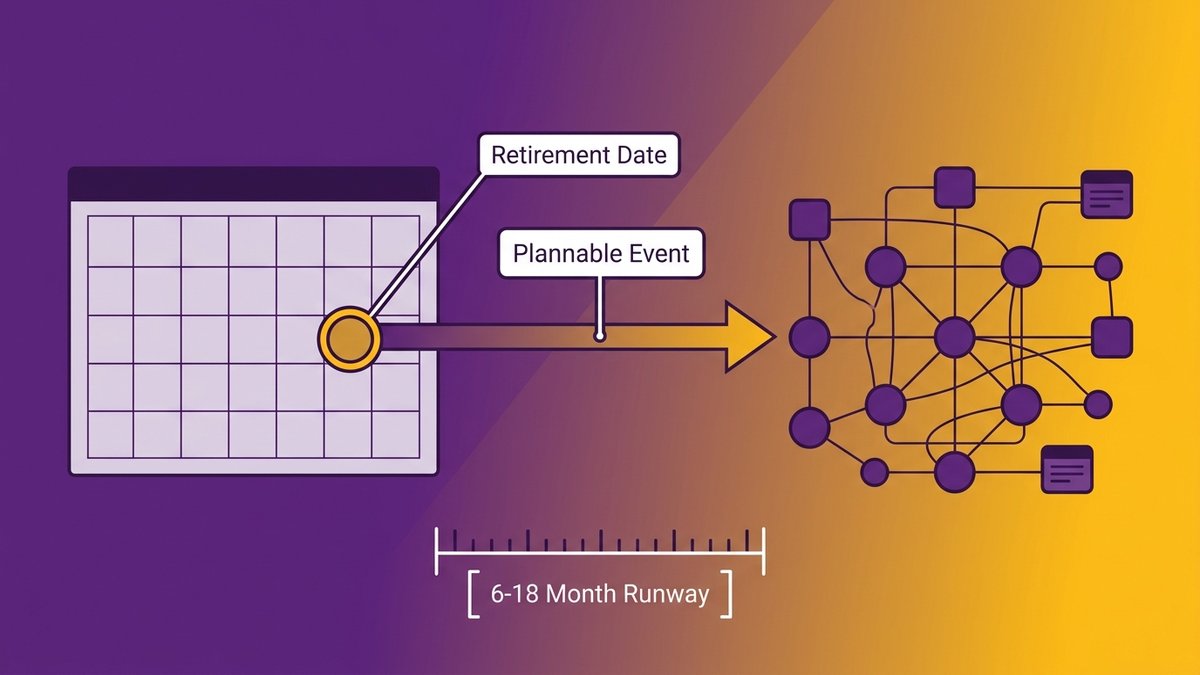
A calendar marked with a scheduled retirement date sitting beside a legacy system diagram
What Actually Walks Out the Door When an Engineer Retires
Explicit knowledge lives in a wiki, a README, or a ticket. Tacit knowledge lives in a person’s head, built from years of judgment calls nobody wrote down. Only one of those survives a retirement party.
Researchers estimate that tacit knowledge makes up roughly 90% of what an organization actually knows, with only about 10% ever captured in documents, wikis, or code comments. That imbalance is why losing one senior engineer can feel disproportionate to their job title. They aren’t just holding tickets closed, they’re holding the reasoning that never made it into any system of record.
Explicit knowledge versus the tacit “why”
Explicit knowledge answers “what does this function do.” Tacit knowledge answers “why does it do it that way, and what happens if we change it.” Your codebase can tell a new hire the first answer. Only a person who lived through the original decision can reliably give the second, and that’s exactly the knowledge that a retiring engineer takes with them if nobody asked the question earlier.
Key-person dependency: the system only one person understands
Every mid-market company has at least one system like this: a billing engine, a reporting pipeline, an integration layer that only one engineer can touch without breaking something. It usually isn’t documented as a risk. It’s documented, if at all, as “ask Dave.” When Dave retires, the risk stops being theoretical.
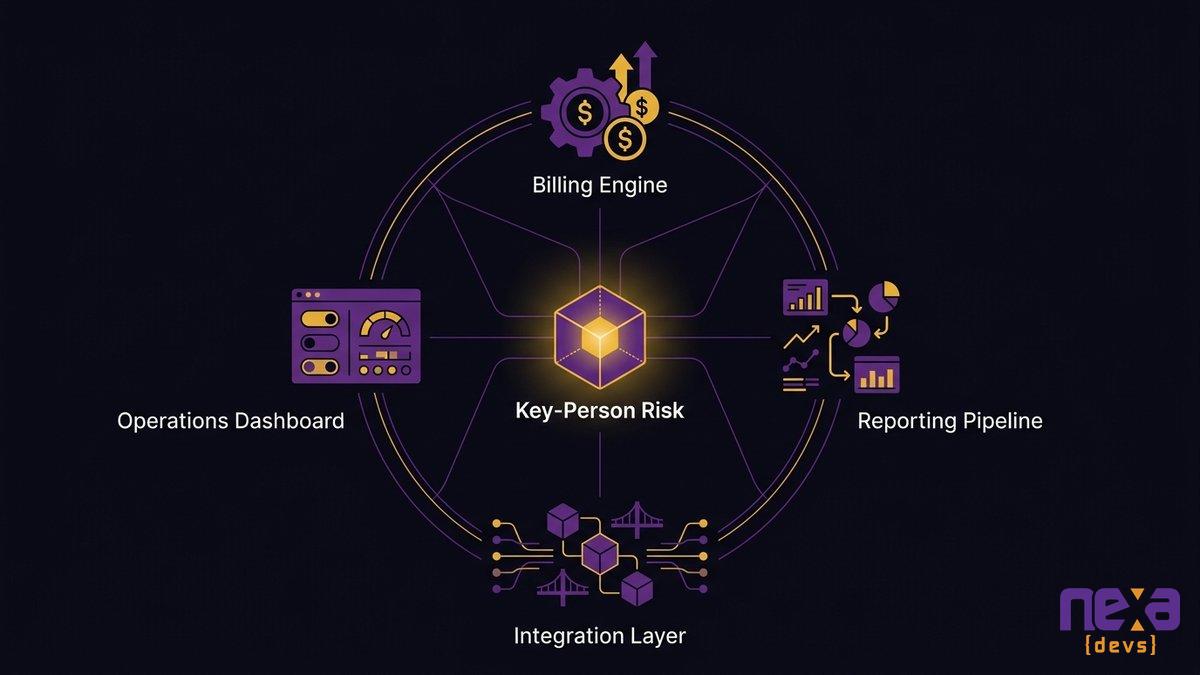
An illustration of one engineer connected to every critical system, showing concentrated key-person risk
The Real Cost of Losing Institutional Knowledge
Deloitte puts the figure at $1.3 trillion a year: institutional knowledge loss costs U.S. companies that much annually across every industry, according to Deloitte’s 2024 Human Capital Trends research. That number covers everything from slower onboarding to duplicated work to decisions made without the context that would have prevented them.
For a mid-market company, the cost shows up in smaller, more specific ways. Replacing a senior technical hire typically runs 150% to 400% of their salary once you count recruiting, ramp time, and lost productivity, and delays projects six to twelve months, according to ClearlyAcquired’s analysis of key-person risk. New engineers coming into an undocumented system routinely need sixteen to twenty weeks before they’re contributing at full speed. Multiply that by every retirement your organization has scheduled over the next three years, and the number stops looking abstract.
The compounding part is what leaders underestimate. An undocumented system costs more to staff, and it costs more every single time someone touches it, because every change requires re-deriving context that used to live in one person’s head. That tax never goes away on its own. It gets worse with each engineer who leaves without transferring what they knew.
how tacit knowledge creates vendor risk
Why Last-Minute Knowledge Capture Fails
Two weeks before an engineer’s last day, someone hands them a laptop and says “write it all down.” That plan fails almost every time it’s tried, and it fails for reasons that have nothing to do with the engineer’s effort.
Fourteen days isn’t enough time to reconstruct a decade of context. The engineer doesn’t remember every tradeoff they made in 2019. They document what feels urgent, not what a future hire will actually need. And they’re doing it while also handing off active tickets, training a replacement, and mentally checking out of a job they’re about to leave. The result is a document that looks thorough and turns out, six months later, to be missing the one detail that would have prevented an outage.
This is why “we’ll capture it before they leave” isn’t a plan. It’s a hope dressed up as a plan. Real capture has to happen continuously, months and years before anyone announces a retirement date, as a normal part of how the system gets built and maintained.
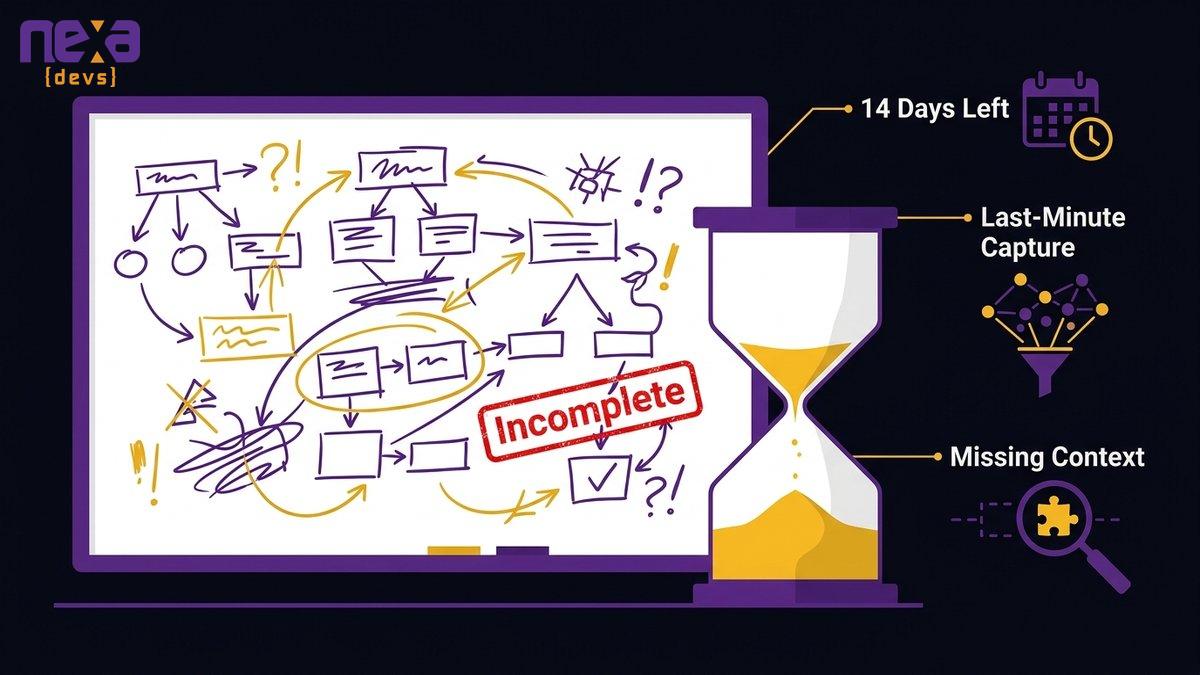
A last-minute documentation scramble happening in an employee’s final days on the job
Make Documentation a Byproduct of How the System Is Built
Documentation as a farewell task always loses to documentation as a delivery standard. One happens under duress, written by someone who’s already mentally gone. The other happens every sprint, written by someone who’s actively building the thing they’re describing.
That structural shift is what actually works: instead of treating documentation as a separate project competing for time against feature work, it becomes a required output of the development process itself, the same way tests and code reviews already are on well-run teams.
The artifacts that outlive the author: UML, ADRs, API references, test coverage
A development process built this way produces four things as standard deliverables on every engagement: UML architecture diagrams that show how the system fits together, architecture decision records that capture why specific choices were made and what alternatives got rejected, API references that document every integration point, and test coverage that encodes expected behavior in a form nobody can quietly forget. None of these require a retiring engineer to sit down and write a memoir. They accumulate automatically as the system gets built and modified.
Andrea Goulet, CEO of Corgibytes, put it well: “We realized that what we were doing transcended clearing out old code. We were actually remodeling software the way you would remodel a house to make it last longer, run better, do more.” Documentation produced this way is part of the remodel itself, not a chore bolted onto the end of a project.
Living documentation versus the stale wiki
Most companies already have a wiki. Most of those wikis stopped matching reality years ago, because updating them was optional and optional documentation always loses to a shipping deadline. The fix isn’t a better wiki, it’s making documentation a required, reviewed part of every change, so it stays accurate for the same reason your code stays functional: because the process won’t let it drift.
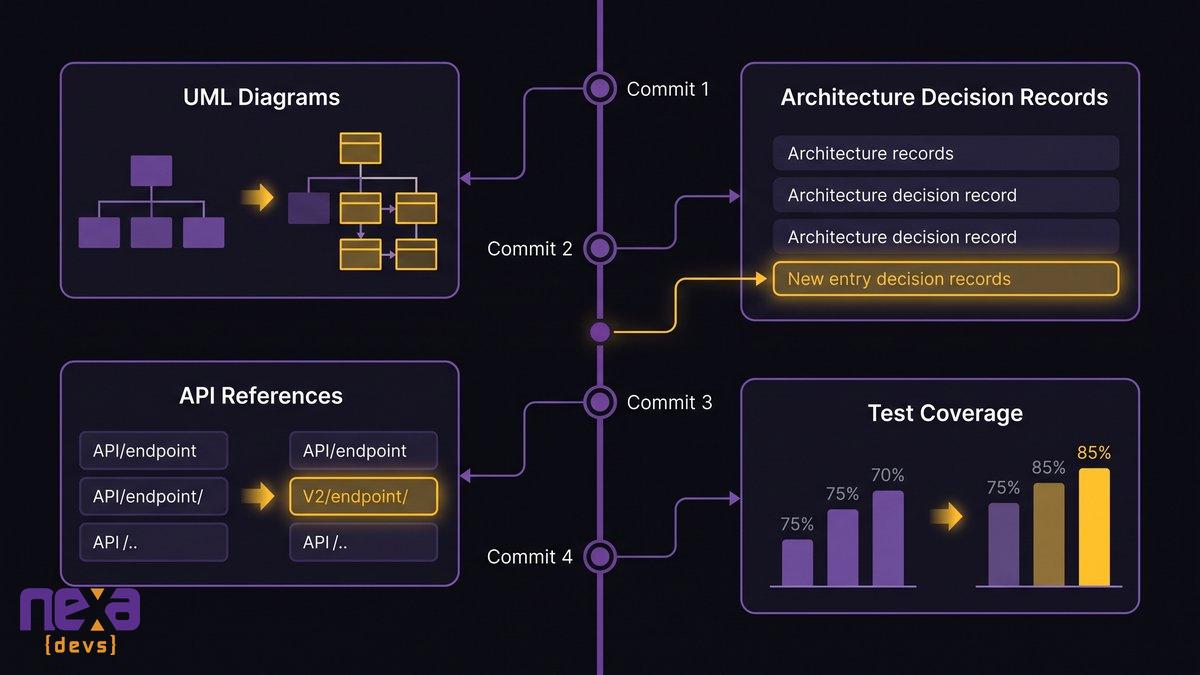
A documentation dashboard that updates automatically alongside code changes rather than sitting stale
what an AI-augmented SDLC actually produces
What AI Can and Cannot Capture
AI can read a codebase and generate a UML diagram in minutes. It can scan an API and produce a reference doc that used to take a developer a full week. What it can’t do is tell you why your team chose a queue over a cron job in 2019, or why a particular validation rule exists because of a customer incident nobody wrote down.
That distinction matters more than most AI vendors admit. AI-assisted documentation tools are genuinely good at encoding what’s written or observable: the structure of the code, the shape of the data, the paths a request takes through a system. They’re built for pattern recognition, not for archaeology into a decision that happened in a hallway conversation six years ago and never made it into a commit message.
Put honestly, AI is a supporting tool for capture, not a replacement for deliberate documentation. It can capture the “what” faster than any human ever could. The “why” still needs a person, usually the engineer who made the call, to sit down and explain their reasoning while they’re still around to ask. Skipping that step because AI handled the diagrams is how companies end up with beautiful documentation that still can’t answer the one question that mattered.
Turning a Retirement Into a Scheduled Transition
A retirement handled well looks almost boring. A handoff meeting. A transition period measured in months, not days. A new name on the on-call rotation, and nobody scrambling to figure out what the old name used to fix. That’s the goal, achievable once documentation stops being a scramble and starts being a byproduct of daily work.
Nexa Devs builds toward that outcome through long-term embedded partnerships, including a relationship with UCLA’s David Geffen School of Medicine that has run more than ten years. Institutional memory doesn’t live in one retiring employee’s head in that model. It lives in the partnership itself and in documentation the client owns unconditionally from day one, regardless of whether the engagement continues.
That’s the antidote to knowledge walking out the door. Not a heroic documentation sprint before someone’s last day, but a development process that produces UML diagrams, architecture decision records, API references, and test coverage as standard output every sprint, plus a partner who’s been embedded long enough to remember the “why” even when the person who made the original call has moved on to retirement.
If your organization is watching senior engineers approach retirement age without a documentation plan in place, see how AI-driven layoffs create the same knowledge risk, the underlying mechanics are the same whether the departure is voluntary or not.
FAQ
How many Americans are turning 65 every day in 2026?
Roughly 10,000 Americans turn 65 every day, a pace that’s held steady since 2011 and continues through around 2030. That’s why engineer retirements cluster into a predictable wave instead of arriving as isolated surprises.
Is it true that by 2030 all baby boomers will be age 65 or older?
Yes. The youngest Baby Boomers, born in 1964, turn 65 around 2029, meaning the entire generation will have crossed that age threshold by roughly 2030. For engineering teams, that’s the outer edge of the retirement wave.
What does institutional knowledge mean?
Institutional knowledge is the accumulated understanding of how an organization’s systems, processes, and decisions actually work, including the reasoning behind past choices. It splits into explicit and tacit knowledge.
How do you prevent institutional knowledge loss when an engineer retires?
You prevent it by making documentation a continuous byproduct of development, not a task assigned during someone’s final weeks, so UML diagrams, architecture decision records, and API references already exist before a retirement date.
Can AI capture institutional knowledge automatically?
AI can capture what’s written or observable in a codebase quickly and accurately. It can’t capture the tacit reasoning behind past decisions unless a person deliberately documents that reasoning first.
What’s the difference between tacit and explicit knowledge in software?
Explicit knowledge is written down and readable by anyone. Tacit knowledge is undocumented judgment and experience a person accumulates, and it disappears when that person leaves.