Table of Contents
ERP Implementation Failure: Why Mid-Market Companies Keep Paying the Price
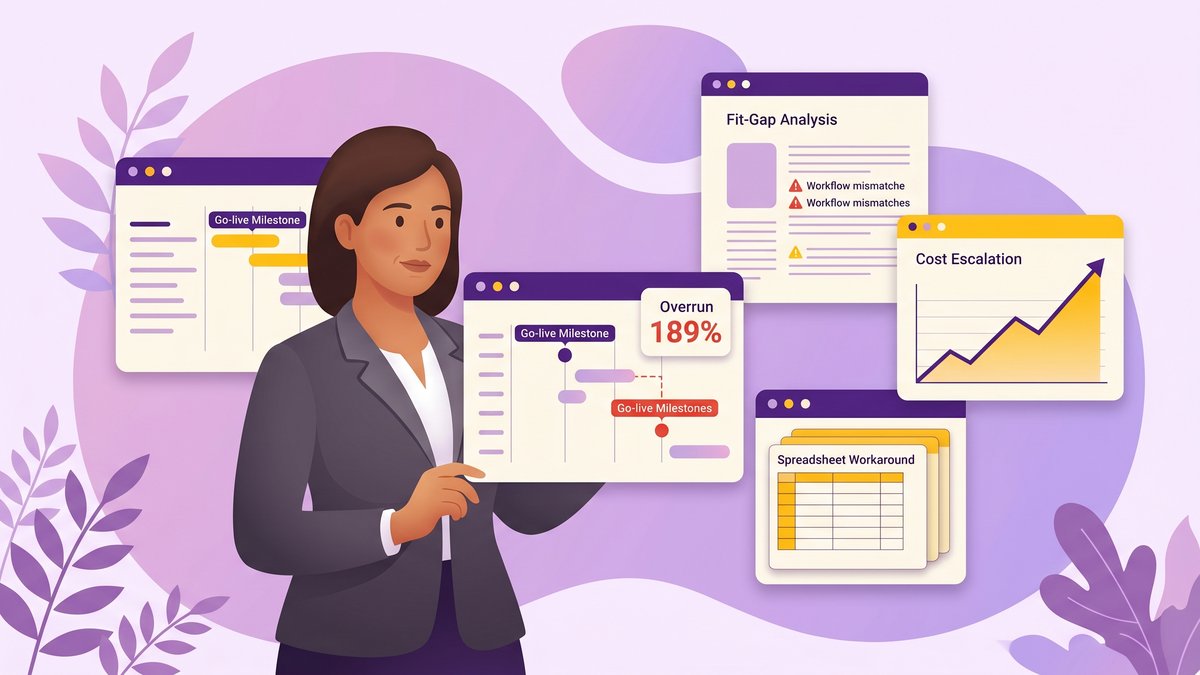
There’s a version of this story that plays out in boardrooms about twice a year. A CEO signs an ERP contract after a sixteen-week sales process. The implementation kicks off. Eighteen months later, the go-live date has slipped three times, the budget has doubled, and half the company’s operations are running on spreadsheets because the new system can’t handle the workflows everyone actually uses. The implementation partner says the scope changed. The vendor says the data migration was more complex than anticipated. The CFO is asking why a system that was supposed to reduce costs is now the single biggest line item in IT.
ERP implementation failure isn’t an anomaly. It’s a pattern. And for mid-market companies, those in the 50- to 500-employee range, the pattern is especially punishing because there’s no budget buffer and no enterprise-scale PMO to absorb the damage.
This post breaks down why it keeps happening, what the real failure mechanism is, and what mid-market CEOs and COOs can do instead.
Why ERP Fails at the Starting Line
The pitch and the contract are fundamentally different documents. That gap is where most ERP implementations are already broken before they start.
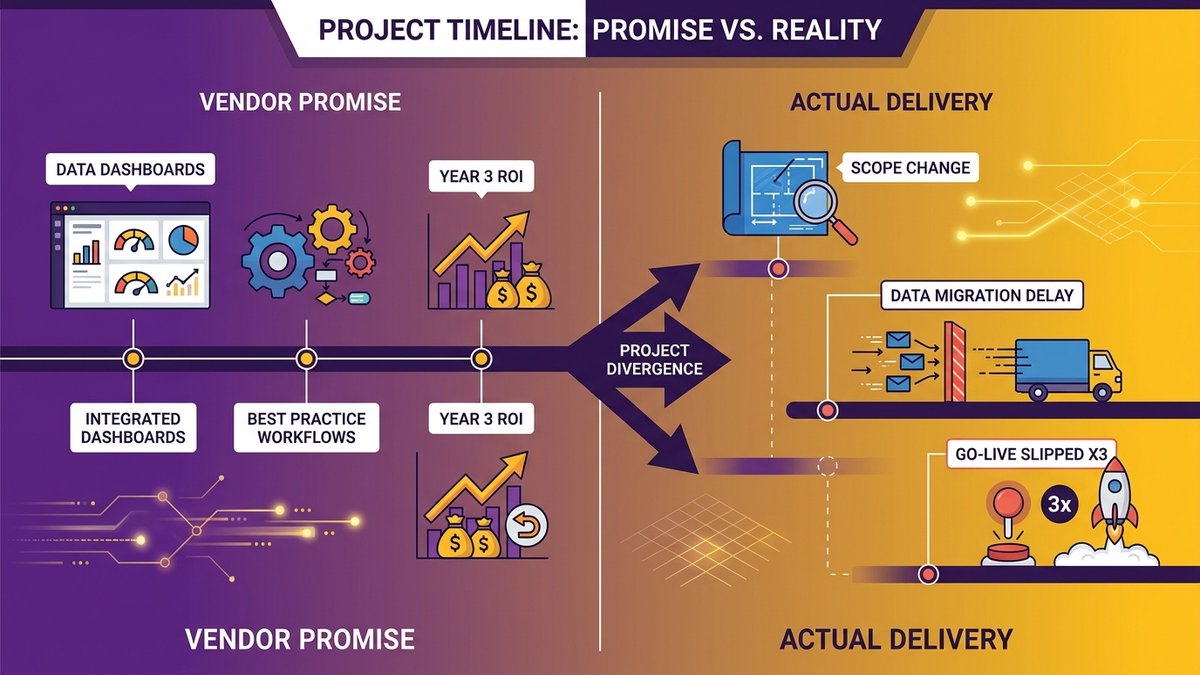
A CEO reviews an ERP implementation timeline against actual project milestones: the gap between promise and delivery rarely stays hidden past go-live.
What the Vendor Deck Shows, and What the Contract Actually Commits To
The sales process for a mid-market ERP contract typically runs three to four months. You see demos of clean, integrated dashboards. The implementation partner talks about “best practice workflows” and “out-of-the-box configuration.” The total cost of ownership model looks favorable by year three.
What the contract actually commits to is narrower. It commits to delivering a configured version of software that operates according to the vendor’s workflow assumptions. When those assumptions don’t match how your business actually runs (and they rarely do, precisely), the contract gives you options like custom development (expensive), configuration workarounds (fragile), or process change (organizational pain). The vendor wins in all three scenarios.
None of this is concealed. It’s just rarely surfaced until you’re nine months in and the implementation partner is explaining that your five core operational processes need to be redesigned to match what the software expects.
The Gartner Number Every CEO Should Know Before Signing
Gartner projects that more than 70% of ERP implementations will fail to meet their original business case goals by 2027. That’s not a fringe finding from a boutique consultancy. It’s the most widely cited analyst assessment in enterprise software, and the 70% figure has been directionally consistent for over a decade, suggesting the problem is structural rather than a matter of companies making preventable mistakes.
Panorama Consulting Group’s methodology puts average cost overruns at 189% across all industries, with discrete manufacturing experiencing 215%. Only 32% of ERP projects achieve their stated objectives. The Hidden Tax of Technical Debt
Those numbers deserve a moment. If you went into any other capital expenditure category expecting an 189% cost overrun and a 68% failure rate, the board would reject the investment before you finished the sentence.
The Real Pattern: It’s the Architecture, Not the Team
ERP implementations fail because packaged software is architected to make the business adapt to it. That’s not a flaw in how implementations are managed. It’s how the product works.
Why ERP Vendors Win When You Change Your Workflows, Not When You Change the Software
An ERP vendor builds one system and sells it to thousands of companies. To make that math work economically, the system has to encode “best practice” workflows that approximate how most companies in a given sector operate. When your workflows diverge from those assumptions (and every company that has survived long enough to care about ERP has differentiated workflows, because differentiation is how companies survive), you have three options.
You can change how the software works. This is expensive and often contractually limited.
You can change how your business works. This is what implementation partners mean by “process harmonization”: a polished way of saying your people have to work differently to satisfy the software’s assumptions.
You can live with the workaround. Most implementations end up here: a system that theoretically runs certain processes, and a parallel layer of spreadsheets and manual steps handling the parts that don’t fit.
As one experienced ERP consultant described it in a public forum after roughly thirty client implementations: “No two businesses are exactly alike. Often not even close. The very act of survival requires many businesses to differentiate themselves to find a competitive edge. This differentiation is often in an area already standardized by their packaged software. So it doesn’t work. And can’t.”
That’s held true across thirty years of ERP projects. The software’s architecture isn’t the bug. It’s the feature, for the vendor.
The Fit Gap Illusion: How Gap Analyses Systematically Undercount Workflow Divergence
Before signing an ERP contract, most mid-market companies run a fit gap analysis: a structured assessment of how well the software’s built-in functionality matches current operational processes. The analysis typically shows a manageable gap. That’s usually a flawed measurement.
Fit gap analyses capture the workflows that are visible and documented. They don’t capture the institutional knowledge baked into how people actually do the work: the sequence of steps that experienced staff follow automatically, the exception-handling routines that aren’t in any process document, the data relationships that evolved organically and never got formally specified.
When those hidden workflows collide with the ERP’s assumptions at go-live, the implementation partner calls it “scope creep.” From where you’re standing, it looks like the system doesn’t work. Both descriptions are accurate. Neither is helpful at that point.
What $100M Failures Actually Look Like
These aren’t cautionary tales about companies that cut corners or skipped due diligence. They’re about companies that ran thorough implementation processes and still failed for structural reasons.
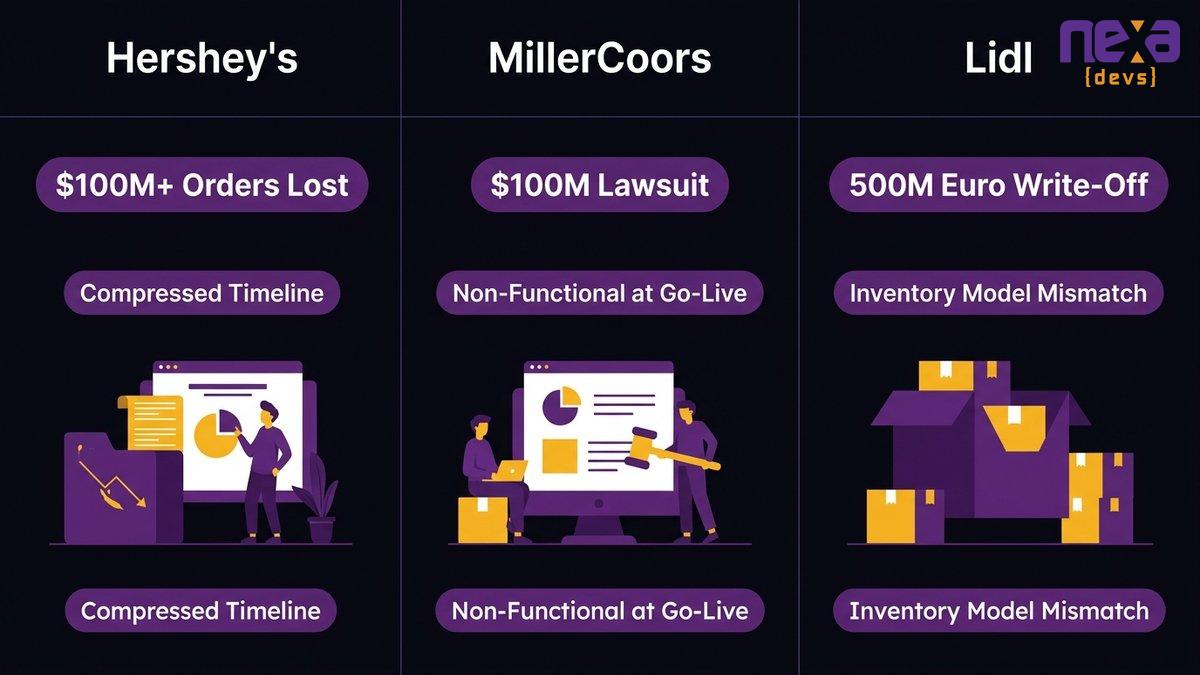
Famous ERP failures at Hershey, Lidl, and MillerCoors share a structural pattern: workflow reality diverged from packaged software assumptions at a moment the business couldn’t absorb.
Hershey’s: Compressed Timelines, Peak Season, $100M in Unprocessed Orders
In 1999, Hershey’s went live with a combined SAP, Manugistics, and Siebel implementation in the middle of the Halloween and Christmas shipping season. CIO.com’s reporting on company filings and historical analyses found the result was more than $100 million in unprocessed orders, a 19% quarterly profit decline, an 8% single-day stock drop, and a 12% annual revenue fall between 1998 and 1999.
The implementation was compressed from four years to thirty months under budget pressure. The seasonal timing was flagged internally and overruled. The system went live before testing was complete. Every warning sign was visible before go-live. None of them stopped the project.
MillerCoors: A $100M Lawsuit and a Project Dead Before Go-Live
MillerCoors filed a $100 million lawsuit following its ERP failure in 2017. CIO.com, citing court filings, reported the company’s complaint alleged that the implementation partner had failed to deliver a functional system despite years of work and payments. The project was, by the lawsuit’s account, non-functional at the time it was supposed to be live.
The suit named specific deliverables that were promised and never arrived. This wasn’t a case of a system that worked imperfectly. This was a system that didn’t work.
Lidl: 500M Euros Written Off After Seven Years, Then a Return to the Old System
In 2018, Lidl wrote off 500 million euros on a failed SAP implementation and reverted to its legacy system. CIO.com cited the company’s announcement directly. The project had run for seven years.
Lidl’s specific failure point was a mismatch between SAP’s inventory valuation method and Lidl’s existing approach. SAP uses retail price for inventory valuation; Lidl used purchase price. Changing the system would have required changing a core operational decision the company had made before the implementation began. Changing the company to fit the system was not viable after seven years of accumulated workflow dependencies.
Seven years. Half a billion euros. The old system.
The Mid-Market Version: Smaller Numbers, Same Structural Failure
Mid-market ERP failures don’t make CIO.com. They don’t generate $100M lawsuits or board-level write-offs that require a press release. They generate a company that spent $400,000 to $2 million on a system it partially uses, supplemented by the spreadsheets it was trying to replace, operated by people who are now deeply skeptical of any future system change.
The numbers are smaller. The failure mode is the same.
Why Mid-Market Is Uniquely Exposed
Large enterprises take real damage from ERP failures. Mid-market companies can’t weather the same hit. The structural reasons explain why.
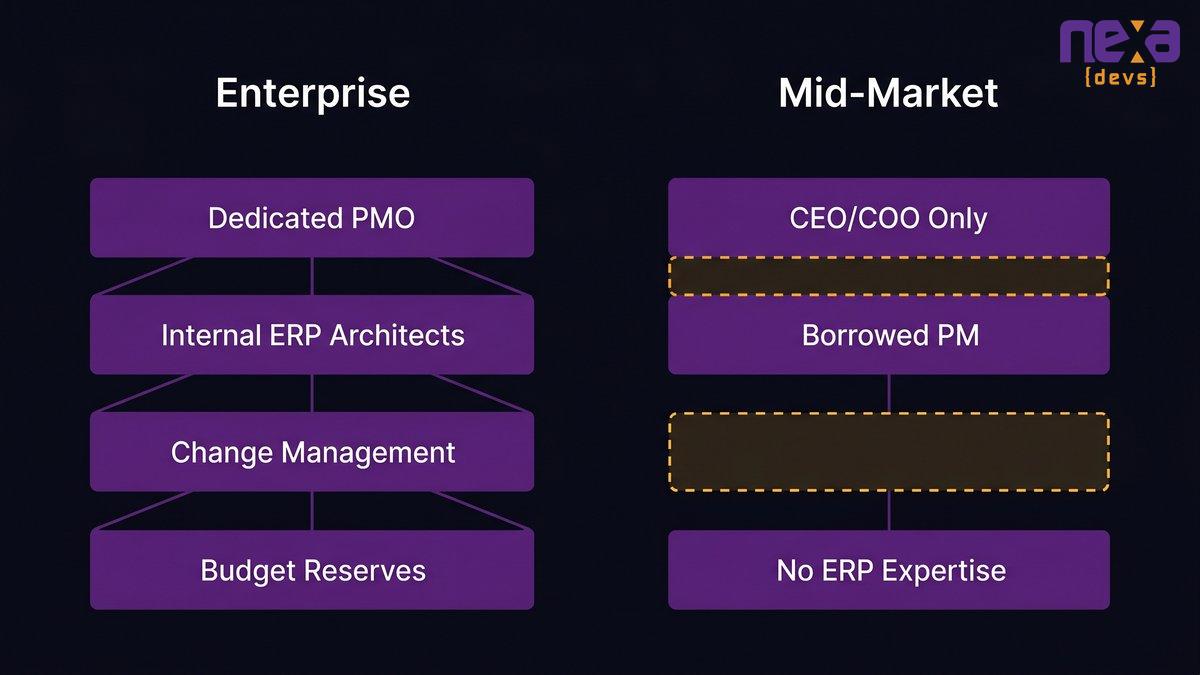
Mid-market operations lack the PMO infrastructure and internal ERP expertise that larger enterprises use to absorb implementation risk, making them structurally more vulnerable to cost overruns and scope failures.
No Dedicated PMO, No Internal ERP Expertise, No Buffer for 189% Cost Overruns
A Fortune 500 company implementing SAP has a dedicated project management office, internal systems architects who have been through prior implementations, a change management function, and budget reserves allocated for implementation contingency. When something goes wrong (and something always goes wrong), there are structures to absorb the impact.
A mid-market company at 200 employees has the CEO, the COO, one or two IT staff who have never managed an ERP implementation, and a project manager borrowed from operations who is also responsible for their actual job. When the implementation partner asks for a scope change decision, it comes to the CEO. When the data migration hits unexpected complexity, there’s no internal team qualified to evaluate the vendor’s proposed solution.
The 189% average cost overrun that Panorama Consulting documents is painful but survivable for a large enterprise. For a company with an annual IT budget of $2 million, a 189% overrun on a $500,000 implementation project is a board-level crisis.
The Consultant Dependency Trap: Mid-Market Companies Pay for Expertise They Can’t Retain
ERP implementations require specialized expertise that most mid-market companies don’t have in-house. So they rent it from implementation partners for the duration of the project. When that relationship ends, all the institutional knowledge about why things were configured the way they were, what the customizations actually do, and where the edge cases live goes with it.
What stays behind is a system the internal team runs but doesn’t fully understand. Maintenance goes back to the original partner at premium rates, or to a new one starting from scratch. The dependency doesn’t stop at go-live. It just changes shape.
This is the vendor dependency pattern that mid-market CEOs describe as feeling like a “hostage negotiation.” They signed a contract to solve an operational problem. They ended up in a long-term dependency on a vendor whose incentive structure doesn’t align with theirs.
The Sunk Cost Trap: Why Companies Keep Doubling Down
The most expensive phase of an ERP failure is the period after the warning signs are clear and before the decision to stop.
The Psychology of “We’ve Come Too Far to Stop Now”
At some point in a failing ERP implementation, usually somewhere between month eight and month eighteen, the internal signals become unambiguous. Timelines are slipping. Budget is gone. The system can’t do what was promised in the pre-sales process. The people who use it daily have developed workarounds that reproduce the spreadsheet problem the system was supposed to solve.
And yet the project continues.
This pattern shows up well outside ERP: organizations that have invested heavily in a course of action grow more committed to it as evidence mounts that it’s failing. Stopping means admitting the investment was wrong. Continuing means holding onto the possibility that the next phase will be different. Neither option is rational at that point, but one of them avoids the conversation with the board.
For a CEO or COO who championed the initiative, approved the vendor, and signed the contract, stopping is a public reckoning. Continuing costs more money but avoids that conversation. The math says stop. The organizational dynamics say keep going.
Recognizing the Decision Point: When to Cut Losses vs. When to Push Through
There’s a legitimate version of this question. Some ERP implementations recover. The ones that recover share certain characteristics: the core workflow gap has been identified and scoped, there’s a credible path to close it, the implementation partner has skin in the game for the outcome, and the organization has the internal capacity to drive the change management required.
The ones that don’t recover keep receiving remediation timelines that slip, scope additions that weren’t in the original contract, and explanations that locate the problem in the client’s processes rather than the vendor’s configuration.
The question to ask is not “how much have we spent?” That’s the sunk cost framing. The question is: “Given what we know now about the gap between this system’s capabilities and our actual operational requirements, what is the realistic path to closing that gap, and what does it cost compared to starting with a system built for our requirements?” Technical Debt ROI Framework
What Actually Fixes This: Systems Built Around Your Workflows
The alternative to ERP failure isn’t a better ERP implementation. For a significant portion of mid-market companies, the right answer is a system designed from scratch around how the business actually works.
Custom-Designed Workflow Systems vs. Packaged ERP: The Strategic Trade-Off
Packaged ERP gives you proven functionality across a wide range of processes, fast time to value for the processes that fit, and a vendor roadmap that evolves the product without requiring your internal investment. The trade-off is that you adapt to the software: your workflows, your exceptions, your competitive differentiators all get filtered through what the package allows.
Custom-built systems give you software that fits the actual workflow, no forced process harmonization, and no dependency on a vendor’s architecture decisions. The trade-off is a higher upfront cost and the requirement to own the system long-term.
For companies whose competitive advantage lives in the processes that ERP doesn’t fit, and that describes most mid-market companies that have survived long enough to be having this conversation, the trade-off favors building.
The position here is clear: for mid-market companies with differentiated workflows that a packaged system can’t accommodate without significant customization, custom-built software is the more rational choice. Not always. But for more companies than currently believe it.
The Build Cost Myth: Why Custom Isn’t Always More Expensive Over Five Years
The comparison most companies make is wrong. They compare the sticker price of an ERP license plus implementation against a software build estimate. The correct comparison includes the full five-year cost of ERP ownership: annual license fees, implementation partner support, customization work, upgrade cycles, data migration when the vendor moves to a new platform, and the productivity loss embedded in workflows the software never quite supported.
Panorama Consulting’s methodology finds that 50% of ERP projects require additional unplanned technology, and 40% underestimate staffing requirements. Those aren’t implementation costs. They’re ongoing operational costs that don’t appear in the original TCO model.
When you add those to the comparison, the build option is often cost-competitive within a five-year horizon, especially at mid-market scale where the license plus implementation costs are comparable to a custom build that produces a system you own outright.
What Nearshore AI-Augmented Development Makes Possible
Three years ago, the build argument was harder to make for mid-market companies because the cost and timeline of custom development were harder to predict and control. AI-augmented development has changed both variables.
Nearshore teams running AI across the full build cycle, from requirements and architecture through implementation and testing, are delivering systems faster and with better documentation than comparable projects looked like two or three years ago. The documentation piece matters specifically here: one persistent failure mode of custom-built systems is that they become the next black box nobody understands. When documentation is generated as a standard output of the development process rather than a checklist item tacked on at the end, that changes.
At Nexa Devs, every system delivered comes with complete documentation transferred unconditionally to the client. UML architecture diagrams, system design documents, API references, test coverage reports: all of it owned by the client from day one, regardless of whether the engagement continues. The goal is to eliminate the new-vendor-dependency problem entirely, not just shift it.
Before You Sign the Next Contract: Six Questions Every CEO Should Ask
If you’re evaluating a new ERP or reassessing a current one, these questions create a clearer picture of what you’re actually buying.
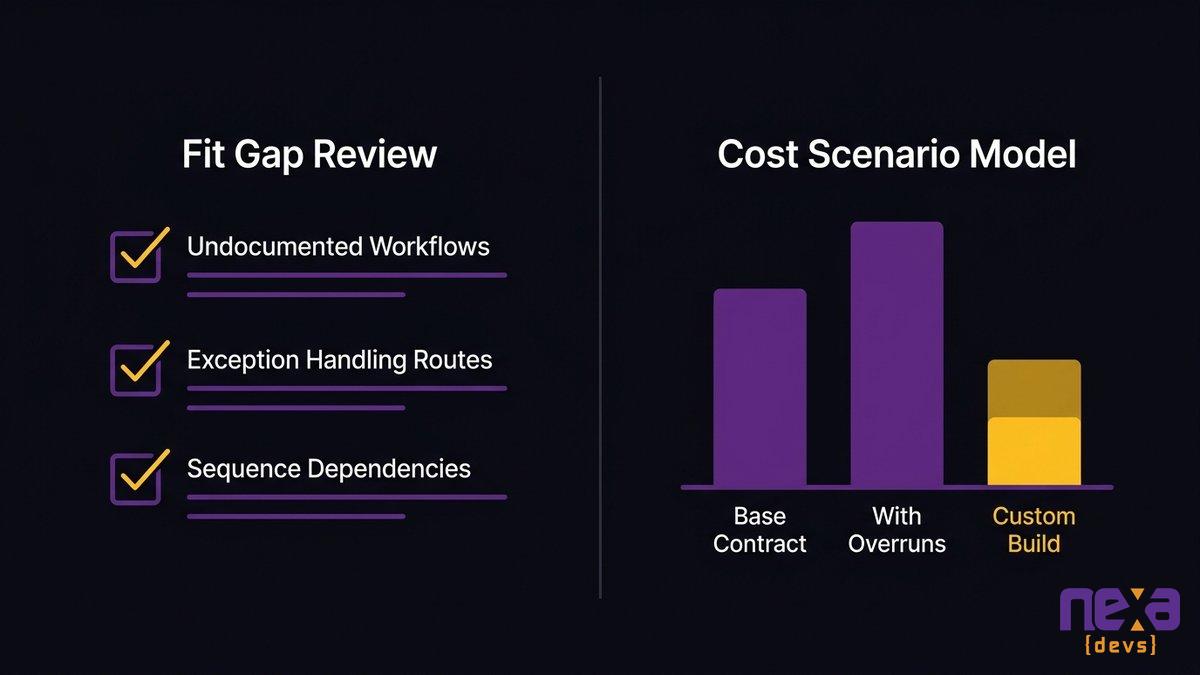
An executive review of ERP vendor proposals should include workflow fit documentation and cost-overrun scenario modeling, not just feature comparison.
Questions About Fit Gap Methodology and Workflow Preservation
Question 1: How does your fit gap analysis account for undocumented workflows?
The vendor will describe a structured documentation process. Ask specifically how they handle the processes that experienced staff perform from memory: the exception-handling routines, the sequence dependencies that aren’t in any written process map. If the answer is “we’ll document them during discovery,” ask what happens when discovery misses something and it surfaces at go-live. What does that cost, who pays for it, and how long does it take?
Question 2: For the workflows where there’s a gap between what your system does and what we currently do, what are the options, and who bears the cost of each?
Get this in writing. “Best practice alignment” usually means “you’ll change your workflow.” That’s not inherently wrong, but it should be an explicit decision with a documented cost, not something that surfaces in month nine as a scope change.
Questions About Cost-Overrun Scenarios and Contractual Protections
Question 3: What percentage of your implementations at our scale come in on time and on budget?
If the answer isn’t immediately available, or if it’s presented as a success rate rather than an on-time/on-budget rate, push for specifics. An implementation that went live twelve months late but is now “successful” from the vendor’s perspective isn’t the same as one that hit its original timeline.
Question 4: What protections does the contract include if the system doesn’t perform as demonstrated in the pre-sales process?
Ask specifically what happens if core workflows demonstrated in the demo turn out to require customization to function in your environment. The answer tells you whether the vendor is confident in what they sold you or relying on contract language to manage the gap.
Questions About the Alternative to Packaged Software
Question 5: Have you modeled what it would cost to build a custom system for the five processes this ERP is meant to solve?
Most mid-market companies haven’t run this comparison before signing an ERP contract. They’ve compared ERP vendors. The build option is often dismissed as too expensive or too risky without a current estimate. Get the estimate. The gap between an ERP total cost of ownership and a custom build may be smaller than you expect.
Question 6: If this implementation doesn’t achieve its objectives, what are the exit options, and what does each cost?
This question makes vendors uncomfortable. It should. Companies that go into an ERP implementation without a clear understanding of the exit path end up in the sunk cost trap by default. Knowing the exit cost before signing changes the decision calculus, and changes what you’re willing to accept in the contract.
One Question Worth Sitting With
The companies that got burned by Hershey’s-scale ERP failures didn’t make stupid decisions. They made reasonable decisions with incomplete information, in organizations where stopping mid-implementation carried its own political cost.
Mid-market CEOs and COOs evaluating their current or future ERP situation deserve a clearer frame: the question isn’t whether your ERP implementation will be difficult. It’s whether the difficulty is worth what you get on the other side, and whether a system designed from the ground up around your actual workflows would get you there faster, cheaper, and with an outcome you own.
If you want to model what a custom-built alternative would cost for your specific operational scope, we’re happy to run that comparison before you sign anything. Talk to a development partner who will show you both options. Schedule a consultation
FAQ
What are the common ERP implementation failures?
The most common ERP implementation failures stem from workflow mismatches, compressed timelines, inadequate testing, and poor change management. Gartner’s data shows over 70% fail to meet original goals. The root cause: packaged software requires businesses to adapt workflows to the software rather than the other way around.
What is the fail rate of ERP implementation?
Gartner projects more than 70% of ERP implementations will fail to meet their original business case goals by 2027. Panorama Consulting puts the figure at 68% not achieving objectives. Only about 32% of ERP projects are considered fully successful by their original business case criteria.
How many SAP projects fail?
SAP implementations follow roughly the same pattern as ERP broadly. Lidl’s half-billion-euro write-off and MillerCoors’ $100M lawsuit were both SAP-related projects. The failure rate is not uniquely worse for SAP. The structural cause applies across vendors because it’s rooted in packaged-software architecture, not any specific product.
What are the common reasons for ERP implementation failure?
Core reasons include: fit gap analyses that underestimate workflow divergence, compressed timelines that skip adequate testing, insufficient change management, implementation partner misalignment, and the structural mismatch between packaged-software assumptions and differentiated business workflows. Mid-market companies face additional risk from lack of internal ERP expertise or dedicated PMO.
What is the difference between custom development and ERP?
ERP is packaged software built for broad applicability; your business adapts to its workflow assumptions. Custom development produces software designed around your specific workflows, owned outright. For companies with differentiated workflows that ERP can’t accommodate, custom development is often more cost-effective over a five-year horizon.
What is the Big 3 ERP system?
The Big 3 ERP systems are SAP, Oracle, and Microsoft Dynamics. All three follow the same packaged-software architecture prone to implementation failures. The fit-gap challenge, process harmonization requirement, and consultant dependency trap apply across all three platforms.