
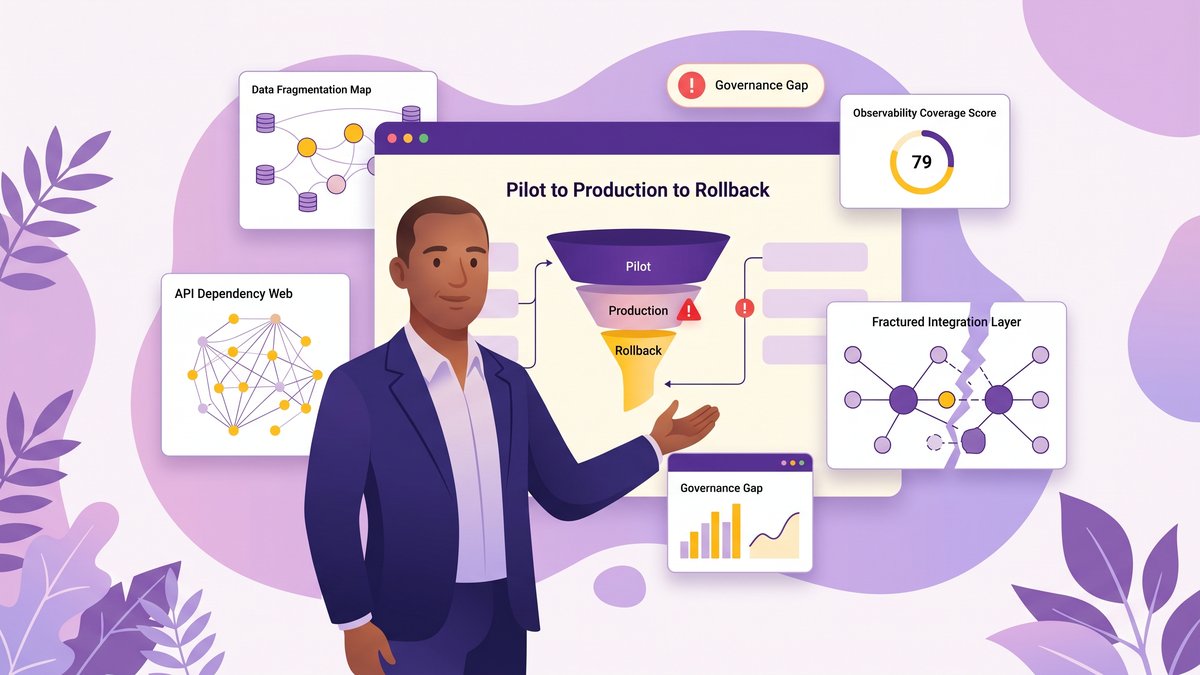
Table of Contents
Enterprise AI Agents Production Failure: Why 74% Roll Back (And What the 26% Did Differently)
Your AI pilot worked. The demo ran clean. The board approved the rollout. Twelve months later, you’re restarting from scratch, explaining to the same board why you’re spending the budget again.
That story is playing out across the industry. The rollback epidemic in enterprise AI is real, documented, and accelerating as investment outpaces infrastructure. The question isn’t whether it happens. It’s why it keeps happening to companies with good models, good intentions, and real budgets. That answer is what separates the 26% that reach production from the 74% that don’t.
Quick answer: why enterprise AI agents fail production
- 74% of enterprises have already rolled back or shut down a customer-facing AI agent after deployment, according to Sinch’s AI Production Paradox report (May 2026).
- The model is almost never the problem. Data fragmentation, integration complexity, and governance gaps kill deployments long before the AI logic fails.
- Mid-market companies face a structurally harder path than large enterprises: less IT staff, fragmented legacy stacks, and no dedicated AI governance function.
- The 26% that succeed deploy infrastructure-first: data quality, integration architecture, governance ownership, and observability in place before the agent goes live.
- Fixing the rollback cycle starts with a pre-deployment audit, not a better model selection.
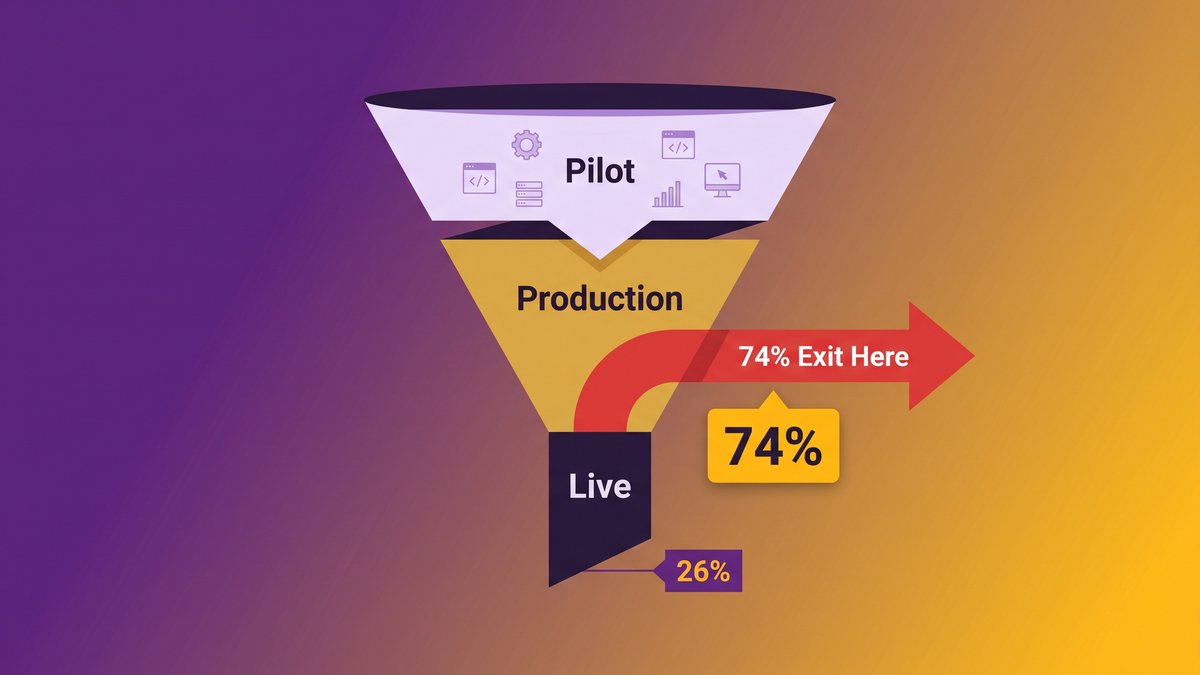
Most AI deployments never survive the jump from sandbox to production. The gap isn’t the model; it’s the surrounding infrastructure.
The 74% Rollback Problem Nobody Warned You About
Three-quarters of enterprises have already pulled an AI agent out of production. That number demands an explanation, and the explanation isn’t what most people expect.
In May 2026, Sinch published its AI Production Paradox report, surveying 2,527 senior decision-makers across 10 countries. The headline finding: 74% of enterprises had already rolled back or shut down a customer-facing AI agent after deployment due to a governance failure. Not a forecast. Live deployments that went live and then got pulled.
What the Sinch AI Production Paradox report actually found
The 74% figure applies specifically to customer-facing AI communications agents, not every category of enterprise AI deployment. The scope matters. Customer-facing agents represent the category most enterprises deployed first: chatbots, virtual assistants, automated response systems. These are the highest-visibility, lowest-tolerance-for-failure deployments in the portfolio. They failed at nearly three in four.
Two other numbers from the same report tell the rest of the story: 62% of enterprises already have AI agents live in production, and 98% are increasing AI investment. Rollback is not a retreat from AI. It’s a sign that companies are deploying faster than their foundations can support.
Why the 81% rate among mature-governance organizations is the most important number
The paradox in the report’s title comes from this: organizations with fully mature governance frameworks roll back their AI agents at a rate of 81%, four points higher than average.
Better governance doesn’t prevent rollbacks. It surfaces failures that less mature organizations miss entirely. The agent is underperforming, producing errors, or creating compliance exposure. Organizations with weak governance often never find out. Organizations with strong governance catch it and pull the plug.
That’s the uncomfortable reading of the data. When a company with a rigorous governance framework still rolls back four in five agents, the problem isn’t how you manage the agent. The problem is what the agent runs on when it reaches production.
The Real Villain: It Was Never the Model
A failed AI deployment tends to generate blame in a predictable direction: the model isn’t accurate enough, the prompt engineering needs work, the AI vendor oversold the capability. Most of the time, that diagnosis is wrong.
Post-mortems from hundreds of failed deployments point elsewhere entirely. RAND Corporation’s analysis found that more than 80% of AI projects fail, double the rate of equivalent non-AI IT projects. The gap isn’t because AI models are twice as unreliable. It’s because AI agents expose infrastructure weaknesses that traditional software tolerates or hides.
What post-mortems across hundreds of failed deployments actually show
An AI agent operates differently from a traditional application. A conventional system runs a defined workflow and fails gracefully when it can’t complete a step. An AI agent reasons over inputs, selects from available tools, takes sequential actions, and compounds errors across each step. It doesn’t just execute. It decides.
When an agent decides badly, the cause is almost always upstream of the model. Inconsistent data produces inconsistent reasoning. Undocumented APIs produce unpredictable behavior. Undefined scope boundaries lead to scope creep at runtime. Observability gaps mean the agent was failing for weeks before anyone noticed.
The model is the starting point, not the variable. Data fragmentation, integration complexity, and governance gaps are the three killers. All three are infrastructure problems, not AI problems.
The demo-to-production gap: why controlled pilots create false confidence
A sandbox environment is built to succeed. Data is clean and consistent. API endpoints are stable. The test workflow is bounded and well-defined. The team running the test is paying close attention.
Production is the opposite of all that. Real data carries three years of inconsistent formats from three different input systems. Vendors update APIs without notifying you. Edge cases the pilot never saw arrive on day one. The business pressure that funded the deployment now expects results, so boundary creep begins immediately.
Pilots measure whether the model produces reasonable outputs in controlled conditions. They don’t measure whether your infrastructure can support an agent running at production volume, on production data, with production-level consequences when it gets something wrong.
Why Mid-Market Companies Face a Harder Production Path
A Fortune 500 company deploying an AI agent does so with a dedicated data engineering team, a formal AI governance function, infrastructure engineers on staff, and a budget specifically for data remediation before the agent goes live. Mid-market companies don’t have any of that.
This isn’t a criticism. It’s a structural reality that changes the risk calculus entirely.
The infrastructure gap that large enterprises can budget around, and the mid-market cannot
Large enterprises can assign a team to clean data before the deployment begins. A formal discovery sprint documents API dependencies. A governance committee reviews every agent action boundary. Dedicated observability tooling surfaces model drift in real time.
A mid-market company with a 12-person engineering team and a CRM from 2009 starts from a completely different position. Those 12 engineers are already running at capacity, maintaining existing systems. The CRM’s API documentation is three years out of date. Nobody owns the governance question because there’s no dedicated function to own it. The starting conditions are different. The deployment risk reflects that.
Fragmented legacy stacks, limited IT capacity, and the missing governance function
Most mid-market companies running custom internal software have stacks that grew by accretion over a decade. A core system from 2012 talks to a module from 2018 via a middleware layer that one developer wrote and then left. The CRM exports to a spreadsheet that feeds a reporting tool. Data lives in six places, and none of them agree.
An AI agent trying to reason over that environment hits what the underlying architecture has been accumulating for years: undocumented dependencies, inconsistent schemas, and connections that were never designed to be interrogated at machine speed.
The agent isn’t failing because it’s a bad agent. It’s failing because no previous system ever tried to operate across the full stack at once.
Why only 31% of AI use cases reached full production in 2025
ISG’s State of Enterprise AI Adoption Report (2025) found that only 31% of AI use cases reached full production in 2025. The remaining 69% stalled in pilot, got deprioritized, or were explicitly rolled back.
The reasons vary by company. The pattern doesn’t. Organizations that invested in infrastructure readiness before deployment consistently outperformed those that deployed first and addressed problems reactively. Mid-market companies, working with fewer resources available for pre-deployment work, made up a disproportionate share of that 69%.
How AI agents require infrastructure readiness before deployment
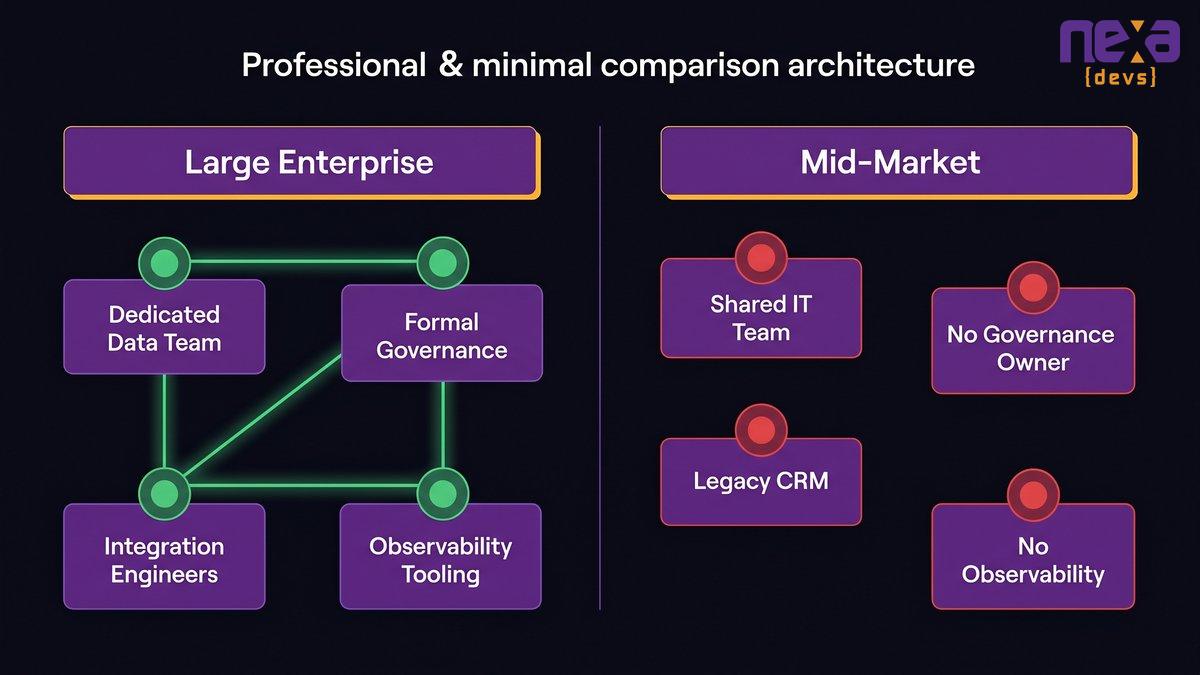
The mid-market AI deployment challenge isn’t ambition or budget alone. It’s the structural gap between what agents require and what most mid-market stacks provide.
The 5 Infrastructure Failures That Trigger Rollbacks
These five failure modes show up in failed AI agent deployments with enough consistency that they’re predictable. None of them are model problems. Each one is a pre-deployment readiness gap that should have been addressed before the agent went live.
Data fragmentation: when the agent trains on clean data but runs on chaos
Agents trained on curated datasets encounter production data that looks nothing like what they trained on. The customer record has three conflicting email addresses. The transaction history has gaps from a 2019 system migration. The product catalog has duplicates from a vendor feed that was never reconciled.
The agent doesn’t crash. It reasons. When the data is inconsistent, the reasoning compounds that inconsistency across every action it takes. The output looks like a model problem. The actual cause is years of data hygiene debt that nobody addressed because no prior system ever demanded clean data at this resolution.
Integration complexity: what legacy ERPs and undocumented APIs do to agent reliability
AI agents need to call external systems to act. Those calls depend on stable, documented, accessible APIs. Most mid-market internal stacks don’t have them.
The ERP from 2014 has a proprietary API requiring a middleware layer to query. The CRM was updated last quarter, and the field names changed without notice. The inventory system exposes a REST endpoint that returns different schemas depending on whether you query by product ID or SKU. An agent in this environment encounters a different system than the one the development team tested against.
The integration layer isn’t just a technical dependency. It’s the most fragile part of the deployment, and it’s almost always underdocumented.
Governance gaps: why rollback procedures and audit trails get built after the crisis
Governance documentation, approval workflows, escalation paths, and rollback procedures are almost never built before an AI agent goes live. They get built after the first incident that required them and didn’t have them. That sequence is expensive.
The Sinch report found that 84% of AI engineering teams spend at least half their time on safety infrastructure rather than improving the product. That time is reactive, not planned. It’s the cost of skipping governance before deployment. For organizations willing to do the work before go-live, a properly specified governance framework is the single highest-leverage pre-deployment investment available.
Scope overreach: the organizational pressure that turns a bounded agent into an unreliable one
A bounded agent with a narrow, measurable function can be tested, validated, and monitored. An agent with an expanding scope that grows under organizational pressure can’t reliably be any of those things.
The pressure is predictable. An agent that performs well in a narrow use case gets noticed. Business stakeholders request expanded functionality. Scope grows without a corresponding investment in testing the new boundaries. The agent that was reliable at one task becomes unreliable across six, and the reliability failures are harder to diagnose because the failure surface expanded faster than the observability tooling tracking it.
Observability gaps: why you don’t know the agent is failing until customers do
Traditional software fails predictably: an error gets thrown, a log gets written, an alert fires. AI agents fail differently. An agent can produce plausible-sounding but incorrect outputs for weeks without triggering any conventional error monitoring.
Without purpose-built observability, tracking confidence scores, escalation rates, output quality against expected patterns, and comparison against fallback responses, you don’t know the agent is degrading. Your customers know first.
What Separates the 26% That Succeed
The 26% isn’t a lucky group. They made different decisions before the deployment began.
What separates them isn’t model selection, vendor choice, or team size. It’s sequence. Organizations that succeed treat infrastructure readiness as the prerequisite, not the follow-on activity.
The 4 pre-deployment readiness pillars: data, integration, governance, observability
Every successful production AI agent deployment has four things in place before the first live request.
Data readiness: A defined, consistent data contract for every source the agent will consume. Not “clean data” as an aspiration. A documented contract specifying format, refresh frequency, ownership, and validation rules for each input source.
Integration architecture: A map of every system the agent will read from or write to. Documented API contracts, rate limits, authentication requirements, and failure behaviors. Validation that those APIs are stable enough for production use before the agent depends on them.
Governance ownership: A named owner assigned before go-live. That person approves scope changes, reviews escalation logs, and has the authority to trigger a rollback. A governance framework without a named owner is a document. Not a control.
Observability and rollback: Monitoring built specifically to track AI output quality, not just system availability. Defined thresholds that escalate to human review. A rollback procedure that’s documented and tested before the agent goes live.
The infrastructure-first sequencing that most companies get is backward
Most failed deployments follow the same sequence: build the agent, deploy the agent, discover the infrastructure gaps, patch while live, and eventually roll back to restart.
The minority that succeeds reverses it: map infrastructure gaps first, address the blockers before building the agent, build against a stable foundation, deploy with observability already in place.
This resequencing sounds obvious when stated plainly. The organizational pressure driving most deployments pushes in the other direction. Leadership approved an AI initiative with a timeline. The team needs to show results. Infrastructure work doesn’t look like progress. The pilot already worked, so what exactly needs fixing?
That pressure is the proximate cause of most rollbacks.
AI infrastructure readiness assessment for mid-market companies
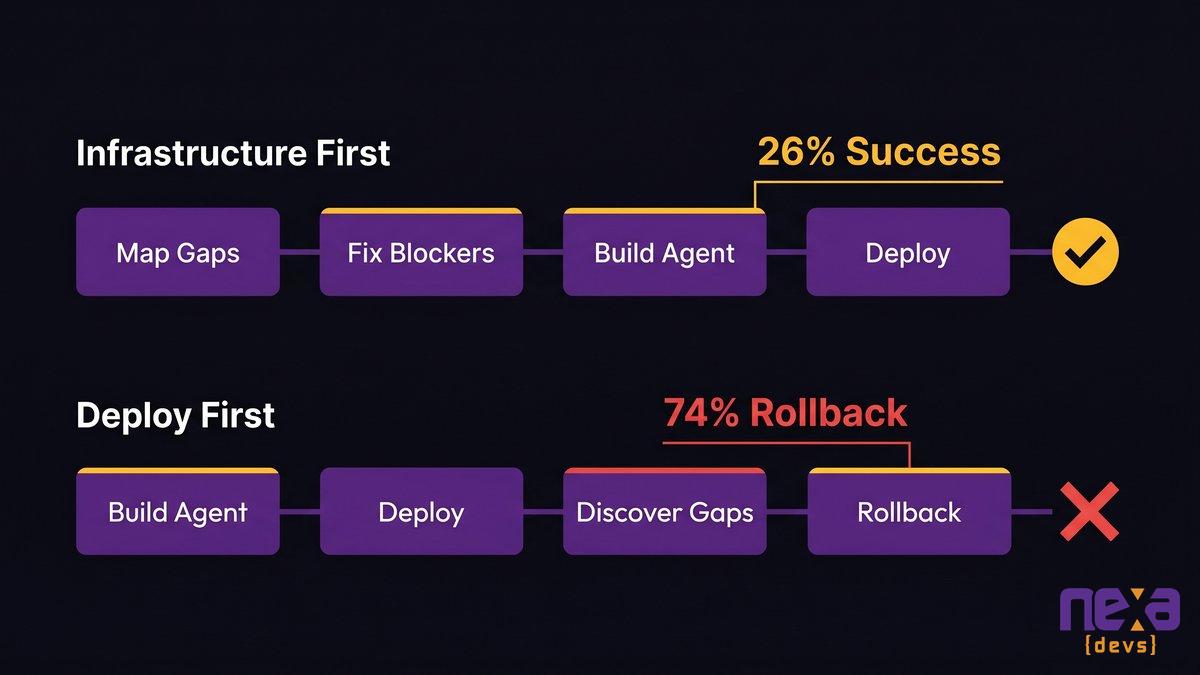
Infrastructure-first sequencing isn’t the obvious choice under deadline pressure. It’s the choice that separates the 26% from the 74%.
A Pre-Deployment Readiness Audit for Mid-Market Leaders
Before any AI agent build begins, run this audit. The questions are blunt by design. A “no” on any of the first four items is a build blocker, not a risk to manage.
Data readiness: the 5-question audit before any agent build begins
- Can you name every data source the agent will consume, with a documented owner for each?
- Is there a validation process that runs before data reaches the agent, or will the agent encounter raw production data directly?
- Have you identified fields that are inconsistently formatted across sources, and do you have a resolution plan?
- Do you know how often each data source updates, and does the agent’s operational logic account for staleness?
- Is there a record of how data quality has changed in the last 12 months for each source?
If you answered no to two or more of these questions, data remediation is your first deliverable, not the agent.
Integration architecture: mapping what your agent will actually touch in production
List every API endpoint the agent will call. For each one, document: who owns it, when it was last updated, what the failure behavior is when it’s unavailable, and whether the development environment accurately reflects production. Then call every one of them under production-like load conditions before the agent goes live. An API that works in testing but rate-limits under production traffic is a deployment stopper you’d rather find before go-live.
Governance ownership: who approves, who audits, who pulls the plug
Three questions. Who approves changes to the agent’s operational scope? Who reviews the escalation log weekly? Who has the authority and the procedure to execute a rollback within 24 hours? If any answer is “the team” rather than a named person, you don’t have governance ownership. You have a document with nobody responsible for following it.
Rollback and observability: designing for failure before you deploy
Define your rollback procedure before the agent is live. Write it down, test it in staging, and confirm the relevant personnel know where to find it. Then build monitoring that tracks escalation rate to human agents, output quality against a held-out validation set, and comparison of agent responses against your defined acceptable range. Test alerting by deliberately triggering failure conditions in staging. If your first real test of the rollback procedure is a production incident, you didn’t prepare for failure. You waited for it.
AI readiness assessment guide for mid-market CEOs and CTOs
The Cost of the Rollback Cycle
The first rollback is expensive. The second is more expensive, and not only financially.
Sunk costs: why failed projects cost most of their budget in the final 30% of the timeline
AI agent projects follow a consistent spending pattern. Requirements, architecture, and model selection take up a relatively small share of the budget. The large expenditures arrive at deployment: infrastructure preparation, integration work, testing, and the operational resources needed to support a live system. By the time a rollback decision gets made, most of the project budget is already gone. The cost of the failure isn’t the cost of the bad decision. It’s every good decision that preceded it and now has nothing to show for it.
Board credibility and the compounding cost of repeated pilots
One failed AI deployment is a learning experience. Two is a credibility problem. Three is a pattern that follows the CEO or CTO into every budget conversation that comes after.
Boards approved AI investment because they were told results were achievable. Each rollback resets not just the timeline but the internal credibility of the people advocating for AI investment. The cost isn’t just the sunk budget. It’s how much harder the next initiative is to fund.
Gartner predicts that over 40% of agentic AI projects will be canceled by the end of 2027, not because the models fail but because of systemic architectural oversights. The organizations on their second and third restart are contributing to that number.
The competitive opportunity cost while competitors in your industry succeed
Organizations in the 26% don’t just recover their investment. They extend it. A competitor whose AI agent handles customer escalations reliably is building an operational lead while you’re resetting your roadmap.
The competitive gap between the 26% and the 74% isn’t static. Every quarter a successful deployment runs while a failed one gets rebuilt, the distance grows. This is the argument for getting infrastructure right before deployment, not for delaying investment. The cost of doing it correctly the first time is almost always less than the cost of the rollback cycle it prevents.
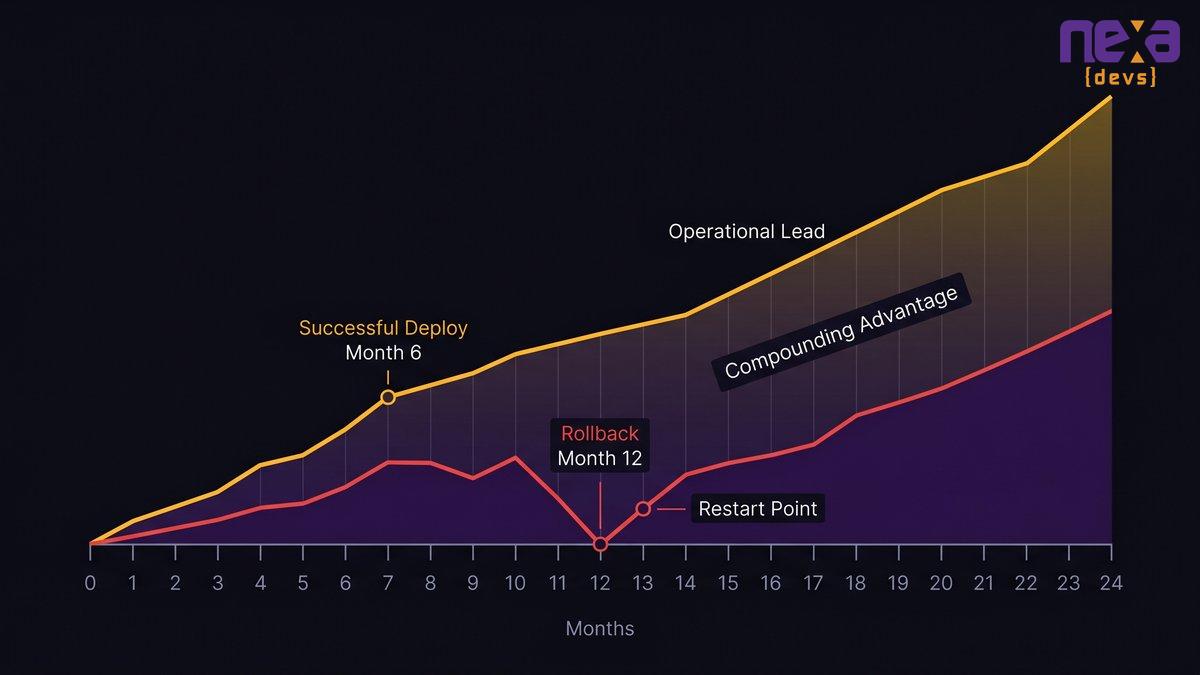
The rollback cycle doesn’t just cost money. It costs the compounding operational advantage your competitors are accumulating while you’re restarting.
If your AI initiative is in flight or you’re planning the next one, the pre-deployment audit in this post is the right starting point. If your team needs help mapping infrastructure gaps before you build, get in touch with the Nexa Devs team.
FAQ
Why do most enterprise AI projects fail?
Most enterprise AI projects fail because of infrastructure problems, not model problems. Data quality, integration complexity with legacy systems, and missing governance frameworks are the three most common root causes. The model is rarely the variable. The data it runs on and the systems it connects to determine whether a deployment survives.
Why do AI models fail in production?
AI models appear to fail in production when the production environment differs significantly from the environment where they were tested. Inconsistent data formats, undocumented API changes, scope expansion beyond the tested boundaries, and missing observability tools all make production performance worse than pilot performance. The model logic often works correctly. The surrounding infrastructure creates the failures.
Why do 90% of AI projects fail?
Estimates vary by scope and definition, but the core finding is consistent: AI projects fail at roughly twice the rate of equivalent non-AI IT projects, according to RAND Corporation. Compounding agent errors, infrastructure dependencies, and the gap between controlled pilots and live production all drive the elevated rate.
What does production-ready mean for an AI agent?
A production-ready AI agent has four things in place before go-live: a validated data contract for every input source, tested integration architecture for every system it calls, named governance ownership with rollback authority, and observability tracking output quality in real time. An agent meeting all four can be fixed when it degrades. One that doesn’t gets rolled back.
How do you prevent AI agent rollback after deployment?
Preventing rollback requires infrastructure work before deployment. Audit data quality and establish validation before the agent touches production data. Test every API dependency under production load. Assign named governance ownership before go-live. Build monitoring that catches degradation before a customer complaint does. Most rollbacks are preventable if the pre-deployment audit finds the blockers first.
What is the 10-20-70 rule for AI?
The 10-20-70 rule allocates AI project effort: roughly 10% to the model itself, 20% to data and integration work, and 70% to the organizational change, governance, and operational readiness needed to sustain a live deployment. The split reflects a hard truth: model selection is the smallest part of a successful deployment.