

Table of Contents
EMR Lab Integration: Fixing the Gap Without a Rebuild
A hospital’s EMR and its lab system are supposed to talk to each other without help: an order goes out, a result comes back, and nobody touches it in between. EMR lab integration is the technical work that makes that happen, connecting your EMR to your LIS, radiology system, and referral network through HL7 or FHIR interfaces so data moves without a human retyping it. When that connection breaks, or was never built cleanly in the first place, the workflow doesn’t stop. It moves to your staff, one keystroke at a time.
This plays out every day wherever LIS EHR integration happens by hand: rekeyed results, duplicate patient records, and manual bridges that hold together right up until volume climbs past what they can carry. Below, we walk through why the gap exists, what it costs a hospital operationally, and how mid-market providers close it with incremental integration middleware rather than a full EMR replacement.
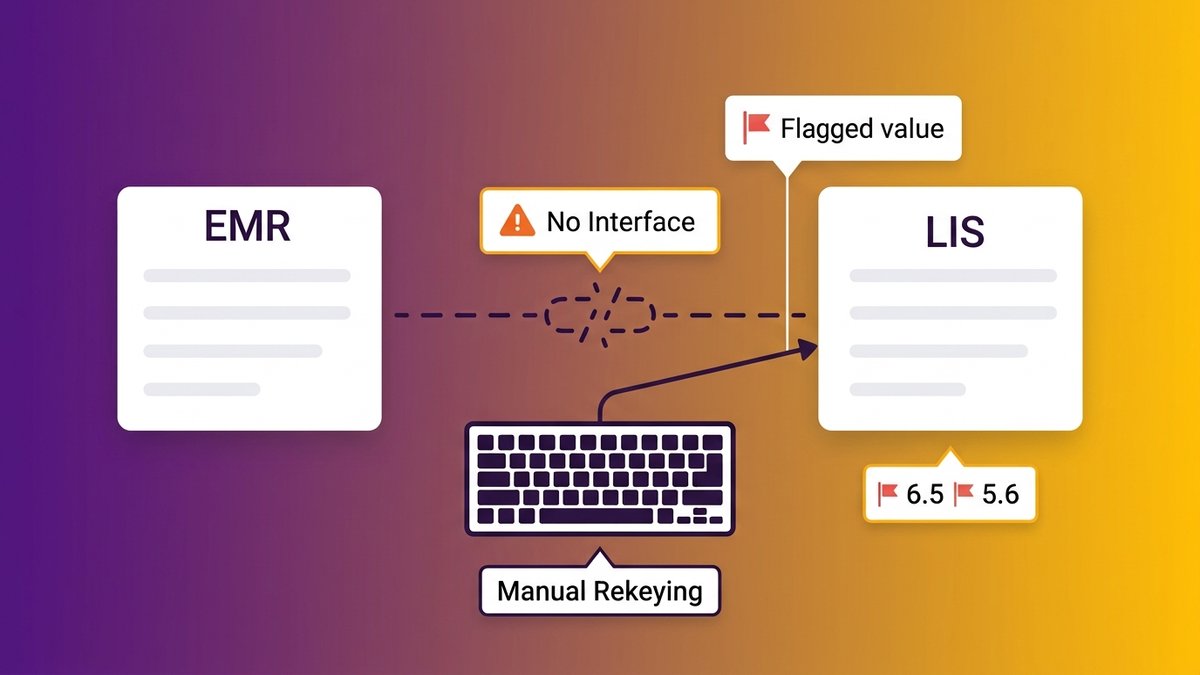
A clinical staff member manually re-entering lab results because the EMR and LIS have no clean data connection.
When Your EMR Can’t Talk to Your Lab System, the Workflow Runs on People
A lab tech at a 200-bed regional hospital finishes a results batch at 4:45 pm. The LIS has no clean feed into the EMR, so she opens both screens and retypes fifteen results by hand before her shift ends.
Multiply that by every shift, every department, and every system that was never designed to exchange data with the one beside it, and you start to see the real shape of the integration gap. Nobody filed it as a missing feature or put it in a budget. It just quietly turned into a permanent staffing cost.
Rekeying lab results by hand between systems
Manual rekeying isn’t a minor inconvenience. Every retyped value is a chance for a transposed digit, a missed decimal, a result attached to the wrong encounter. A potassium level of 6.5 entered as 5.6 doesn’t get flagged by either system, because neither system knows the number came from a human instead of an interface. The clinician downstream trusts the chart. The chart is only as accurate as the last person who typed into it.
How duplicate patient records multiply when systems don’t reconcile
When the EMR and LIS can’t reconcile patient identity automatically, staff build workarounds: a new record here, a manually matched chart there. CertifyHealth’s analysis of ONC data found that only 43% of hospitals report routine engagement across all four interoperability domains: send, find, receive, and integrate. The other 57% are living with some version of this gap, and duplicate records are one of its most visible symptoms.
What happens to the patient record when two systems disagree about who the patient is? Usually, both versions survive. A lab result posts to the wrong MRN, a medication history splits across two charts, and the clinician making a decision at 2 am is working from an incomplete picture without knowing it’s incomplete. That’s not an efficiency problem. That’s a patient-safety problem.
The Hidden Operational Cost: Manual Bridges That Break Under Load
Manual bridges hold up fine on a slow Tuesday. Add a flu surge, a new referring clinic, or a lab acquisition, and the same workaround buckles within days, because a human process doesn’t scale the way an interface does.
Where the workarounds fail during volume spikes
The failure pattern is predictable. Volume climbs, the same two or three staff members who know the manual process are already at capacity, and results start queuing. A result that should post in seconds sits in someone’s inbox for forty minutes, then two hours, then it’s the end of shift and nobody’s sure what’s been transcribed and what hasn’t.
Aalpha’s 2025 research, citing Gartner, puts the figure at up to 75% of hospital IT budgets consumed by maintaining legacy systems rather than fixing the workflow gaps sitting on top of them. That number isn’t abstract for a COO staring at a stack of overtime approvals during a bad flu season.
Rework, delayed results, and staff burnout as measurable operational drag
Every rekeyed result that turns out wrong needs to be caught, traced, and corrected, which means someone re-does the work a second time. Delayed results delay clinical decisions. And the staff holding the bridge together, the ones who know which spreadsheet tracks what and which fax needs a follow-up call, are the same staff a COO can’t afford to lose. anchor text “hidden cost of running critical systems on manual workarounds”
None of this shows up on a single line item. It shows up as unplanned overtime, as a nurse manager pulled off the floor to reconcile a chart, as the quiet turnover of the two people who understood the workaround well enough to keep it running.
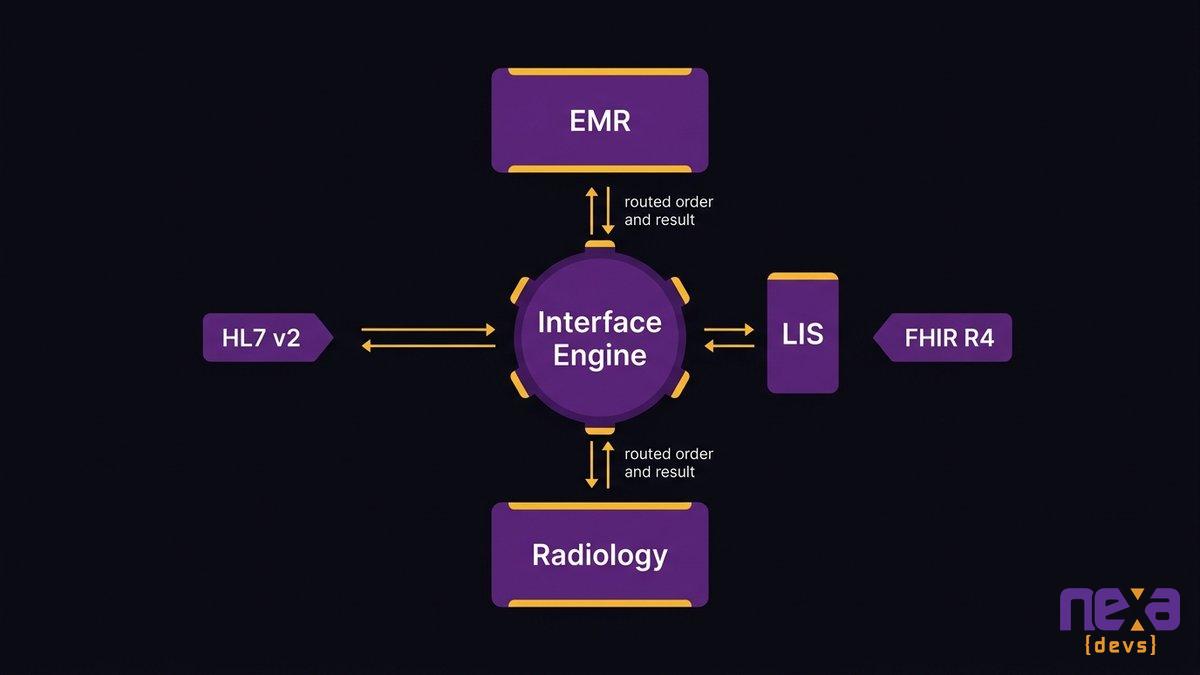
A simplified view of an interface engine routing lab orders and results between the EMR, LIS, and radiology systems.
Why the Systems Don’t Talk: HL7, FHIR, and the Interface Layer Underneath
HL7 v2 is a decades-old messaging standard built around pipe-delimited text segments rather than a modern API. FHIR R4 is newer, built on REST and JSON. Most hospitals run both side by side, which is completely normal.
HL7 v2 messaging vs. FHIR R4 APIs
HL7 v2 still carries most day-to-day electronic lab ordering and results traffic, and it works well enough, as long as every endpoint implements the same optional fields the same way. In practice, endpoints rarely do. FHIR R4 adds a standardized, resource-based API layer on top, useful for real-time queries, patient portals, and newer applications that were never built to parse pipe-delimited segments.
Invene’s research, citing HIMSS data, found that 67% of CIOs name interoperability as their biggest digital transformation barrier. The regulatory direction backs that up: the CMS-0057-F final rule requires impacted payers to implement four FHIR APIs, covering patient access, provider access, payer-to-payer exchange, and prior authorization, by January 1, 2027. So FHIR has stopped being a future consideration. Every serious health IT investment is already heading in its direction.
Point-to-point interfaces vs. a middleware/interface-engine approach
Point-to-point interfaces connect exactly two systems, one custom build at a time. Add a fourth lab partner or a new referral network, and you’re commissioning another custom interface, tested and maintained separately from every other one you already have. An HL7 interface engine sits in the middle instead, translating once and routing to every connected system from a single, maintainable layer.
Where legacy interfaces fall short of current interoperability requirements
Interfaces built a decade ago were often scoped narrowly: this lab, this EMR, this one message type. They weren’t built to add a fifth radiology partner or expose data through a modern API, so every new connection becomes a bespoke project instead of a configuration change. That architecture problem is what shows up downstream as overtime, rekeying, and burnout.
What Closing the Loop Actually Buys You: Orders and Results That Flow
A closed order-to-result loop means an order placed in the EMR reaches the LIS in seconds, and the result posts back to the right chart without anyone touching a keyboard in between. Every hospital should start from that baseline. It is not a premium feature a vendor gets to upsell later.
Closing the loop buys three things a COO and a CTO both care about, for different reasons. Fewer manual steps means fewer chances for a transcription error to reach a clinician. Faster turnaround means a result that matters at 2 am actually shows up at 2 am, not during morning rounds. And clean, structured clinical data exchange means the reporting your leadership team relies on reflects what actually happened in the systems, rather than what someone remembered to type in after the fact. That is clinical workflow integration doing its job quietly in the background.
None of this requires exotic technology. The Office of the National Coordinator for Health IT has published a working definition of interoperability for over a decade: the ability of systems to exchange and use information without special effort on the part of the user. “Without special effort” is the entire point. If your staff is putting in special effort every shift, the loop isn’t closed yet, no matter what your EMR vendor’s marketing page says.
Incremental Integration Middleware vs. Ripping Out the EMR
Rip-and-replace is the wrong first move for almost every mid-market provider chasing a lab integration fix. It’s also the most expensive one, and it solves a problem you don’t actually have.
Connecting LIS, radiology, and referral systems without replacing the core EMR
Your EMR usually isn’t the broken part. The connections around it are. A phased healthcare API middleware build, an interface engine or FHIR facade layered over your existing EMR, connects the LIS, radiology, and referral systems you already depend on without touching the system your clinical staff has spent a decade learning to trust.
As Ashwin Ballal, CIO at Freshworks, states: “Legacy systems have become so complex that companies are increasingly turning to third-party vendors and consultants for help, but the problem is that, more often than not, organizations are trading one subpar legacy system for another.” A full EMR replacement carries exactly that risk, at a much higher price and on a much longer timeline.
A phased rollout that de-risks the change
Hypertrends’ 2026 research puts a full EHR replacement at a mid-size health system between $50 million and $200 million, spanning three to five years. The same research found that big-bang modernization projects, the ones that try to replace everything at once, fail more than 70% of the time. A phased rollout does the opposite: connect the highest-friction system first, usually the lab, prove the pattern works, then extend it to radiology and referral networks on a timeline that doesn’t require betting the department’s budget on a single go-live date.
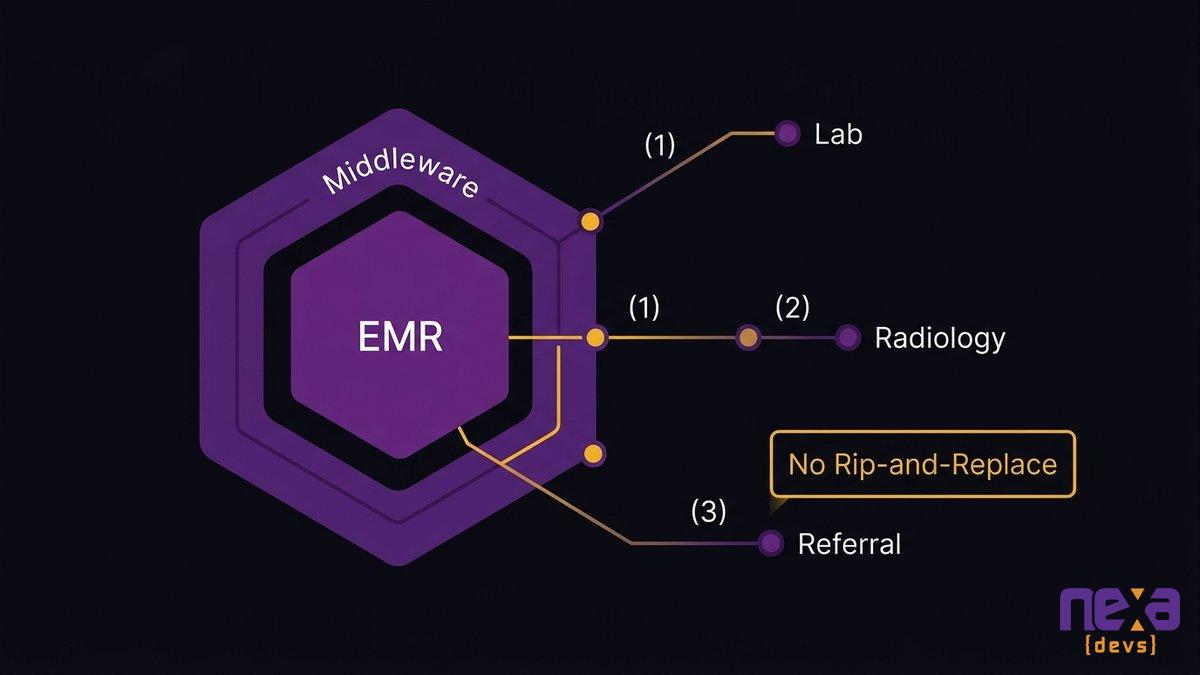
A phased middleware rollout connecting the EMR to lab, radiology, and referral systems one interface at a time.
Getting It Right: Security, Compliance, and Documentation You Own
PHI moves through every interface you build. That makes security and compliance design requirements you settle at the first architecture diagram, long before anyone gets to a post-launch checklist.
Protecting PHI and staying compliant during and after integration
Every connection point, EMR to LIS, LIS to a reference lab, referral system to a specialist’s portal, is a place PHI can leak if access controls, encryption, and audit logging aren’t built in from the start. According to ANI Solutions, information blocking penalties under ONC enforcement can reach up to $1 million per violation for health IT developers. A penalty that size is a strong argument for building the integration correctly the first time, with security reviewed at every interface as you go rather than bolted on once everything is already live.
Why owning the interface documentation matters for a mid-market provider
Ask who currently understands your existing interfaces well enough to modify one without breaking three others. If the honest answer is one person, or one vendor who won’t hand over specifications, you already have a second, quieter integration gap: a knowledge gap. Complete interface documentation, message specs, mapping logic, and architecture diagrams, transferred to and owned by your organization, closes that gap permanently. anchor text “how EHR interoperability compliance requirements reshape your integration roadmap” It also means the next vendor, or the next hire, doesn’t start from zero.
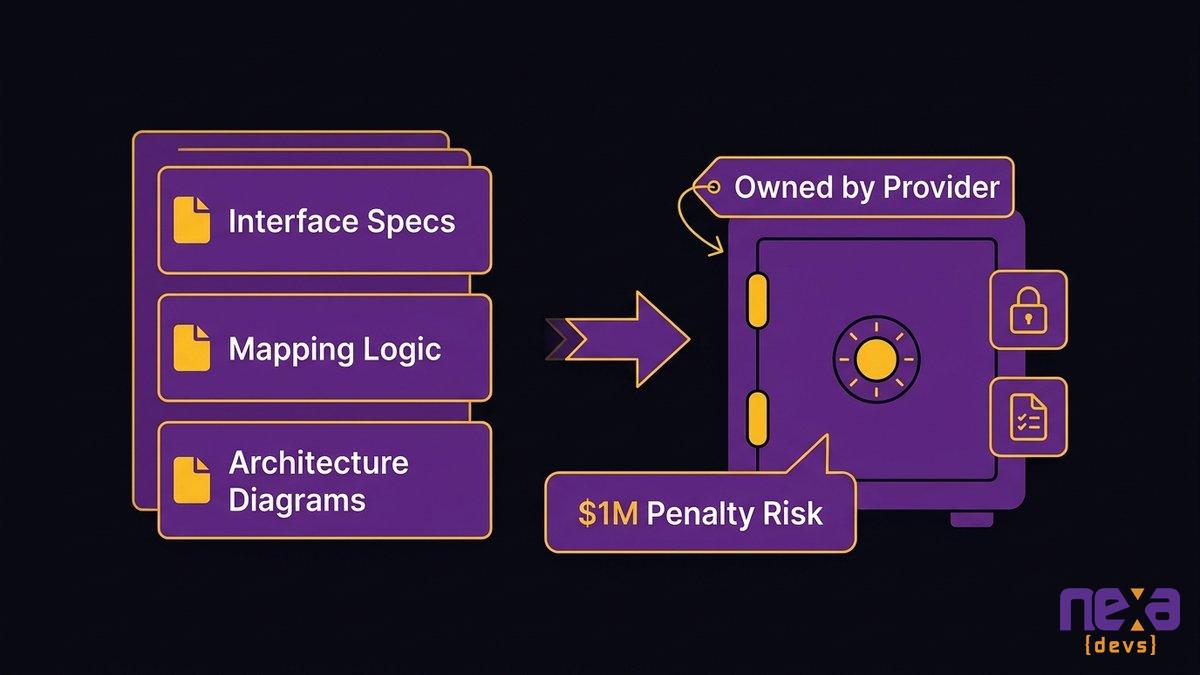
A COO and CTO reviewing complete interface documentation that stays with the organization instead of a vendor’s files.
Choosing an Integration Approach That Fits a Mid-Market Provider
Most mid-market providers don’t need a platform vendor selling a new EMR for what is really a hospital system integration problem. They need a partner who can map their specific EMR, LIS, and referral network, then build the interfaces in a sequence that doesn’t stall clinical operations.
Three things separate an integration partner worth hiring from one that isn’t. First, a phased plan that connects your highest-friction system first, before it promises anything about the rest. Second, documentation you own outright at every milestone, handed over as you go and never held back until project close. Third, a real track record in environments where a mistake carries clinical consequences, the kind of work an e-commerce shop relabeled for healthcare has never actually done.
Nexa Devs has maintained an embedded engineering relationship with UCLA’s David Geffen School of Medicine for more than ten years, building and supporting systems in a regulated, high-stakes clinical environment where documentation and reliability aren’t optional. That kind of track record is the credibility anchor mid-market providers should be asking every integration vendor to match. If a firm can operate inside an academic medical center’s compliance requirements for a decade, a mid-market hospital’s LIS and referral network is a problem they’ve already solved a version of.
Nearshore, AI-augmented delivery, applied to the analysis, build, and testing phases of an integration project, means that phased middleware rollout can move faster than a traditional staffing model without cutting corners on documentation or testing coverage. The goal isn’t a faster rip-and-replace. It’s a shorter path from “our systems don’t talk to each other” to an integration layer that runs quietly in the background, the way it should have from the start.
Ready to connect your EMR to the lab, radiology, and referral systems it should already be talking to, without a rip-and-replace? Talk to Nexa Devs about building your integration roadmap. We build the HL7/FHIR middleware layer, with documentation you own, in environments where the stakes are real.