You’re the CTO. Your CEO walked out of a board meeting with a mandate to ship AI features this quarter. You know your system can’t do it — not because AI is hard, but because your infrastructure was never built for it. That’s the conversation no one is having out loud.
This isn’t an AI problem. It’s an architecture problem that AI just made visible.
The board doesn’t distinguish between “using AI tools” and “running AI agents.” You do. The gap between those two things is the gap between your CEO’s timeline and your technical reality. Understanding that distinction precisely is where this article starts.
What “AI-ready” actually means at the infrastructure level
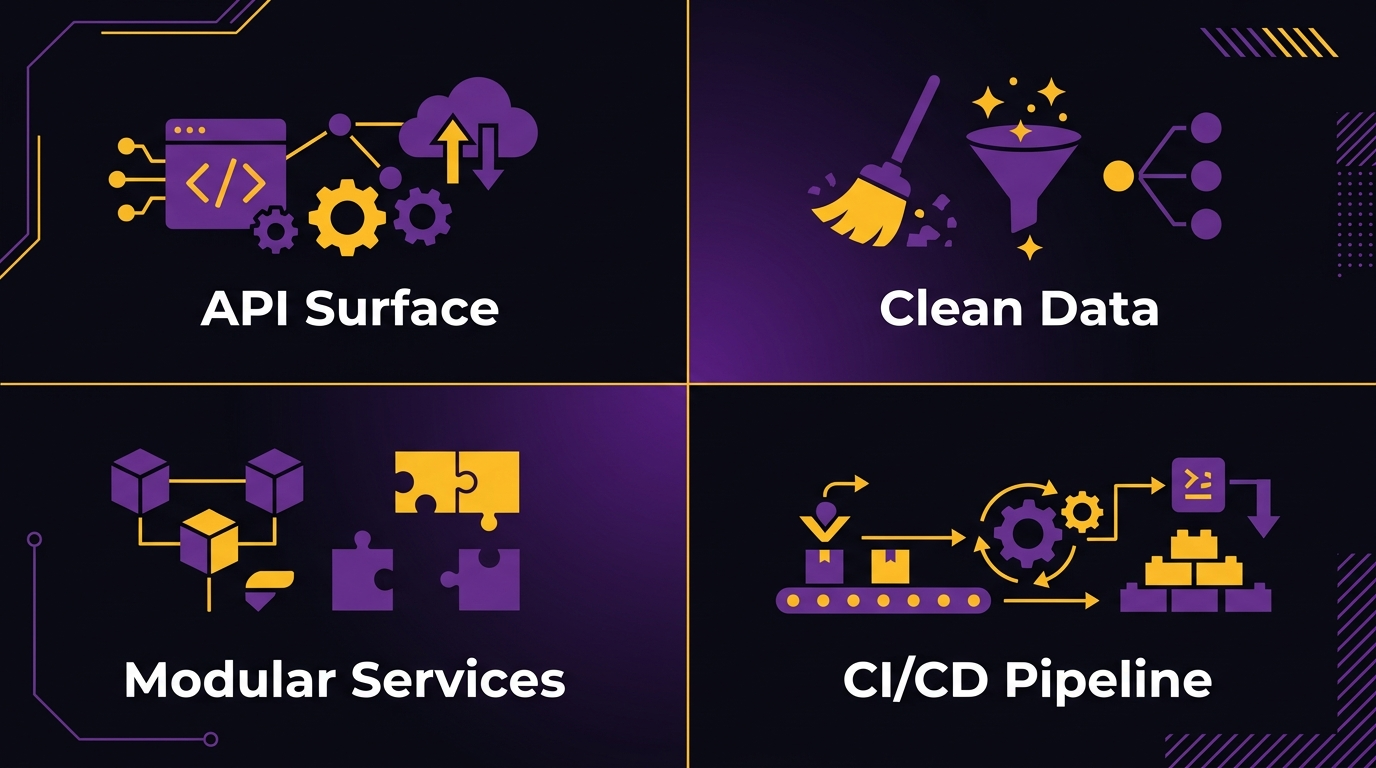
“AI-ready” is not a mindset or a strategy. It’s a concrete set of architectural requirements. An AI agent needs a surface it can call, data it can read, services it can orchestrate, and a deployment pipeline that can push updates without a six-week freeze.
Your 15-year-old monolith meets none of those requirements. Not partially — none. The next section lays out exactly what an AI agent needs. Read it as a checklist against your current system.
What AI Agents Actually Demand from Your Infrastructure
AI agents have specific infrastructure requirements. They’re not generic AI tools you bolt on — they’re autonomous reasoning loops that call external tools, interpret results, and take sequential actions. Your infrastructure has to support that interaction model, or the agent can’t function.
Here’s what that means in concrete terms.
An API surface with callable tool endpoints
An AI agent operates by calling tools. Each tool is an API endpoint the agent can invoke: “query this database,” “update this record,” “trigger this workflow.” If your system has no API layer, the agent has nothing to call. Integration doesn’t become difficult — it becomes impossible.
Most legacy monoliths weren’t designed to be called externally. They were designed to run internally. That architectural choice, made fifteen years ago for perfectly good reasons, is the first structural blocker for any agent deployment.
Clean, unified data that the model can reason over
A language model reasons over data. It summarizes, classifies, extracts, and decides — but only from data it can see. Siloed databases, inconsistent schemas, duplicate records, and data locked inside application logic are all invisible to the model. Garbage in, hallucinations out.
According to the IBM Global AI Adoption Index, 25% of businesses name data complexity as their top barrier to AI adoption, and 22% say AI projects are too difficult to integrate and scale with their current infrastructure. Those numbers track with what development teams actually encounter: the data is there, but the model can’t reach it.
Modular services with clear domain boundaries
AI agents orchestrate multiple services. They call one service to fetch context, another to write a result, and another to send a notification. That requires modular architecture — services with clean interfaces and clear domain ownership. A monolith where business logic is entangled across shared database tables and direct function calls doesn’t support orchestration. It supports a single application doing everything internally.
A CI/CD pipeline that ships without six-week freezes
AI features iterate fast. Model versions change. Prompts get tuned. New agent tools get added. Without a CI/CD pipeline that can ship continuously, every iteration stalls at the deployment gate. Six-week release cycles aren’t just slow — they make AI development economically irrational. The feedback loops AI requires don’t fit inside them.
Why a 15-Year-Old System Fails Every One of These Requirements
Check the four requirements above against a typical legacy monolith. The result isn’t “partial fit.” It’s a systematic failure across all four dimensions. Here’s why.
The data silo problem: your AI model can’t see half your data
Legacy systems accumulate data in isolated stores. The CRM lives in one database. The ERP in another. Operational data sits in a third, maintained by a vendor who controls schema access. None of these stores were designed to expose their data to external consumers — let alone to an AI model reasoning over them in real time.
Data quality compounds the silo problem. Fifteen years of schema drift, inconsistent entry standards, duplicate records from system migrations, and undocumented business rules embedded in application code mean the data you can access isn’t clean enough for a model to reason over reliably. The model doesn’t fail gracefully when data is dirty — it hallucinates.
The API void: no endpoints, no agent surface
If your system predates the API economy, it almost certainly has no API layer. Business logic runs inside the application. Data access happens through direct database queries within that same application. There’s no surface an AI agent can call because the system was never designed to be called.
Adding an API wrapper to a monolith doesn’t solve this. A wrapper exposes the monolith’s chaos — tightly coupled functions, undocumented behavior, brittle data dependencies — through a new interface. The agent can reach it, but the surface it reaches is unreliable.
The tight coupling trap: every change is a crisis
In a tightly coupled system, changing one component risks breaking ten others. Developers know this, so they avoid changes. Features that used to take two weeks now take twelve. Every sprint carries a risk assessment meeting before any meaningful work starts.
That environment is incompatible with AI development, which requires constant iteration. You can’t tune an agent’s tool definitions when every tool definition change triggers a full regression cycle. You can’t ship a new model version when deployment requires six weeks of coordination.
Maintenance-dominated IT: your team is busy keeping the lights on
According to CIO Dive (2025), only 29% of annual IT budgets go toward transformative technologies, while 43% is devoted to maintaining legacy systems. Your team isn’t failing to build AI features because they lack skill. They’re failing because 43 cents of every dollar you give them goes to keeping an aging system alive — not building anything new.
As Cesar DOnofrio, CEO and co-founder of Making Sense, states: “AI initiatives stop being strategic levers and become isolated experiments” when infrastructure spending crowds out the investment that would make those initiatives work.
Why “Bolting AI On Top” Always Fails
When board pressure mounts, the tempting answer is an AI layer without touching the underlying system. A middleware wrapper. An AI-powered front end that talks to the existing back end. A pilot scoped specifically to avoid the structural problems.
This approach produces demos. It doesn’t produce production AI capabilities.
The demo works because you hand-picked the data the model would see, kept the agent’s scope narrow enough to avoid the broken API surface, and accepted a manual deployment process. When the pilot graduates to real workloads, every one of those constraints comes back. The agent starts calling endpoints that return inconsistent responses. It reasons over data that wasn’t cleaned for the pilot. The release cycle prevents updates from shipping fast enough to iterate on model behavior.
According to Gartner, more than 40% of agentic AI projects are predicted to be canceled by 2027 due to cost and value-proof challenges. The pilot-to-production gap is structural, not motivational. Organizations that fail at production AI aren’t insufficiently committed. Their infrastructure isn’t ready for it.
A wrapper on a broken foundation is still a broken foundation.
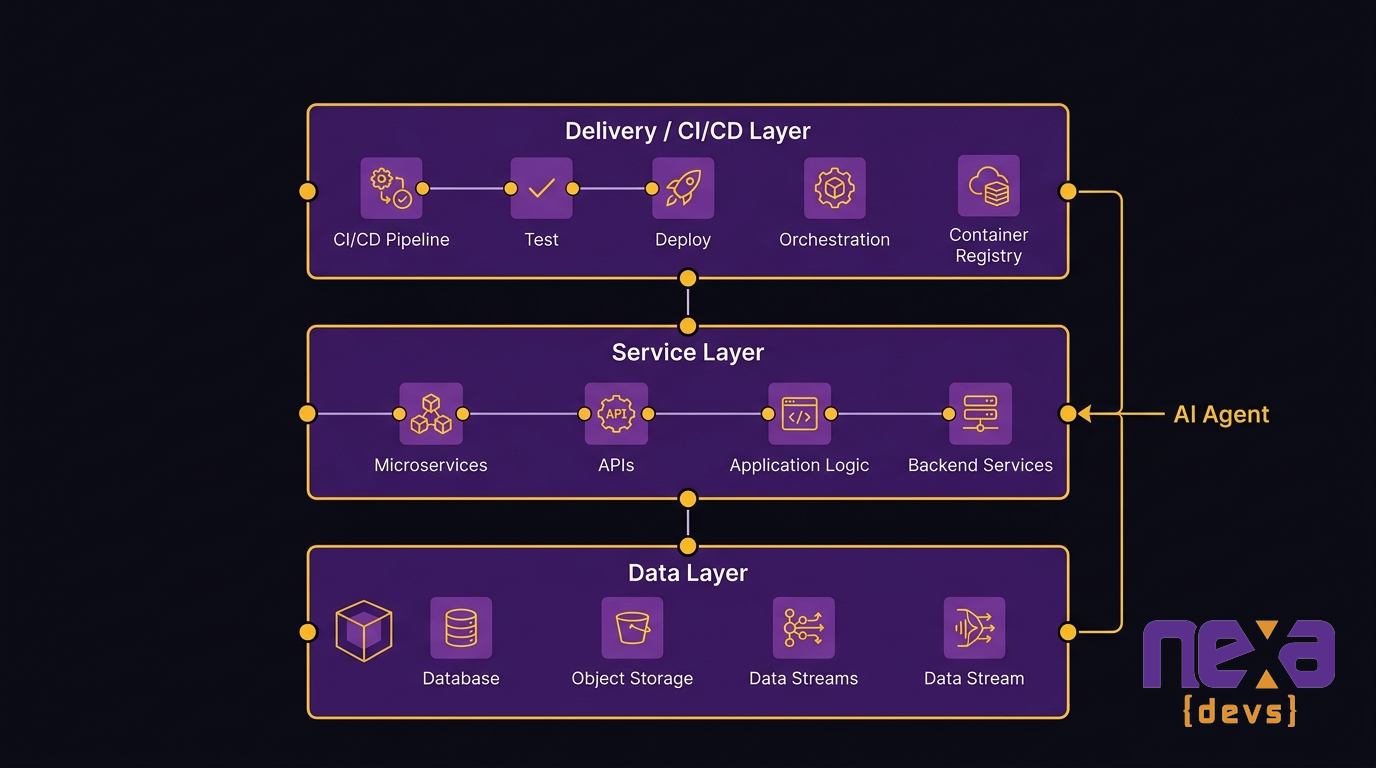
AI-ready architecture isn’t a single technology choice. It’s a set of design decisions that together give an AI agent the surface it needs to operate. Each of the four agent requirements maps directly to a layer of the target architecture.
Data layer: unified, observable, queryable by external systems
A unified data layer makes data accessible to systems outside the application — including AI models. That doesn’t mean a single database. It means an architecture where schemas are consistent, access is controlled through documented interfaces, and data exposed to external consumers is validated and clean.
This requires data governance work alongside technical architecture work: defining ownership of each data domain, establishing data quality standards, and retiring the hand-coded integrations that currently move dirty data between isolated stores.
Service layer: API-first design with loosely coupled modules
An API-first service layer means every business capability is exposed through a defined, callable interface. Services have clear domain boundaries — one service owns customer data, another owns order processing, another owns notifications. They communicate through those interfaces, not through shared database tables or internal function calls.
This design makes each service independently deployable and independently testable. It’s also what gives an AI agent a clean set of tools to call. Each API endpoint becomes a potential agent tool. The cleaner the interface, the more reliable the agent behavior.
Delivery layer: CI/CD that supports iterative model deployment
A CI/CD pipeline built for AI deployment ships model updates, prompt changes, and agent tool definitions independently of full application releases. That means feature flags, automated test gates, and deployment environments that mirror production closely enough to catch model behavior regressions before they reach users.
Without this layer, AI iteration stalls at the deployment gate. With it, the feedback loop between model behavior and business outcome compresses from weeks to hours.
How to Get There Without Replacing Everything
A big-bang rewrite is almost never the right answer. It takes longer than projected, costs more than budgeted, and forces a live business to run on a frozen codebase during execution. The organizations that have successfully modernized toward AI-ready architecture didn’t replace everything at once — they replaced strategically.
Identify the AI-blocking chokepoints first — not the entire system
Not every part of your system blocks AI. The parts that block it are specific: the modules with no API surface, the databases where the data an AI agent would need sits in the most chaotic schema, the services where a single change triggers the longest regression cycle.
Start with an architecture assessment that maps your system against the four agent requirements. The output isn’t a list of everything that needs to change. It’s a ranked list of the specific components whose current state prevents AI deployment. Fix those first.
The strangler fig pattern: incrementally replace without a full shutdown
The strangler fig pattern is the standard incremental modernization approach: build new, clean services alongside the legacy system, route traffic to them progressively, and retire legacy components as they’re replaced. The system stays live throughout. The new architecture grows while the old one shrinks.
For AI readiness, each new service built in this pattern is API-first and agent-ready from day one. You don’t end up with a legacy system patched with modern components. You end up with a modern system built incrementally around the legacy core.
At Nexa Devs, the delivery process is AI-native from the first sprint. Systems built or modernized through our process emerge with clean architecture, complete API documentation, and the test coverage that makes future AI integration straightforward — not as a post-delivery activity, but as a standard artifact of how we build.
How to show AI wins while the foundation is being built
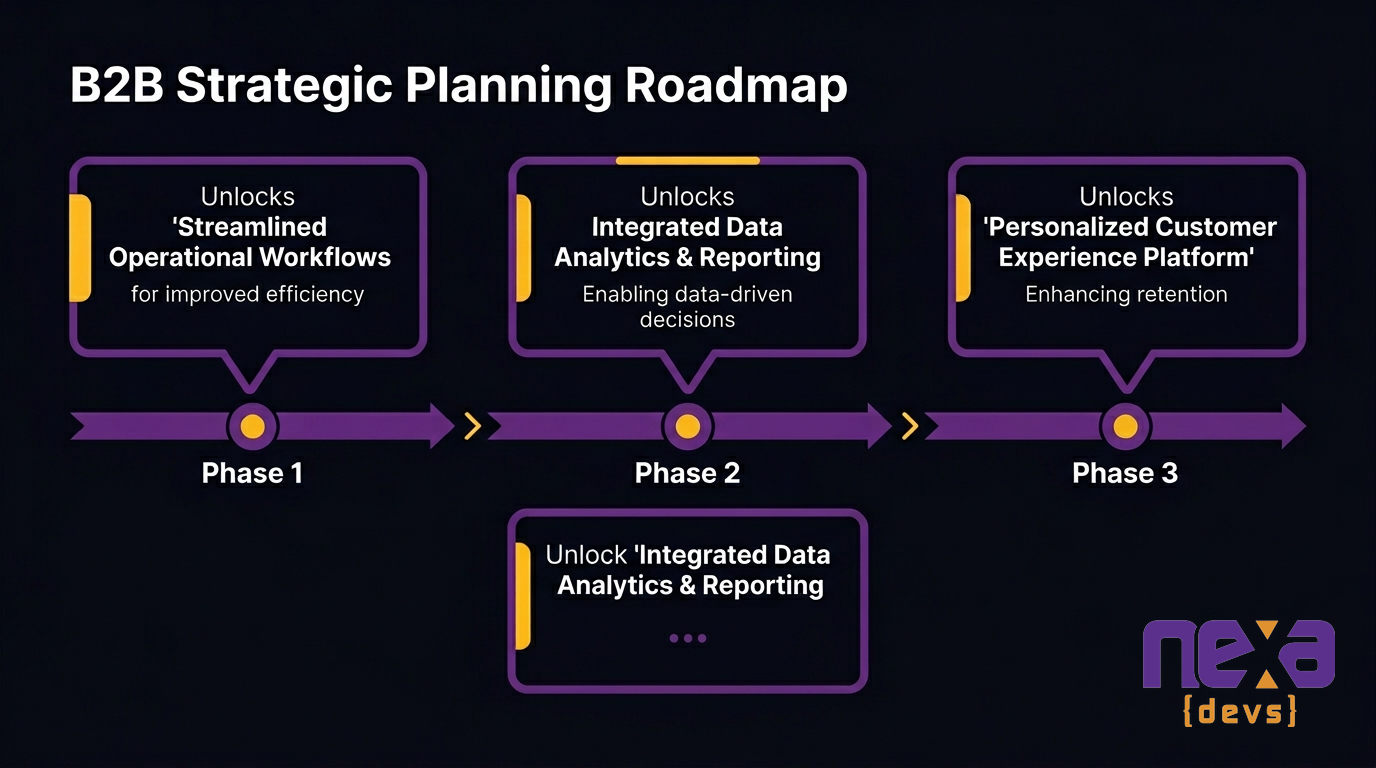
The modernization roadmap doesn’t have to be invisible to the business while it runs. Each phase can be sequenced to unlock a specific AI capability when it completes.
Phase one cleans the customer data domain and exposes it through a new API. That immediately enables an AI agent to answer customer-facing queries from clean data. Phase two extracts the order processing service. That enables an AI agent to take order actions autonomously. Each phase produces both architectural improvement and a new AI capability the business can see.
This is the language that keeps the modernization roadmap funded: every infrastructure investment maps to a specific AI feature that ships when the phase completes.
Talking to Your CEO: Reframing Infrastructure as AI Strategy
The CEO wants AI shipped. You need a budget to modernize the infrastructure that makes AI possible. Those two things sound like a conflict. They’re actually the same conversation — if you frame it correctly.
The cost of not modernizing vs. the cost of a phased modernization
The consequences of technical debt aren’t deferred — they’re compounding. According to AEI (2025), the consequences of technical debt, including cybersecurity incidents, operational failures, and legacy maintenance costs, total $2.41 trillion annually across U.S. businesses. That’s the cost of not fixing it.
A phased modernization has a known cost and a defined timeline. The alternative — continuing to pay 43% of the IT budget to keep legacy systems alive while AI capability accumulates in competitors — has an unknown cost that grows every quarter.
As Skylar Roebuck, CTO of Solvd, has noted: “AI capability is compounding rapidly.” The real risk isn’t moving too fast. It’s the compounding cost of delay.
How to frame infrastructure investment as AI readiness investment
The framing that works with CEOs isn’t “we need to modernize our infrastructure.” That sounds like a sunk-cost engineering project with no visible output. The framing that works is: “each phase of this modernization unlocks a specific AI capability — here’s what ships in phase one, what ships in phase two, and the business outcome attached to each.”
Infrastructure investment and AI strategy are the same investment when you sequence the work correctly. That’s the argument that moves the budget.
The organizations competing with you for market share aren’t waiting. If your infrastructure can’t support AI agents today, the question isn’t whether to modernize — it’s how fast you can afford to move.
Build AI Capability on Architecture That Can Hold It
You can’t run AI agents on a system with no API surface, dirty siloed data, and a six-week deployment cycle. That’s not a problem you work around with the right vendor or the right model. It’s a structural constraint — and the only path through it is fixing the structure.
The answer isn’t a big-bang rewrite. It’s a phased modernization that sequences infrastructure improvements to unlock AI capabilities as each phase completes, so the business sees AI wins while the foundation is being built.
Nexa Devs runs architecture assessments that map your system against the four requirements AI agents actually need, then delivers incremental modernization using an AI-native process that produces clean architecture and full documentation as standard artifacts. You end up owning the system — not renting access to a new dependency.
Ready to find out where your infrastructure stands?
Start with an architecture assessment to identify which components block AI deployment — missing API layer, siloed data, tightly coupled services. Use the strangler fig pattern to build API-first replacements incrementally alongside the existing system. Sequence each phase to unlock a specific AI capability on completion. Bolting an AI layer on top without fixing the underlying architecture produces demos, not production capability.
What are the challenges of legacy modernization?
The main challenges are tight coupling, data silos, no API surface for AI agents to call, and a maintenance burden that consumes budget. According to CIO Dive (2025), 43% of IT budgets go to keeping legacy systems alive — leaving little for modernization. Justifying infrastructure investment to business stakeholders before AI features ship is the key organizational challenge.
What is the legacy model in AI?
In infrastructure terms, a legacy system is a monolithic or end-of-life application that predates the API economy and can’t support modern AI agent workflows — no callable interface, unclean or siloed data, and tight internal coupling that makes change risky. This structural mismatch is the most common AI-readiness blocker for mid-market organizations.
What are the problems with legacy systems?
Legacy systems have four structural problems that block AI: no API layer, siloed and dirty data, tight coupling that makes every change a crisis, and a maintenance burden that consumes IT budget. According to CIO Dive (2025), 43% of IT budgets go to legacy maintenance — leaving only 29% for transformative technology investment.
Why are AI agents not working?
AI agents fail in production because the infrastructure wasn’t built for them. Agents need callable API endpoints, clean unified data, loosely coupled services for orchestration, and a fast deployment pipeline. When those four requirements aren’t met, agents work in controlled pilots and fail under real workloads. The failure is the infrastructure, not the agent.
The healthcare industry is undergoing a digital transformation. Software solutions are at the forefront of this change. They enhance patient care and streamline operations. Aging systems in healthcare need modernization. Custom solutions are key to addressing unique organizational needs. They offer flexibility and scalability. Health management systems companies are leading this charge. They provide innovative solutions tailored to specific challenges. Their role is crucial in this evolving landscape.
Future trends in software development are promising. Artificial intelligence and telemedicine are gaining traction. Enhanced data security is also a top priority. Cloud-based solutions are becoming more popular. They offer cost-effectiveness and scalability. This shift is reshaping the industry. Interoperability is another focus area. Seamless data exchange between systems is essential. It improves efficiency and patient outcomes. Healthcare IT services companies are expanding their roles. They offer comprehensive support and maintenance. This ensures smooth operation of software systems. The future of healthcare software is bright. Embracing innovation is key to better healthcare outcomes.
The Evolution of Healthcare Management Software
Healthcare management software has come a long way. It started as simple record-keeping tools. Now, it’s a vital part of patient care. Early systems focused on administrative tasks. They managed patient records and billing. This was a groundbreaking shift at the time. Today’s software offers much more. It integrates various aspects of healthcare. From patient history to diagnostics, it’s comprehensive. Medical software companies drive innovation. They’ve introduced new features over time. These include telemedicine and AI capabilities.
Let’s break down the evolution:
Record-keeping to Integrated Systems: Initial systems were basic, but integration soon became crucial.
Administrative to Clinical Functions: Early platforms dealt with logistics, while modern ones support clinical decisions.
Standalone to Interoperable Solutions: Initial software was isolated, today’s systems ensure seamless data flow across platforms.
Hospital software companies focus on improving workflows. Their solutions aim to reduce manual tasks. Automation is becoming a standard feature. Healthcare IT services companies are also playing a crucial role. They support the implementation and maintenance of these systems. Their expertise ensures software is up-to-date. The shift to cloud-based platforms marks a key milestone. It offers scalability and cost-efficiency. Healthcare facilities are fast embracing this trend. The evolution of health management systems continues. Advances in technology promise further transformation. Expect more personalized and efficient solutions.
Why Aging Healthcare Systems Need Modernization
Aging healthcare systems face significant challenges. They struggle with inefficiencies that impact patient care. Modernization is essential to address these issues. Outdated systems often lack interoperability. This hinders data exchange and collaboration. Medical professionals need seamless access to information. Legacy systems are more prone to failures. This can lead to data loss and security breaches. These risks are unacceptable in today’s healthcare environment. New advancements offer better performance. Modern systems are faster and more reliable. They support complex healthcare applications and improve workflow efficiency.
Consider these reasons for modernization:
Improved Interoperability: Enables smooth data exchange across platforms.
Enhanced Security: Protects sensitive patient information against breaches.
Increased Efficiency: Reduces manual processes and administrative burdens.
Healthcare software vendors play a crucial role. They provide solutions tailored to current needs. Their focus is on upgrading systems for better outcomes. Cost is a major factor for healthcare providers. Transitioning to new systems might seem expensive. However, long-term savings make modernization worthwhile. The demand for modern healthcare technology solutions is growing. Facilities that adapt to new software gain a competitive edge. They can offer enhanced patient care, which is a top priority. Overall, modernizing healthcare systems is no longer optional. It is vital for maintaining quality care and operational efficiency. Embracing new technology ensures healthcare facilities meet future demands.
Key Trends Shaping the Future of Healthcare Software Development
Healthcare software development is rapidly evolving. Emerging trends are set to transform the industry, offering improved patient care and efficiency.
Artificial intelligence (AI) is taking center stage. AI-driven solutions enhance diagnostics and treatment planning, delivering personalized care. AI’s integration into healthcare IT is promising significant advancements.
Machine learning (ML) complements AI, analyzing large datasets for insightful patterns. This aids in predictive analytics, improving decision-making and patient outcomes.
Telemedicine’s rise is a game-changer. Remote care has become a vital component of healthcare, driven by the need for accessible and efficient solutions.
Enhanced data security is now paramount. Compliance with regulations like HIPAA is crucial. Healthcare software vendors are focusing on robust security measures.
Consider these future trends:
Cloud-based Solutions: Scalability and cost-effectiveness are driving their adoption.
Interoperability: Seamless integration between systems is gaining importance.
Wearable technology is another area witnessing rapid development. It provides real-time health data, facilitating patient monitoring and proactive care. Blockchain technology is being explored for its potential in secure data sharing. Its ability to ensure data integrity is promising for healthcare applications. best medical software companies are investing heavily in research and innovation. They aim to stay ahead by adopting cutting-edge technologies.
Population health management software is gaining attention. It analyzes community health data to improve outcomes and resource allocation. These technological advancements offer numerous benefits. However, they also pose challenges, including cost and integration issues. The healthcare sector must adapt to these changes. Embracing technology ensures improved patient care and operational efficiency. Overall, these trends highlight the dynamic nature of healthcare technology solutions. Staying updated is crucial for healthcare providers to remain competitive and efficient.
Artificial Intelligence and Machine Learning in Healthcare IT
AI and ML are revolutionizing healthcare IT. They offer unprecedented possibilities for patient care and operational efficiency. AI applications are expanding rapidly. From diagnostics to personalized treatment plans, AI is being integrated across various healthcare domains. ML algorithms analyze vast amounts of data. They uncover patterns that are beyond human capabilities, aiding in preventive care.
Key applications of AI and ML:
Predictive Analytics: Identifying potential health risks before they manifest.
Automated Diagnostics: Enhancing accuracy and speed of diagnosis.
These technologies also streamline administrative tasks. AI-powered chatbots assist with appointment scheduling and patient queries. Healthcare software companies are at the forefront of these innovations. They are developing solutions to harness the full potential of AI and ML. AI and ML ensure data-driven decision-making. They improve patient outcomes while reducing operational costs.
However, implementation is not without challenges. Data security, quality, and ethics are crucial considerations. Investment in AI research and development is essential. This ensures healthcare providers can leverage these technologies effectively. Ultimately, AI and ML are shaping a future of precision and efficiency in healthcare. Embracing these technologies is crucial for modern healthcare systems.
The Rise of Telemedicine and Remote Care Solutions
Telemedicine is transforming healthcare delivery. It offers accessible and efficient care, eliminating geographical barriers. The pandemic accelerated telemedicine adoption. It became essential for safe and remote healthcare access. Remote care solutions provide various benefits. They reduce travel costs and save time, making healthcare more convenient.
Key features of telemedicine:
Video Consultations: Direct access to healthcare professionals from anywhere.
Remote Monitoring: Continuous tracking of patient health metrics.
Telemedicine supports chronic disease management effectively. Patients receive continuous care while maintaining their routines. Healthcare software providers are developing robust telemedicine platforms. These solutions integrate seamlessly with existing systems. Telemedicine ensures better resource utilization. It reduces patient load on physical facilities, optimizing operations.
However, challenges remain, such as ensuring data privacy and technological infrastructure. Healthcare IT companies play a critical role in addressing these issues. They offer solutions to enhance telemedicine’s potential. As telemedicine evolves, it is set to become a standard component of healthcare services. Its growth signifies a fundamental shift towards patient-centric care.
Enhanced Data Security and Compliance
Data security is a top priority for healthcare software firms. Protecting sensitive patient information is crucial in this digital age. Healthcare providers must comply with strict regulations. Adhering to standards like HIPAA is essential for maintaining trust and integrity. Enhanced security measures are being implemented. These range from encryption to multi-factor authentication, ensuring data protection.
Key elements of data security:
Encryption: Secures data both in transit and at rest.
Access Controls: Limits data access based on roles and responsibilities.
Healthcare software solutions incorporate these features to safeguard data. They ensure privacy and confidentiality for patient information. Breaches can lead to severe consequences. Financial loss and damage to reputation are significant risks. Medical IT services focus on comprehensive security strategies. They include regular audits and vulnerability assessments. Education and training are also vital. They equip staff with knowledge to recognize and counter cyber threats. Healthcare IT solutions companies are investing in security innovation. They aim to stay ahead of emerging threats and ensure patient data safety. Ultimately, strong security frameworks are indispensable. They foster trust and enable the safe implementation of modern healthcare technologies.
The Power of Custom Healthcare Software Solutions
Custom healthcare software solutions are revolutionizing medical practices. These tailored systems address specific organizational needs, optimizing workflow and improving patient outcomes. Unlike off-the-shelf products, custom solutions are developed with unique user requirements. They align seamlessly with existing processes and future goals. Custom software offers flexibility. It evolves with the organization, accommodating growth and change without compromising efficiency.
Consider these standout features of custom solutions:
Personalized User Interface: Designed to enhance usability for staff and patients.
Scalable Architecture: Enables easy expansion as the organization grows.
The implementation of such solutions significantly reduces operational bottlenecks. This enhances productivity and patient satisfaction, making healthcare delivery more efficient. The collaboration with healthcare software companies ensures these solutions are cutting-edge. Regular updates and support are available to meet regulatory demands and technological advances. Customization also facilitates integration with various devices and platforms. This ensures interoperability, which is crucial in today’s digital ecosystem. Challenges may arise in the development phase. However, they are outweighed by the long-term benefits of a tailored approach. Investing in custom software demonstrates a commitment to patient-centered care. It empowers healthcare providers to offer more effective and personalized services. In short, custom healthcare software solutions are key to modernizing systems and improving care delivery. They provide a strategic advantage in a competitive landscape.
Benefits of Custom Solutions for Healthcare Providers
Custom solutions offer immense benefits to healthcare providers. They ensure systems meet specific needs, streamlining operations and enhancing care quality. One major advantage is increased efficiency. Custom software reduces redundant tasks, allowing staff to focus on patient care. It also supports better resource management. Providers can allocate staff and equipment more effectively, optimizing operational performance.
Noteworthy benefits include:
Enhanced Data Management: Improved data handling and reporting capabilities.
Patient-Centered Features: Customization for patient engagement and experience.
Another benefit is reduced error rates. Custom software often includes tailored checks and balances, minimizing errors in patient records and treatment plans. Healthcare software firms offer ongoing support and maintenance. This ensures the software remains compliant and up-to-date with industry standards. Custom solutions facilitate innovation within organizations. They empower staff to adapt and respond quickly to changes in healthcare trends and demands. Adopting custom solutions ensures competitive advantage. Providers can deliver a higher standard of care, attracting patients and maintaining trust.
Overcoming Integration Challenges with Custom Software
Integrating custom software into existing systems can present challenges. However, strategic planning and expert partnerships make it feasible. Successful integration requires collaboration with experienced healthcare IT services companies. They possess the skills needed to navigate complex IT environments. Common integration challenges include system compatibility and data migration. Addressing these challenges ensures smooth transitions and minimizes disruptions.
Key strategies for overcoming integration hurdles:
Thorough Assessment: Evaluate existing infrastructure and identify needs and constraints.
Incremental Deployment: Implement software in manageable phases for risk mitigation.
Custom solutions offer the flexibility to adapt to legacy systems. They ensure functionality is preserved while upgrading capabilities. Communication is crucial during integration. Engaging stakeholders throughout the process promotes clarity and alignment with organizational goals. Continual support from IT companies is essential. They provide troubleshooting and optimization services to enhance system performance post-integration. Achieving seamless integration enhances operational efficiency and maximizes the benefits of custom software. It’s a step forward in modernizing healthcare infrastructure.
Leading Healthcare Management Software Companies: Innovators and Market Leaders
The landscape of healthcare management software is dynamic, with various companies leading the charge in innovation. These companies are consistently pushing the envelope to modernize healthcare IT solutions.
Among the largest healthcare software companies, some set the standards with pioneering solutions. They focus on interoperability, data security, and user-friendly applications.
These innovators prioritize research and development, ensuring their products remain ahead of the curve. Their commitment to advancing technology fosters better patient care and operational efficiency.
Notably, many healthcare software vendors are moving towards cloud-based solutions. This transition offers scalability and reduces costs for healthcare providers. By leveraging the cloud, companies ensure their software adapts to growing data needs.
Additionally, medical management software leaders emphasize compliance with regulations such as HIPAA. This commitment to safeguarding patient data earns them trust and builds reputations as reliable partners.
Prominent companies in this domain provide comprehensive healthcare IT services. This includes strategic consulting, software development, and implementation support. Their extensive expertise enables them to offer customized solutions for diverse healthcare needs.
Key characteristics of leading healthcare software companies:
Innovation: Continuously develop new features and improve existing solutions.
Customer-Centric: Prioritize user feedback to refine products.
Global Reach: Operate across multiple regions, offering multilingual support.
Their strategic partnerships with hospitals and clinics are crucial. These collaborations enable real-world testing and adaptation of software to actual healthcare environments.
Top Healthcare IT Companies to Watch
Staying informed about top healthcare IT companies helps stakeholders make informed decisions. The best healthcare software companies are known for transformative products that redefine patient care.
In this ever-evolving field, certain companies have distinguished themselves as leaders. These firms are at the forefront of developing sophisticated healthcare software solutions.
When considering healthcare IT companies to watch, important attributes include innovation capacity and customer satisfaction. Companies that excel in these areas are well-positioned for sustainable growth.
Leading companies often feature:
Scalability: Solutions that grow with healthcare organizations.
Comprehensive Services: Bundling software development with support and training.
Cutting-Edge Research: Constantly seeking to integrate the latest technology trends.
Monitoring these companies offers insight into emerging trends and best practices. As they lead by example, they drive the broader industry’s progress and inspire new solutions.
Staying updated on these trailblazers is crucial for any healthcare organization aiming to maintain a competitive edge. As they advance in technology, they guide the trajectory of healthcare software development.
Choosing the Right Healthcare Software Partner
Selecting a healthcare software partner is a critical decision for any organization. The right partner can significantly influence the success of technology implementations. A thorough evaluation of potential partners is essential.
Start by assessing their experience and track record in the healthcare industry. Established medical software companies often bring valuable insights and proven solutions. This industry-specific experience is crucial for understanding unique healthcare challenges.
Next, consider the range of services they offer. A comprehensive portfolio, including development, integration, and support, is ideal. This ensures that you have a single point of contact for all software needs, simplifying management and coordination.
Also, explore their focus on innovation and adaptability. Partners committed to research and new technology trends will keep your systems current. They should also be open to customizing solutions to fit your organization’s specific requirements.
Key factors to consider when selecting a healthcare software partner include:
Industry Experience: Established track record in healthcare.
Range of Services: Development, integration, and support.
Adaptability: Willingness to customize solutions.
Finally, ensure they value customer feedback and have a robust support system. This ensures any challenges you encounter are addressed promptly. A partner who listens to user feedback can continuously refine their offerings to better serve your organization.
Implementation Best Practices for Modern Healthcare Software
Successfully implementing modern healthcare software requires strategic planning and execution. Proper preparation significantly impacts the outcome of the software integration. Engaging stakeholders early in the process is essential.
Collaboration among departments ensures that software meets cross-functional needs. Gathering input from clinical staff, IT teams, and administration provides a comprehensive understanding of system requirements. This collaboration helps in aligning the software with the organization’s overall goals.
Moreover, investing time in training users can elevate adoption rates and proficiency. Tailored training sessions should focus on real-world scenarios to enhance learning. Hands-on practice allows users to gain confidence in utilizing new tools effectively.
Continuous monitoring and evaluation of the software post-implementation are critical. It helps identify any discrepancies or areas for improvement. Regular feedback loops facilitate timely updates and enhancements to the system.
Key practices for smooth implementation include:
Stakeholder Engagement: Involve all relevant parties early.
User Training: Conduct scenario-based training.
Continuous Evaluation: Regularly assess and refine the software.
By following these best practices, healthcare organizations can ensure a smooth transition to modern systems.
The Future Outlook: What’s Next for Healthcare Management Software Companies?
As healthcare evolves, management software companies face new challenges. They must adapt to shifting industry trends and growing technological advancements. Prioritizing innovation will be crucial for survival and success in this competitive landscape.
The demand for personalized healthcare solutions is growing. Individuals expect software that can cater to their unique health needs. Companies that focus on patient-centric designs are likely to gain a competitive edge.
Furthermore, cloud-based solutions will continue to shape the future. Scalability and cost-efficiency make cloud options appealing. This shift enables healthcare organizations to manage resources more effectively.
Additionally, regulatory compliance remains a top priority. Software companies must ensure their products adhere to strict health data laws. Maintaining high security standards will solidify trust with healthcare providers.
Emerging trends that will influence future growth include:
Personalized Medicine: Software customized for individual patient needs.
Cloud Integration: Enhanced scalability and reduced costs.
Regulatory Compliance: Stringent adherence to data protection standards.
By embracing these trends, healthcare management software companies can pave the way for a more innovative and efficient future.
Conclusion: Embracing Innovation for Better Healthcare Outcomes
The future of healthcare heavily relies on innovative software solutions. Embracing new technologies leads to improved efficiency and patient care. Custom solutions tailored to specific needs ensure better alignment with healthcare goals.
Healthcare management software companies stand at the forefront of this transformation. By prioritizing development, they empower providers with tools for success. The journey toward modernization promises enhanced outcomes for all stakeholders involved.
Artificial intelligence is reshaping the business landscape. AI business automation tools are at the forefront of this transformation. They streamline operations and boost efficiency. AI tools automate repetitive tasks. This allows employees to focus on strategic activities. The result is increased productivity and reduced costs. Intelligent automation solutions combine AI with machine learning. This enhances decision-making processes. Businesses can now make data-driven decisions with ease. AI platforms for business offer scalable solutions. They grow with the company, adapting to changing needs. This flexibility is crucial in today’s fast-paced market. Workflow automation tools optimize business processes. They ensure tasks are completed efficiently and on time. This leads to improved customer satisfaction. AI productivity tools are particularly beneficial for local service businesses. They enhance customer interactions and service delivery. This gives businesses a competitive edge. In this article, we explore the top AI tools transforming business automation in 2025. Discover how these tools can drive growth and innovation.
The Rise of AI Business Automation Tools in 2025
The landscape of business automation is rapidly evolving. In 2025, AI business automation tools are taking center stage. This shift is driven by advancements in AI technology.
These tools are now crucial for maintaining competitiveness. Businesses are leveraging them to enhance efficiency and reduce costs. AI is not just a tool, but a vital strategy for growth.
AI-driven automation offers several benefits. It automates mundane tasks, boosts productivity, and improves decision-making. With more data than ever, AI helps make sense of it all.
The rise of AI automation is influenced by a few key factors:
Cost Reduction: Minimizing operational costs is vital for profitability.
Data Management: AI tools handle and analyze vast amounts of data efficiently.
Enhanced Customer Experience: AI-driven interactions are more personalized and effective.
Furthermore, AI platforms are increasingly user-friendly. Even non-tech users can navigate these systems easily. This accessibility makes AI more appealing and widely adopted.
As businesses recognize the power of AI, its integration becomes more seamless. The goal is a future where AI handles routine tasks, freeing up human resources for creativity and innovation.
Key Benefits of AI-Driven Business Automation
AI-driven business automation offers a multitude of benefits. One primary advantage is efficiency. AI tools streamline operations by performing repetitive tasks faster and more accurately than humans. This efficiency translates into notable time savings.
Cost-effectiveness is another significant benefit. By automating tasks, businesses can reduce labor costs. AI also minimizes human error, resulting in fewer costly mistakes. This precision can significantly enhance operational profitability.
AI tools improve decision-making processes. They provide insights by analyzing data patterns, helping businesses make informed choices. This leads to more strategic planning and a competitive edge in the marketplace.
The advantages of AI-driven business automation include:
Increased Efficiency: Automation speeds up processes and enhances accuracy.
Cost Savings: Reducing labor and error costs boosts profitability.
Improved Decision-Making: Data analysis offers actionable insights and better decisions.
Strategic Growth: Supporting scalable operations and market expansion.
In addition, AI enhances customer experiences. By personalizing interactions and ensuring swift responses, businesses can elevate customer satisfaction. As a result, AI not only aids internal processes but also improves client-facing services.
How to Choose the Best AI Tools for Your Business
Choosing the best AI tools for your business requires careful analysis and planning. Start by identifying specific needs and challenges within your operations. Understand what tasks require automation to achieve optimal results.
Next, evaluate the scalability of AI tools. Your business will grow, and your tools should scale with it. Ensure the AI solutions can handle increased workloads without compromising performance.
Consider integration capabilities. The AI tools should seamlessly integrate with your existing systems. This ensures smooth transitions and minimal disruptions to daily operations.
When selecting AI tools, also consider:
User-Friendliness: Tools should be accessible to all team members.
Support and Training: Robust customer support eases the learning curve.
Customization: The ability to tailor tools to your industry’s unique needs.
Additionally, evaluate vendor reliability. Research the company’s reputation and user reviews to gauge satisfaction and performance. Reliable vendors provide consistent updates and improvements, ensuring your tools stay relevant and effective in evolving market conditions.
Top 10 AI Business Automation Tools for 2025
In 2025, AI tools will redefine business operations with innovation and efficiency. Companies will leverage these tools to automate tasks and enhance workflow. Each tool offers unique capabilities catering to diverse business needs.
Notable tools transforming business automation include:
UiPath emerges as a leader in business automation. It provides agentic automation solutions that empower enterprises to automate complex workflows. Its agentic AI improves decision-making by learning from data.
UiPath’s user-friendly platform allows easy integration with existing systems. It supports both attended and unattended automation, offering flexibility in task management. The platform enhances productivity by handling routine tasks swiftly and accurately.
Core features of UiPath include:
Robust Security: Ensures data integrity and compliance.
Advanced Analytics: Provides insights for better business strategies.
Extensive Bot Management: Simplifies bot deployment and oversight.
With its continuous updates, UiPath adapts to the growing needs of businesses. It stands out as a crucial tool for companies seeking efficient automation solutions.
2. Microsoft Power Automate (with AI Builder)
Microsoft Power Automate, coupled with AI Builder, facilitates seamless automation. This platform excels at integrating AI with everyday tasks to optimize workflow processes. Its capabilities streamline operations across departments.
AI Builder enhances Power Automate by adding powerful AI models. These models assist in predicting trends and automating decision-making processes. The intuitive interface makes it easy for users to set up AI-driven automation.
Key benefits of using Microsoft Power Automate include:
Seamless Integration: Connects effortlessly with Microsoft 365 and other apps.
Scalability: Grows alongside your business needs.
Custom AI Models: Tailors automation to specific business functions.
Power Automate continues to innovate, making it indispensable for businesses focusing on AI-enhanced productivity.
3. Zapier AI Agents
Zapier AI Agents revolutionize automation by connecting different applications. It allows businesses to create custom workflows that automate repetitive tasks. Zapier simplifies the integration of AI into daily operations.
Businesses can use Zapier to automate simple and complex tasks with ease. Its AI Agents learn and adapt, improving efficiency and productivity over time. This adaptability makes it ideal for various business environments.
Highlights of Zapier include:
Ease of Use: Create workflows without coding.
Broad Integration: Connects with thousands of apps.
Dynamic Automation: Adjusts workflows as needs change.
In 2025, Zapier AI Agents will continue to drive innovation in business automation, simplifying processes across industries.
4. Automation Anywhere
Automation Anywhere stands out with its intelligent automation capabilities. It integrates AI to automate business processes efficiently. This tool is a leader in digital workforce technology, offering scalable solutions.
Its platform empowers businesses by automating tasks ranging from simple to highly complex ones. Automation Anywhere enhances process efficiency, thus freeing up valuable human resources for strategic initiatives.
Key features include:
Cloud-native Architecture: Offers flexibility and accessibility.
AI-Driven Insights: Provides data for informed decision-making.
Comprehensive Bot Store: Access to pre-built automation solutions.
For businesses aiming to optimize performance, Automation Anywhere offers a comprehensive AI automation platform.
5. IBM Watson Orchestrate
IBM Watson Orchestrate combines AI with orchestration to improve task management. It automates workflows by understanding user queries and executing tasks accordingly. Watson is renowned for its predictive analytics capabilities.
Businesses benefit from Watson’s intelligent task automation. This tool helps in managing complex processes by predicting outcomes and offering insights. It is particularly helpful in industries requiring rapid decision-making.
Key aspects of Watson Orchestrate include:
Personalized Automation: Adjusts to user behavior and preferences.
Collaborative Workflows: Enhances team collaboration.
Advanced Security: Safeguards sensitive business data.
Watson’s flexibility and intelligence make it a top choice for businesses looking to improve efficiency and innovation.
6. Notion AI
Notion AI introduces artificial intelligence into the realm of knowledge management. It assists businesses in automating content creation and data organization. Notion AI is designed to streamline the documentation process with its innovative features.
It simplifies collaboration by automating the generation of documents and reports. Its integration with task management further enhances productivity, making it a favorite among teams.
Attributes of Notion AI include:
Smart Editing: AI-assisted content creation.
Efficient Data Management: Automatically organizes information.
As businesses seek smarter document management in 2025, Notion AI positions itself as an indispensable tool for enhancing productivity.
7. HubSpot AI
HubSpot AI transforms customer relationship management with its intuitive capabilities. It automates customer interactions by predicting behavior and suggesting actions. Its platform integrates AI to provide enhanced marketing automation.
HubSpot’s AI features improve efficiency in managing leads and customer data. The user-friendly interface ensures businesses can implement AI solutions without extensive training.
Key features of HubSpot AI include:
Predictive Marketing: Anticipates customer needs.
Automated Lead Scoring: Prioritizes sales efforts.
Integrated CRM: Offers a holistic view of customer interactions.
For companies striving for excellence in customer management, HubSpot AI becomes a valuable ally in 2025.
8. Reclaim AI
Reclaim AI focuses on calendar automation to optimize time management. It uses AI to rearrange schedules based on priority and availability. Reclaim ensures tasks are aligned with business goals, improving efficiency.
Businesses using Reclaim AI find enhanced productivity in their daily operations. It manages time efficiently, reducing conflicts and boosting team coordination.
Priority Management: Aligns tasks with strategic goals.
Seamless Integration: Works with existing calendar apps.
Reclaim AI becomes an essential tool for organizations aiming to maximize resource management in 2025.
9. Moveworks
Moveworks leverages AI for task automation in IT departments. It automates tech support processes, quickly resolving issues through intelligent chatbots. Moveworks enhances service delivery by handling requests autonomously.
With Moveworks, businesses experience reduced downtime and higher service levels. Its AI-driven approach ensures queries are answered promptly and accurately.
Key features include:
Automated Ticket Resolution: Speeds up troubleshooting.
AI Chatbots: Enhances user interaction.
Actionable Insights: Provides data for service improvement.
Moveworks remains a cornerstone for IT departments seeking smarter, faster service delivery solutions.
10. Workato
Workato is a robust platform for integrating applications and automating workflows. It allows businesses to develop custom integrations with minimal coding. Workato’s AI modules enhance operational efficiency across departments.
The platform offers versatile automation options, making it adaptable for various industries. Its ease of use and strong integration capabilities stand out, offering unique benefits.
Standout features of Workato include:
Flexible Integration: Connects diverse applications.
Minimal Coding: Simplifies the automation process.
Comprehensive Workflow Automation: Covers broad business needs.
Workato’s innovative approaches to integration and automation make it a key player in business automation strategies.
AI Automation Use Cases Across Industries
AI automation tools are revolutionizing diverse industries. Each sector utilizes these tools to meet unique challenges and enhance operations. The adaptability of AI allows it to solve complex problems efficiently.
In healthcare, AI automates patient record management and appointment scheduling. Banks use AI for fraud detection and customer service automation. Retailers benefit by optimizing supply chains and personalizing customer experiences.
Manufacturing industries experience increased efficiency with AI-driven quality control and predictive maintenance. In education, AI personalizes learning, automating administrative tasks. Legal firms deploy AI for document review and contract analysis.
Key industry applications of AI automation include:
Healthcare: Patient data management, appointment scheduling
AI automation tools continue to transform industries by providing tailored solutions. These tools drive innovation, helping organizations operate more effectively and efficiently. Businesses in various sectors increasingly rely on AI to stay competitive and meet evolving demands.
Overcoming Challenges in AI Business Automation
Implementing AI in business automation comes with challenges. Companies often face issues like high initial costs and integrating new systems with existing processes. Overcoming these challenges requires careful planning and expert guidance.
Data security is another concern. Businesses must ensure that data handling within AI systems complies with privacy regulations. Furthermore, workforce adaptation is crucial. Employees need training to use AI tools effectively and to understand their benefits.
Common challenges in AI business automation include:
Cost management: Balancing initial investments with long-term benefits
Integration issues: Ensuring seamless compatibility with legacy systems
Data security: Maintaining compliance with privacy standards
Workforce training: Upskilling employees for AI tool utilization
Addressing these challenges ensures successful AI automation adoption. By investing in training and consulting with AI experts, businesses can unlock the full potential of these transformative tools. Effective challenge management leads to improved productivity and efficiency in operations.
Implementation Roadmap: How to Get Started with AI Automation
Getting started with AI automation requires a strategic approach. Begin by defining clear goals for automation and identifying processes that will benefit. Evaluate the potential impact and set realistic expectations for improvements.
Next, choose the right AI tools. Research and compare various solutions to find those that align with your business needs. Consider factors like scalability, ease of integration, and support services when making your decision.
Create a phased implementation plan. Start small, with pilot projects, to test the waters before scaling up. Ensure you have a plan for ongoing monitoring and adjustments as needed.
Here’s a basic roadmap to follow:
Set objectives: Define automation goals and benefits.
Select tools: Research AI options that suit your needs.
Plan phases: Implement in stages with pilot projects.
Evaluate progress: Continuously monitor and adapt strategies.
By following this roadmap, businesses can strategically implement AI automation, leading to improved operations and growth.
Future Trends: What’s Next for AI Business Automation?
AI business automation is rapidly evolving, and future trends will likely reshape industries. In the next few years, we anticipate enhanced integration between AI and IoT (Internet of Things), driving smarter, more connected systems.
Another exciting trend is the advancement in natural language processing. This will allow more intuitive user interactions with systems, improving task execution and customer service experiences. We can expect AI to become more adaptive, tailoring solutions in real time based on data inputs.
Here are some trends to watch:
AI and IoT merge: Seamless integration for smarter systems.
Adaptive AI: Real-time adjustments and decision-making.
Ethical AI: Focus on transparency and responsible AI use.
Augmented analytics: Advanced insights from complex data.
With these developments, AI-driven automation will offer more robust, intuitive solutions, setting new standards for efficiency and productivity. The future holds promise for businesses ready to embrace these innovative trends.
Conclusion: Maximizing Business Growth with AI Automation Tools
AI automation tools are key drivers for business growth. They enhance efficiency, streamline operations, and reduce costs. Adopting these tools can significantly boost productivity and create a competitive edge.
To maximize benefits, businesses should focus on:
Selecting tools that align with specific goals.
Ensuring seamless integration with current systems.
Regularly evaluating performance and adapting strategies.
By leveraging AI effectively, companies can unlock new opportunities, foster innovation, and achieve sustained growth. Embracing AI today positions businesses for success in an ever-evolving landscape.
Building a custom AI agent can transform your business operations. It offers tailored solutions to meet specific needs. AI agents are not just for tech giants anymore. They are accessible to businesses of all sizes. With the right approach, you can create an AI agent that enhances efficiency. It can automate complex tasks and improve decision-making. The process involves several key steps. From defining objectives to deploying the agent, each step is crucial.
Understanding AI agent programming is essential. It involves machine learning algorithms and data processing. Custom AI tools and platforms simplify development. They provide the resources needed to build robust AI solutions. AI development services can offer expertise and accelerate your project. They ensure quality outcomes and scalability. This guide will walk you through the process. You’ll learn how to build your own custom AI agent.
Understanding Custom AI Agents
Custom AI agents are intelligent systems designed to perform specific tasks. They’re tailored to meet particular needs or solve problems unique to an organization. These agents work by mimicking human-like cognitive functions. Tasks such as understanding language, recognizing patterns, and making decisions can be automated. Key components of a custom AI agent include:
Input Processing: Analyzing data from various sources.
Decision-Making: Implementing logic and rules to reach conclusions.
Interaction: Communicating results or actions based on data analysis.
Custom AI agents are versatile. They can be deployed in industries like healthcare, finance, or retail. Each deployment is customized to improve operational efficiency and outcomes. Creating a custom AI solution involves using data relevant to your business. This allows the agent to learn and perform tasks accurately. The complexity of AI agent programming depends on the tasks they perform. From simple rule-based systems to advanced neural networks, the design aligns with specific goals. Understanding these basics prepares you for the process of custom AI agent development. The right knowledge and tools enable businesses to fully leverage the power of AI.
Why Build a Custom AI Agent?
Building a custom AI agent offers numerous advantages to businesses. These agents can be uniquely tailored to fit your organization’s specific needs. One of the major benefits is enhanced efficiency. Custom AI solutions can automate complex tasks, saving time and reducing human error. This leads to increased productivity across different departments. By creating a custom AI agent, businesses can gain a competitive edge. Tailored solutions allow them to perform tasks that are uniquely beneficial to their operation. This can differentiate them from competitors.
Additionally, custom AI tools help in optimizing resources. By streamlining processes, organizations can allocate their resources more effectively. This ensures that crucial tasks are prioritized and completed efficiently. Investing in custom AI agent development can also improve decision-making. These agents can analyze vast amounts of data quickly and provide insights that support strategic initiatives. Key advantages of building a custom AI agent include:
Increased Efficiency: Automate repetitive and time-consuming tasks.
Resource Optimization: Make better use of available resources.
These factors make creating a custom AI agent a strategic decision for businesses looking to innovate.
Key Use Cases for Custom AI Agents
Custom AI agents are versatile tools that can be applied across numerous industries. They cater to various needs and bring transformative changes.
In healthcare, AI agents assist in diagnostics. They analyze patient data quickly, providing more accurate and timely results. This improves patient care and treatment outcomes.
The finance sector utilizes AI agents for fraud detection and risk management. Automated monitoring systems help identify anomalies and potential threats in real-time. This enhances security and operational efficiency.
In retail, AI agents personalize the shopping experience. They analyze consumer behavior, offering tailored recommendations and promotions. As a result, customer engagement and satisfaction are significantly boosted.
Manufacturing industries benefit by implementing AI agents for predictive maintenance. They monitor machinery health, predicting failures before they occur. This reduces downtime and maintenance costs significantly.
Key use cases for custom AI agents include:
Healthcare: Enhanced diagnostics and patient care.
Finance: Fraud detection and risk management.
Retail: Personalized customer experiences.
Manufacturing: Predictive maintenance and efficiency improvements.
These applications highlight the diverse potential of AI agents, driving innovation across sectors.
The Custom AI Agent Development Process: Step-by-Step
Developing a custom AI agent involves a series of structured steps. Each phase is crucial to ensure the success of the final product. From defining objectives to continuous monitoring, each step requires careful planning and execution. This process ensures the AI agent meets business goals and operates efficiently in real-world applications.
By following this step-by-step approach, developers can create AI agents that are robust, scalable, and adaptable. This systematic method enhances productivity and aligns AI capabilities with business strategies.
Step 1: Define Objectives and Scope
The first step is defining the objectives and scope of the AI agent. Clear objectives outline the agent’s purpose and expected outcomes. Without a defined scope, projects can quickly become unmanageable and over-budget.
To start, identify the problems the AI agent will solve. Will it automate tasks, provide insights, or enhance customer experiences?
Once the problems are defined, set measurable goals. These should be achievable and aligned with broader business aims.
Key aspects to define include:
Purpose: What the AI agent will accomplish.
Functionality: Features and capabilities required.
Constraints: Limitations and resources available.
Success metrics: How performance will be assessed.
Defining the objectives and scope is vital for a focused development process. It ensures all stakeholders have a clear understanding and commitment to the project’s direction.
Step 2: Assemble the Right Team
Building an effective team is essential for successful AI development. Diverse expertise ensures comprehensive solutions.
Start by identifying the roles needed. Common roles include data scientists, AI engineers, and project managers. Each role plays a vital part in developing different aspects of the agent.
When choosing team members, consider their experience and skillset. A diverse team brings creative solutions and enhances problem-solving.
The composition of an ideal team might include:
Data Scientist: Focuses on data analysis and model development.
AI Engineer: Specializes in implementing algorithms and systems.
Project Manager: Coordinates tasks and timelines.
Collaboration and communication within the team drive project success. A well-assembled team ensures that every facet of the development is covered.
Step 3: Data Collection and Preparation
Data is the backbone of AI agent development. Collecting and preparing data correctly is paramount for building a powerful agent.
Start by identifying the data sources needed. Sources can include databases, customer interactions, or external data vendors. Ensure data is relevant and aligned with the project’s scope.
Once data is gathered, focus on cleaning and organizing it. This step involves removing duplicates, correcting inaccuracies, and ensuring consistency.
Data preparation is followed by data augmentation. This step involves enhancing the dataset to increase diversity and improve training results.
Essential tasks in data collection and preparation include:
Data Sourcing: Identifying and acquiring necessary data.
Data Cleaning: Ensuring data quality and consistency.
Data Augmentation: Enhancing data for better model training.
Effective data collection and preparation lay the foundation for a successful AI model. They enable the model to learn accurately and perform well in diverse scenarios.
Step 4: Choose the Right Tools and Technologies
Choosing the right tools impacts the project’s efficiency and outcome. Selecting technologies compatible with the project goals is crucial.
Evaluate various platforms and libraries, considering factors like ease of use and community support. Popular frameworks such as TensorFlow, PyTorch, and Scikit-learn offer robust functionalities.
Consider utilizing cloud platforms for scalability and ease of deployment. Providers such as AWS, Google Cloud, and Azure offer comprehensive AI services.
Factors to consider when selecting tools include:
Compatibility: Alignment with project requirements.
Ease of Use: Learning curve for development.
Scalability: Ability to expand with project needs.
Support: Community and documentation availability.
Selecting the right tools streamlines the development process and ensures the AI agent is built on a solid technological foundation.
Step 5: AI Agent Programming and Model Development
With data prepared and tools selected, the next step is programming and model development. This involves coding the logic and algorithms that drive the AI agent.
Start by exploring various machine learning models. Choose between supervised, unsupervised, or reinforcement learning based on the objectives.
Develop the model iteratively. Begin with a simple version and progressively enhance complexity and features.
Programming languages like Python and R are commonly used for AI model development due to their wide array of libraries and community support.
Important steps in programming and model development include:
Model Selection: Choosing the right learning approach.
Algorithm Implementation: Coding the logic and structure.
Iterative Development: Refining and improving the model.
Performance Optimization: Ensuring efficiency and accuracy.
Effective programming and model development are the heart of the AI agent. They determine the quality and reliability of the final application.
Step 6: Testing, Validation, and Iteration
Testing and validation ensure the AI agent functions as intended. This step is crucial for identifying issues and refining performance.
Begin by running tests to evaluate the model’s accuracy and efficiency. Use a separate dataset for testing to ensure unbiased results.
Validation involves comparing the agent’s outputs against expected outcomes. Identify discrepancies and iterate on the model to improve performance.
Key aspects of testing and validation include:
Accuracy Tests: Measure how well the model predicts outcomes.
Performance Benchmarks: Assess speed and resource usage.
Iteration Cycles: Improve model based on test findings.
The iterative process of testing and validation leads to a robust and reliable AI agent. It helps to ensure the model meets business and technical requirements.
Step 7: Deployment and Integration
Deploying the AI agent involves implementing it in the production environment. This stage ensures it integrates seamlessly with existing systems.
Begin by setting up the deployment infrastructure. Consider using cloud services for easier scalability and management.
Integration involves ensuring the AI agent connects effectively with other systems and processes. Proper integration maximizes the agent’s impact and utility.
Tasks involved in deployment and integration include:
System Integration: Ensuring compatibility with existing systems.
User Accessibility: Providing interfaces for interaction.
A smooth deployment and integration process optimizes the agent’s performance and drives value for the business.
Step 8: Monitoring, Maintenance, and Continuous Improvement
Post-deployment, constant monitoring is key to maintaining performance. This ensures the AI agent operates smoothly and adapts to new data.
Set up dashboards and alerts for real-time monitoring. These tools help identify issues quickly and allow for prompt responses.
Regular maintenance involves updating models and correcting inefficiencies. Continuous improvement ensures the AI agent remains effective and valuable.
Essential activities include:
Performance Monitoring: Tracking key metrics and identifying trends.
Ongoing Maintenance: Addressing bugs and updates.
Continuous Improvement: Enhancing capabilities and features.
Monitoring and maintenance keep the AI agent aligned with evolving business needs, ensuring long-term success and relevance.
Essential Tools and Platforms for Custom AI Agent Development
Choosing the right tools and platforms is critical for efficient AI agent development. The options available today offer vast capabilities and specialized features.
Prominent frameworks include TensorFlow and PyTorch. These libraries provide extensive support for model training and optimization. They are essential for implementing machine learning algorithms and designing neural networks.
Cloud platforms are also significant in AI development. Services from Amazon Web Services (AWS), Google Cloud, and Microsoft Azure offer scalability. They provide resources for training complex models without investing in physical infrastructure.
Open-source tools play a vital role. They provide flexibility and community-driven enhancements. Libraries like Scikit-learn and Keras offer simpler APIs for quick experimentation.
Here’s a summary of essential tools and platforms:
Frameworks: TensorFlow, PyTorch, Scikit-learn
Cloud Services: AWS, Google Cloud, Microsoft Azure
Libraries: Keras, OpenCV, NLTK
Data Management: Hadoop, Apache Spark
Using these tools ensures that developers have the necessary resources and support. They help build reliable, scalable, and efficient AI agents tailored to specific needs.
Working with AI Development Services vs. Building In-House
Deciding between external AI development services and in-house development is crucial. Each option has unique advantages and challenges to consider.
AI development services provide specialized expertise and faster project timelines. For businesses looking for a reliable partner, Nexa Devs provides complete custom AI development services. We handle everything from ideas to deployment, customized for your industry needs. We offer a broad range of skills that can accelerate development and ensure high-quality outcomes.
Building in-house enables greater control over the development process. It fosters a deep understanding of the system, aligning more closely with internal needs and objectives.
Choosing the best path depends on several factors:
Project Complexity: Consider the sophistication of the AI agent required.
Internal Expertise: Assess if the current team has the necessary skills.
Budget Constraints: Determine financial resources for either option.
Timeframe: Evaluate how quickly deployment is needed.
Many organizations opt for a hybrid approach. They leverage external expertise while developing internal capabilities, striking a balance between speed and control.
Security, Privacy, and Ethical Considerations
Security is paramount in custom AI agent development. Protecting sensitive data from breaches or misuse is essential to maintain trust and integrity. Privacy concerns demand careful attention to data handling processes. Implementing robust encryption and anonymization techniques helps in safeguarding user information. Ethical considerations guide responsible AI usage and development. It is crucial to ensure that AI systems are fair and unbiased, promoting equality in outputs and decisions.
Key aspects to focus on include:
Data Protection: Ensure compliance with data protection laws.
Fairness and Bias: Regularly audit algorithms for biases.
Transparency: Maintain clear communication about data usage.
By addressing these challenges, developers can build AI agents that respect user rights and operate within legal frameworks. A proactive approach to these issues not only mitigates risks but also enhances the credibility of AI-driven solutions.
Common Challenges and How to Overcome Them
Developing custom AI agents often involves several challenges. These hurdles can impact development timelines and outcomes. Data quality is a frequent issue. Poor data can lead to subpar AI performance. Ensuring that data is accurate and representative is critical. Algorithm selection is another challenge. Choosing the wrong algorithm can hinder effectiveness. Hence, rigorous testing and validation are necessary. Integration with existing systems may pose difficulties. Seamless integration ensures consistent operation without disrupting current processes.
Key challenges include:
Data Quality: Regularly audit datasets for accuracy.
Algorithm Choice: Evaluate multiple models before finalizing.
System Compatibility: Conduct thorough compatibility tests.
Overcoming these challenges requires strategic planning, continuous testing, and adaptation. By spotting and dealing with these problems early, teams can make AI agent development and deployment easier. This leads to successful and efficient solutions.
Future Trends in Custom AI Agent Development
The future of custom AI agent development is promising and rapidly evolving. With advancements in technology, AI solutions are becoming more sophisticated. One significant trend is the rise of explainable AI. This approach makes AI models transparent, helping users understand decision-making processes better. The integration of AI with IoT devices is also gaining momentum. This combination offers dynamic, real-time data processing and automation capabilities. Enhanced natural language processing (NLP) is expected to revolutionize AI agents. Improved NLP allows for more natural and seamless human-computer interactions.
Key future trends include:
Explainable AI: Enhancing transparency in AI decisions.
AI and IoT Integration: Improving automation and real-time data use.
Advanced NLP: Elevating the user experience through better interaction.
These trends indicate exciting opportunities for developing custom AI agents. Staying abreast of these changes will be crucial for organizations aiming to leverage AI’s full potential.
Best Practices for Successful AI Agent Creation
Creating a successful AI agent requires careful planning and execution. Each step in the development process should be executed with precision. First, define clear objectives. Establishing goals from the start helps in measuring the AI agent’s success later on. Collaboration is essential. Bringing together a cross-functional team ensures a variety of skills and perspectives. Ongoing feedback is crucial for refinement. Regularly testing and incorporating user feedback will lead to continuous improvement.
Here are some best practices to consider:
Set Clear Objectives: Define what you want the AI agent to achieve.
Foster Collaboration: Work with a diverse team for better insights.
Focus on User Feedback: Regularly test and adapt based on user input.
By adhering to these best practices, organizations can significantly enhance their chances of building effective AI agents. These steps lay a foundation for success, driving impactful results.
Conclusion: Unlocking the Power of Custom AI Solutions
Building custom AI agents is a powerful strategy. It enables businesses to address unique challenges effectively. The customization ensures alignment with specific goals and enhances outcomes.
Embracing AI technologies transforms operations. Companies gain competitive advantages through automation and efficiency. Tailored AI solutions bring new capabilities to various industries.
Commitment to innovation is vital. As technology evolves, staying adaptive and forward-thinking maintains relevance. Leveraging AI today prepares businesses for a more intelligent future. By investing in custom AI development, organizations are well-positioned to succeed in the digital age and beyond.
In the digital age, businesses are constantly seeking ways to gain a competitive edge. One such way is through custom application development. Custom application development refers to the creation of software applications tailored to a business’s specific needs. These applications are made for the company’s specific needs. They consider the unique infrastructure and branding of the company. The benefits of custom app dev are numerous. It can provide a competitive advantage, streamline business processes, and offer a personalized user experience. Moreover, custom applications can grow with the business, integrate seamlessly with existing systems, and offer superior data security. They can also lead to long-term cost savings and a higher return on investment.
In this article, we will delve into the benefits of custom application development for businesses. We want to show how investing in custom applications can boost efficiency. It can also give you a competitive edge and meet specific business needs.
Join us as we explore the world of custom app dev and its potential to transform your business operations.
Understanding Custom Application Development
Custom application development is pivotal for businesses aiming to tailor technology to their unique needs. This process involves creating software solutions specifically designed to meet the specific requirements of a business. Unlike generic software, custom applications are not one-size-fits-all. They are crafted to align with a company’s specific workflows and processes. This ensures that the software fits perfectly within the existing business framework. The development of custom applications often begins with a detailed analysis of business needs. Developers work closely with company stakeholders to ensure the final product meets all required standards and specifications. This close collaboration ensures the application is precisely what the business requires.
Custom apps can enhance a company’s competitive edge. By offering a unique tool that meets specific demands, businesses can differentiate their services in the market. They stand out from competitors who rely on standardized software solutions. Furthermore, custom applications can evolve with a business. As the company grows, these applications can be scaled and adjusted to support new processes and increased workloads. This adaptability is crucial for businesses planning long-term growth.
Key Advantages of Custom App Dev for Your Business
Custom application development offers numerous advantages tailored to business-specific needs. These benefits go beyond simple functionality and extend into strategic areas, enhancing the core aspects of business operations.
One primary advantage of custom applications is their ability to provide unique solutions. These solutions are designed to meet exact business requirements, unlike off-the-shelf software. This customization can vastly improve user experience and satisfaction.
A list of key benefits includes:
Tailored solutions that fit business processes precisely
Enhanced flexibility to accommodate future business changes
Potential for integration with existing systems
Ownership of software and intellectual property
Improved security aligned with business-specific risks
By focusing on unique business challenges, custom apps help address specific goals. They are not constrained by the limitations of generic software solutions. This capability is vital in adapting to rapidly changing market environments.
Custom applications can also lead to reduced operational costs. While the initial investment may be higher, not having to pay licensing fees can save money over time. Furthermore, having a tailored solution reduces waste and increases productivity.
Custom apps improve data management by gathering and analyzing specific datasets. This leads to smarter decision-making and strategic insights. With better data handling, businesses can react faster to opportunities and threats.
The collaborative development process fosters a deep understanding between developers and business stakeholders. This partnership ensures that the software aligns with the company’s strategic goals and enhances its operational model.
Finally, custom app development creates a long-term competitive edge. By leveraging technology uniquely, businesses can differentiate themselves in the marketplace. This differentiation is crucial for sustaining business success.
Personalized User Experience
Custom applications provide a distinct advantage by focusing on personalized user experiences. By aligning the application with user needs, businesses can improve satisfaction and productivity. With custom apps, businesses can design interfaces that reflect user preferences. This customization enhances usability and effectiveness. As a result, the application feels natural and intuitive to users.
Personalization extends to functionalities as well. Custom features accommodate specific user roles and workflows. This enables employees to accomplish their tasks more efficiently. The ability to tailor interfaces helps meet diverse user needs. Custom applications can address varying levels of technical proficiency among employees. This inclusivity fosters a cohesive and productive work environment. Ultimately, a well-designed user experience boosts morale and engagement. Employees are more likely to embrace tools that feel tailored to their tasks.
Enhanced Business Efficiency
Enhanced efficiency is a hallmark of custom application development. With tailored solutions, businesses can streamline operations and eliminate inefficiencies. Custom apps automate repetitive tasks, reducing human error and increasing speed. These applications integrate seamlessly with existing systems. Integration reduces redundancy and ensures consistent data flow across all platforms. This streamlining of processes improves overall business operations.
Custom apps also provide real-time data insights. This capability enables quick decision-making based on current information. Consequently, businesses can react faster to market changes. Efficiency gains translate into increased productivity. Employees can focus on strategic initiatives rather than mundane tasks. This shift in focus drives innovation and growth within the company. Overall, a custom application ensures that every part of the business operates at peak efficiency. By designing solutions that fit perfectly, businesses see significant performance improvements.
Competitive Differentiation
Custom application development offers a significant competitive edge. Businesses can create unique applications that distinguish them in the marketplace. Differentiation is essential for standing out among competitors. A custom application can reflect brand values and enhance market presence. By aligning with company goals, the app strengthens a business’s identity. Customers notice and value this alignment.
Additionally, custom features and functionalities can provide services competitors cannot match. These exclusive offerings attract customers looking for tailored solutions. The uniqueness of custom apps allows companies to adapt quickly. Responsive businesses can seize new opportunities and innovate where necessary. This agility is crucial in fast-changing industries. Ultimately, custom applications contribute to building a strong, differentiated brand. They offer unique advantages that are hard for competitors to replicate. Businesses that leverage this strategy enjoy a robust market position.
Scalability and Growth with Custom Applications
Custom applications provide a pathway for seamless scalability. As businesses expand, their software needs change. Custom applications can easily accommodate this growth, ensuring systems remain efficient. Unlike fixed off-the-shelf solutions, custom apps evolve with the business. They can handle increased workloads and support new processes as they arise. This adaptability is crucial for maintaining performance during growth phases.
Moreover, custom applications can be designed to integrate future technologies. This proactive approach ensures that businesses aren’t left behind as technological landscapes shift. The software grows with the company, not against it. Scalability also means optimizing resources effectively. Custom apps prevent unnecessary spending on irrelevant features. Thus, businesses can allocate budgets to areas that directly contribute to growth. Overall, scalable custom solutions are instrumental for businesses aiming for long-term success. They offer the flexibility needed to explore new opportunities without compromising existing operations.
Seamless Integration into Existing Systems
Integration is key in today’s complex IT environments. Custom application development excels in creating solutions that fit seamlessly into existing systems. Unlike generic software, custom apps are tailored to match your specific infrastructure needs. This tailored approach reduces redundancy and minimizes errors. With a custom solution, businesses experience smoother operations and more efficient workflows. The custom application bridges systems, ensuring data flows correctly and reliably. Businesses often work with various software tools. Custom applications bring these tools together, streamlining processes and enhancing productivity. They serve as a central hub, providing unified access to different resources. Additionally, seamless integration ensures that staff can quickly adapt to new systems. This reduces training time and helps maintain ongoing operations.
With a custom app, team members enjoy a smoother transition and enhanced user experience. Overall, seamless integration is a significant benefit of custom app development. It enhances operation efficiency, allowing businesses to focus on their core competencies without being bogged down by technical issues.
Superior Data Security and Compliance
Custom applications offer enhanced security features tailored to a business’s unique risks. Unlike generic software, they allow for heightened protection measures that are specific to your industry. Tailored security solutions mean fewer vulnerabilities and a reduced threat of data breaches. Businesses face stringent compliance standards. Custom application development supports adherence to regulations like GDPR, ensuring data protection and privacy. Custom solutions provide peace of mind, knowing your operations comply with current laws and standards.
Moreover, custom apps afford greater control over data. With tailor-made solutions, you can implement specific access controls and encryption standards. This level of customization is often not possible with ready-made products. These products may have extra features or missing parts. Regular updates and custom support further enhance security. Dedicated development teams can swiftly address new threats or changes in the law. Continuous monitoring and maintenance ensure your application remains secure and compliant. In today’s world, data security is crucial. Custom applications offer strong and reliable solutions. They also meet compliance requirements for your business needs.
Long-term Cost Savings and ROI
Investing in custom application development projects may seem costly upfront. However, it yields significant savings over time. By eliminating recurring licensing fees, businesses can allocate resources more efficiently. Custom apps are built specifically for your needs, avoiding unnecessary features. This results in streamlined operations and reduced costs associated with excess software functions. The focus stays on what genuinely benefits your business. Furthermore, custom applications improve productivity. They automate repetitive tasks and integrate smoothly with existing systems. Improved efficiency means fewer workers are needed for simple tasks. This lets teams focus on important activities, leading to a higher return on investment (ROI).
Support and maintenance costs are also reduced. With a tailored solution, your developers are familiar with the application architecture. This ensures quick problem-solving and minimizes downtime, translating into direct financial savings. Custom apps provide a personalized way to invest in technology. They help maximize long-term financial returns and support business growth and change.
Agile Development and Ongoing Support
Agile development is a core benefit of custom application development. It emphasizes flexibility and rapid iterations. This approach ensures that changes and improvements are quickly implemented to meet evolving business needs. Working closely with the development team allows businesses to participate actively in the process. Frequent communication ensures that the application aligns closely with business objectives and user feedback. This creates a cycle of continuous improvement.
Agile methodologies facilitate the incorporation of advanced features as they become necessary. The ability to iteratively enhance the app provides a competitive edge by adapting to changing market demands. This adaptability is crucial in fast-paced industries. Ongoing support is another critical advantage. Developers who created the application understand the intricacies of its code and architecture. As a result, they can offer prompt and efficient support, minimizing downtime and maximizing performance. Additionally, agile processes foster strong relationships between the business and development team. This partnership is important for the long-term success of the application. It helps ensure that the app meets its goals effectively.
Intellectual Property Ownership
Owning intellectual property is a standout feature of custom application development. It allows businesses full control over their software assets. This control extends to modifications, enhancements, and future innovations without third-party restrictions.
When a company invests in custom applications, they gain exclusive rights to the source code. This ownership eliminates the need for recurring license fees. It also ensures that the business is not dependent on external software vendors for updates or feature additions.
Moreover, owning the application means the software can be tailored precisely to a company’s unique needs. Unlike off-the-shelf solutions, there are no limits on customization. This ensures a perfect fit with existing processes and strategic goals.
Intellectual property ownership also protects the business’s competitive advantage. Proprietary software can be a unique differentiator in the market. It showcases a commitment to originality and innovation, setting a company apart from competitors.
Ultimately, owning custom software is a strategic asset. It offers freedom, flexibility, and potential for growth. By harnessing this ownership, businesses can adapt swiftly, innovate continuously, and strengthen their market position.
Conclusion: Why Custom App Dev is a Strategic Investment
Investing in custom application development delivers substantial benefits for businesses. It provides tailored solutions that address specific needs. This makes it a strategic choice for many organizations seeking long-term success.
With custom applications, businesses gain a competitive edge through differentiation. They enhance efficiency, scalability, and security, all crucial for sustained growth. These applications are designed for seamless integration, ensuring a cohesive IT environment that supports evolving business strategies.
In the long run, the cost savings, coupled with increased return on investment (ROI), justify the initial expense. Custom application development is not just a tactical solution. It’s a smart investment that connects technology with business goals. This helps encourage innovation and builds a strong base for the future.