Table of Contents
The AI-Modernization Window: Why 2026 Is the Year Mid-Market Companies Must Break Free From Their Legacy Systems
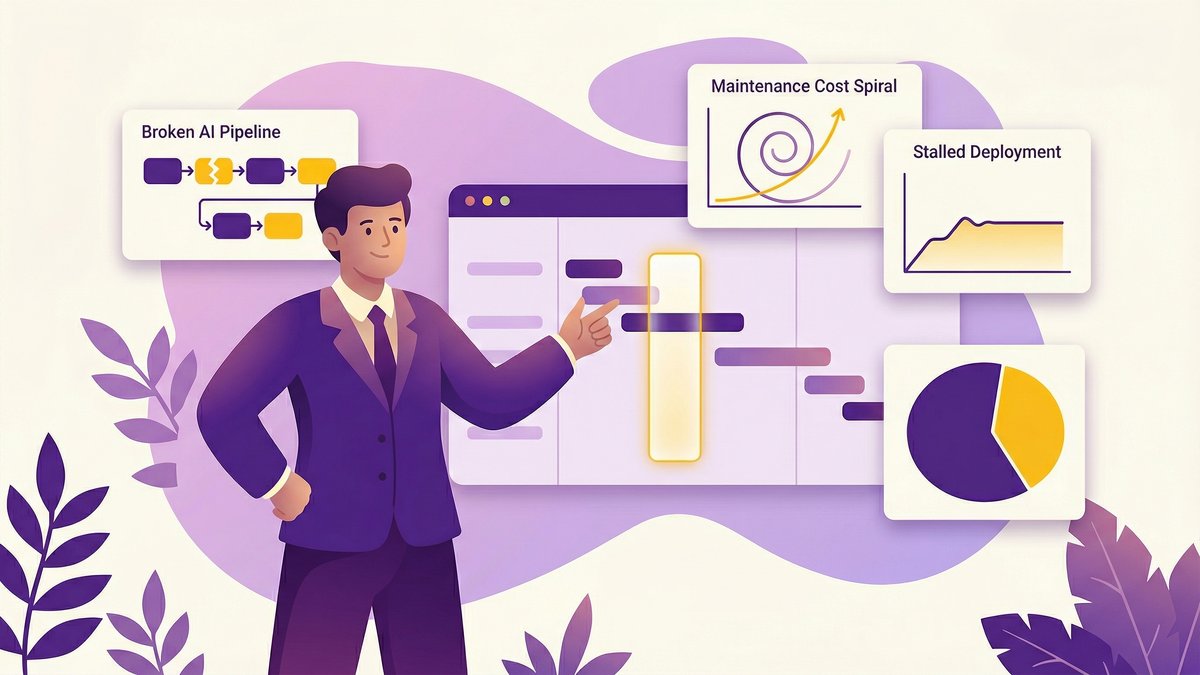
You ran a pilot. Maybe two. The AI demos were impressive. Your team was energized. Then someone asked the question that ended the conversation: “Can our current systems actually support this?”
That pause, that moment of quiet before someone changes the subject, is where most mid-market AI strategies die. Not because the AI doesn’t work. Because the systems underneath it don’t.
This is the most common and least discussed bottleneck in mid-market technology today. And in 2026, ignoring it has a cost that compounds daily.
The 2026 Modernization Window: Why Mid-Market CEOs Are Running Out of Time
The window is real, it’s narrow, and it won’t reopen on a convenient schedule.
According to QBSS (2026), 2026 marks the inflection point where mid-market velocity surpasses enterprise scale in AI adoption. That’s not a marketing claim. It’s a structural shift in who moves fastest when the bottleneck is organizational agility, not capital.
The competitive divide is compounding daily
Enterprise companies are slow. Their AI initiatives require cross-functional steering committees, 18-month procurement cycles, and change management programs. That used to be an advantage; they had the capital to absorb those timelines.
Mid-market companies don’t have that luxury. But they also don’t have that drag. A 150-person company with an engineering team of 15 can make and execute a modernization decision in a quarter. The ones doing this now are building AI capabilities that their larger competitors won’t match for two years.
The ones that aren’t? They’re watching competitors ship things their own systems can’t support.
According to an Everest Group report commissioned by R Systems (March 2026), over 40% of mid-market enterprises are already bypassing traditional AI adoption stages to accelerate competitiveness. They didn’t wait for a perfect roadmap. They found an entry point and moved.
Why 2026 is different from previous “transformation” cycles
For the past decade, someone has declared it “the year of digital transformation.” This time, the market data backs the claim.
According to Mordor Intelligence, the global legacy software modernization market is valued at $29.39 billion in 2026, growing at a 17.64% CAGR. That growth rate doesn’t happen because of hype. It happens because the cost of not modernizing finally exceeded the perceived risk of doing it.
The companies winning in 2026 aren’t the ones with the best AI strategy on paper. They’re the ones who eliminated the infrastructure barrier that was blocking the strategy they already had.
The Hidden Tax: What Legacy Systems Are Really Costing Your Business
Legacy systems aren’t a technical problem. They’re a budget problem, and the bill arrives on your P&L every month.
Most CEOs view legacy maintenance as a fixed operating cost: unavoidable, predictable, and manageable. It’s not. It’s a growing tax on your capacity to compete.
The 60–70% maintenance trap: how IT spend became a treadmill
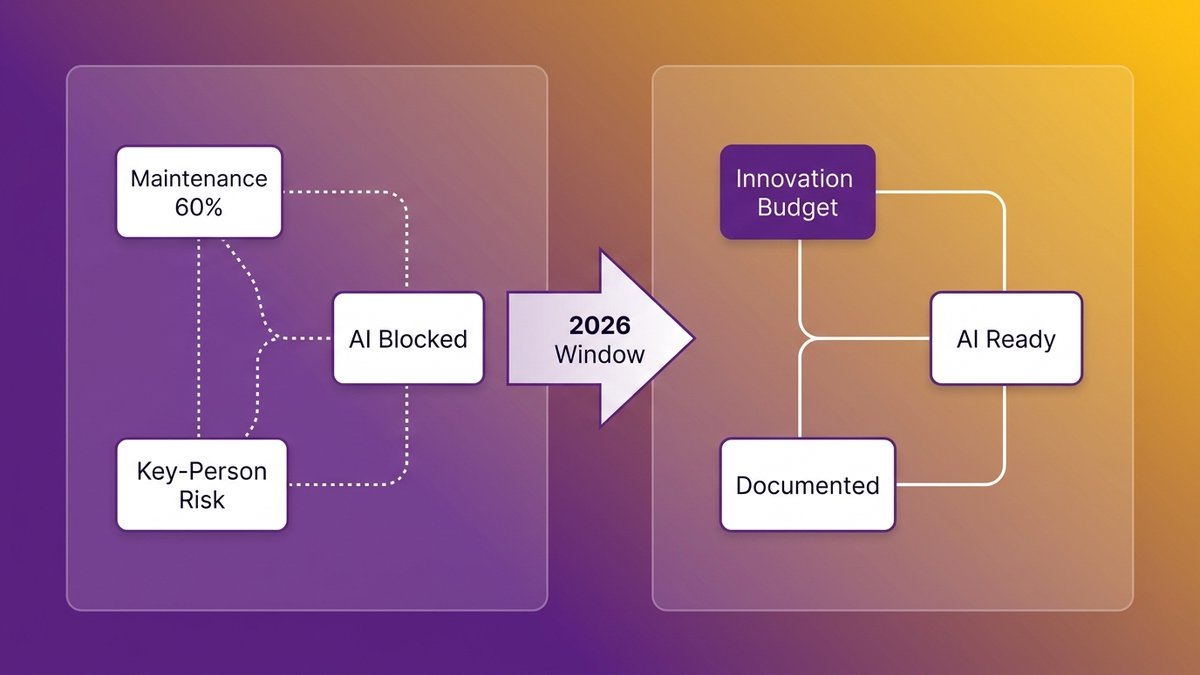
According to ADEVS Tech Journal (February 2026), 60–70% of total software spend now goes to maintenance rather than innovation. Think about what that means at your scale.
If your annual technology budget is $2 million, you’re spending $1.2M to $1.4M keeping existing systems running. You have $600,000 left, maybe less, to build new capability, integrate AI, or modernize anything. That’s not a technology strategy. That’s a maintenance contract with a side budget for ambition.
According to Deloitte’s 2026 technology leadership research, nearly 60% of technology leaders believe 21–50% of their existing technology’s value remains trapped and inaccessible due to technical debt. The systems you’re paying to maintain aren’t even performing at full potential. You’re subsidizing underperformance.
What $3.6M/year in technical debt actually looks like on your P&L
According to Garnet Grid, a mid-market company with a 20-person engineering team loses an average of $3.6 million per year to accumulated technical debt, measured in lost velocity, delayed features, increased incident response, and developer attrition.
That number makes more sense when you break it down. It’s not a single line item. It shows up as:
- Developers are spending 30–40% of their time on maintenance work instead of features
- Incidents that pull the whole team off productive work for days at a time
- Delayed product launches because the underlying system can’t support the change
- Engineers are leaving because they don’t want to spend their careers fighting code that predates their careers
The $3.6M is real. It just doesn’t appear under one budget line, which is exactly why it keeps getting approved.
Read our deep dive on the real cost of technical debt for mid-market companies.
Why Your Legacy Systems Are Blocking Your AI Strategy
Your legacy systems aren’t just expensive to maintain. They’re actively preventing you from doing the thing your board is asking about.
If you’ve tried to implement any AI capability, automation, intelligent reporting, agentic workflows, and hit a wall, the wall has a name. It’s your legacy architecture.
The 60% barrier most CEOs don’t see until it’s too late
According to Deloitte Tech Trends 2026, 60% of AI leaders identify legacy system integration as their primary barrier to the implementation of agentic AI. Not talent. Not a strategy. Not budget. The systems they already own.
AI tools, whether you’re talking about automation platforms, LLM integrations, or purpose-built agents, need clean, accessible data. They need API endpoints that expose system functions reliably. They need an architecture that can accept new inputs and return structured outputs. Legacy systems, by design, have none of these. They were built in a world where software talked to humans through a screen, not to other software through an API.
This is why AI pilots succeed in demos and fail at scale. The demo environment is clean and controlled. Production is your actual legacy system, and it wasn’t built for this.
How competitors shedding legacy debt will compound their AI advantages
Here’s what doesn’t get discussed enough: this is a compounding dynamic.
A competitor that modernizes its core systems this year doesn’t just get one AI capability. It gets a platform that can absorb AI capabilities as they develop. Every quarter, it adds another automation, another integration, another agent that handles a process your team still does manually. Your competitor’s AI advantage next year isn’t the same size as today. It’s larger because each new capability built on a clean foundation costs less and ships faster than the one before.
Your legacy debt works the same way in reverse. Each year you don’t address it, the gap widens.
See our CTO-focused guide to the AI agent infrastructure requirements your legacy system can’t meet
The Two Bad Options, And Why Both Fail Mid-Market Companies
Two options dominate the conversation about legacy modernization. Both are wrong for mid-market companies. Understanding why both fail is the only way to find the path that actually works.
The rip-and-replace trap: why full rewrites cost more than they return
The rip-and-replace approach is appealing in theory. You retire the old system entirely and build something clean from scratch. No legacy constraints. Fresh architecture. Modern stack.
In practice, it’s one of the highest-failure-rate projects in enterprise technology. Full rewrites routinely run over budget, over schedule, and under-deliver, because the team building the new system never fully understands what the old system actually does. Legacy systems accumulate business logic over the years. Edge cases, workflow accommodations, workarounds that became features. None of it is documented. Most of it isn’t even visible until the new system goes live and users discover what’s missing.
For a mid-market company, the operational risk is acute. You can’t take your core system offline for 18 months while a rewrite completes. The business runs on the old system. The new one has to be built while the old one keeps running, and eventually they have to switch over, which is where most rewrites fail.
The indefinite patching trap: why “we’ll deal with it later” is a strategy for falling behind
The alternative most mid-market companies choose is indefinite patching. Add a module here. Wrap an API there. Bolt on a new interface. Keep the core system intact, but extend it for each new requirement.
This works, until it doesn’t. And the moment it stops working is usually a critical business moment: a compliance deadline, a customer demand, a board-mandated AI initiative. The system that “mostly works” becomes the system that “can’t do this” at precisely the wrong time.
Patching also accelerates debt, not reduces it. Every workaround added to a legacy system makes the next workaround harder. The architecture gets more brittle, not less. You’re not buying time. You’re selling future options at a discount.
Mid-market companies don’t have the resources to survive a failed rip-and-replace. They also don’t have the margin to survive indefinite patching when AI competitors start pulling ahead. Both options are wrong. That’s not a pessimistic observation. It’s the starting point for finding the option that’s actually right.
The Risk Your Org Chart Doesn’t Show: Key-Person Dependency
Your legacy systems have a risk that doesn’t appear in any board presentation. It’s a person. Usually one person.
What happens to your business when the one person who knows your systems leaves
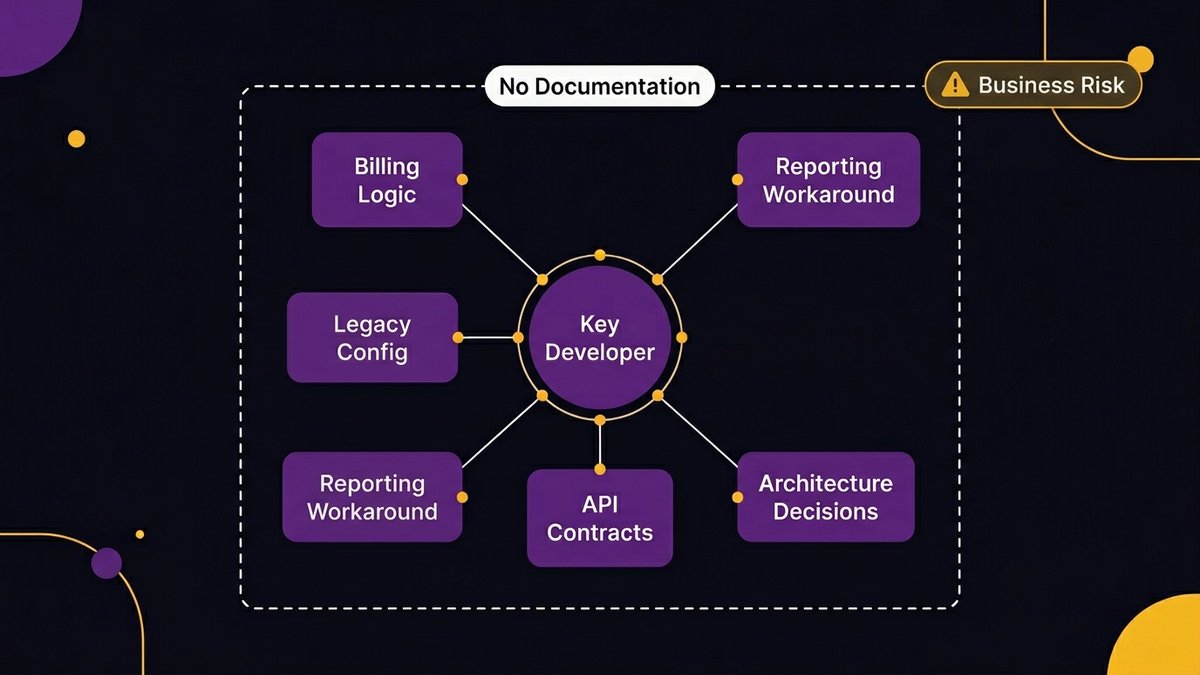
Most mid-market companies have at least one person, sometimes one person, who truly understands how a critical legacy system works. They know why a specific field has a specific value. They know what breaks if you change the billing logic. They know where the workaround lives that keeps the reporting module from crashing every Monday morning.
That person is your key-person dependency. And they will leave, retire, or become unavailable. Not as a hypothetical, as a certainty.
When they do, the institutional knowledge leaves with them. The code stays. The documentation doesn’t exist. The next person to touch that system will spend months reverse-engineering what the previous developer understood intuitively.
This isn’t a technical risk. It’s a business continuity risk. It belongs in the same conversation as your disaster recovery plan and your succession planning.
As Ashwin Ballal, CIO at Freshworks, has observed, adding vendors or building on unmaintainable systems compounds complexity rather than resolving it. The root problem is never the system itself; it’s that the system is a black box that only one or two people can operate.
Why documentation debt is a business continuity risk, not just a technical one
Documentation debt is the gap between how your system actually works and how much of that is written down anywhere. For most legacy systems, that gap is enormous.
A system with strong documentation can be handed to a new developer in weeks. A system with no documentation takes months to six months to become productive, and even then, the new developer learns by breaking things, not by reading the map.
The CEO rarely thinks about documentation until something breaks. The right time to think about it is before something breaks, when the cost of creating it is a structured project rather than an emergency archaeology exercise.
Complete documentation transfer, where every architecture decision, every API contract, every business logic rule is documented and owned by your organization, is not a nice-to-have. It’s the deliverable that transforms a modernization project from a vendor dependency into an organizational asset.
The Third Path: AI-Augmented Incremental Modernization
There is a path between rip-and-replace and indefinite patching. It’s incremental, it’s documented, and it doesn’t require betting the business on a single outcome.
What “incremental” actually means, and what it doesn’t
Incremental modernization isn’t a slower version of a full rewrite. It’s a fundamentally different strategy.
Instead of replacing the system, you identify the highest-friction components, the parts of the legacy system that cost the most to maintain, create the most operational risk, or most directly block your AI strategy. You modernize those first, while the rest of the system keeps running.
Each phase delivers a working, improved system. Not a promise of a better system when the project is done. A better system, now, with the next improvement already scoped.
This is how mid-market companies modernize without operational disruption. And it’s the only approach that fits mid-market risk tolerance and budget cycles. You’re not committing to a 3-year transformation program. You’re committing to a 90-day starting point.
How AI tools compress modernization timelines by 40–50%
The reason incremental modernization has historically been slow, and therefore unattractive, is that understanding and documenting legacy code takes enormous time. Before you can modernize a component, someone has to read, understand, and map exactly what that component does.
AI changes this calculus significantly. Fujitsu reported that AI-assisted modernization reduced project timelines by approximately 20%; agentic AI cut timelines by up to 50% (SphereInc, 2026, citing Fujitsu case data). According to HFS Research (2026), organizations deploying agentic modernization platforms report 40–60% productivity improvement and 30–50% faster modernization timelines.
AI tools can read legacy codebases, including COBOL, Oracle Forms, aging Java monoliths, and produce architecture maps, dependency diagrams, and business logic documentation in days rather than months. That documentation becomes the foundation for the modernization work itself, and the documentation transfer deliverable that the client organization owns at the end.
This is the mechanism behind AI-augmented modernization. Not magic. A faster, more systematic way to do the hardest part of modernization, understanding what already exists.
What complete documentation transfer looks like in practice
At the end of an AI-augmented modernization engagement, the documentation package you receive should include:
- Architecture diagrams, UML system design showing how all components relate
- API reference documentation, every endpoint, every integration, every data contract
- Business logic records, the rules embedded in the code, are now written in plain language
- Test coverage reports, what was tested, what the expected behavior is, and where edge cases live
- Decision records, why the architecture was designed the way it was, not just what it does
This documentation is yours. Unconditionally. It doesn’t expire when the engagement ends. You don’t need the development partner to interpret it for you. If you bring in a different partner tomorrow, they can read the documentation and get productive in weeks, not months.
That’s the opposite of the black-box vendor dependency. It’s the antidote to key-person risk. And it’s the deliverable that transforms modernization from a cost into an asset.
What a 90-Day Starting Point Actually Looks Like
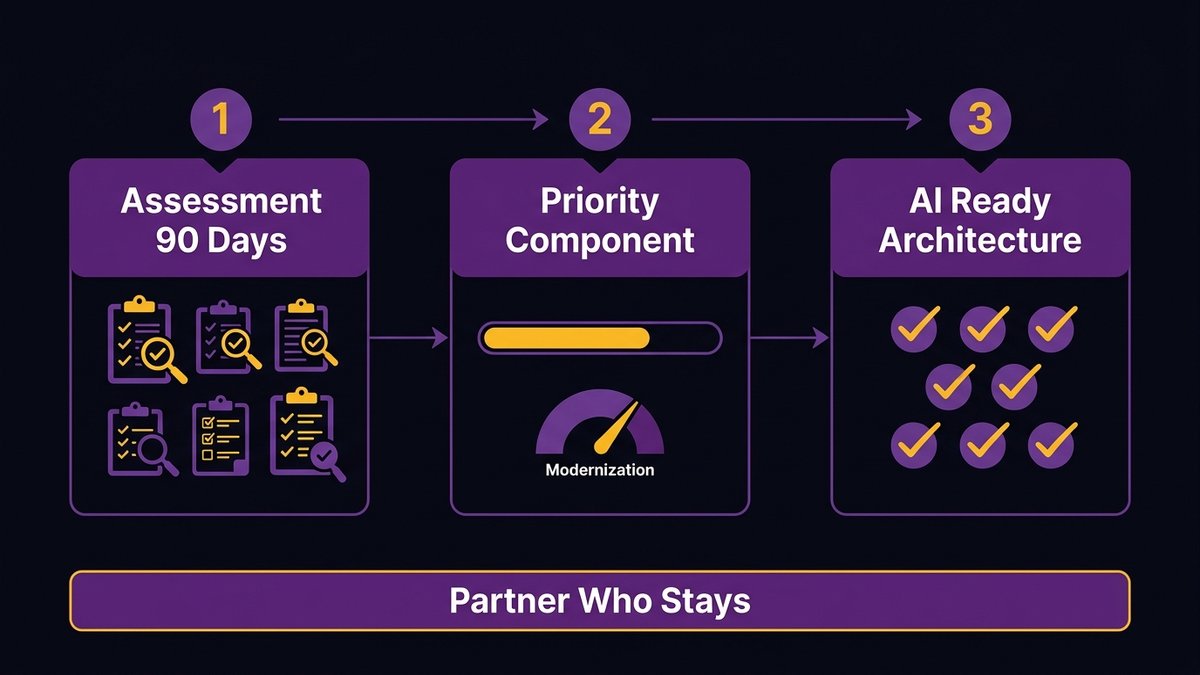
You don’t need a 3-year transformation program. You need a 90-day starting point with a partner who stays.
The most common reason mid-market companies delay modernization isn’t budget. It’s scope anxiety. The project feels enormous, the timeline feels open-ended, and the last time they engaged a vendor on something like this it took longer and cost more than quoted.
A 90-day starting point reframes the engagement entirely.
What a modernization discovery phase delivers, and what you should expect to own at the end
The first 90 days of a well-run modernization engagement produce three things you can use immediately, regardless of what happens next:
A complete system assessment. Every component of your legacy system is mapped, including dependencies, risk areas, AI-readiness gaps, technical debt concentration, and business logic documentation. You own this. If you decide not to continue the engagement, you still have the map.
A prioritized modernization roadmap. The components sorted by business impact and risk. Not what’s technically interesting, but what costs you the most and blocks you the most. With effort estimates and phase sequencing that fit your budget cycle.
A 90-day proof-of-concept delivery. One component of your system has been modernized. Not promised. Delivered. Running in your environment. So you know what the work actually looks like before you commit to a longer engagement.
This is what de-risked modernization looks like for a mid-market company. You’re not betting on a 3-year roadmap. You’re evaluating a 90-day starting point, getting tangible deliverables, and deciding what comes next based on evidence.
How to evaluate whether a partner actually stays
The “partner who stays” part of this framing isn’t marketing language. It describes a specific structural requirement.
Most development vendors are project-oriented. They scope a project, deliver it, and move on. The handoff is their exit. If something breaks after the project closes, you’re starting a new conversation or a new vendor selection.
A partner built for ongoing engagement works differently. SLA-based support covers the systems they build, but also systems they didn’t build. The relationship adapts as your needs change. The institutional knowledge they accumulate about your systems over time is the same kind of knowledge your key-person dependency currently holds, except it’s documented, it’s in your possession, and it doesn’t leave when someone gets a better job offer.
According to Mismo Team’s 2026 outsourcing statistics guide, 58% of IT firms now prefer nearshore partners specifically for time zone alignment. Timezone compatibility isn’t a convenience feature. It’s a collaboration requirement. Real-time communication during sprints, incident response during business hours, and architecture conversations that don’t require scheduling across 10 time zones are the practical conditions that determine whether a development partner actually stays engaged or gradually becomes a stranger who checks in async.
That’s why Nexa Devs operates with Latin America-based engineers in U.S. timezone alignment. Not to tick a nearshore box. Because synchronous collaboration is the operational foundation for a partnership that outlasts the project.
How to Know If Modernization Is the Right Move Right Now
Self-assessment isn’t about checking boxes. It’s about naming what you already know.
Most mid-market CEOs who read this far already know the answer. The question isn’t whether their legacy systems are costing them. It’s whether the cost has crossed the threshold where acting is less risky than not acting.
Seven signs your legacy system has become a growth constraint
Check how many of these are true for your organization right now:
Your AI strategy has stalled at the proof-of-concept stage. The demos worked. Production integration failed or was never attempted. No one wants to say why.
Your engineering team spends more time on maintenance than on new features. Ask them. If the answer is “we spend about half our time keeping things running,” you already know the number; it’s likely higher.
A single developer holds irreplaceable knowledge of a critical system. If that person resigned tomorrow, how long before you’d feel the impact? How long before it became a crisis?
Your reporting team exports data to spreadsheets to get answers. If your systems can’t answer basic operational questions without manual extraction and manipulation, your data architecture is blocking your decision-making.
You’ve been told that an AI feature “can’t be integrated” with your current system. This is the diagnosis the system itself gives you. It’s accurate.
You’ve had an incident in the last 12 months that required emergency vendor involvement to resolve. One incident is a warning. Two is a pattern.
You’ve delayed a product, feature, or strategic initiative because the underlying system couldn’t support it. This is the clearest signal. The system is now your strategic constraint.
A self-assessment for mid-market executives
If three or more of those are true, you’re past the point of evaluating whether to modernize. You’re at the point of evaluating how, and with whom.
The “how” question has already been answered in this article: incremental, AI-augmented, documentation-first. Not a rip-and-replace gamble. Not indefinite patching.
The “with whom” question is what a 90-day starting point is designed to answer. Not through a sales process. Through delivered work.
If you’re seeing yourself in this list, the conversation worth having isn’t about transformation. It’s about which component to address first, what you should own at the end of the first 90 days, and what a partner who stays actually commits to.
The market data points in one direction. Legacy debt compounds. AI advantages compound. The gap between companies that modernize in 2026 and those that wait will be measurably larger by 2027, and will keep growing.
The 2026 window is real. The question is whether you use it.
Ready to Find Your 90-Day Starting Point?
Most of our clients don’t start with a 3-year roadmap. They start with a question: “Which part of our system is costing us the most right now?”
That’s the right question. We can help you answer it, with a concrete assessment of your current systems, a prioritized modernization roadmap, and a clear picture of what the first 90 days look like before you commit to anything longer.
Schedule a no-commitment architecture assessment with Nexa Devs
FAQ
What are the benefits of updating legacy systems with AI?
AI-assisted modernization compresses timelines by 40–50% by automating legacy code analysis, documentation, and test generation. Beyond speed, it produces cleaner architecture, full documentation, and systems that can accept AI integrations, converting your legacy infrastructure from an AI blocker into an AI foundation.
Is replacing a legacy system worth it?
For most mid-market companies, a full replacement is too risky. The ROI of incremental, AI-augmented modernization is stronger: lower upfront cost, no operational disruption, and each phase delivers working improvements. According to Garnet Grid, technical debt costs a 20-person engineering team $3.6M annually. That’s the baseline cost of doing nothing.
Are legacy systems expensive?
Yes. According to ADEVS Tech Journal (February 2026), 60–70% of total software spend goes to maintenance on existing systems, not innovation. The direct costs compound with the opportunity cost of AI initiatives that can’t run on legacy infrastructure.
What are the disadvantages of legacy systems?
Legacy systems create four compounding problems: they consume 60–70% of software budgets in maintenance; they block AI integration because they lack the API architecture AI requires; they create key-person dependency when institutional knowledge lives with one or two developers; and they fall further behind each quarter.
Is it worth modernizing your legacy codebase?
Yes, if done incrementally and with complete documentation transfer as a deliverable. The cost of staying on legacy systems is high and growing. The question isn’t whether to modernize, it’s whether to do it in a way that doesn’t risk the business you’re currently running.