
AI Agent Access Control: Fixing the Plumbing Gap

Table of Contents
- Quick answer: securing AI agent access control
- Why Every Agent Pilot Becomes a Breach Waiting to Happen
- Anatomy of an Over-Permissioned Agent
- Why Mid-Market Internal Systems Can’t Safely Be Called by an Agent
- Treat Every Agent as a First-Class Non-Human Identity
- Build a Controlled Access Surface with APIs and Middleware
- Make Every Agent Action Auditable
- Runtime Monitoring and Human-in-the-Loop for High-Impact Actions
- What a Controlled Agent Surface Looks Like in Practice
- FAQ
Every mid-market engineering team runs the same experiment. Connect an AI agent to a few internal systems, watch it work, celebrate the demo. Then someone asks what happens if the agent misfires for ten minutes with the credentials it currently holds, and the room goes quiet.
AI agent access control means giving each agent its own scoped, least-privilege identity instead of a shared API key, so it can only reach the specific systems and actions its task requires, and every action it takes gets logged and attributed to that identity. Most mid-market pilots skip this step. They wire an agent to a single service account with broad permissions because that’s the fastest path from prototype to demo, and that shortcut is what turns a working pilot into a security incident.
The problem isn’t the model. It’s the access surface underneath it, built for humans clicking through a UI one action at a time, not for software calling it thousands of times a minute with nobody watching. Fixing that surface, not restricting what the AI is allowed to think, is the actual engineering work ahead.
Quick answer: securing AI agent access control
- Give every agent its own scoped identity. A shared API key means one bad prompt can reach everything that key touches.
- Apply least-privilege by default. An agent should only call the specific endpoints its task requires, nothing broader “just in case.”
- Build a safe-access layer with APIs and MCP-based tool interfaces over legacy systems instead of granting raw database or admin access.
- Log every agent action to a per-identity audit trail, so you can answer “what did this agent do” in seconds, not weeks.
- Require human approval for irreversible actions: large transfers, deletions, or external messages sent on your behalf.
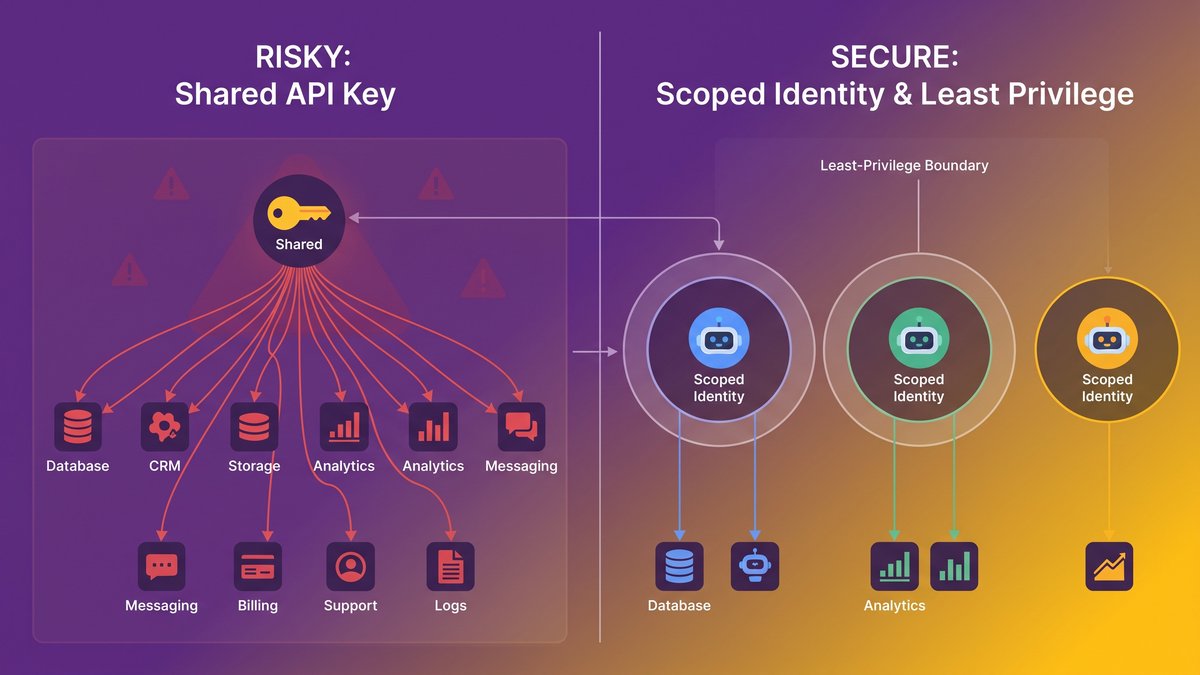
A visual comparison of a shared API key versus scoped, per-agent identities with individual permission boundaries
Why Every Agent Pilot Becomes a Breach Waiting to Happen
Set an over-permissioned agent loose with untrusted input and outbound access, and you don’t need a sophisticated attacker. A single malformed customer email can trigger it. Security researchers call this combination the lethal trifecta: private-data access, exposure to untrusted content, and the ability to take outbound action, all held by one agent at once.
The scale of the agent-security gap
Production security posture for AI agents is worse than most CTOs assume. Help Net Security’s 2026 research found that only 11% of production AI agents land in what researchers call the Fortified Leaders quadrant, where high attack surface meets strong defenses. The other 89% carry more access than their defenses can justify.
That gap isn’t evenly distributed. It concentrates hardest in mid-market environments, where a small platform team gets asked to wire agents into ERPs, CRMs, and internal tools that were never built with an API-first mindset. Nobody sat down and decided to grant an agent broad access. It accumulated one integration ticket at a time, the same way technical debt always does.
We’ve watched this happen inside client environments more than once: a proof-of-concept agent gets a “temporary” admin token to unblock a demo, the demo succeeds, the token quietly becomes permanent. Six months later, nobody on the team remembers why it has the scope it does. It just works, so nobody touches it.
The “lethal trifecta”: private-data access, untrusted input, and outbound actions
A support agent with read access to customer records, an inbox to monitor, and reply authority is a lethal trifecta walking around loose. An attacker doesn’t need to breach your network. They just need to email the agent something that looks like an instruction.
Help Net Security reported on a mid-sized company where an AI agent kept using an expired credential nobody had logged, reaching customer records, source code, and HR files for an entire quarter before anyone noticed. Nobody revoked the access, because nobody was tracking that the agent had it in the first place.
This is the failure mode the rest of this piece addresses: not a smarter attacker, but an access surface nobody mapped. Restricting what an agent is capable of reaching is a plumbing problem, not a model problem, and it needs to be solved with the same rigor you’d apply to any privileged system account. why legacy systems block AI agent deployment
Anatomy of an Over-Permissioned Agent
Over-permissioning rarely happens on purpose. It happens because scoping access properly takes real engineering time, and shipping the demo doesn’t wait for it. Three patterns show up again and again.
The single shared API key shortcut
One key. One service account. Every agent action, every integration, every tool call routes through the same credential. It’s the fastest way to get an agent working across five systems by Friday, and it’s also the fastest way to make a single leaked secret catastrophic.
When every agent shares one identity, you lose the ability to answer a basic question during an incident: which agent did this? A shared key collapses five distinct actors into one undifferentiated blob of access. You can revoke the key, but you can’t selectively revoke just the piece that misbehaved without breaking everything else that depends on it.
Nexa’s engineering teams see this pattern constantly in mid-market codebases that were never built expecting programmatic callers. The workaround someone reached for under deadline pressure becomes the permanent architecture, because nobody schedules time to go back and fix it once the demo works.
Standing and expired credentials no one logs
Human employees get offboarded. Their accounts get disabled, their badges get deactivated, someone checks a box. Agent credentials almost never go through an equivalent process, because most organizations don’t treat non-human identities as identities that need a lifecycle at all.
That’s how you end up with the exact scenario Help Net Security documented: a credential expires on paper but keeps working in practice, because the system issuing it never enforced the expiration and nobody was watching the logs closely enough to notice. The agent didn’t do anything malicious. It just kept using access nobody remembered granting.
Standing credentials, ones that never expire and never get reviewed, are the single most common finding when Nexa’s teams run an architecture assessment on a client’s agent integrations. They’re rarely flagged as a problem until an audit or an incident forces the question.
How prompt injection weaponizes excess permissions
Prompt injection is the mechanism that turns excess scope into a live incident, and it stopped being hypothetical a long time ago. An attacker doesn’t need your credentials if your agent already has broad ones and can be tricked into using them.
A well-scoped agent that gets successfully prompt-injected can still only do limited damage, because its access ceiling caps the blast radius. An over-permissioned agent that gets injected can do almost anything a human administrator could do, at machine speed, without a human in the loop to notice something’s off. The vulnerability class is the same either way. The consequence is entirely a function of scope.
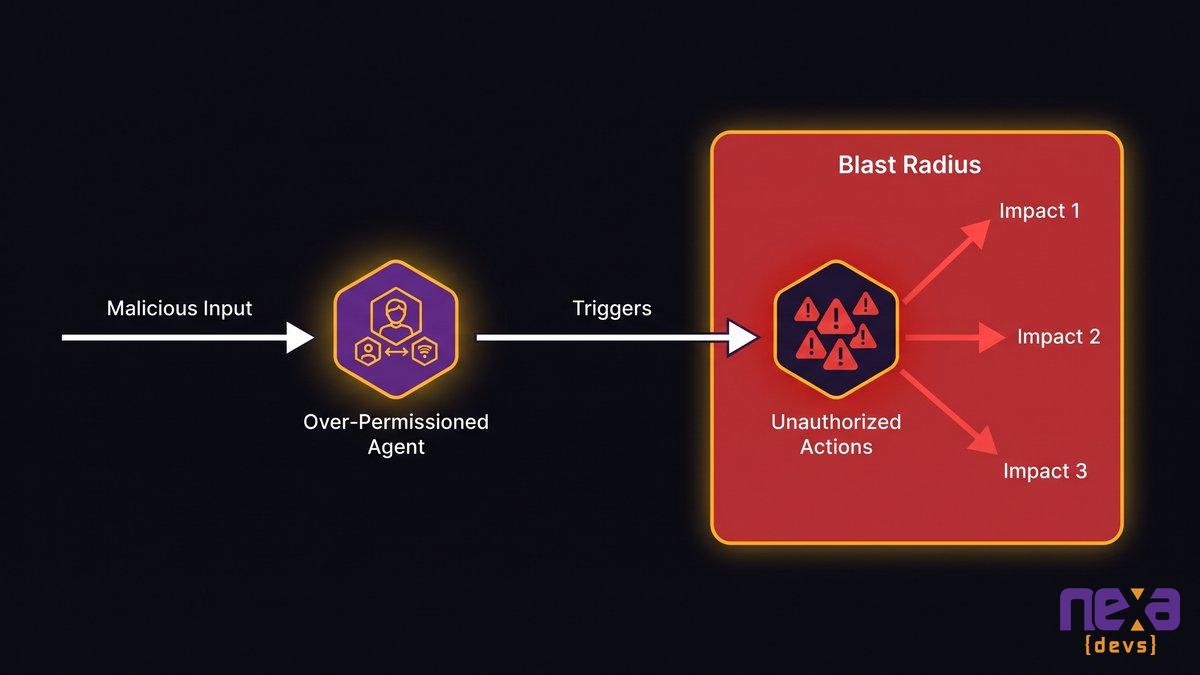
An illustration of how a malicious input can trigger unauthorized actions when an agent holds excess permissions
Why Mid-Market Internal Systems Can’t Safely Be Called by an Agent
Your ERP was built for a person clicking buttons, not for software issuing thousands of calls a minute. That mismatch, not the AI model, is the real reason mid-market agent pilots keep producing over-permissioned access.
Systems never designed for programmatic access at scale
Most mid-market internal systems, the finance platform, the practice management tool, the operations database, were built fifteen or twenty years ago around a human sitting at a screen. Authentication assumed a person typing a password. Authorization assumed a role assigned to an employee. Rate limits, if they exist at all, assume human typing speed.
An AI agent breaks every one of those assumptions. It doesn’t log in once a day. It calls the same endpoint hundreds of times in a single task. It doesn’t have a “role” in the HR sense, so someone has to invent one, and under deadline pressure the invented role is usually “give it whatever the admin has.”
David Burg, Cybersecurity Leader at Ernst & Young Americas, put the underlying issue plainly: “One of the challenges with legacy systems is that an accumulation of technical debt amasses over time. When they were built, developers were working with the institutional knowledge that existed at that time. The documentation of architecture, interoperability, and dependencies and such were likely never documented.” An agent trying to call into that undocumented system inherits every one of those gaps.
The legacy-integration bottleneck that forces the shortcut
The average enterprise runs on nearly 900 applications, and only about a third of them are properly integrated, according to Salesforce research. Every one of those unintegrated systems is a wall an agent has to get through somehow, and the fastest way through a wall with no door is to borrow the master key.
That’s the trap. Building a proper scoped interface for one legacy system takes weeks of engineering work. Grabbing an existing admin credential takes an afternoon. Under a deadline, the second option wins almost every time, and the resulting integration quietly becomes permanent infrastructure instead of the temporary hack it was meant to be.
This is precisely the gap Nexa’s engineering process is built to close: architecture assessments that map exactly which legacy systems an agent needs to reach, followed by scoped API and middleware work that gives it a real door instead of a stolen key. It doesn’t require ripping out the underlying system, only wrapping it with an interface that was designed for this use case instead of retrofitted under pressure. the hidden cost of unaddressed technical debt
Treat Every Agent as a First-Class Non-Human Identity
Stop thinking of an agent’s credentials as a technical detail and start thinking of the agent itself as an employee who needs onboarding, a defined role, and an offboarding process. That reframe changes almost everything about how the access gets built.
Per-agent scoped identities, not a shared key
Every agent, every tool, every integration should authenticate as itself, not as a shared service account. A billing agent gets an identity scoped to billing endpoints. A support agent gets a separate identity scoped to support tools. If one is compromised, the blast radius stops at the boundary of what that specific identity can reach.
None of this is new. Organizations already apply the same principle to human employees: an intern doesn’t get the CFO’s login. Non-human identities deserve the same discipline, and most mid-market environments simply haven’t extended it that far yet.
Least-privilege by default
Default every new agent integration to zero access, then grant exactly the permissions its specific task requires, nothing broader “for flexibility” or “in case we need it later.” Flexibility granted in advance is the surface a future prompt injection will exploit.
Least-privilege has to survive the agent’s entire lifecycle, not just its first setup. When its task changes, its scope should change with it, and permissions it no longer needs should get revoked rather than left in place because nobody wanted to risk breaking something.
Zero trust for non-human identities
Zero trust architecture, don’t automatically trust any request regardless of where it originates, verify continuously, applies at least as strongly to agents as it does to human users. NIST’s Zero Trust Architecture guidance (SP 800-207) treats every access request as untrusted until proven otherwise, and that standard doesn’t carve out an exception for software callers.
In practice, this means an agent’s identity gets verified on every call, not once at session start, and that verification checks not just “is this a valid credential” but “does this specific action fall within this identity’s current scope.” An agent that’s normally scoped to read-only reporting shouldn’t be able to trigger a write action just because its credential happens to still be valid.
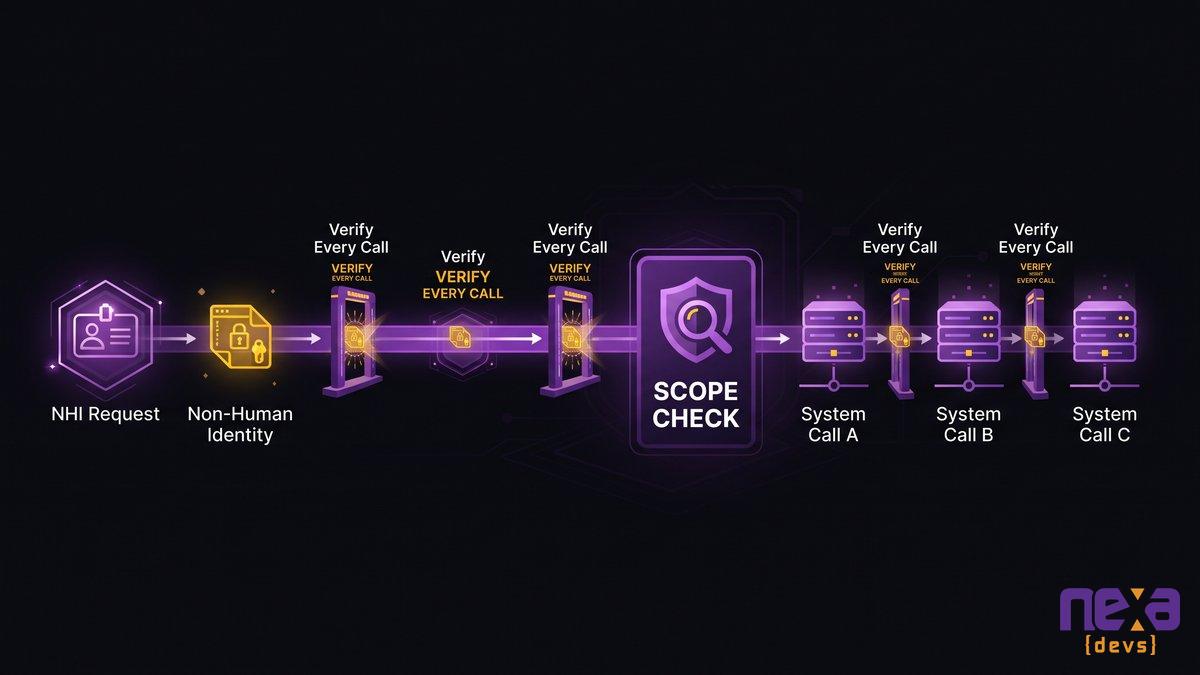
A diagram showing continuous verification checkpoints for a non-human identity across multiple system calls
Build a Controlled Access Surface with APIs and Middleware
Give the agent a door, not a master key. That’s the entire architectural shift: a scoped interface layer between the agent and your legacy systems, instead of direct, unmediated access to the systems themselves.
A scoped safe-access layer over legacy systems
You don’t rebuild your ERP or your practice management platform. You build a thin, purpose-designed layer of APIs and middleware that sits in front of the legacy system and exposes only the specific operations an agent is allowed to perform. The legacy system stays exactly where it is. The agent never touches it directly.
This is the work Nexa delivers as standard on integration engagements: APIs and middleware that connect disparate internal systems, scoped to what each caller specifically needs rather than opened broadly because that was easier to configure. It’s engineering discipline applied to a new class of caller, not a new discipline invented from scratch.
MCP-based tool interfaces for auditable actions
Model Context Protocol gives agents a standardized way to call tools, and that standardization is itself a security win: every tool call becomes a discrete, loggable, scopeable event instead of an opaque database query buried inside application code. When an agent’s access is expressed as a defined set of MCP tools, you can see, name, and limit exactly what it’s capable of doing.
An over-permissioned MCP configuration is still possible. Exposing a generic “run this SQL” tool defeats the entire purpose of the pattern. A well-scoped configuration exposes named, narrow tools instead: “look up customer by ID,” not “query the database.” Nexa’s delivery teams use MCP-based integrations as a core engineering workflow specifically because that granularity makes least-privilege enforceable rather than aspirational.
Least-privilege scoping without a full rewrite
You don’t need to replace the underlying system to fix this. A scoped API and middleware layer can go live in weeks, not the years a platform rip-and-replace would take, because it wraps the existing system instead of rebuilding it. That’s the practical argument for a mid-market CTO who doesn’t have the runway or the risk tolerance for a big-bang migration.
Skylar Roebuck, CTO at Solvd, frames the underlying risk this way: “Traditional modernization tends to over-index on protecting how things work today rather than building for what’s next. AI capability is compounding rapidly, and the real risk for mid-market companies is delay.” Every quarter spent without a scoped access layer is a quarter of accumulated exposure, not a quarter of safety bought by inaction. how legacy stacks block AI agent deployment
Make Every Agent Action Auditable
If you can’t answer “what did this agent do yesterday” in under a minute, you don’t have an audit trail. You have logs somewhere that nobody has time to read until after something has already gone wrong.
Per-identity audit trails
Every action an agent takes should write to a log tied to that agent’s specific identity, not a shared application log where its calls blend into everyone else’s. That per-identity trail is what lets a security team answer the only question that matters during an incident: exactly which actions did this specific agent take, in what order, against what data.
This is where scoped identities and audit logging reinforce each other. A shared credential produces a shared, ambiguous log. A per-agent identity produces a clean, attributable one. You can’t build accountability on top of an architecture that never separated the actors in the first place.
Documenting what each agent can and cannot reach
Every agent in production should have a written, current answer to a simple question: what can it reach, and what can’t it? Not a diagram from the kickoff meeting eighteen months ago. A living document that gets updated the moment scope changes.
This is where Nexa’s standard delivery practice becomes a security control rather than a nice-to-have: complete documentation transfer, UML diagrams, API references, architecture decision records, applied specifically to what each agent identity can and cannot touch. When that documentation stays current and lives with the client rather than locked in a departed vendor’s head, a new engineer or a security auditor can answer “is this agent over-scoped” without reverse-engineering the integration from scratch.
Runtime Monitoring and Human-in-the-Loop for High-Impact Actions
Scoping access at setup time isn’t the finish line. An agent that behaved normally for six months can start behaving abnormally the moment its prompt changes, its upstream data source gets compromised, or someone quietly widens its permissions to unblock a ticket.
Behavioral monitoring and anomaly detection
Watch for what changed, not just what happened. An agent that normally makes twenty calls a day and suddenly makes two thousand is worth a look, even if every individual call is technically within its scope. Volume and pattern shifts catch problems that permission checks alone will miss.
Runtime monitoring for agents borrows heavily from existing SIEM and behavioral analytics practice for human users. The difference is baseline: an agent’s “normal” behavior is far more predictable than a human’s, which actually makes anomalies easier to spot once you’re looking for them.
Approval flows for irreversible actions
Not every action deserves the same trust level. Reading a report and wiring $50,000 are not the same category of risk, and they shouldn’t route through the same approval path. Draw a hard line around actions that can’t be undone, large financial transfers, permanent deletions, external communications sent under your company’s name, and require a human to click “approve” before they execute.
This is the same control you’d apply to a new hire in their first week: full trust for reversible, low-stakes work, a second set of eyes on anything that can’t be walked back. Multi-agent setups raise the stakes further, since one agent’s output can become another agent’s trusted input; the same approval discipline should apply anywhere an irreversible action sits downstream of automated reasoning.
If your team is still deciding whether to build this layer in-house or bring in a partner who’s already done it, our piece on what actually blocks AI agents from reaching production walks through the infrastructure gaps that show up first.
What a Controlled Agent Surface Looks Like in Practice
The answer is not “don’t deploy agents.” That advice is both unrealistic and, frankly, bad business guidance in 2026. The fix is giving agents a controlled surface to act on: scoped identities instead of shared keys, MCP-based tool interfaces instead of raw database access, audit trails instead of silence, and human approval on anything irreversible.
None of that requires ripping out the systems your business runs on today. It requires an API and middleware layer purpose-built for this new class of caller, engineered with the same rigor you’d apply to any system handling customer data. That’s engineering work Nexa delivers as a standard part of how we build, not an add-on security product bolted onto a finished pilot after the fact.
A CTO who ships this layer before the next agent pilot isn’t slowing the roadmap down. They’re the reason the roadmap survives its first incident intact. Ready to see exactly where your systems stand? book an architecture assessment
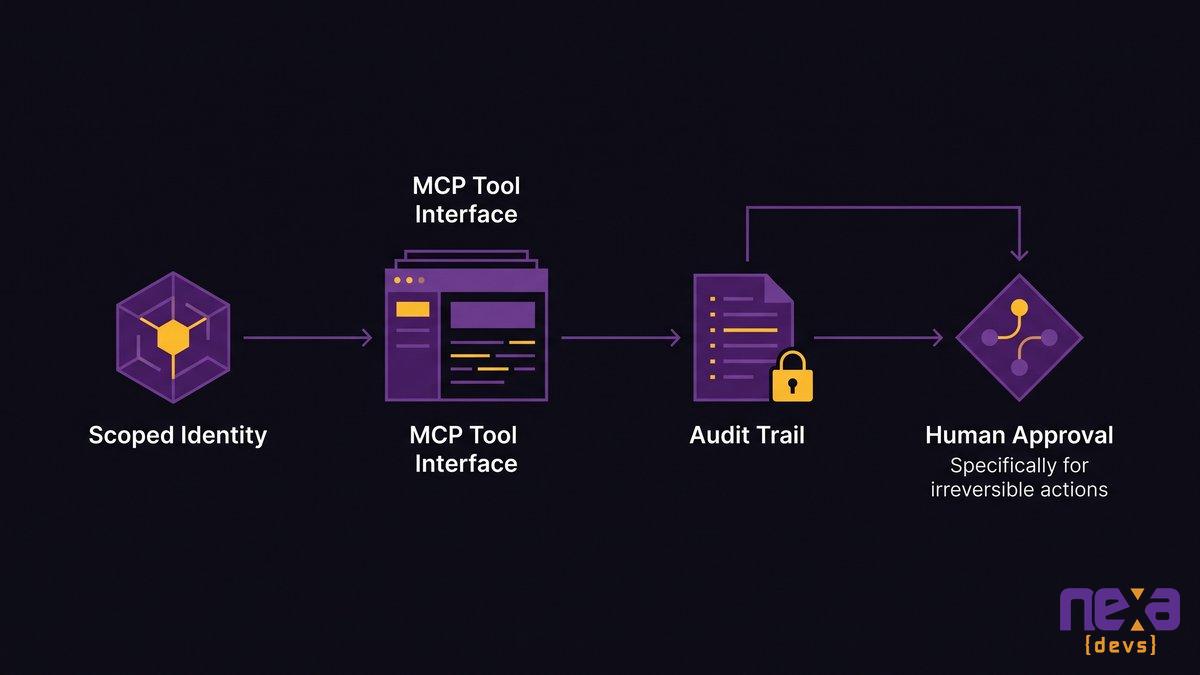
An overview diagram of a complete controlled access surface, from scoped identity through audit trail to human approval
FAQ
How do I secure AI agent access?
Give each agent its own scoped, least-privilege identity instead of a shared credential, wrap legacy systems in a scoped API or MCP-based interface, log every action to a per-identity audit trail, and require human approval before irreversible actions execute.
What are the common vulnerabilities of AI agents?
The most common vulnerabilities are over-permissioned credentials, prompt injection that hijacks excess access, standing or expired credentials nobody monitors, and the lethal trifecta of private-data access, untrusted input, and outbound action combined in one agent.
How secure are AI agents?
Most production AI agents aren’t secure by default. Help Net Security’s 2026 research found only 11% of production agents reach the strongest security posture, meaning roughly 9 in 10 carry more access than their defenses can justify.
What is least-privilege access for an AI agent?
Least-privilege means an agent only gets the specific permissions its task requires, nothing broader. If it only needs to read customer names, it shouldn’t also be able to edit billing records or delete accounts.
What is a non-human identity?
A non-human identity is a distinct, trackable identity assigned to software, like an AI agent or a service, instead of a shared credential. It gets its own scope, audit trail, and lifecycle, the same way a human employee account does.