

Table of Contents
Copper Retirement FCC Order 2026: A Records Problem
The FCC’s 2026 Network and Services Modernization Order made it easier for carriers to retire copper, and it started a filing clock at the same time. If you run network operations at a regional telco, CLEC, or independent fiber operator, the copper retirement FCC order 2026 handed you blanket grandfathering authority and a faster discontinuance path. That reads like relief, and on the network planning side it mostly is. The back office is where it gets complicated, because a faster filing path only helps if the line list you file against is accurate.
Every notice you send under this order has to be accurate down to the line and the customer, and most operators can’t say that with confidence right now. What stalls a copper retirement is rarely the fiber rollout. It’s a far more boring question: do your switch records, service inventory, billing system, and field work orders describe the same network? Ask four system owners at a regional operator and you’ll often get four answers that can’t all be true at once.
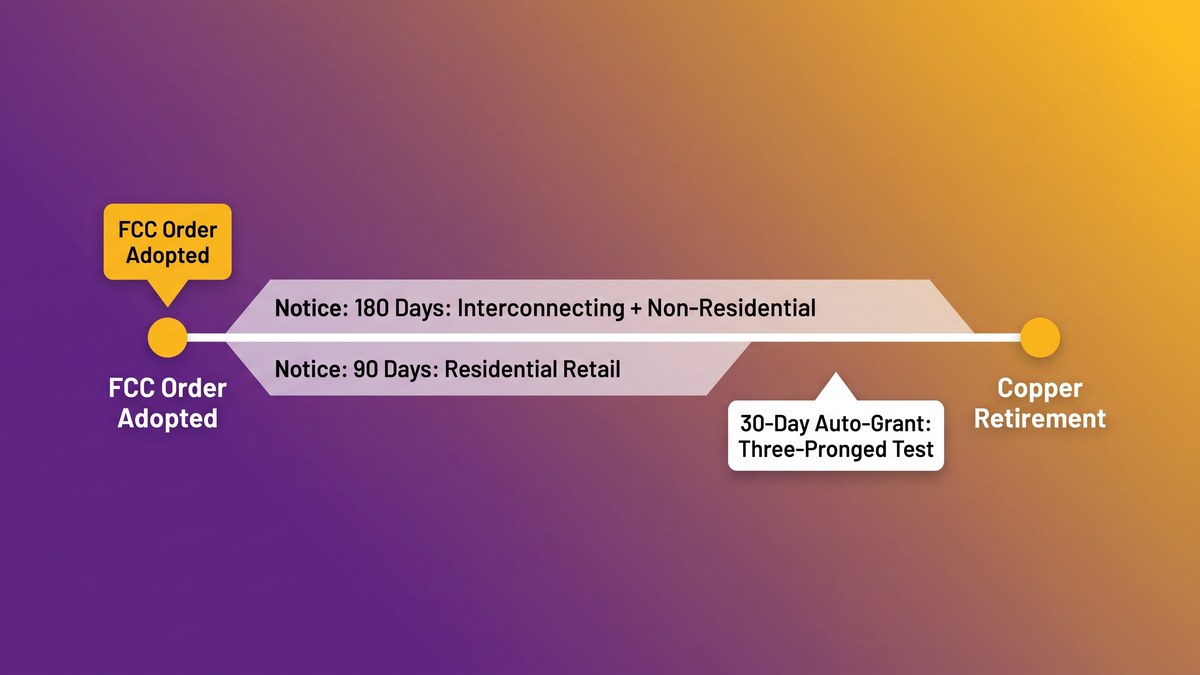
A visual timeline showing the FCC’s 90-day and 180-day copper retirement notice windows
Copper Retirement FCC Order 2026: The Sunset Clock Is Now a Filing Deadline
Carriers now file under one faster discontinuance standard instead of petitioning case by case. For the operator doing the retiring, the practical effect is that the clock started when the order passed, on the regulator’s schedule rather than on the readiness of your inventory.
What the Network and Services Modernization Order changed for the carrier doing the retiring
The FCC adopted the order on March 26, 2026. It gives carriers broader authority to grandfather legacy copper voice service with simplified customer notification, and it simplified the technical test a discontinuance application has to pass. According to the FCC’s own guidance, an application to discontinue legacy TDM-based voice service in a technology transition can be automatically granted in 30 days if the carrier meets a three-pronged test. Set against the old petition process, that is a steep compression, and it explains why retirement schedules are now running well ahead of the back-office systems that have to support them.
The notice obligations you own: 90 days, 180 days, and who has to be told
The faster approval path doesn’t reduce who you have to tell or how precisely you have to tell them. The FCC’s notice requirements run at least 180 days for interconnecting entities and non-residential retail customers, and at least 90 days for residential retail customers. State governors, state public utility commissions, and Tribal governments need notice at least 180 days before retirement too, unless no customers are still using the copper network, in which case 90 days is sufficient. Every one of those notices has to land on the right account and the right physical line. Even a small error rate across a service territory means notices going out to customers who were never on the copper in question, and customers entitled to notice who never receive one.
The Migration Plan Breaks at the Line List, Not at the Fiber
Ask an operations director where the retirement program is stuck and the answer is almost never trenching or splicing. It’s that four internal systems give four different answers to the one question the program depends on: which lines actually exist.
Four systems, four different answers to “which lines exist”
A regional operator preparing a retirement filing pulls records from the switch, the service inventory platform, the billing system, and the field work-order log, expecting them to reconcile into one line list. They rarely do. The switch may show a line as active because nobody decommissioned it at the hardware level. Billing may show it as closed because the account was terminated two years ago. The work-order system may show an open ticket from a technician who never closed it out. None of these systems is lying. Each one is accurate to the process that feeds it, and none was built to check itself against the other three.
What is riding on a copper line that no single system records
Counting lines is the easy half; knowing what depends on each one is where the program gets hard. Fire panels, elevator phones, alarm circuits, lifeline accounts, and wholesale interconnection trunks all ride on copper, and the system that provisioned the line rarely records what’s plugged into it on the customer’s side. An operations team can audit every switch port and still miss the elevator phone circuit at a three-story medical building that hasn’t been touched since it was installed. Auditing harder won’t close that gap, because the gap comes out of how these systems were scoped in the first place, back when none of them was expected to reconcile against the others.
Why Your Records Drifted From the Field in the First Place
Two structural facts explain most of the drift. One is where the field work physically happens, the other is who closes it out afterward, and neither one is a measure of how careful your team is. That’s why tightening process discipline so rarely fixes it.
Maintenance happens where there is no connectivity, so visit data arrives late or never
Technicians do real work in ducts, enclosed nodes, and basements: locations with no signal and no terminal access. A line gets spliced, rerouted, or decommissioned on-site, and the paperwork catches up days or weeks later, if it catches up at all. Multiply that across a service territory with decades of copper plant and the gap between what happened in the field and what the inventory system says stops being an exception and starts being the baseline.
Subcontractor crews close work in their own systems, not yours
Independent fiber operators and regional CLECs lean heavily on subcontractor crews for installs, splices, and decommissioning work, and those crews frequently report completion through their own scheduling and ticketing tools rather than the operator’s system of record. The work gets done, but the record of it travels a separate, slower, and less reliable path back to the systems that are supposed to govern your retirement filing. No individual on either side has to make a mistake for the two to diverge, since the arrangement produces drift on its own.
What Bad Line Records Cost Before You Send a Single Notice
The cost arrives well before the first discontinuance notice does. Some of it is compliance exposure, and some of it is money spent on work that was never necessary in the first place.
Compliance exposure on grandfathering and discontinuance notices
An inaccurate line list produces notices sent to the wrong customer, notices that miss a customer entirely, or a filing that misstates which lines are still carrying live traffic. The compressed timelines in this order leave very little runway to find and correct errors like that internally, which is how something that started as an operations issue ends up in front of a regulator.
CAPEX and OPEX leakage: excess procurement, stranded assets, wasted truck rolls
McKinsey’s research on legacy OSS environments found that operators running low-maturity inventory systems consistently report 10% to 15% excess network hardware procurement, driven by planning teams compensating for data they don’t trust. That shows up as hardware bought for lines that turn out to be already retired, truck rolls dispatched to service circuits that don’t exist anymore, and stranded assets nobody bills for because nobody is sure they’re still live. For context on scale, the FCC reports that just 5% of U.S. households still have legacy copper telephone service, 76% of adults live in wireless-only households, and 79% of fixed home voice connections already run over VoIP. The remaining copper base is small, which does nothing to make locating it accurately any easier.
Replacing the OSS Before the Sunset Is the Wrong Bet
Every regional operator with a sunset deadline eventually gets the same internal suggestion: replace the OSS, start clean, solve the records problem once and for all. It’s the wrong call.
A full OSS replacement is a multi-year program with its own integration risk, its own data migration risk, and its own vendor dependency. Running that program on the same clock as a fixed regulatory deadline means betting your compliance timeline on a project that historically overruns. Regional operators who try to solve a records problem by replacing the whole system around it tend to arrive at the sunset deadline with a half-migrated OSS and the same unreconciled records they started with, just spread across two platforms instead of one. A reconciliation layer built on top of what you already run gets you an accurate line list in months, not years, and it doesn’t ask you to bet the retirement deadline on a system that isn’t finished yet.
Build the Reconciliation Layer, Not a New OSS
The practical alternative is a thin layer that forces your existing systems to agree with each other and leaves all four of them in place.
Pulling switch, service inventory, billing, and work-order data into one authoritative view
A reconciliation layer sits above your switch records, inventory platform, billing system, and work-order log, and resolves conflicts between them into a single line of truth your compliance and operations teams can trust. It doesn’t replace any of those systems. It reads from all of them, applies rules for which source wins when they disagree, and flags the cases where no automated rule can resolve the conflict and a human needs to look. That flagging behavior matters as much as the resolution logic, since a layer that quietly picks a winner on ambiguous records will hand your compliance team a clean-looking list that no one has actually verified.
APIs and middleware over rip-and-replace, with the sunset clock running
This gets built through APIs and middleware connecting systems that were never designed to share data, which is exactly the kind of work Nexa Devs does for mid-market operators whose internal systems have outgrown their original design. documentation your team owns Building the connective layer instead of the underlying systems means you can scope the work to fit inside your filing deadline instead of extending the deadline to fit the work.
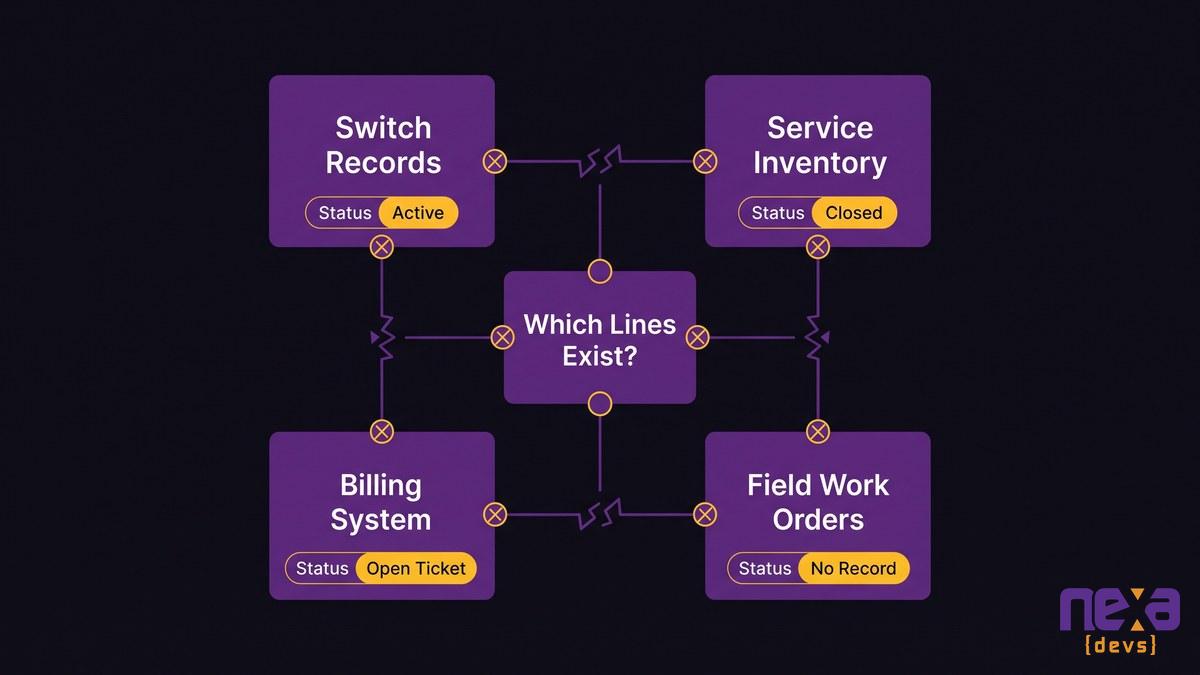
Switch records, service inventory, billing, and work orders often disagree about which lines are active
Recovering the Mapping Logic Nobody Documented
The logic that connects a customer account to a physical line usually lives in two places: a switch configuration and the memory of whoever last touched it. Operators tend to find that out at the exact moment they need it written down.
AI-assisted analysis of undocumented legacy logic
A switch configured two decades ago, modified by a rotating cast of engineers and contractors since, encodes a huge amount of mapping logic that exists only as behavior, not as documentation. AI-assisted analysis can work through that legacy configuration and surface the rules that were never written down, including the exceptions and edge cases that would otherwise only surface when something breaks in production. AI-assisted legacy system analysis As Thomas Johnson, co-founder of Multiplayer, puts it: “You’ve got to know where it lives. You’ve got to know the quirks, you’ve got to gather the intelligence about older items. People who used legacy equipment and software come and go.” That’s the whole problem with copper plant that’s been in the ground since before most of your current staff started.
Generated test coverage that proves the reconciled records are right
Reconciled data is only as good as your confidence in it, and a spreadsheet that looks clean is not evidence of anything. Generating automated test coverage against the reconciled line list, checked against known-good samples pulled from the field, is what lets you show a regulator, a board member, or your own CFO the basis for the numbers instead of asking them to take the list on faith.
From Reconciled Records to Notices to Cutover
A reconciled line list is the first milestone in a sequence that ends with a filed notice and a completed cutover, and operators who treat it as the finish line tend to stall somewhere between the two.
Once the reconciliation layer produces a trusted line list, the sequence runs in order: validate the list against a sample of field data, generate the notice content and recipient list directly from the reconciled records instead of the old billing export, file under the compressed FCC timeline with confidence in the underlying data, and schedule the physical cutover against the same validated list the notices were built from. Treating reconciliation as the first phase of the migration program, rather than a side project running in parallel to it, is what keeps the notice content and the cutover plan pointed at the same facts.
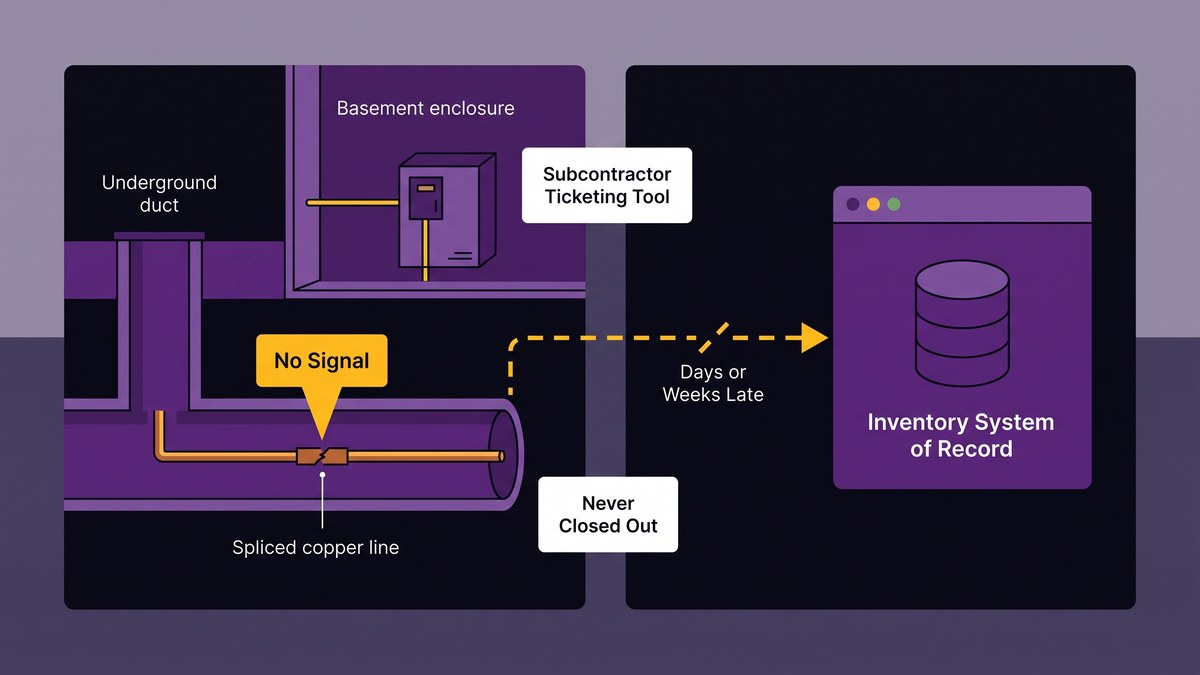
Maintenance performed in basements and duct runs rarely syncs back to the central inventory in real time
Own the Reconciled Data Model After the Sunset
Who holds the only accurate picture of your network when this project ends? If the answer is a consultant rather than your own team, the records problem has been relocated rather than solved.
The replacement-availability constraint that used to justify slow, cautious retirement timelines is largely gone. The FCC’s own data shows that over 99.4% of homes and small businesses already have access to 4G or 5G mobile service, and over 97% can upgrade to a modern fixed internet-based service like VoIP. Replacement capacity was never the real constraint here. Your own data is, and it stays one unless your team ends up holding it. Complete documentation transfer decides whether you are still dependent on an outside party the day after the sunset deadline passes, which means the reconciled data model, the mapping rules, the test coverage, and the tooling itself all land with your team instead of staying locked inside a vendor’s head. fixing BSS for eSIM and IoT That same ownership-after-delivery standard applies across every system Nexa builds for telecom operators, not just this one.
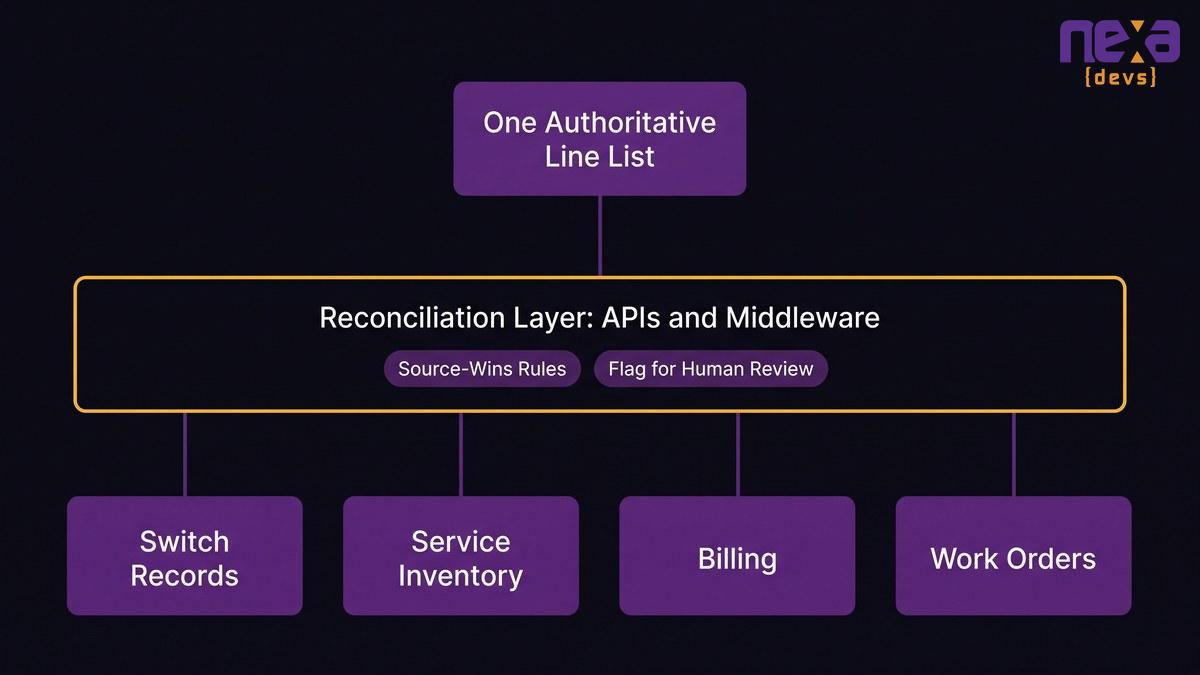
A reconciliation layer pulls switch, inventory, billing, and work-order data into one authoritative view
Regional operators facing this deadline don’t need a new OSS, and they don’t need a rewrite of systems that still work. What they need is one accurate answer to a question their own systems currently answer four different ways. The notices, the filing, and the cutover all run off that answer, which means a compliance filing built on a line list no one trusts doesn’t get any safer for having fiber already in the ground behind it.
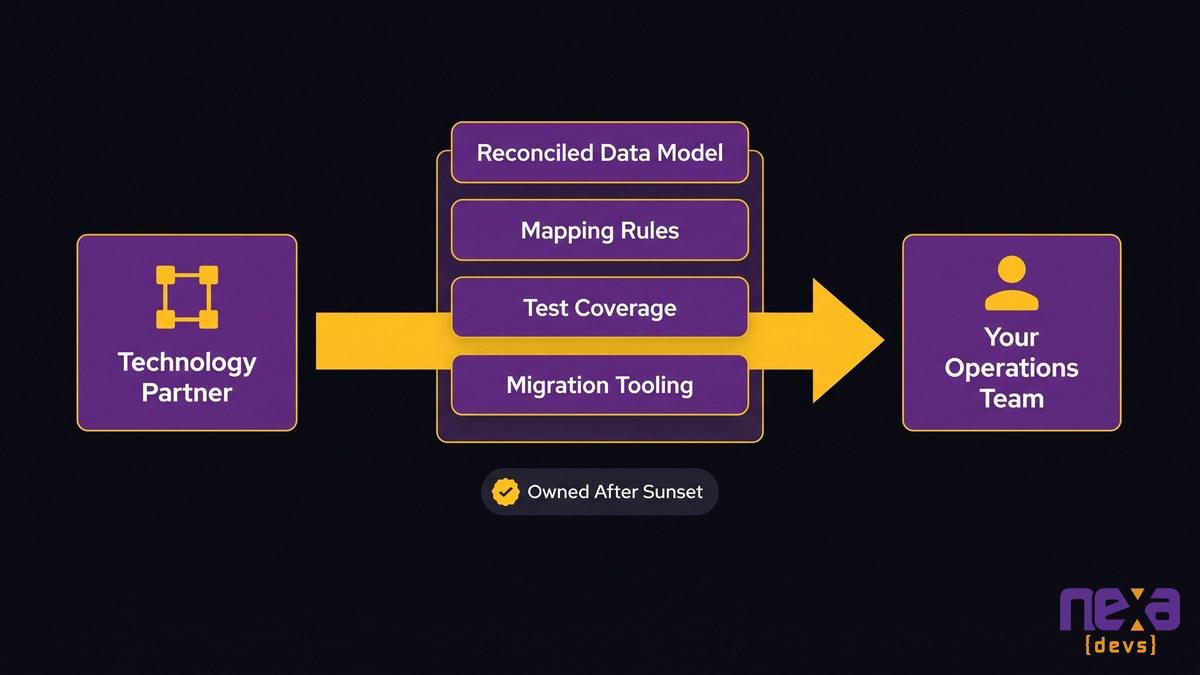
Complete documentation transfer means the operator owns the reconciled data model after the sunset
If your team is staring down a copper retirement filing and isn’t confident in the line list underneath it, schedule a call with Nexa Devs and let’s scope the reconciliation layer before your notice deadline does the scoping for you.
FAQ
What are the requirements for FCC copper retirement mandates?
Carriers must give at least 90 days’ notice to residential customers and at least 180 days’ notice to non-residential and interconnecting customers before retiring copper. State governors, PUCs, and Tribal governments generally need 180 days’ notice too. Applications can be automatically granted in 30 days if a three-pronged technical test is met.
Will all copper landlines be phased out?
Not immediately, but the trend points that direction. Only about 5% of U.S. households still use legacy copper telephone service, and major carriers including AT&T and Verizon have published multi-year retirement schedules. The FCC’s 2026 order makes discontinuance filing faster and simpler going forward.
How do I know if my line inventory is accurate enough for a copper retirement filing?
If your switch records, billing system, and field work orders don’t already agree on which lines are active without manual reconciliation, your inventory isn’t ready. Test it: sample 50 lines and check whether all four systems tell the same story about each one.
What happens if we send a discontinuance notice based on wrong records?
A notice sent to the wrong customer, or missed entirely, creates regulatory exposure under FCC rules, on top of the operational mess of a botched migration. The compressed 2026 filing timelines leave little room to catch and fix that kind of error afterward.
Should we replace our OSS before the copper sunset deadline?
No, not against a fixed deadline. A full OSS replacement is a multi-year program that commonly overruns, leaving you with a half-finished system and the same unreconciled records. A reconciliation layer built on your current systems delivers accurate records far faster.
Who should own the reconciled network data once the migration is complete?
Your organization should, not the vendor who built the reconciliation layer. Complete documentation transfer, including the data model, mapping logic, and test coverage, should be a condition of the engagement from day one, not something negotiated after the project ends.