

Table of Contents
Disconnected Systems Cost: Find Your Integration Tax
Disconnected systems cost mid-market companies far more than any software line item shows. The real bill is hours. Every week, somebody on your operations team logs into four tools, copies numbers into a spreadsheet, and hunts down the one figure that refuses to match. Call it the integration tax: the toll your team pays because systems that should hand data to each other automatically instead wait for a person to carry it.
Nobody budgets for it directly. It shows up as headcount that never quite catches up, a weekly report that eats half a day, and a COO who can describe the problem in vivid detail but has never priced it. So let’s price it. You’ll find a measurement you can run this week, the three root causes behind most of the manual hours, and what a real fix looks like when it isn’t a platform swap or another subscription.
Quick answer: the cost of disconnected systems
- Disconnected systems cost you staff hours, not just software fees. People copy, reconcile, and chase data between tools that don’t talk to each other.
- The math is simple: hours per week per person on manual handoffs, times loaded salary, times 52.
- Three gaps produce most of those hours: no data exchange, mismatched formats, exceptions nobody owns.
- Replacing the ERP or buying another tool rarely closes the gaps, and usually adds cost.
- What works is a scoped connective layer: APIs and middleware around your real handoffs, with documentation your team owns.
An operations manager cross-checking figures across disconnected business systems before a leadership report
What the Integration Tax Actually Is
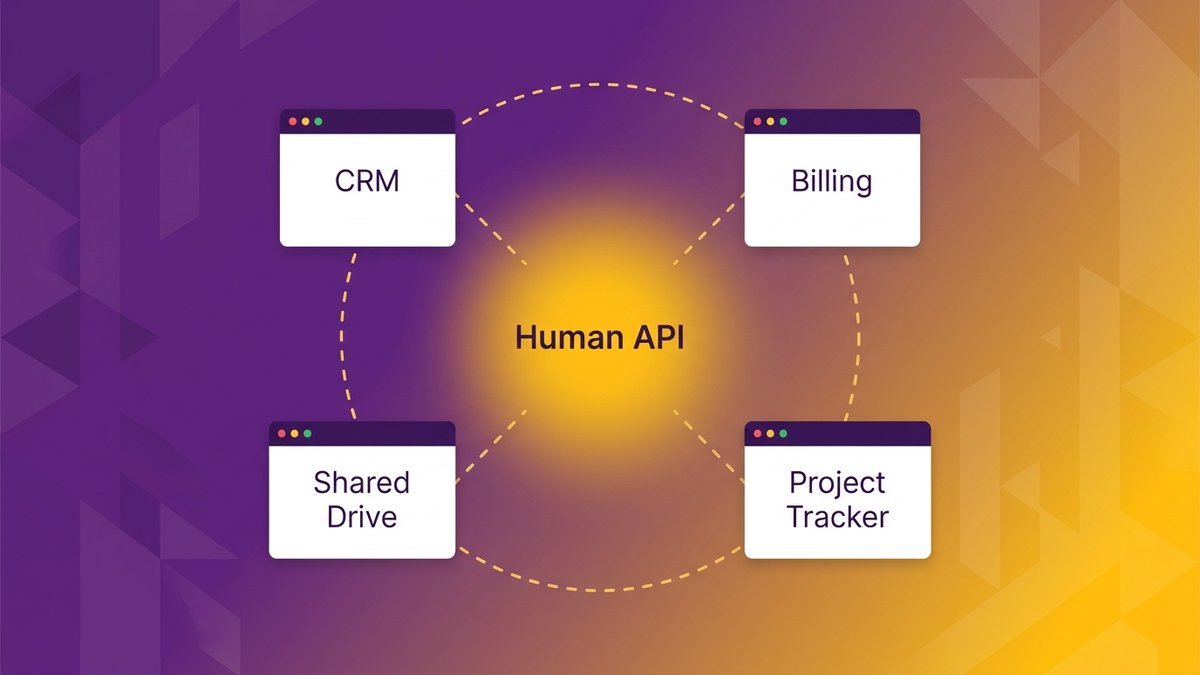
Your operations team doesn’t build software. Every Monday, they run it by hand: pulling data out of one system, reshaping it, feeding it into the next.
The human API: what your operations team does between systems
Watch what happens in the hour before a leadership meeting. Someone opens the CRM and exports a pipeline number, then opens the billing platform for last month’s invoiced total, then checks the project tracker for delivery status. None of it arrives in a shared format. So a person sits in the middle and translates each number into whatever shape the next system, or the next spreadsheet, expects.
That person is the real cost of disconnected systems. The missing piece is a connection, and a human is standing in the gap where an API should be. The job appears on no org chart. It gets absorbed into “operations,” into “reporting,” or into whoever built the spreadsheet first.
Why the gaps appear exactly where they do
The gaps aren’t random. They sit at the seams, between tools that separate teams bought years apart, each for a reason that made sense at the time. Sales picked the CRM. Finance picked the billing platform. Nobody picked the connection between them, because buying a connection was never on anyone’s list.
Which makes it an architecture problem, not a people problem. Your team is doing integration work by hand because nobody ever built the automated version.
A shared spreadsheet assembled by hand from four separate systems every Monday morning
Where the Hours Go: The Weekly Report Assembled by Hand
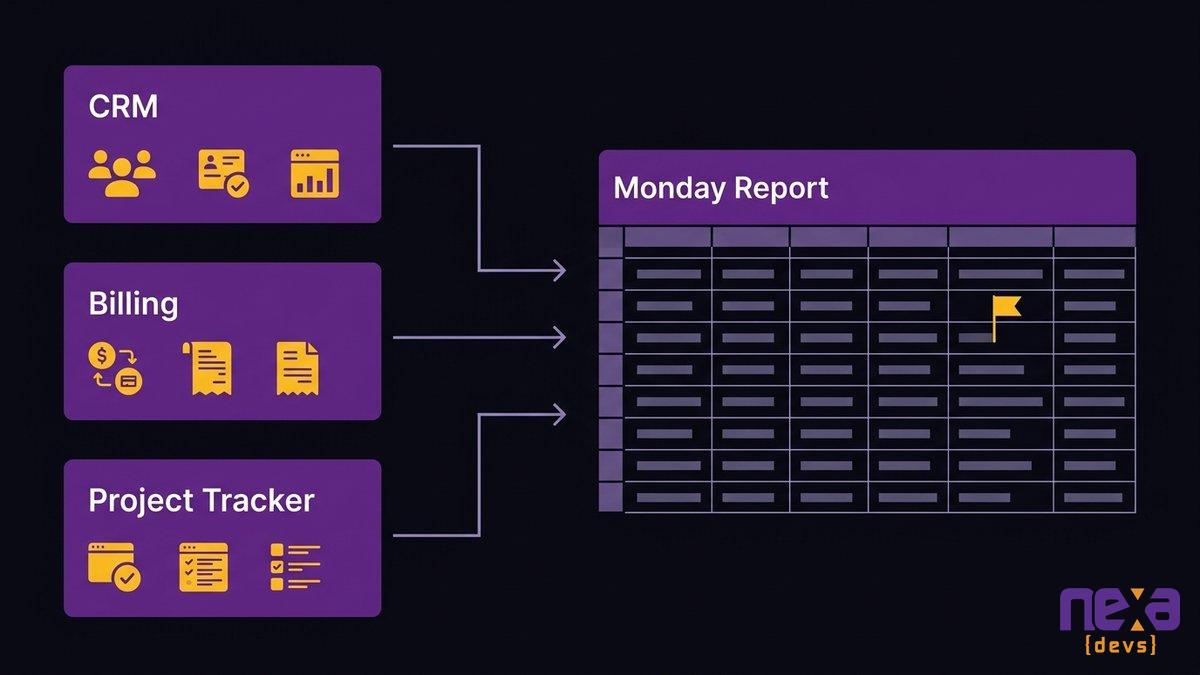
Every Monday at 9 a.m., someone pulls last week’s numbers from the CRM, the billing platform, the project tracker, and a shared drive, then builds the leadership report in a spreadsheet nobody else is allowed to touch.
Four systems, one spreadsheet, every Monday
We see this at almost every mid-market company we work with. One spreadsheet turns into the unofficial source of truth, because it’s the only place sales, delivery, and finance data finally sit next to each other. And whoever built it maintains it forever, since rebuilding that logic from scratch always feels riskier than living with it.
The average company now runs close to 900 applications, and only about a third are connected, according to Salesforce research. The rest wait for someone to remember to check them, export from them, and reconcile what they say against everything else. Asana’s Anatomy of Work Index puts the share of a typical workday lost to repetitive, low-skill task work at roughly 62 percent.
Rekeying, reconciling, and chasing status
Rekeying is the easy part. Reconciling is slower: the CRM says a deal closed, billing shows a different amount, and now twenty minutes go to working out which system is wrong, or whether both are right and nobody updated the other. Then there’s chasing status, pinging a project manager for a number that should already be on a screen somewhere. That eats the rest of the morning.
The work that never appears on anyone’s job description
None of this has a title. It isn’t in anyone’s performance review, and nobody gets credit when the report lands on time. It turns visible exactly once: the week the report is late. Even then, the response is “move faster,” not “fix the gap.”
Converting weekly manual-reconciliation hours into an annual, dollar-denominated cost figure
Turning Those Hours Into a Number Your CEO Can Read
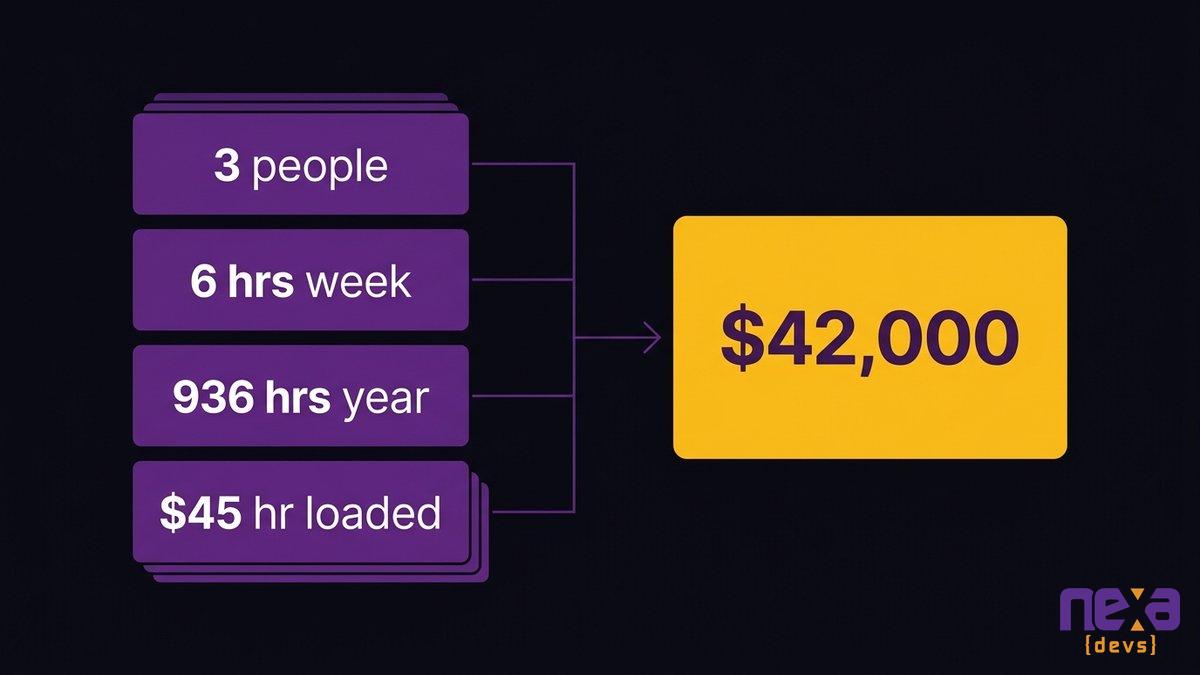
Multiply hours by headcount by loaded salary. The arithmetic takes about ten minutes, and almost no operations team has ever been asked to run it.
Hours per week per person, measured not estimated
Estimates will undersell this, so measure it. For one week, ask everyone who touches the weekly report, the billing reconciliation, or the status chase to log real minutes spent on manual handoffs, separate from the minutes spent on the underlying work. Teams are regularly surprised by the total once it’s written down instead of guessed at.
Annualizing against loaded salary cost
Run the math with your own figures. Say three people each spend six hours a week reconciling data between systems. Eighteen hours a week, or roughly 936 hours a year. At a loaded cost of $45 an hour (salary, benefits, and overhead combined), you’re at about $42,000 a year for one recurring report.
That tracks with McKinsey’s research, which puts the time employees lose hunting for information across disconnected systems at close to a fifth of the work week. Asana’s research is harsher on duplicated effort specifically: roughly 19 workdays a year per employee go to recurring task work, nearly a full working month spent redoing what already exists somewhere else.
Why the number is bigger than the software budget you are defending
The weekly report is rarely the only recurring handoff. Finance reconciles invoices against delivery records. Customer success checks renewal dates against a CRM field nobody trusts. Add all of it up across a 50-person operations and finance function, and the annual number regularly runs past the entire software budget the COO is defending in next quarter’s planning meeting.
That version of the number is the one worth bringing upstairs. A CEO who has never seen “integration tax” on a line item recognizes it instantly once it’s priced in headcount hours instead of described as a workflow annoyance.
The Three Gaps That Produce Most of the Manual Hours
Most of the manual hours trace back to one of three gaps, not a dozen different problems.
Systems that never exchange records at all
The first one is the simplest. Two systems hold related information and have never been connected, by API or anything else. So someone has to be the connection, every single time a record needs to move from one to the other.
Systems that exchange records, but not in the shape the next step needs
The second gap hides better. Two systems do pass data back and forth, but in formats, field names, or units that don’t match what the receiving system or person needs. The data arrives. It just arrives wrong, so someone still reshapes it by hand before anyone can use it.
Exceptions with nowhere to go
The third gap is the one most automation projects skip entirely: what happens when a record doesn’t fit the standard path. A refund that doesn’t match the original invoice, a contract amended mid-cycle. Those exceptions need somewhere to go, and in most disconnected environments “somewhere” means a person’s inbox.
As Jesper van den Bogaard, CEO at Factor Blue, describes it: “We need to process manufacturing, but the invoice is here, the order data is there, and we’re manually passing information around, with data scattered across different systems.” Teams know something is broken. They’re rarely asked which of the three gaps is doing the damage. Which one is yours?
The Two Fixes Worth Declining
Two vendors have probably already pitched you a fix this year. Neither one closes the gap.
Do not replace the ERP: the gaps survive the migration
Replacing the ERP doesn’t close integration gaps. It relocates them to a newer, pricier system that still can’t talk to your other tools without the same connective work you were trying to avoid. Gartner’s research on technical debt flags this trap repeatedly: migration spend doesn’t retire the underlying architecture problem. Meanwhile the migration eats a year or more of attention, and the human API keeps running the whole time, just between a different set of screens.
Do not buy a twelfth tool: one more system to hand off to
A new integration platform or iPaaS subscription sounds like the fix, until you notice it’s one more system: its own login, its own maintenance window, its own handoff gap at both ends. We’ve watched this pattern play out with the department spreadsheet that quietly becomes production infrastructure. Another subscription rarely breaks that pattern. It adds a layer to it.
What a Connective Layer Looks Like Instead
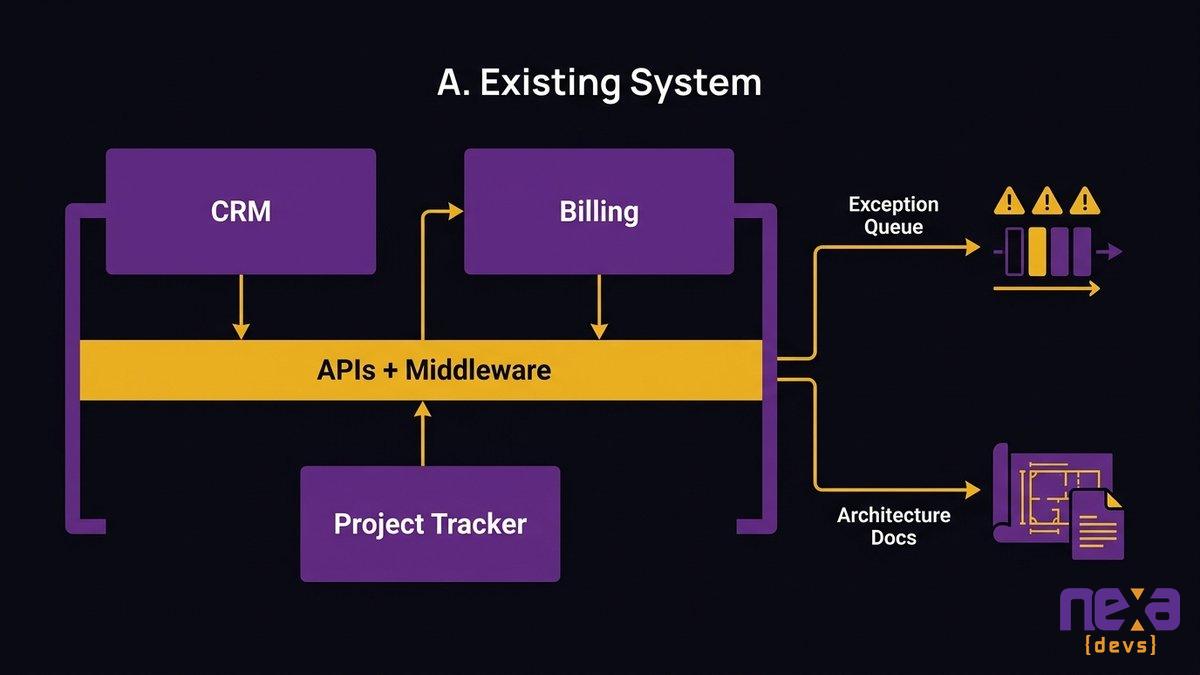
A connective layer isn’t a platform. It’s a small, specific set of APIs and middleware built around the handoffs you really run.
APIs and middleware scoped to the real handoffs, not to a vendor’s idea of the process
The work itself is narrow. Scope the three or four handoffs producing most of the manual hours, then build the specific connections that close them. Not a company-wide integration platform. Not a rebuild of every system you own. Just the gaps costing you hours, closed with code shaped around the way your team already works.
Architecture documentation handed over so it does not become the next black box
This is where integration work fails you. A contractor builds the connection, it works, they leave, and nobody inside the company understands how it’s wired together. One black box gets stacked on another. Martin Fowler’s writing on integration architecture makes the same point from the engineering side: a connective layer becomes critical infrastructure the moment it goes live, and it deserves the documentation rigor of any core system. Architecture diagrams and API references should transfer to your team as a condition of the engagement, not as a favor if you ask nicely.
What changes in week one versus month three
In week one, nothing changes on the surface. The handoff still happens by hand while the connective layer gets built and tested against real data. By month three, the weekly report pulls itself, exceptions route to a defined queue instead of somebody’s inbox, and the person who used to own the spreadsheet is spending that time on work that requires judgment.
A scoped integration layer connecting existing systems around the business’s actual handoffs
How to Find Your Own Number This Week
No consultant is required to find your number. Three handoffs and twenty minutes with the people who run them will do it.
Pick the three handoffs people complain about most
Ask around. The handoffs people gripe about in hallway conversations are almost always the ones producing the most manual hours. Pick the three mentioned most often, not the three that sound most technically interesting.
The three questions to ask at each one
For each one, ask three things: how long does it take each time, how often does it happen, and what breaks downstream when it’s late or skipped. You can run a structured audit of the kind IT governance frameworks such as COBIT recommend. Fifteen minutes with the right person answers all three just as well.
What to do with the number once you have it
Run the math from earlier against your real answers, then bring the figure to your next leadership meeting in annual dollars rather than weekly minutes. If you want the wider context this sits inside, read why the maintenance tax on aging systems keeps growing. Framed that way, the number is what gets a connective-layer project funded instead of filed under “someday.”
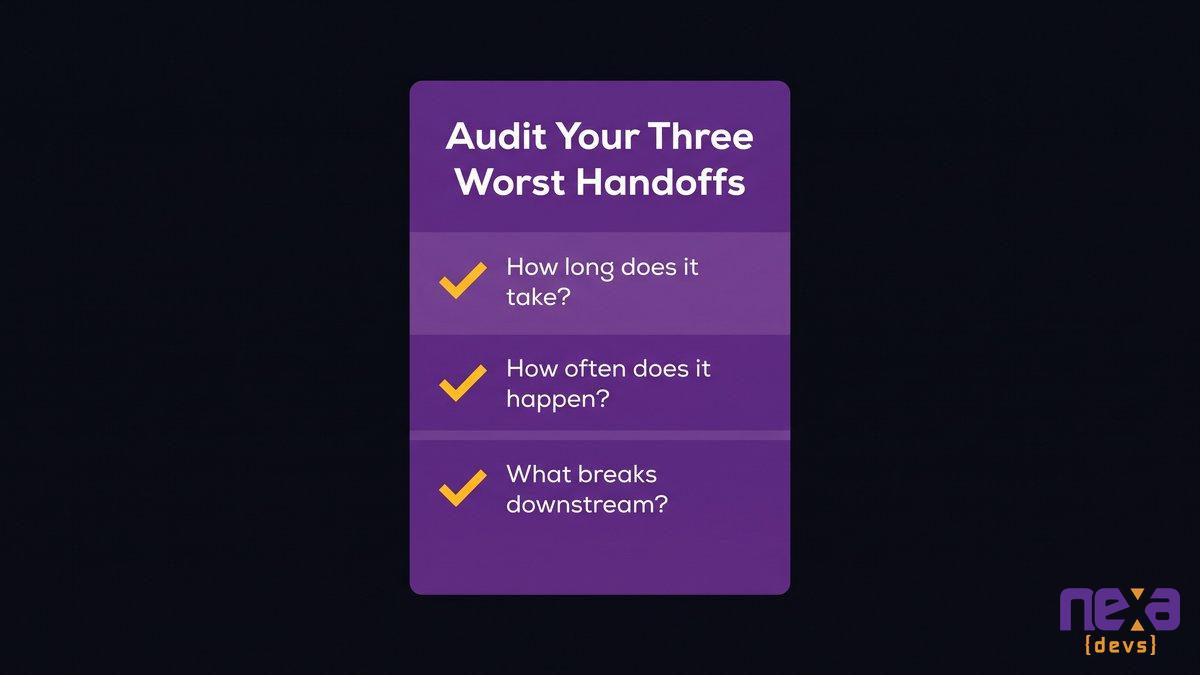
A simple one-week audit to identify and price your organization’s worst manual handoffs
Most operations leaders already know where their time goes. What they haven’t done is write it down next to a dollar figure and hand it to the person who controls next year’s budget. Schedule a call with Nexa Devs if you’d rather have that conversation with an engineering partner who has already built this fix for teams your size.
FAQ
How much does it cost to integrate disconnected systems?
It varies by scope, but most mid-market connective-layer projects cost far less than the manual hours they replace. A targeted project closing two or three handoff gaps typically pays for itself within a year once you price in the staff hours saved.
What are some examples of hidden costs of disconnected systems?
Common examples include staff hours spent rekeying data, delayed decisions from stale reports, billing errors from mismatched records, and the salary cost of someone maintaining a shadow spreadsheet that quietly became critical infrastructure.
What is the integration tax?
The integration tax is the ongoing cost of running manual work between systems that should exchange data automatically. It shows up as staff hours spent copying, reconciling, and chasing information instead of doing higher-value work.
How do I calculate the cost of disconnected systems for my team?
Track the hours each person spends weekly on manual handoffs for one week, multiply by headcount and loaded hourly salary, then multiply by 52 weeks. That annualized figure is your integration tax.
Should I replace our ERP to fix data silos?
Usually not. ERP migrations are expensive and slow, and they rarely close the actual handoff gaps between systems. A scoped connective layer built around your real workflow is typically faster and cheaper than a full platform replacement.
What is a connective layer in software integration?
A connective layer is a set of APIs and middleware built to connect your existing systems around your actual workflow. It replaces manual data handoffs with automated ones, and good implementations include documentation your team owns.