
Table of Contents
Legacy Migration Strategy: Big-Bang vs Incremental
A legacy migration strategy comes down to one choice: replace everything on a single cutover date, or replace the system piece by piece while it keeps running. The first approach is a big-bang rewrite. The second is incremental migration, usually built on the strangler fig pattern. For most mid-market companies, incremental wins.
Big-bang rewrites fail at a rate that should alarm any CEO signing the budget, and the reason is structural rather than bad luck. Teams start rebuilding before they understand what the current system actually does, then bet the entire project on one delivery date set eighteen months out. Incremental migration avoids both mistakes. You map the system before touching it, and you ship value in gated phases the board can actually see.
This guide covers why big-bang rewrites fail so often, how the strangler fig pattern works mechanically, and how to sequence an incremental roadmap that doesn’t stall halfway through.
Quick answer: choosing your legacy migration strategy
- Big-bang rewrites replace everything on one cutover date. Incremental migration replaces the system piece by piece while the old one keeps running.
- Big-bang rewrites fail more often because teams start rebuilding before they understand what the current system actually does.
- Incremental migration gives a CEO value-gated milestones the board can see, instead of one high-risk delivery date eighteen months out.
- The strangler fig pattern routes traffic gradually from old code to new code, so every cutover stays reversible.
- Most mid-market teams should default to incremental delivery. A full rewrite is only defensible for small, isolated, well-understood systems.
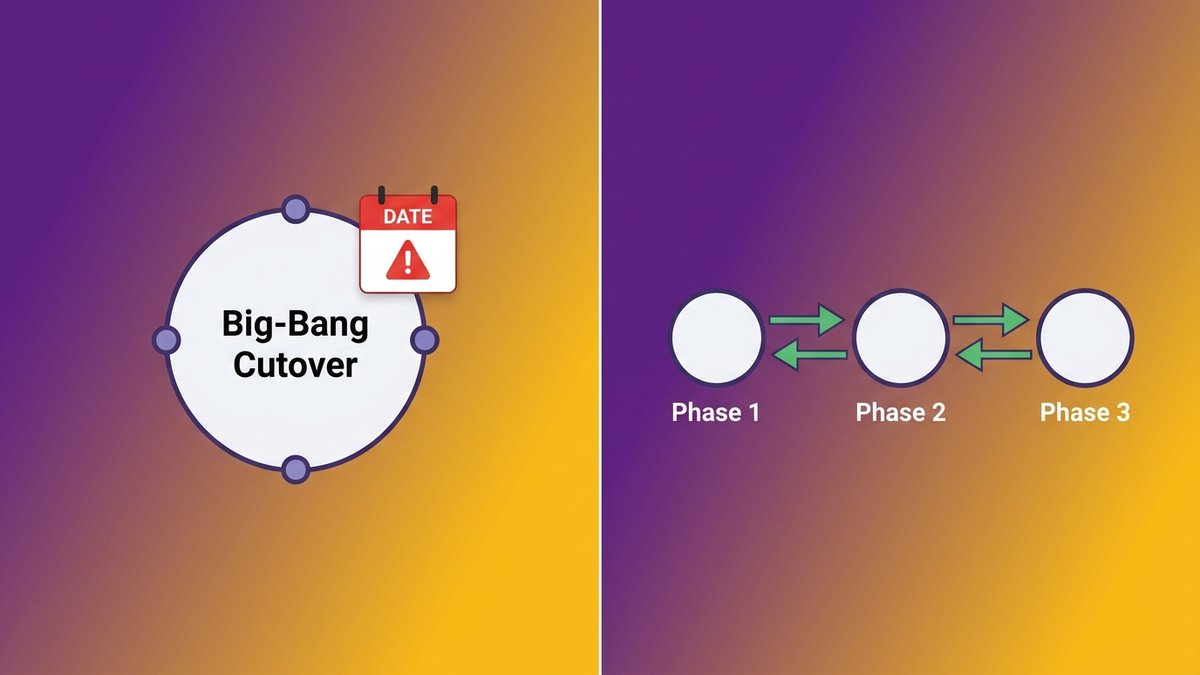
A side-by-side view of the two migration paths: one high-risk cutover date versus a series of smaller, reversible phases
The Real Reason Modernization Projects Stall
A CTO at a 200-person logistics firm once told us her team hadn’t shipped a customer-facing feature in four months. Nothing had broken. Nothing had shipped either. Every sprint went to keeping the current system running.
That’s the legacy tax at work: the slow transfer of engineering capacity from building new things to defending old ones. CIO Dive’s analysis of enterprise IT spending found teams sending 43% of budget to legacy maintenance and just 29% to transformative technology work. The rest goes to keeping systems compliant, patched, and barely stable.
The tax compounds every year a system goes unaddressed. Dependencies get more tangled. The people who understand the original design get harder to reach. Boards start asking why velocity keeps dropping, and engineering leaders start dreading that question, because the honest answer (most of our capacity goes to holding the current system together) doesn’t sound like a plan. It sounds like an excuse.
This is the moment most companies decide to modernize. It’s also the moment they make the decision that determines whether the project ships or stalls: how do you get from the system you have to the system you need?
Big-Bang Rewrite vs Incremental Migration: What the Choice Actually Means
Two paths exist for retiring an aging system, and only one lets you change your mind halfway through. Both start from the same diagnosis. They diverge completely on execution.
This isn’t the classic “rewrite vs. refactor” debate that plays out inside a single codebase, where a team decides whether to clean up one module or start it over. Here you’re deciding how to retire an entire legacy platform, and that decision shapes budget, timeline, and risk for the next one to two years.
The big-bang rewrite: one date, all-or-nothing
A big-bang rewrite builds the replacement system in parallel, off to the side, while the legacy system keeps running production unchanged. Nothing goes live until the new system is judged “done.” On cutover day, traffic switches all at once. The old system gets retired, usually within weeks.
It’s the approach most people picture when they hear “system migration process.” It’s also a lift-and-shift in the worst sense: everything moves at once, on a single date, with no partial credit for getting most of it right.
The incremental path: replace in place, piece by piece
Incremental migration replaces functionality in slices. One workflow, one module, or one customer segment moves to the new system while everything else keeps running on the old one. Both systems coexist for months, sometimes longer, connected by a routing layer that decides which system handles which request.
This is the phased migration approach behind the strangler fig pattern, which we’ll walk through mechanically in the next section. The short version: you never bet the whole project on one date, because there is no single date.
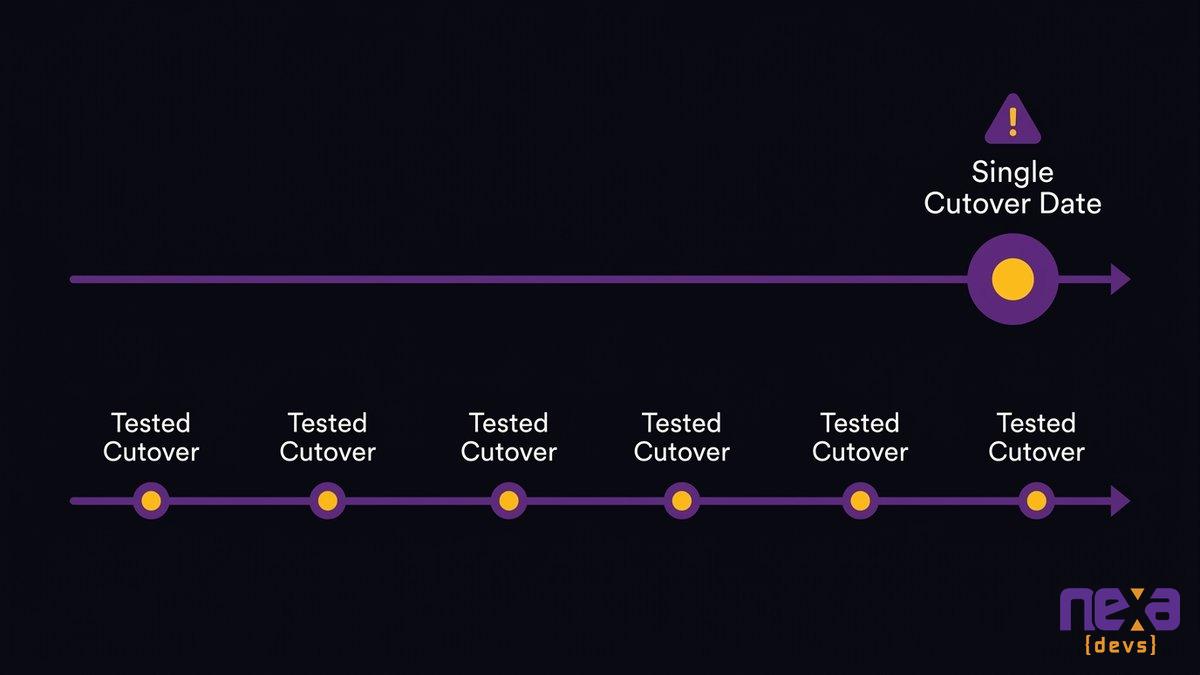
A timeline view comparing a single high-stakes cutover date against a sequence of smaller, independently tested cutovers
Why Big-Bang Rewrites Are the Most Common Way Modernization Dies
Big-bang rewrites fail at a rate that should worry anyone signing the check. Hypertrends’ 2026 research found that big-bang modernization projects fail more than 70% of the time, whether “fail” means over budget, past deadline, or quietly shelved. That number holds up against what we see across mid-market engagements: the pattern is structural, not situational.
The comprehension gap: starting before you understand the system you have
Most rewrite projects start with a requirements document, not a system audit. Nobody maps what the current codebase actually does before deciding what the new one should do instead. Edge cases that took years to discover in production get rediscovered the hard way, usually after launch, usually by an angry customer.
As Ashwin Ballal, CIO at Freshworks, states: “Legacy systems have become so complex that companies are increasingly turning to third-party vendors and consultants for help, but the problem is that, more often than not, organizations are trading one subpar legacy system for another. Adding vendors and consultants often compounds the problem, bringing in new layers of complexity rather than resolving the old ones.” A rewrite built on an incomplete understanding of the original system doesn’t remove the legacy tax. It just moves into a newer building.
The single-cutover risk: everything rides on one delivery date
TSB Bank’s 2018 core banking migration is the case study every CTO in financial services already knows. On cutover weekend, a large share of TSB’s customer base lost access to online and mobile banking, and the outage stretched on for weeks. The financial and regulatory fallout, later covered extensively by the Financial Times and the BBC, ran into the hundreds of millions of pounds.
A single cutover date means every risk in the project (technical, operational, and organizational) lands on the same day. There’s no partial rollback, no gradual detection of what broke. There’s a go-live and a postmortem.
How the Strangler Fig Pattern Works in Practice
Martin Fowler, who named the pattern, borrowed the term from a vine that grows around a host tree until the original tree is gone and the vine stands on its own. Fowler’s original description frames incremental replacement as a discipline, not just a scheduling choice.
Routing and the facade layer
A facade layer sits in front of both systems and decides, request by request, which system handles the work. Early on, almost everything routes to the legacy platform. As new functionality ships, more traffic routes to the new system, one endpoint or one workflow at a time. Users never see the switch. They just notice, eventually, that features ship faster.
This is the same mechanism behind a monolith to microservices migration, except the target architecture doesn’t have to be microservices. It can be a modern monolith, a modular service layer, or anything else that fits the team’s operating model. The facade is what makes the migration incremental. The target architecture is a separate decision.
Parallel running and reversible cutovers
Each slice of functionality runs in parallel for a defined window before the old path gets retired. If something breaks, the facade routes traffic back to the legacy system in minutes, not weeks. Nobody is betting the business on a single migration event, because there isn’t one. There are dozens of small, individually reversible ones.
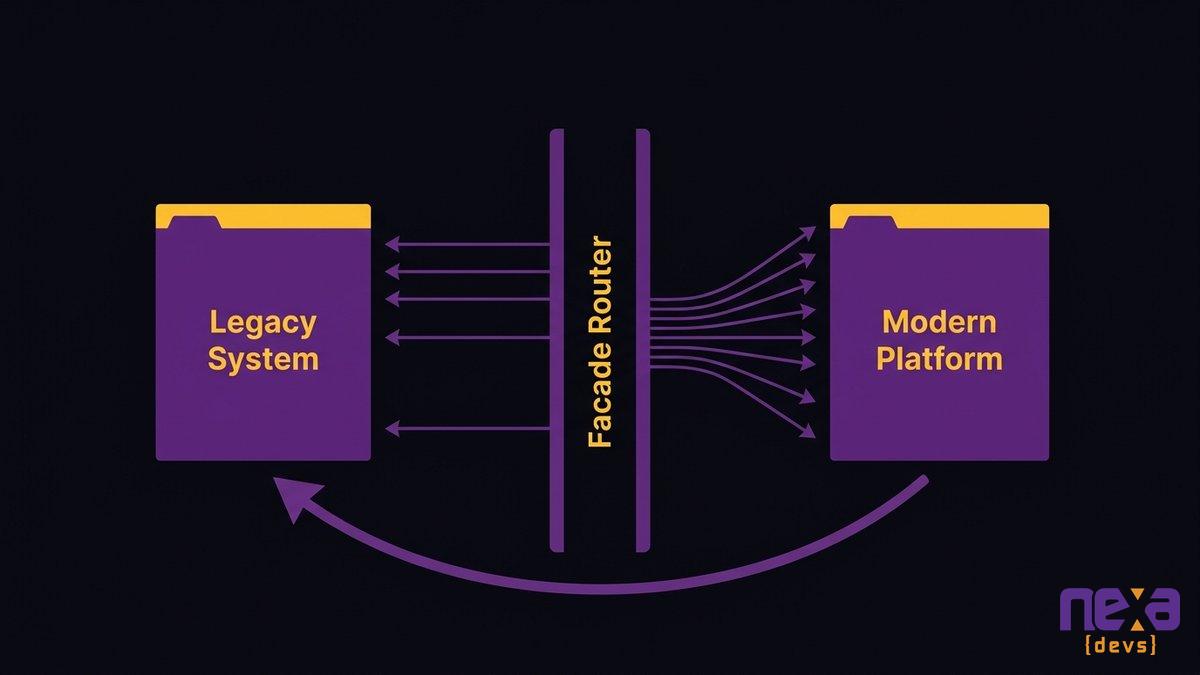
How a routing layer gradually shifts traffic from the old system to the new one, keeping each cutover reversible
What Incremental Delivery Gives a Non-Technical Budget Owner
A big-bang rewrite gives the board one report: green until the day it’s red. Incremental delivery gives a dozen reports, each one gated to a milestone the board can actually see and evaluate on its own merits.
Value-gated milestones the board can see
Every phase of an incremental migration ships something real: a workflow that’s faster, a report that’s more accurate, a feature the old system couldn’t support. The CEO isn’t asked to trust an 18-month plan on faith. Each phase either delivers the value it promised or it doesn’t, and the next phase gets funded, adjusted, or paused based on evidence instead of a sunk-cost bet.
Technical debt doesn’t just slow down engineering. AEI’s 2025 analysis puts the annual cost of unaddressed technical debt to the US economy at roughly $2.41 trillion. It’s the number a board sees when nobody acts. Value-gated milestones are how you show a board that action is producing something measurable instead of just spending against that number.
Accountability at every cutover, not one delivery date
A big-bang rewrite typically ends with a single handoff: the vendor delivers, invoices, and moves on. If the system fails six months later, who answers for it depends on the contract, and contracts written before launch rarely cover problems discovered after. This is where Nexa Devs’ engagement model diverges from a standard project vendor. Every phase runs under the same SLA-based partnership, so accountability doesn’t reset at each cutover. And because documentation transfers to the client unconditionally at every stage, not just at final delivery, each phase is something the client actually owns and can operate without Nexa in the room. Reversibility here isn’t only architectural, it’s contractual.
Choosing Your Path: A Decision Framework
Incremental is the safer default for most mid-market teams. A rewrite still makes sense, but only in a narrow set of cases, and pretending otherwise is how projects end up as another Hypertrends statistic.
When a rewrite is actually defensible
A full rewrite makes sense when the system is small enough to fully understand in a few weeks, isolated enough that few other systems depend on it, and either already failing outright or built on a platform nobody can hire for anymore. Under those conditions, the comprehension gap shrinks and the single-cutover risk shrinks with it. Replatforming versus re-architecture becomes a much smaller decision when the blast radius is small.
When incremental is the safer default
Everywhere else, incremental wins. Systems tightly coupled to other internal tools, systems processing regulated or customer-facing transactions, and systems nobody on the current team fully understands are exactly the cases where a single cutover date is the riskiest possible plan. Deloitte’s research, cited by Aalpha, found that phased modernization led to a 25 to 40% reduction in IT operational costs over three years compared to rip-and-replace approaches.
As Skylar Roebuck, CTO at Solvd, puts it: “Traditional modernization tends to over-index on protecting how things work today rather than building for what’s next. AI capability is compounding rapidly, and the real risk for mid-market companies is delay.” Most people read incremental as the cautious option. In practice it’s the one that keeps you shipping while the rest of the system catches up.
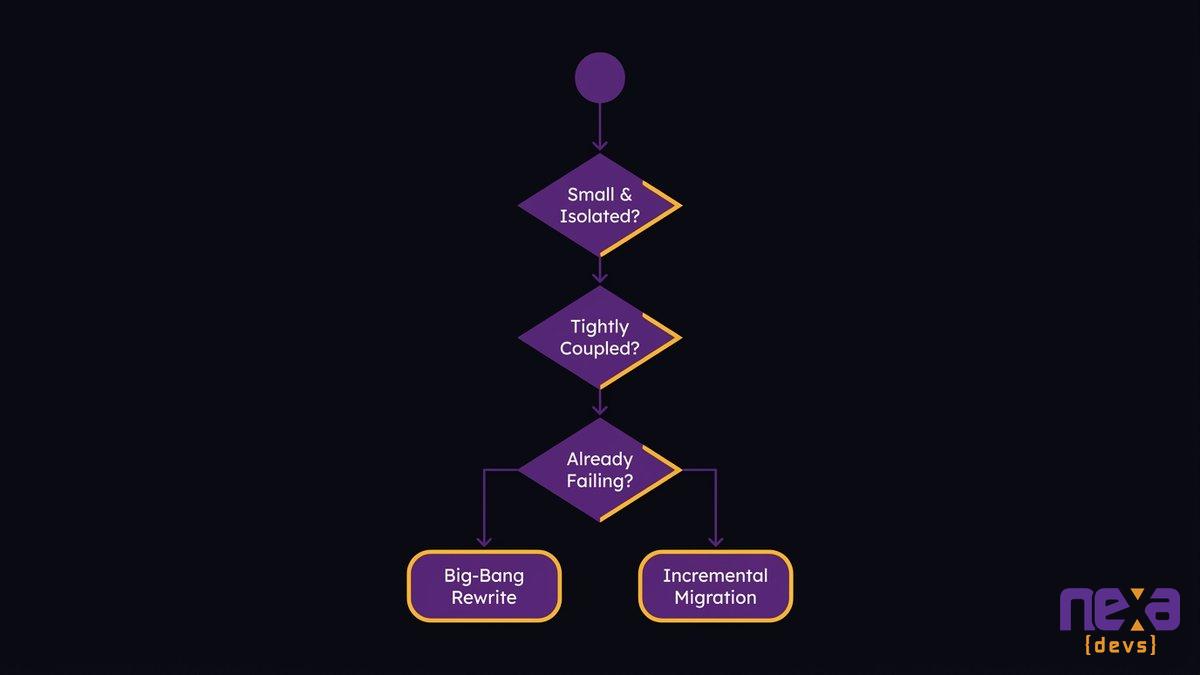
A simple decision tree: system size, coupling, and current failure state determine which migration path fits
Sequencing an Incremental Modernization Roadmap
Skip the comprehension phase and every phase after it inherits the same blind spot. Map the system first. Everything else in the roadmap depends on that map being accurate.
Comprehension first: map what exists before you touch it
Before any code moves, document what the current system does: its dependencies, its undocumented business rules, and the workflows nobody wrote down because the person who built them never left. This is usually the slowest part of a manual modernization effort, and it’s also where an AI-augmented delivery process earns its keep. how incremental AI integration works without a full rewrite Automated dependency mapping and code analysis compress a comprehension phase that used to take months into weeks, without skipping the step that big-bang projects skip.
Prioritize by risk and value, not by what’s easiest
The instinct is to migrate the easiest module first, because it feels like progress. Better sequencing prioritizes by a combination of business risk and business value: which workflow, if migrated successfully, proves the pattern works and unlocks the most value for the least exposure? That module becomes phase one, not because it’s simple, but because getting it right builds the case for phase two.
What You Gain After Escaping the Legacy Tax
Feature velocity comes back first. Maintenance cost drops months later, once enough of the legacy surface area has actually shrunk.
Teams report shipping features in weeks that used to take a quarter, simply because engineers are no longer routing around a system they don’t fully trust. The legacy modernization market itself reflects how widespread this shift has become. Mordor Intelligence projects the global legacy modernization market to reach $29.39 billion in 2026, up from $24.98 billion the year before, as more mid-market companies decide the cost of standing still now exceeds the cost of moving.
The bigger shift is less visible on a spreadsheet. Systems built or modernized through an incremental, well-documented process are ready for the next thing, whether that’s an AI feature, a new integration, or a team that didn’t build the original system taking it over without months of archaeology. the hidden tax of technical debt and what it costs every year you wait That readiness, not just lower maintenance cost, is what actually justifies the migration.
Choosing a legacy migration strategy isn’t really a technology decision. It’s a risk management decision that happens to involve technology. Big-bang rewrites bet everything on a date. Incremental migration, built on comprehension first and reversible cutovers, bets on a process instead. Talk to Nexa Devs about a phased legacy migration roadmap →
FAQ
What are the 7 migration strategies?
The 7 R’s framework, popularized by AWS, covers rehost, replatform, repurchase, refactor, re-architect, retire, and retain. Most mid-market migrations combine two or three of these across different parts of the system rather than applying one strategy to everything.
Why do companies still use legacy systems?
Because replacing them feels riskier than keeping them. The system still runs, switching costs money right now, and nobody wants to own a failed cutover. Fear drives it, not laziness.
What is legacy data migration?
It’s the process of moving data from an old system into a modern platform, including cleaning and validating it so nothing breaks. It’s usually one part of a larger application migration, not the whole project.
What is the strangler fig pattern?
It replaces a legacy system piece by piece. A routing layer sends some traffic to new code and the rest to the old system, growing the new system gradually until nothing routes to the old one anymore.
Is a big-bang rewrite ever the right choice?
Rarely. It only makes sense when the system is small, isolated, and well understood, or already failing outright. For most production systems, a big-bang rewrite carries more risk than it’s worth.