

Table of Contents
Body Shop Outsourcing Is Collapsing: What Replaces It
Pull up your last outsourcing invoice. A dozen line items, each billed by the hour, and probably not one of them tied to whether the release actually shipped. Paying for seats instead of results has a name in this industry: body shop outsourcing. It ran as the default IT outsourcing model for two decades, and in 2026 the economics that once made it work quietly stopped adding up.
Agentic AI now generates working code faster than any per-seat billing model ever planned for. Typing speed stopped being the bottleneck. What’s hard to find now is someone who owns whether that code is correct, tested, and still readable eighteen months from now. Body-shop vendors sell the one thing that just got commoditized: raw developer-hours model capacity. Below, I walk through why the model is breaking, what’s taking its place, and how to spot whether your current vendor already crossed the line without telling you.
Quick answer: body shop outsourcing model collapsing
- Body shop outsourcing means paying for developer hours, not a finished outcome, and it’s losing ground fast in 2026.
- Agentic AI now generates code faster than any contractor pool, so a markup on headcount no longer buys an advantage.
- The scarce resource shifted to owned outcomes, verification, and documentation the client actually keeps.
- Outcome-based and dedicated-delivery models are replacing body shops because one vendor owns the whole result.
- If nobody can name who’s accountable or where the documentation lives, you’re still renting a body shop.
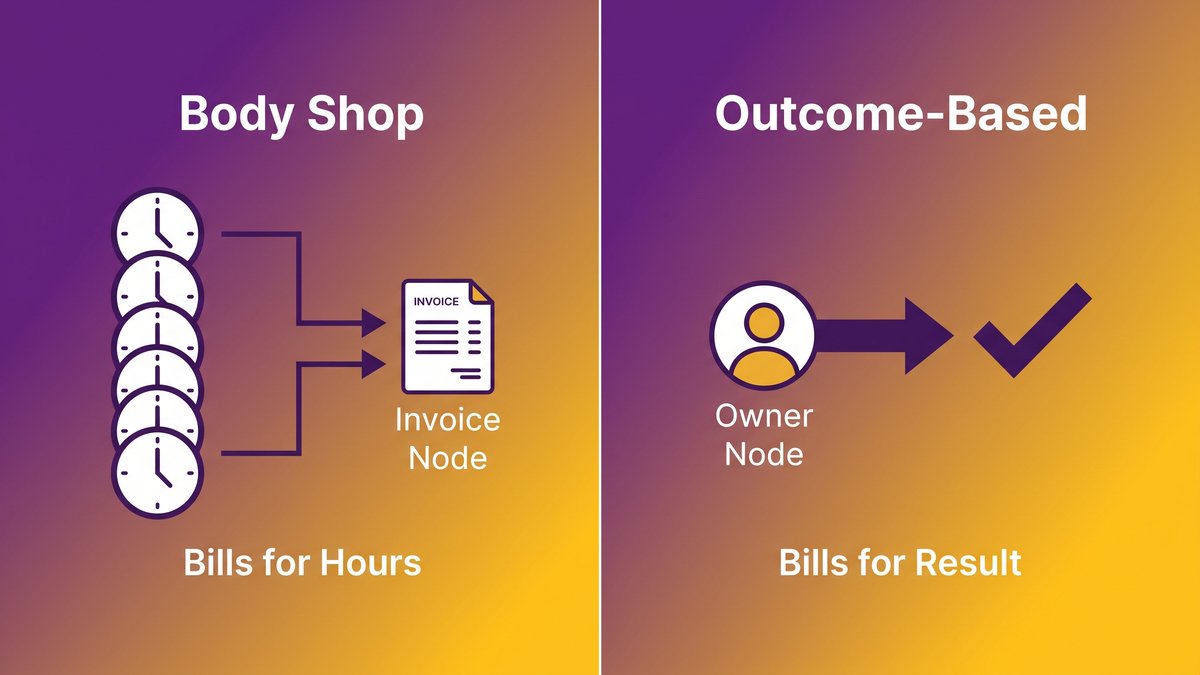
A side-by-side look at how body shop outsourcing bills for hours while outcome-based delivery bills for a finished result.
What an IT “Body Shop” Really Is (And Why You’re Probably Renting One)
A body shop sells hours, not software: billed by the seat, marked up for the work of finding warm bodies who can code. You rent capacity by the hour, and no one at the vendor carries responsibility for whether the work ships.
The term comes from staffing agencies that treat developers like inventory: place a body, bill the hour, move to the next contract. In IT outsourcing, the body-shop vendor recruits contractors to your spec, invoices for their time, and calls the engagement done. Whether the code works, whether anyone documented it, whether a human can maintain it after the contract ends, none of that lands on the invoice.
Picture a mid-market fintech team that watched three different “senior engineers” cycle through the same feature over four months. Each one relearned the codebase from scratch, and the vendor billed every hour of it, because under a developer-hours model, relearning is billable time like anything else.
This is a different animal from staff augmentation done well, and different again from a Staff augmentation arrangement that keeps real oversight in place. What sets a body shop apart is the thing it never owns: the outcome. The vendor tracks one number, hours logged, and leaves the question of whether the sprint produced value sitting with no one.
The Bill You’re Actually Paying: Churn, No Accountability, and Knowledge That Walks Out the Door
DemandSage’s 2026 research puts it at 20 to 25 percent, the share of outsourcing relationships that fall apart inside the first two years, usually for the same structural reason: nobody owned the result.
The invoice looks cheap until you tally what it leaves out. A body-shop contract prices the hour and nothing else: not the ramp-up when a contractor rotates off mid-sprint, not the rework when the next one reads the ticket differently, not the three weeks your internal team burns reverse-engineering undocumented code after everyone’s gone. A blended delivery arrangement, part staff augmentation and part dedicated ownership, tends to inherit the accountability gaps of both rather than the strengths of either.
No single owner of the outcome
Ask a body-shop vendor who owns it when a release slips, and you’ll get a roster of names where you wanted a single one. Time-and-materials outsourcing can’t assign outcome ownership by design, because the vendor gets paid whether or not the work ships. The Deloitte Global Outsourcing Survey found that 55 percent of failed engagements never tracked benefits against the original goal at all. Nobody watched whether the spend produced value, since nobody’s contract hinged on it.
Ashwin Ballal, CIO at Freshworks, frames the deeper version of this: “Legacy systems have become so complex that companies are increasingly turning to third-party vendors and consultants for help, but the problem is that, more often than not, organizations are trading one subpar legacy system for another… Adding vendors and consultants often compounds the problem, bringing in new layers of complexity rather than resolving the old ones.” Rotating contractors through a body-shop contract is just the staffing flavor of the same trap.
The knowledge leaves when the contractor does
Contractors billed by the hour have no contractual reason to write anything down. Documentation doesn’t register as billable progress, so it quietly doesn’t happen. When the engagement wraps, or a contractor jumps to a higher-paying gig mid-project, the knowledge of why the system works the way it does walks out with them. Your internal team inherits code it has to relearn from scratch, which is the very expense the outsourcing deal was supposed to spare you.
For a deeper look at how documentation practices separate a real delivery partner from a body shop in disguise, see outsourcing software development documentation.
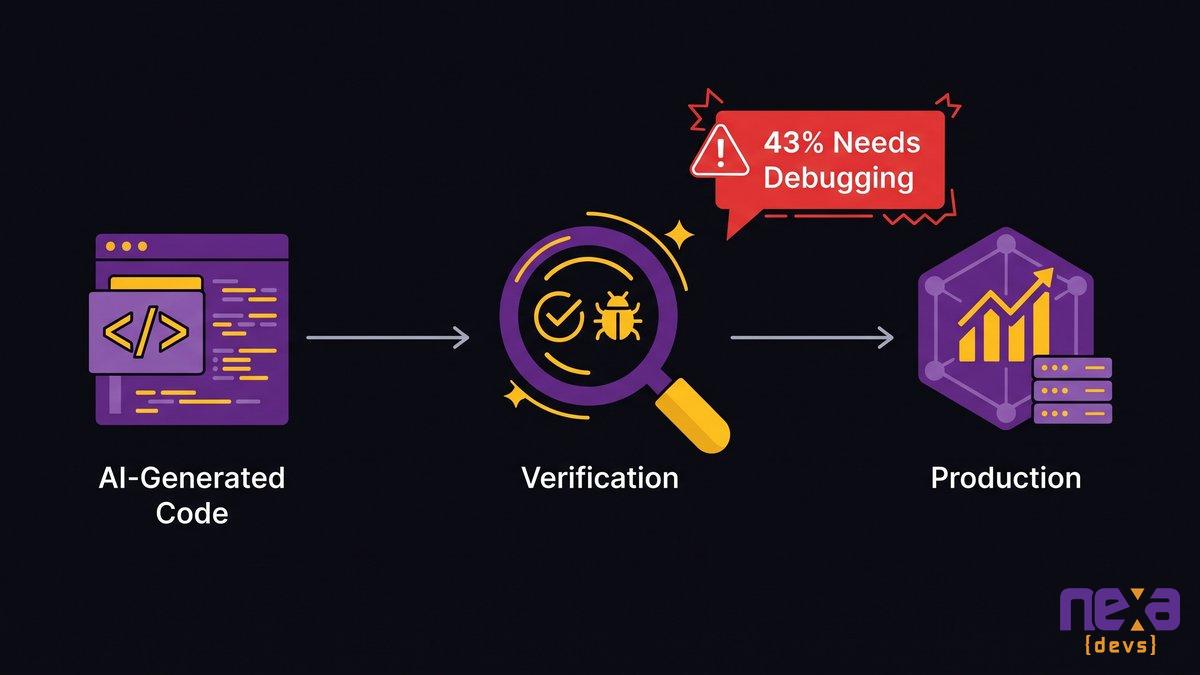
Verification, not code generation, has become the scarce skill agentic AI can’t replace.
Why Agentic AI Just Broke Body-Shop Economics
VentureBeat’s 2026 survey found that 43 percent of AI-generated code changes still need manual debugging in production, even after clearing QA. Most of the case against body shops sits in that one number: writing code got cheap, and checking it got expensive.
For the CTO: raw coding capacity is no longer the bottleneck; verification is
Agentic AI software development tools now turn out working code faster than any team of hourly contractors. A body shop’s core product is developer-hours spent typing, and that’s precisely the capacity agentic AI commoditized first. The part that stayed expensive is reviewing the output, catching the 43 percent that needs fixing before production, and judging whether a generated solution actually fits the system’s architecture. A body shop was built to sell hours, and judgment like that never came in the package.
For the CEO: a markup on headcount no longer buys an advantage
You used to pay a body shop a markup because sourcing, vetting, and managing contractors was slow and costly. Agentic AI ate into more than the coding; it took a bite out of the sourcing problem too, since fewer raw hands now produce the same volume of code. The companies that already switched can see it on the ledger: moving from shaky time-and-materials outsourcing to dedicated managed services saves an average of 15 percent, according to research from Information Services Group (ISG). Paying a markup on commodity capacity means spending against the wrong scarcity.
What Actually Became Scarce: Owned Outcomes, Verification, and Retained Knowledge
The scarce resource in software delivery has shifted. For years it was raw coding capacity, warm bodies who could turn a spec into working code. Now the shortage sits in three places a body shop was never built to supply: someone who owns the result, someone who verifies it’s correct, and documentation that stays put when the contract ends.
Owned outcomes come down to a single accountable party rather than a rotating cast of contractors, each on the hook only for their own logged hours. Verification is the review and testing muscle that catches what agentic AI gets wrong, the same 43 percent VentureBeat found breaking in production. Retained knowledge is documentation that transfers to the client no matter what happens to the relationship, so the next engineer, yours or the vendor’s, doesn’t open the project at zero.
Gartner projects that more than 40 percent of agentic AI projects will be canceled by 2027, cited via Modus Create’s analysis of the AI ambition gap. Many of those cancellations trace to one root cause: nobody built the verification and knowledge-retention layer the pilot needed to reach production, never mind scale.
All three point to the same requirement: a vendor with a structural incentive to own what happens after the code ships, not only what happens while the meter runs. The industry calls this software delivery ownership, and it runs directly counter to what a developer-hours model was built to provide.
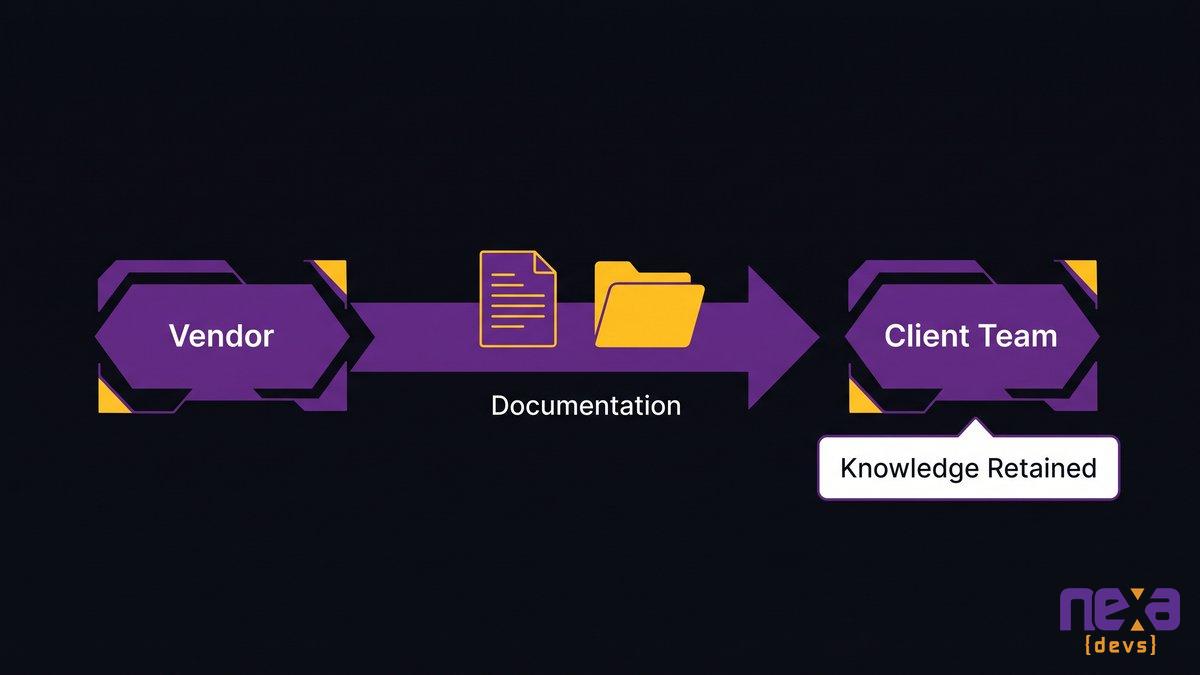
Complete documentation transfer keeps institutional knowledge with the client instead of the vendor.
What’s Replacing the Body Shop: Outcome-Based and Dedicated-Delivery Models
Outcome-based delivery and dedicated-delivery models drop the hourly meter. One bills for the result, the other assigns a single accountable owner to the whole engagement, and both close the accountability gap a body shop structurally can’t.
Outcome-based delivery: the vendor owns the result, not the timesheet
In an outcome-based outsourcing arrangement, payment attaches to a defined deliverable: a working feature, a passing test suite, a system that meets an agreed spec. That flips the vendor’s incentive. Hours spent without shipping the outcome now cost the vendor money instead of earning it. That one change in the incentive structure fixes more body-shop accountability than any volume of vendor management the client can throw at it.
Dedicated delivery: a single owner of day-to-day performance
A dedicated development team puts one lead on the hook for the whole team’s output, in place of a rotating pool of contractors each covering only their own hours. When something breaks, one person owns the fix. Swap a contractor out and the lead runs the transition, so institutional knowledge doesn’t reset with every staffing change. This is the delivery architecture built for engagements measured in years rather than sprints, which happens to be the horizon most mid-market internal systems live on.
For a closer comparison of how dedicated delivery stacks up against staff augmentation on the accountability question specifically, see our breakdown of dedicated team vs. staff augmentation accountability.
How to Tell If Your Vendor Is Still a Body Shop
Pull your last three vendor invoices. If every line item is an hour and nobody signed up to guarantee what those hours produced, you’re renting a body shop no matter what the contract calls it.
Run your current engagement against four questions:
- Who is accountable if the release slips: a named lead, or a list of contractors each covering their own hours?
- Where does the documentation live after this sprint: in your systems, or only in someone’s head?
- Does the vendor’s payment change if the outcome doesn’t ship, or only if the hours aren’t logged?
- Could a new engineer, yours or theirs, pick up this codebase tomorrow without a two-week ramp-up?
Dreamix’s research on vendor transitions found that documentation gaps and undocumented dependencies breed expensive problems months after a handoff wraps, which is exactly what surfaces when the honest answer to that second question is “nowhere.” If two or more of your answers point the wrong way, you’re paying body-shop prices for body-shop accountability, even if the sales deck said “dedicated team.”
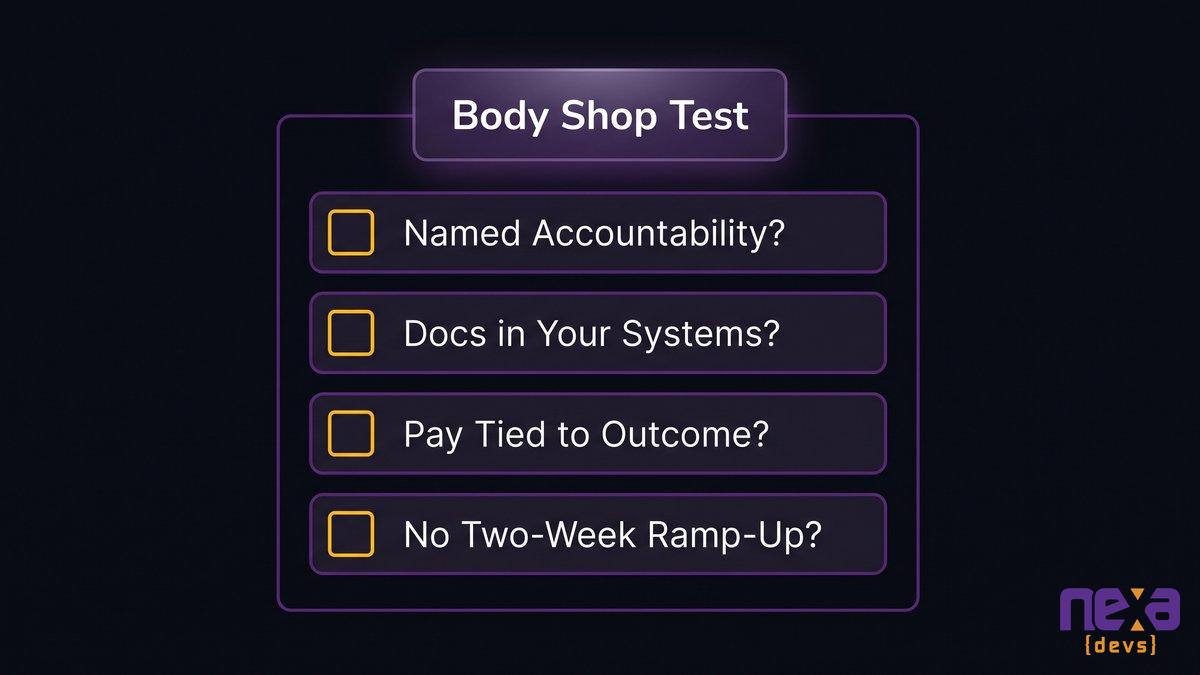
A quick four-question test for spotting body-shop billing hiding behind different language.
Choosing a Delivery Model That Owns the Result
Choosing a delivery model comes down to one structural question: who’s accountable when something breaks? Body-shop pricing was never built to answer it.
A body shop can still earn its keep on a short, well-scoped task where the deliverable is small enough that ownership barely registers: patch a script, cover a two-week gap, staff a proof of concept nobody’s betting the business on. Step outside that narrow lane and the model that owns the outcome wins, because agentic AI already wiped out the cost advantage body shops used to trade on. Body shops were never the villains here; they’re just running out of reasons to exist for anything that matters.
Nexa Devs is built around that model: AI-augmented delivery that produces the outcome rather than just the hours, paired with nearshore execution in U.S. time zones and complete documentation transfer that’s unconditionally yours when the engagement ends, whether or not you renew. The system stays understandable after the contract closes, because the knowledge doesn’t leave with a rotating contractor. That’s what a structural answer looks like for a model already running out of runway.
If you want a second opinion on whether your current vendor is still running a body shop under a different name, talk to our team about what an outcome-owning engagement actually looks like.
FAQ
What is body shop outsourcing?
Body shop outsourcing is a software delivery model where a vendor bills a client for developer hours, or seats, instead of a finished outcome. The vendor supplies contractors and invoices their time. Nobody at the vendor is contractually accountable for whether the work actually ships or works.
How is body shop outsourcing different from staff augmentation?
Staff augmentation done well still embeds a contractor into your team with real oversight and accountability. A body shop goes further: minimal vetting, no ownership of results, and billing that’s purely hours-based. In practice, poorly managed staff augmentation often collapses into a body shop anyway.
What is replacing the body shop model in software outsourcing?
Outcome-based delivery and dedicated-delivery teams are replacing body shops. Both tie the vendor’s incentive to a result instead of hours logged, assign one accountable owner, and typically include documentation transfer so knowledge doesn’t leave when a contractor does.
How do I know if my vendor is still running a body shop?
Check three things: whether a named person is accountable for missed deadlines, whether documentation lives in your systems instead of a contractor’s head, and whether the vendor’s payment depends on the outcome shipping, not just on hours logged.
Is body shop outsourcing still worth it in 2026?
For small, well-defined, short-term tasks, body shop outsourcing can still work fine. For anything strategic or ongoing, agentic AI has erased its main cost advantage, and outcome-based or dedicated-delivery models now deliver more accountability for a comparable price.