

Table of Contents
AI-Ready Data: Why Most AI Pilots Never Ship
A mid-market CTO in Ohio watched her team’s AI pilot nail the demo in March. The chatbot pulled customer records, flagged at-risk accounts, and answered questions her sales team used to escalate to a manager. Leadership loved it. Six months later, the pilot is still a pilot. It never touched production, because production data lives in four systems that don’t talk to each other, and nobody budgeted time to build the connections.
The chatbot was never the weak link. The data was. That is the pattern behind most stalled pilots: what decides whether a project reaches production is the state of the data underneath, well before the choice of model enters into it. And the work to fix it looks a lot more like integration and engineering than anything people picture when they hear “AI project.” It’s the same discipline a team would bring to any systems job: assess what you have, connect it, clean it, and document it so the next project doesn’t start from zero.
Quick answer: why AI pilots stall
1. AI-ready data is information that’s clean, connected across systems, and governed so AI tools can actually use it.
2. Most AI pilots stall because no one built the API and middleware layer that connects the data the AI needs.
3. Gartner projects 60% of AI projects will be abandoned by 2027 due to a lack of AI-ready data.
4. Data quality is the top inhibitor to AI deployment for mid-market firms, cited by 34% of leaders, per the RSM US Middle Market AI Survey.
5. The fix is engineering, not a better model: build the connective layer once and document it for every future project.
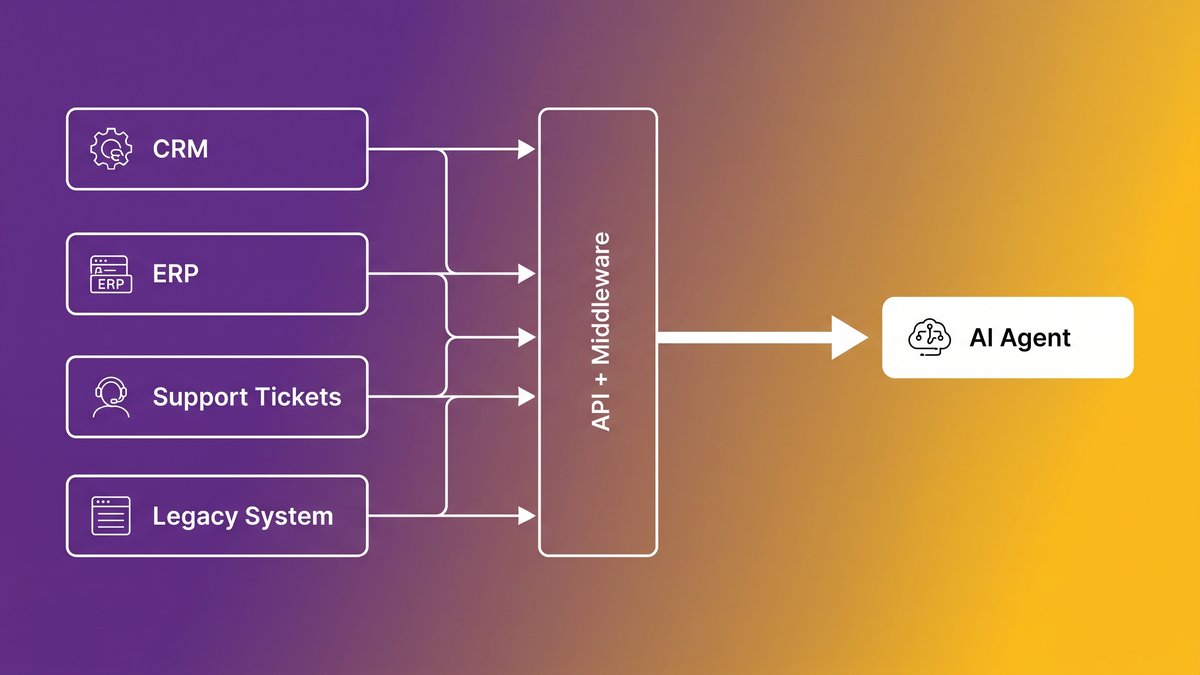
What an AI-ready data pipeline looks like once disconnected systems are wired together
The Real Reason Your AI Pilot Died Between the Demo and Production
Your pilot didn’t die because the model picked a wrong answer. Something more mundane killed it: nobody built the plumbing between the systems holding your data and the tool trying to read it.
Most demos run on a curated sample: a clean CSV export, a handful of test records, maybe a snapshot someone pulled by hand from the CRM. Production data quality sits a long way from demo data quality, because production means live inventory in one system, customer records in another, support tickets in a third, and a homegrown scheduling tool nobody has touched since 2019. The AI that impressed everyone in March needs all four, updated in real time, in a format it can parse. That AI pilot data infrastructure rarely gets built during the pilot phase, because pilots are scoped to prove the model works, not to prove the organization can feed it.
McKinsey’s research found 62% of organizations experiment with AI agents, but only 23% successfully scale them past that stage. IDC’s tracking tells a similar story: for every 33 AI pilots launched, only 4 reach production. Both numbers point to the same gap. The model works in isolation; the organization around it doesn’t.
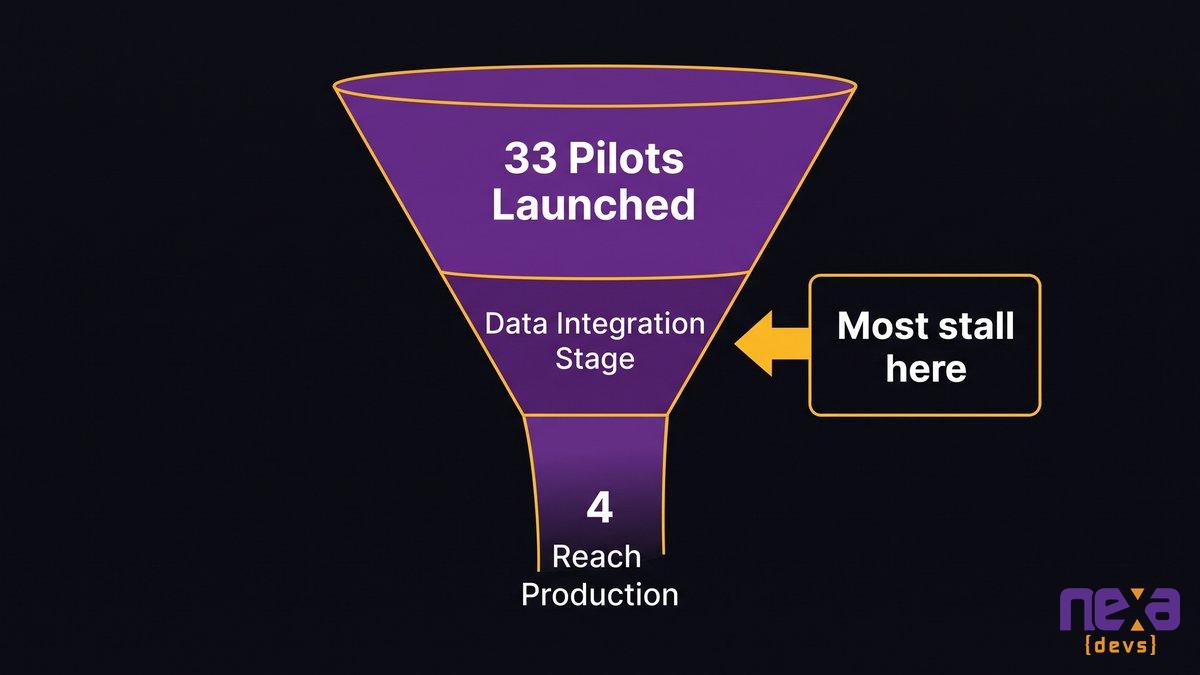
A funnel showing how AI pilots narrow from demo to production, with most stalling at the data integration stage
The gap shows up well beyond Ohio, beyond chatbots, beyond any one vendor’s model. Across the mid-market it plays out the same way: the demo works because someone hand-fed it clean data, and production fails because nobody automated that feed. legacy infrastructure as the real AI bottleneck
AI Readiness Isn’t a Model Problem, It’s a Data Foundation Problem
Buying a better model fixes a data problem about as well as a faster car fixes a traffic jam. The bottleneck sits one layer down, in what the model can actually reach.
Every mid-market leader has sat through the same pitch: switch to a newer model, buy the enterprise AI platform, add another SaaS layer. None of it addresses why the last pilot stalled. Pick any frontier model and it performs identically on your data whether that data is clean or a mess, because the model never sees the mess. It sees whatever gets handed to it. If what gets handed to it is incomplete, duplicated, or three systems out of sync, the model produces confident, wrong, or useless answers regardless of how good it is.
CTOs already know this. It’s the CEO and the board who need convincing, because “buy a better tool” is a much easier budget line than “spend two quarters building integration middleware nobody outside engineering will ever see.” Gartner’s research backs the harder truth: that unglamorous work is what “AI-ready” actually has to mean before anything ships. Data your systems can produce reliably, in a shape the AI can consume, updated on a schedule the business can trust.
why legacy infrastructure blocks AI deployment
What AI-Ready Data Actually Means
Four conditions decide whether your data can support AI, and none of them mention artificial intelligence at all.
Quality, completeness, and consistency
The data has to be accurate, deduplicated, and formatted consistently across every system it lives in. A customer record spelled three different ways across three databases is more than a minor annoyance. An AI agent will misread it, merge it wrong, or drop it entirely. This is the clean data for AI piece most teams underestimate, because the work is tedious rather than technically hard.
Accessible and unified across systems
An AI tool can only use data it can reach. That means APIs, not screen-scraping. It means a common schema, not four teams each naming the same field something different. If your customer data lives in a system with no API and no export beyond a nightly CSV, that data is stranded, not accessible.
Governed, secure, and traceable
Every AI-ready dataset needs a clear answer to three questions: who can access it, where did it come from, and can you prove that when a regulator or a customer asks. Data governance for AI, tracking lineage and metadata so you know which system is the true source of a given field, does real work here. It keeps an AI feature from turning into a liability the moment it touches anything sensitive.
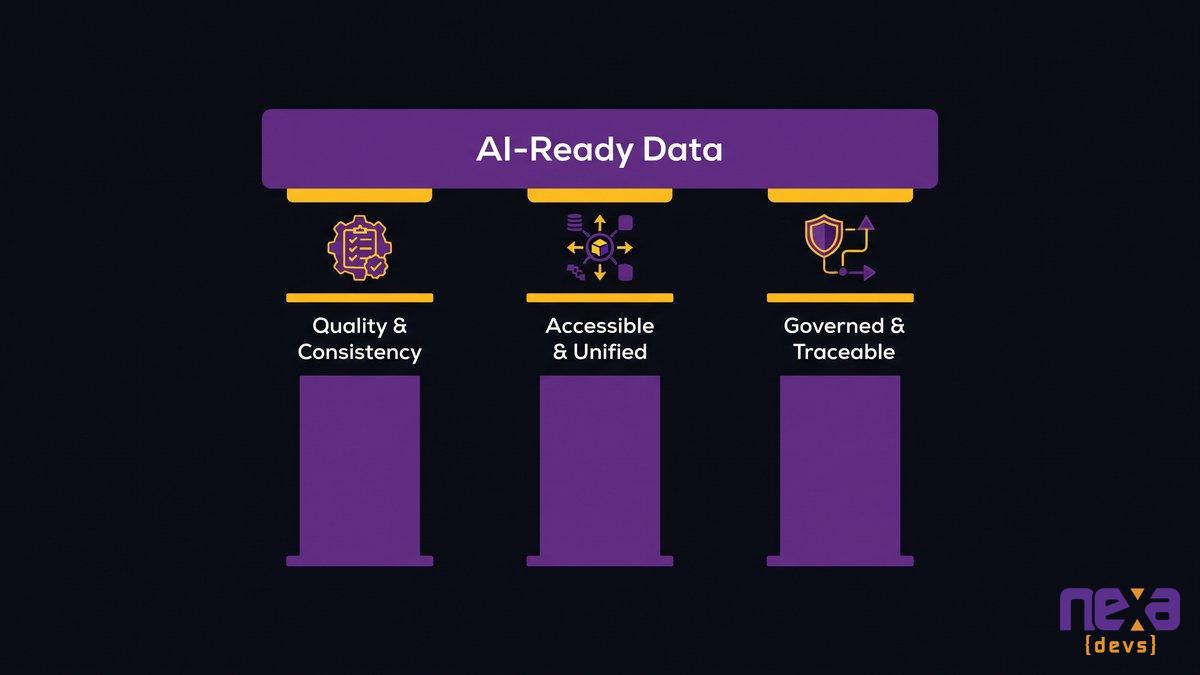
The three conditions that determine whether data can actually support an AI system
None of this is abstract data-governance theory. These are engineering requirements the AI depends on to work at all, the same way an engine depends on real fuel in the tank.
Why Mid-Market Data Isn’t Ready: Silos, Legacy Systems, and Quality Gaps
Data quality and availability are the top inhibitors to AI deployment for mid-market organizations, cited by 34% of respondents, ahead of security concerns, legacy integration, and talent gaps. The RSM US Middle Market AI Survey puts security and privacy at 30%, legacy systems integration at 28%, and talent gaps at 28%. Every one of those numbers traces back to the same root cause: disconnected systems that were never designed to share information.
Disconnected systems and data silos
Most mid-market companies didn’t set out to build silos. They accumulated them, one system at a time, over ten or fifteen years of solving whatever problem was in front of them that quarter. The CRM went in during one hiring wave. The inventory system came from an acquisition. Finance runs on something the original controller picked in 2014, and nobody’s had the appetite to replace it since.
As Jesper van den Bogaard, CEO at Factor Blue, describes it: “We need to process manufacturing, but the invoice is here, the order data is there, and we’re manually passing information around, with data scattered across different systems.” That isn’t a hypothetical. It’s Tuesday for most mid-market operations teams, and it’s the exact condition that makes data silos AI integration impossible until someone deliberately builds the connections.
Legacy stack the AI can’t reach
Some of that data sits behind systems that predate modern APIs entirely: an on-premise ERP with no export beyond scheduled batch reports, a scheduling tool built in-house a decade ago with zero documentation. An AI agent can’t query a system with no interface to query. It can only wait for someone to build one.
Poor data quality and missing lineage
Even connected data often can’t be trusted. Duplicate customer records, three different date formats across systems, no record of which system was the original source of truth. An AI model grounded on that data fails quietly rather than loudly, producing answers that look right until someone downstream catches the error.
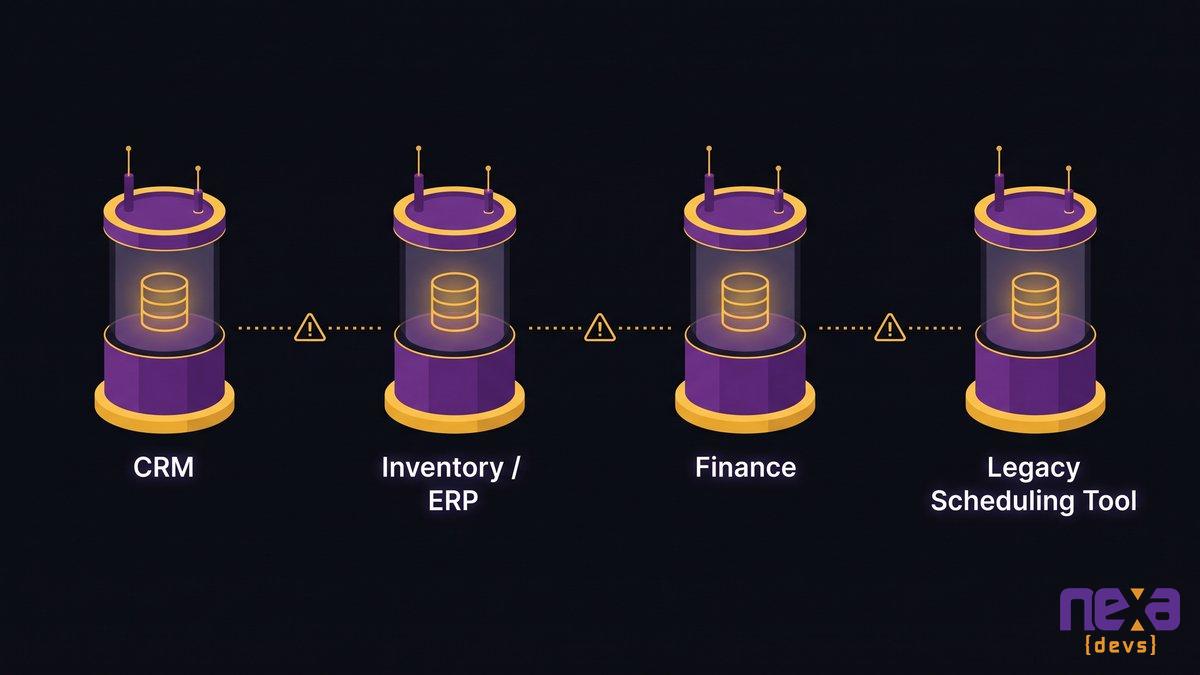
How data silos form across CRM, ERP, and legacy systems in a typical mid-market company
The Business Cost of Skipping the Data Layer
Gartner projects that by 2027, 60% of AI projects will be abandoned because the organizations behind them lack AI-ready data. Read that as a budget statistic, not a technology one, because every abandoned project already burned months of engineering time, a vendor contract, and a line item the CFO approved on the promise of a return.
The mid-market irony is that adoption looks healthy on paper. According to the RSM US Middle Market AI Survey, 86% of middle-market organizations have partially or fully integrated AI into their operations, and 97% report satisfaction with what they’ve built. What does that 97% actually measure, if most of what they’ve built never left pilot stage? Those numbers describe pilots and point solutions, not scaled, production-grade systems the whole business depends on. A chatbot that answers 40% of support tickets correctly still counts as “integrated AI,” and it still isn’t something you’d bet the quarter on.
The real cost shows up in three places: engineering hours spent building against data that keeps changing shape, the opportunity cost of every quarter spent re-litigating the same integration problem, and the trust cost when a pilot leadership championed publicly quietly disappears. None of that shows up on a line item labeled “data infrastructure.” It shows up as delay, and that AI readiness gap, the distance between what mid-market teams have and what production AI actually needs, is the thing competitors with a working data layer are already closing. The hidden tax of technical debt
How to Build an AI-Ready Data Foundation
Building an AI-ready data foundation follows a sequence: assess what you have, clean and connect it, then govern it. Skip a step and the AI project you build on top inherits every gap you skipped.
Assess the current data landscape
Start by mapping where your critical data actually lives, not where the org chart says it should live. Most mid-market assessments turn up at least one system nobody remembered was still load-bearing: a spreadsheet a single analyst maintains, a database an acquired company brought along five years ago. You can’t connect what you haven’t found.
Clean, standardize, and connect the data
This is the unglamorous middle. Deduplicate records, agree on one schema per data type across systems, and build the APIs and middleware that let previously disconnected systems exchange data automatically, instead of through a person copying and pasting between tabs. It’s slower than buying a tool. It’s also the only part of this process that actually removes the bottleneck instead of working around it. A full data platform migration is rarely the right first move for a mid-market team; building the connective layer over what you already have almost always beats replacing it outright.
Establish governance, security, and monitoring
Once data moves automatically between systems, you need to know who can see it, whether it’s still accurate six months later, and what happens when a source system changes its schema without warning. Monitoring catches the quiet failures: the field that started returning null, the API that silently changed its date format. Without it, you find out your AI-ready data stopped being AI-ready when a customer complains, not before.
The Engineering Underneath: APIs, Middleware, and Modernizing the Stack
This is where the actual engineering happens, and it’s mostly invisible to everyone outside the team doing it. Three things get built, and none of them are the AI model itself.
Connecting disparate systems with APIs and middleware
The core work is building the connective tissue: APIs that expose data from systems that never had one, middleware that translates between formats so the CRM and the ERP can finally agree on what a “customer” is. This is the same data pipeline modernization discipline that’s existed in enterprise software for two decades, applied now with AI as the reason it finally gets funded. Martin Fowler’s writing on the strangler fig pattern describes the incremental version of this well: replace and connect one piece at a time, never the whole stack at once. Nexa builds this layer as custom infrastructure scoped to the client’s actual systems, rather than dropping in a generic connector that half-works.
Embedding AI into existing systems instead of bolting on a pilot
A pilot bolted onto data it can’t reach will always be a demo. AI embedded into the systems people already use- the CRM, the internal ops tool, the scheduling platform- reaches production because it runs on the same data pipeline the business already depends on, so there’s no separate sandbox anyone has to remember to feed.
Cleaner architecture and higher test coverage from the start
AI-augmented delivery changes what gets produced during this build, not just how fast. Generating tests alongside code as a continuous practice, running structured QA throughout the sprint rather than at the end, and producing architecture documentation as a standard deliverable means the data layer that comes out the other side is maintainable by someone other than the person who wrote it. That’s the difference between infrastructure and a demo that happened to work once.
Owning the Data Layer, Not Another Black Box
Ask what happens if the vendor who built your data layer disappears tomorrow. If the honest answer is “we’d be stuck,” you haven’t fixed the data problem. You’ve relocated it.
Nexa transfers complete documentation at project close: architecture diagrams, API references, data lineage records, test coverage reports. Not as an optional add-on, but as standard practice regardless of whether the engagement continues afterward. The client owns the data foundation outright, which means the next engineer, whether they’re Nexa’s or someone the client hires directly, can actually understand what’s running and why. Why documentation is the real competitive advantage
Ownership matters more for a data layer than almost any other part of the stack, because a data layer nobody understands is worse than no data layer at all. It fails silently, it resists change, and it becomes the reason the next AI initiative stalls the same way the last one did. Building the connective tissue is half the job. Making sure the client still understands it in two years is the other half, and it’s the half most vendors skip.
Mid-market data readiness never arrives as a checklist you buy off a vendor’s landing page. You build it, document it, and keep it. Once it’s in place, every AI project after the first one starts from a working foundation instead of another six-month integration slog.
FAQ
What is an AI-ready data model?
An AI-ready data model is a data structure built so AI systems can read, interpret, and act on it without manual cleanup. It uses consistent schemas, clear metadata, and documented relationships between fields, so a model or agent can query it directly instead of waiting for someone to reformat a spreadsheet first.
How do I know if my data is ready for AI?
Check three things: can every system holding relevant data expose it through an API, is the data consistent enough that the same customer or product looks identical across systems, and can you trace where each piece of data originated? If any answer is no, your data isn’t ready yet.
How do I get my data ready for AI?
Start with an assessment of where your critical data actually lives, then build the APIs and middleware that connect those systems automatically. Clean and standardize formats as you connect them, and add governance and monitoring so the connections stay accurate over time.
Why do AI pilots fail even with a good model?
Pilots usually run on a small, manually cleaned dataset that doesn’t reflect production. When the AI needs live data from multiple disconnected systems, there’s often no pipeline feeding it automatically, so the project stalls waiting for integration work nobody scoped during the pilot phase.