
Table of Contents
AI Code Review Bottleneck: Why Teams Ship Slower With AI
Your engineering team rolled out AI coding assistants across the board. Velocity metrics look great in standups. Then you check the pull request queue and it’s three times longer than it was in January. That gap between how fast development feels and how fast code actually ships is the AI code review bottleneck: AI-generated code arrives faster than your reviewers can verify it, so the constraint in your delivery pipeline shifts from writing code to checking it. Slowing AI adoption does nothing about it. The gap closes only when the review system gets redesigned so verification keeps pace with generation. Most teams still have review bolted onto the tail end of a pipeline built for a slower era, and that design is exactly what buckles under AI-scale volume.
The root cause here is systemic, and it won’t yield to another tool. Teams that add more AI coding tools without rebuilding how requirements, tests, and review work together end up with more code and the same review capacity they had a year ago. The organizations that get real throughput gains treat generation and verification as one connected system, built and tested together from the first sprint.
Quick answer: AI code review bottleneck explained
- AI speeds up writing code, not verifying it, so pull requests outpace reviewer capacity.
- Review time keeps climbing as AI adoption grows, because merge rates rise faster than review capacity does.
- Adding reviewers or rushing review doesn’t fix a throughput mismatch. It just moves the backlog.
- The real fix: build verification into requirements, tests, and review so it scales with generation, not after it.
- Track delivery flow, not coding speed. That’s where the actual bottleneck shows up.
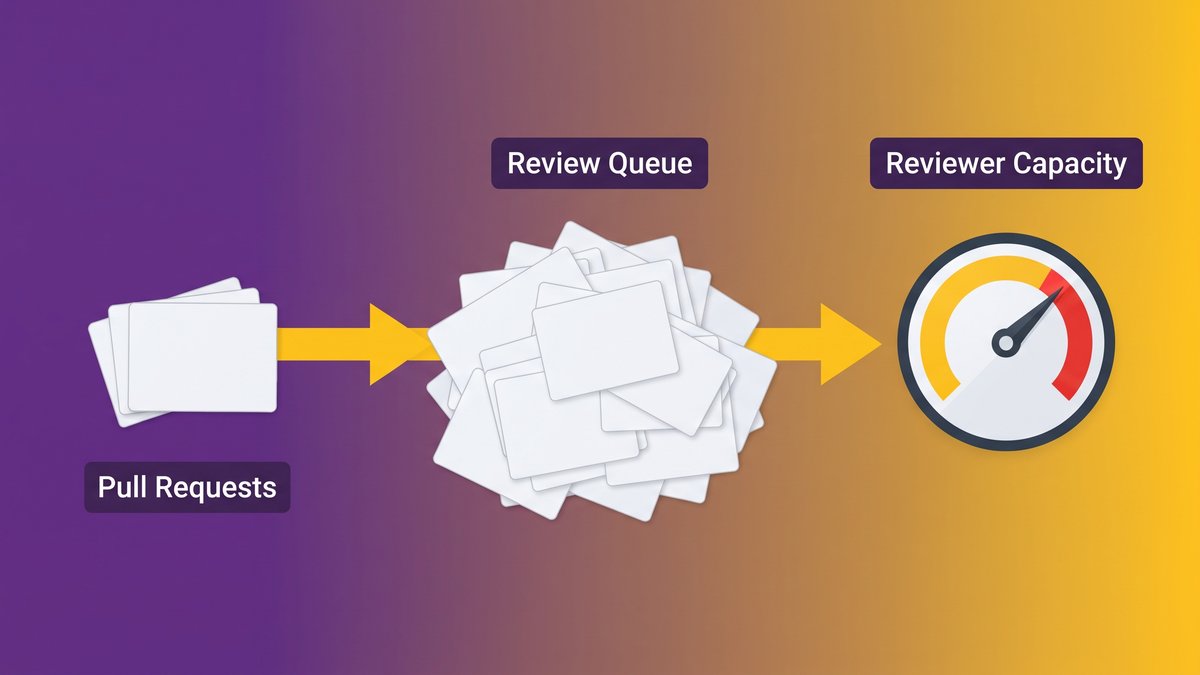
A pull request queue stacking up faster than reviewers can clear it
The velocity illusion: why AI makes teams feel faster while they ship slower
VentureBeat reports that 43% of AI-generated code changes need manual debugging in production, even after clearing QA and staging. Code passes every gate on the way in and still breaks on the way out. Engineers have a name for that: the velocity illusion.
So which is the real story here, the speed you feel or the speed you ship?
Ask a developer how AI changed their week and most say the same thing: a feature that used to take two days now takes an afternoon. Ask a CTO whether the team shipped three times more verified features last quarter and the answer is almost always no. Both experiences are true at once. They just describe different parts of the pipeline.
The gap between perceived speed and measured delivery
Coding speed and shipping speed used to move together closely enough that nobody bothered to separate them. AI broke that link. A developer using an AI assistant can draft, refactor, and generate boilerplate in a fraction of the previous time. None of that touches the step that actually gates a release: someone with context has to read the diff, understand what changed, and decide whether it’s safe to merge. That step hasn’t gotten faster just because the code arrived quicker.
Where the saved coding time quietly goes
The hours a team saves on drafting have to land somewhere, and where they land is downstream. Reviewers spend more time per pull request reconstructing intent from a diff that came out of a model instead of a colleague’s head. QA spends more time chasing edge cases in code nobody on the team wrote line by line. The net time saved across the full delivery cycle is smaller than the time saved on typing alone, and for some teams it’s negative.
The AI code review bottleneck didn’t disappear, it moved
Every queueing system runs on one rule: if arrivals outpace processing capacity, the queue grows without limit no matter how efficient any single step becomes. Pull request review is living out that rule right now.
Faros AI’s analysis of 10,000 developers found that teams with high AI adoption merge 98% more pull requests while PR review time increases 91%, and average PR size grows 154%. So reviewers absorb a triple hit: more pull requests, bigger ones, and all of it from a source that never explains its own reasoning.
Generation scaled overnight; verification capacity didn’t
Rolling out an AI coding assistant is a one-sprint decision. Growing senior review capacity by the same multiple takes months of hiring, if it happens at all, because most mid-market engineering teams don’t have three extra senior engineers sitting idle waiting for a review queue to appear. Generation capacity scaled overnight while verification capacity stayed flat.
Why review queues explode once AI is writing the code
LinearB’s 2026 Software Engineering Benchmarks Report found agentic AI pull requests wait 5.3 times longer for a reviewer to pick them up, and AI-assisted PRs wait 2.47 times longer, compared with unassisted work. Reviewers work the same as they always have. What changed is arrival rate, which crossed the point where the queue stops draining between sprints and starts carrying over.
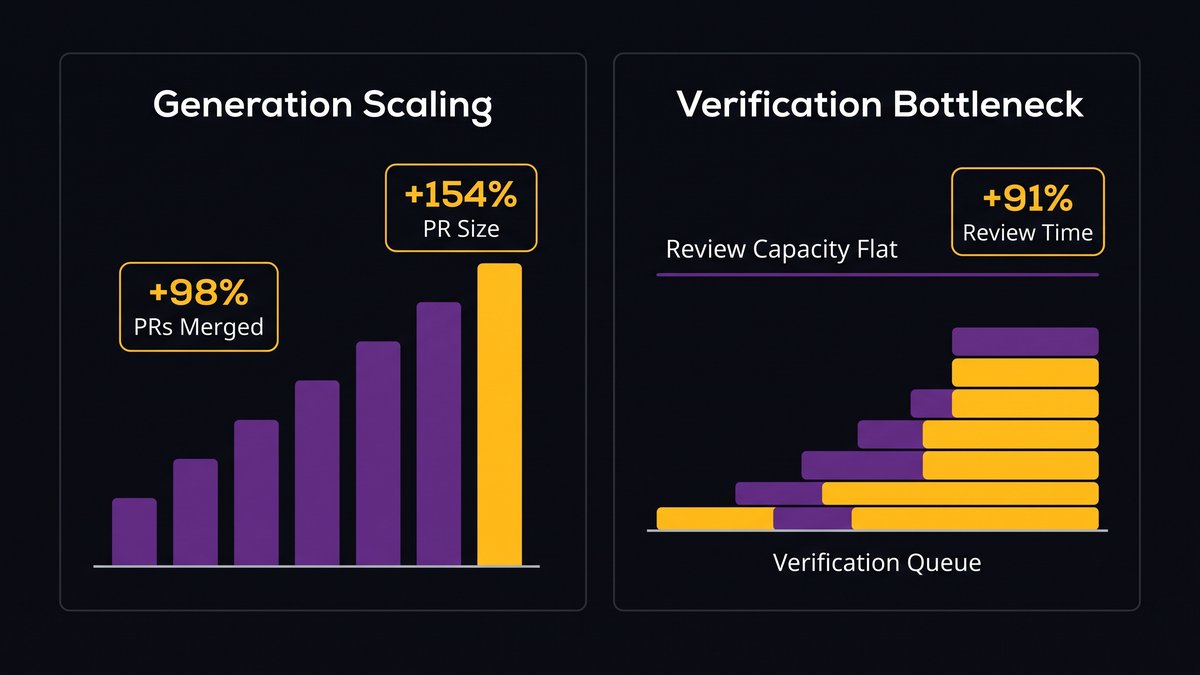
A review queue growing week over week as AI-generated pull requests outpace reviewer throughput
Why AI-generated code is harder to review, not easier
Volume alone is manageable. The trouble is code that shows up with no explanation behind it.
A pull request from a colleague usually arrives with context you already share: a Slack thread about the tradeoff, a half-remembered conversation from standup, an assumption about why the retry logic looks the way it does. A pull request generated by an AI assistant shows up as a finished artifact with none of that. The reviewer has to reverse-engineer intent from the diff, with nothing already communicated to lean on.
No intent trail: reviewers reconstruct decisions from a finished diff
Senior reviewers describe the same experience across teams: reading an AI-generated diff takes longer than reading an equivalent human diff, because there’s no design conversation to fall back on. Every unusual choice, an odd exception handler, a nonstandard data structure, has to be evaluated cold rather than confirmed against something the reviewer already knows.
Plausible-but-wrong code and the trust tax it creates
The more experience teams get with AI-generated code, the less they trust it. The Stack Overflow 2025 Developer Survey found trust in AI accuracy has dropped to 29%, even as adoption climbed. Plausible-looking code that fails on a case the model never considered costs more reviewer time to catch than code that’s obviously wrong, because obviously wrong code gets rejected fast. Plausible-but-wrong code gets a slow, careful second look, every time.
Why “review faster” and “just hire more reviewers” don’t fix it
Push reviewers to move faster and defect-escape rates climb. Add reviewers and onboarding overhead eats the gain for months. Neither response touches the actual constraint.
These are the two reflexes almost every CTO reaches for first, and both fail against the same math. Rushing review lowers the bar for what gets caught before merge, and the queue stays exactly as long as it was. Teams that push this lever hardest are the ones who watch production incidents climb even while their review dashboards look green. Hiring more reviewers helps eventually, but a new senior engineer needs months to build the codebase context that makes their judgment worth anything. During that ramp-up, the queue keeps growing anyway.
This mirrors a much older idea from operations management: in any system with a hard constraint, Theory of Constraints thinking says pushing harder on a bottleneck rarely fixes it, redesigning what feeds it does. There’s a third option nobody reaches for first because it means touching the whole pipeline instead of one stage of it: reduce how much verification work review has to do by catching problems earlier, before a diff ever reaches a human reviewer’s queue. Redesigning the system that feeds review takes more work up front than patching the review stage, but it’s the option that actually holds up.
Measure delivery flow, not coding speed
CircleCI’s 2026 State of Software Delivery report, analyzing more than 28 million CI workflow runs across 22,000-plus organizations, found feature-branch throughput up 59% year over year while main-branch throughput fell about 7% and main-branch success rates dropped to 70.8%.
Those three numbers tell the whole story. Feature branches are full of AI-assisted work moving fast. The main branch, the place where code actually becomes a shipped, verified feature, is moving slower and succeeding less often. If your dashboards only track commits opened, PRs raised, or lines generated, you’re measuring the branch that’s lying to you.
The metric that matters is throughput of verified, merged, deployed work: cycle time from first commit to production, and how often a main-branch build actually passes. Frameworks like Google’s DORA metrics exist precisely because coding activity and delivery performance aren’t the same thing, and mid-market teams adopting AI need that distinction now more than enterprise teams did five years ago. A team that generates twice the code but ships the same number of verified features a quarter later has gotten louder, not faster.
The real fix: scale verification with generation across the whole SDLC
Verification has to run through every phase that produces risk. Bolting it onto the end of a single “code review” stage is why the queue keeps growing in the first place.
What that takes is four structural changes, and not one of them is a new tool.
AI-assisted requirements and design that catch ambiguity before code exists
A vague requirement produces a plausible-looking implementation of the wrong thing, and that’s exactly the failure mode reviewers struggle to catch, because the code works, it just solves the wrong problem. Running requirements and system design through AI-assisted analysis before a single line gets written surfaces ambiguity while it’s still cheap to fix. A missing edge case in a spec costs a paragraph to resolve. The same gap discovered in review costs a rewritten pull request.
Tests written alongside code every sprint, not bolted on at the end
When tests get written after the fact, usually under deadline pressure, they tend to confirm what the code already does instead of what it should do. Writing AI-generated unit and integration tests in the same sprint as the code, as a continuous practice rather than a phase-gate, means a reviewer isn’t the only check standing between a plausible bug and production. This is one of the few places automation can absorb real review load instead of adding another tool to the stack. OWASP’s Software Assurance Maturity Model frames this same principle for security specifically: verification built into every phase beats verification bolted onto the last one.
Continuous code review throughout the lifecycle instead of one end-of-line gate
A single review gate at the end of a sprint is where arrival-rate math breaks a team, because every pull request from two weeks of work lands in the queue at once. Reviewing continuously, as work lands rather than as a batch, spreads the same total review load across the sprint instead of concentrating it at the worst possible moment.
Documentation transfer so review isn’t gated on one person’s head
Review capacity is about more than headcount. What really counts is how many people understand the system well enough to review changes to it with confidence. Nexa Devs treats complete documentation, architecture decision records, system design docs, API references, as a standard deliverable rather than an optional extra, specifically because review that depends on one person’s memory doesn’t scale past that person’s calendar. The relationships that have run longest, including a decade-plus engagement with UCLA David Geffen School of Medicine and eight years with TSB, work because institutional knowledge is written down and transferable, not because one engineer never left. For a closer look at how documentation practices change vendor risk, see “why documentation is the real competitive advantage in outsourced engineering”.
For a deeper walkthrough of how these four pieces connect into one delivery system, see “how an AI-augmented SDLC works end to end”.
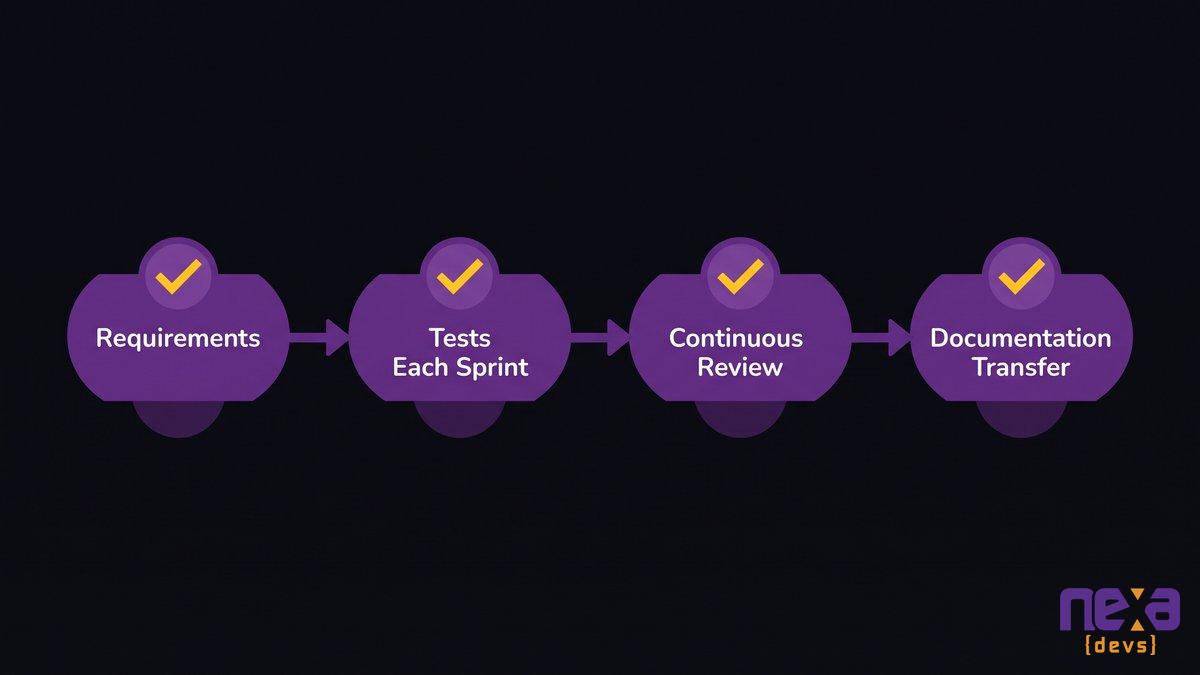
How requirements, tests, and review connect across every sprint instead of gating at the end
What to automate and what human judgment must still own
Static analysis catches syntax and known vulnerability patterns. It doesn’t catch a wrong assumption about how a payment retries under a network partition. Knowing which is which is what the job really comes down to.
Automate what’s mechanical and repeatable: linting, type checking, security scanning, test coverage thresholds, and policy checks against your own architectural rules. The NIST Secure Software Development Framework lays out this same division for secure development at a policy level: standardize the mechanical checks so human reviewers aren’t burning hours on them. These are exactly the checks reviewers waste time catching manually and exactly the checks a well-configured pipeline never gets tired of running. Every hour a reviewer doesn’t spend catching a missing null check is an hour available for the judgment call that actually needs a human.
Reserve human judgment for architecture fit, business-logic correctness, and risk: does this change interact badly with a system three services away, does the behavior match what the business actually needs, is the blast radius of a bug here acceptable. No automated check can evaluate whether a change is the right change. Only a person with context can make that call, and protecting enough of their time to make it well is the point of redesigning the system in the first place.
Governing the generation ceiling: how much AI code is safe to ship
There’s no universal percentage that tells you how much of a codebase is safe to let AI write. There’s only the ceiling your verification system can actually support.
Teams that treat the generation ceiling as a fixed number, capping AI at some fraction of commits and calling it governance, are solving the wrong variable. The ceiling has far less to do with AI’s capability than with how much verified, reviewed, tested code your pipeline can absorb per sprint without the queue growing. Raise verification capacity and the safe ceiling rises with it. Leave verification flat while you add more AI generation, and all you’ve built is a bigger backlog with better marketing.
As Skylar Roebuck, CTO at Solvd, states: “Traditional modernization tends to over-index on protecting how things work today rather than building for what’s next. AI capability is compounding rapidly, and the real risk for mid-market companies is delay.”
Compliance-heavy environments make this concrete: a healthcare or financial services team can’t treat a fixed generation percentage as a governance answer, because the question an auditor actually asks is whether every change, however it was produced, went through equivalent verification. The NIST AI Risk Management Framework frames governance the same way, as a property of the whole system rather than a cap on any one input. Build generation and verification to scale together, and the ceiling question mostly answers itself: ship as much AI-generated code as your verification pipeline can actually stand behind.
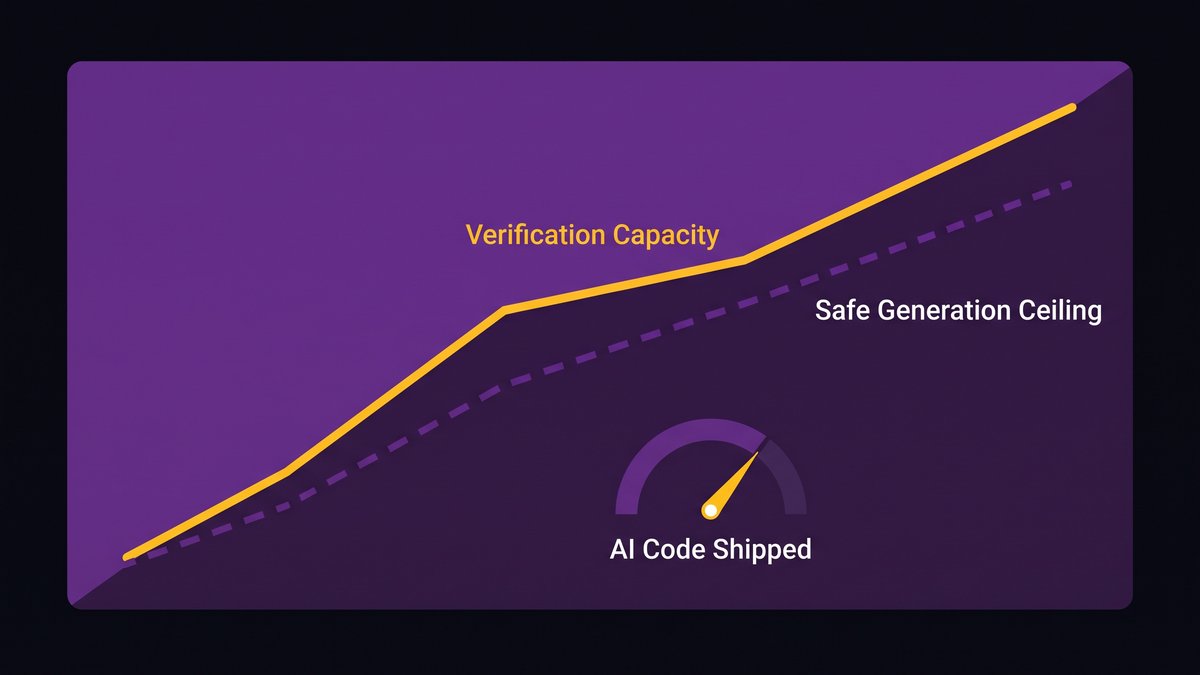
Raising verification capacity is what actually raises the safe AI generation ceiling
The takeaway for engineering leaders
Adding AI to your development process without rebuilding review, testing, and requirements alongside it produces exactly what you’re seeing: faster typing, slower shipping, and a growing sense that something in the pipeline is quietly breaking. Nexa Devs builds AI-assisted requirements analysis, continuous AI-generated testing, ongoing code review, and complete documentation transfer into every engagement, so generation and verification scale together from the first sprint instead of the review stage absorbing the entire cost of AI adoption later.
Ready to see what a review pipeline built for AI-scale generation actually looks like for your team? Schedule an architecture assessment with Nexa Devs and find out where your verification capacity is actually breaking, before your next sprint proves it for you.
FAQ
What is the productivity paradox in AI coding assistants?
The AI coding productivity paradox is the gap between how fast developers feel while using AI and how fast their team actually ships verified code. AI cuts the time to write code, but pull requests pile up faster than reviewers can check them, so delivery slows even though typing speed goes up.
Does AI make coders more productive?
Yes, for the writing-code part of the job, but the gain gets offset downstream. VentureBeat reports 43% of AI-generated code changes still need manual debugging in production even after passing QA, so the time saved drafting code gets partly spent again during review and testing.
Is AI writing 90% of code?
Not typically, no. Most credible industry estimates put AI-authored code well under half of new commits at a typical mid-market engineering organization. The 90% figure usually describes aggressive early-adopter teams or narrow greenfield projects, not the norm.
What is the 40/20/40 rule in software engineering?
The 40/20/40 rule is a rough time-allocation guideline: spend about 40% of a project’s time on planning and requirements, 20% writing code, and 40% on testing and verification. Verification deserves at least as much investment as writing code, not less.
What is the 30% rule in AI?
There’s no single agreed definition, but the phrase usually refers to industry benchmarks showing AI now generates roughly a third of new code at organizations with mature AI adoption. Treat it as a rough adoption signal, not a governance target.