Table of Contents
Vendor Lock-In in Custom Software: The Knowledge Hostage Problem
Call your developer. Ask for a small change to the internal system they built two years ago. Get back a quote. Pay it. Two months later, ask for another change. Get another quote.
That’s not a vendor relationship. That’s a ransom.
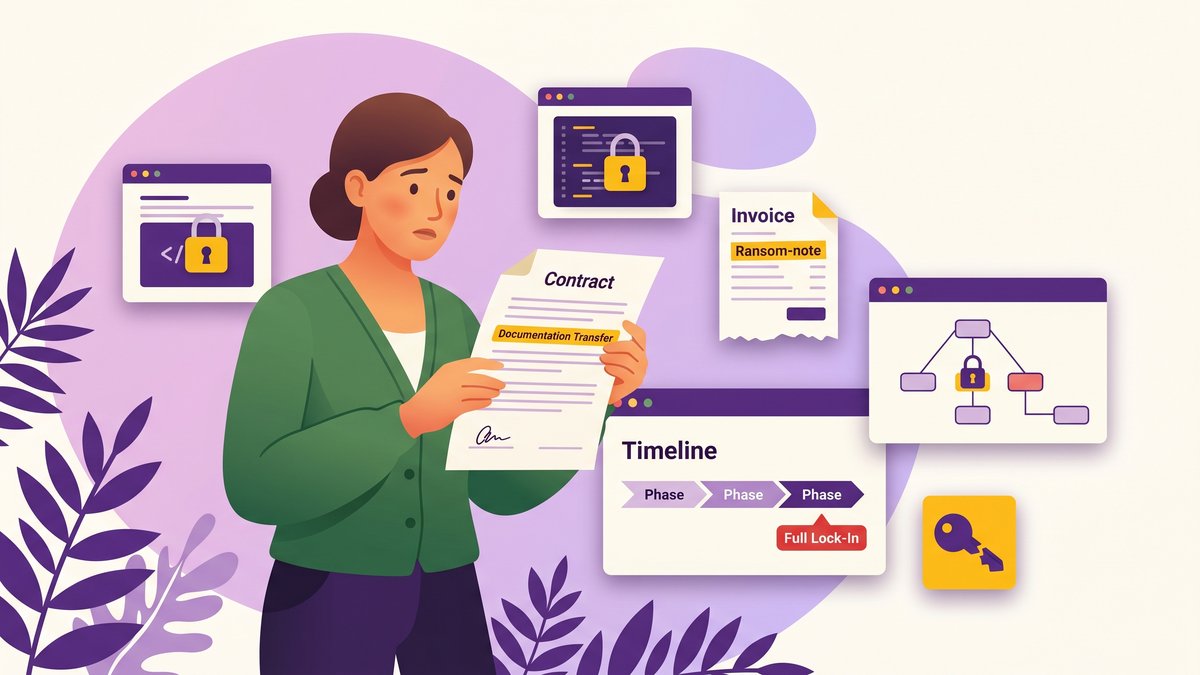
Vendor lock-in in custom software development is rarely about platform dependencies or proprietary licenses. For most mid-market companies, it’s simpler and more personal than that: one contractor or one small agency built something your operations depend on, and they kept the knowledge needed to maintain it. The system works fine. The hostage situation is invisible until the moment you need something to change.
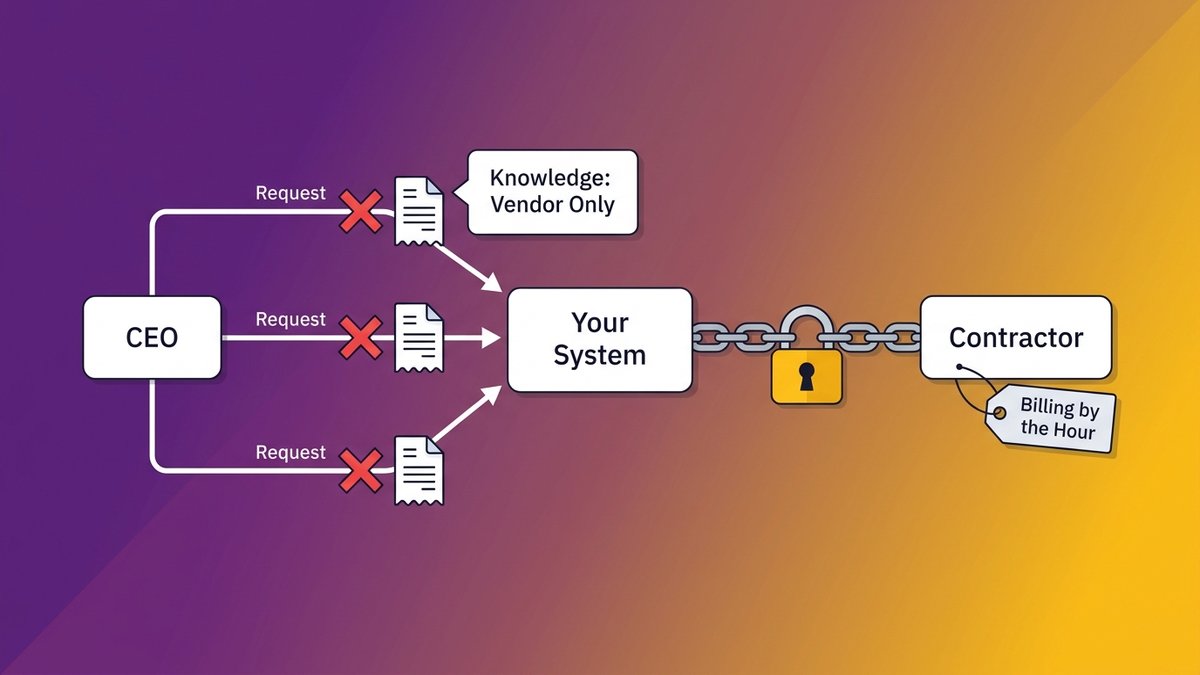
A diagram showing how undocumented software creates ongoing contractor dependency, the core pattern of vendor lock-in in custom software development
By the time most CEOs recognize the problem, they’re already three change requests deep and funding someone else’s business with no exit in sight.
The Moment the Contractor Becomes the Gatekeeper
Your contractor finished the project. You signed off. You got the deliverable. And for six months, maybe twelve, everything ran fine.
Then you needed a change.
Two years in: the only person who can modify your system is billing by the hour
A mid-market operations director contacted their original development agency about adding a new data field to their customer-facing dashboard. Simple request. Two weeks later: a $14,000 quote and a four-week timeline. The operations director pushed back. The agency was apologetic but firm: the system’s architecture had interdependencies only they understood. Someone else could theoretically do the work, but it would take them months just to map what already existed.
The operations director paid. What else could they do?
This is not a technology problem. The software works. The code runs. But the map of the system, the understanding of why it was built the way it was built, never left the agency’s team. And that map is worth exactly as much as the agency charges you to use it.
Why this isn’t a technology problem: it’s a knowledge transfer problem
Vendors hold your system hostage through one mechanism: retained understanding. They know how the pieces connect. They know why a decision made in 2022 affects the behavior you’re seeing in 2026. They know which section of the codebase has workarounds baked in from a week when the original developer was moving too fast.
None of that lives in your files. It lives in their heads.
As Pragmatic Coders puts it directly: legal IP ownership is not the same as practical operational control. You can hold the title to a building you can’t enter. Owning source code without the institutional knowledge to modify it is exactly that situation.
Institutional knowledge loss in software development
How the Knowledge Hostage Pattern Builds Over Time
The dependency doesn’t arrive on the day the project closes. It compounds.
Phase 1: The project delivers, but the knowledge stays with the vendor
Delivery day feels like completion. You’ve received the software. The system is live. The project manager closes the ticket. But the documentation, if it exists at all, is typically a README file and a few API endpoint descriptions. The architecture decision records, the reasoning behind structural choices, the onboarding guides that would let a new developer get productive in under a week: those were never in scope. Nobody asked for them.
That omission is the seed of every hostage situation that follows.
Phase 2: Every change request is a ransom payment
The first change request is usually small. A new field. A different report format. A permissions adjustment. You submit it expecting a few hundred dollars and a quick turnaround. The quote comes back at five times your estimate, with a timeline that suggests your developer is approaching this like an archaeological dig.
They’re not slow. They’re re-learning a system they built 18 months ago, because they never documented it either.
The third change request tends to be when the pattern becomes unmistakable. You’ve now spent more on post-delivery modifications than you anticipated, the invoices arrive faster when you push on scope, and you’ve started rationing change requests to avoid the cost.
Rationing changes to your own software. Think about what that means operationally.
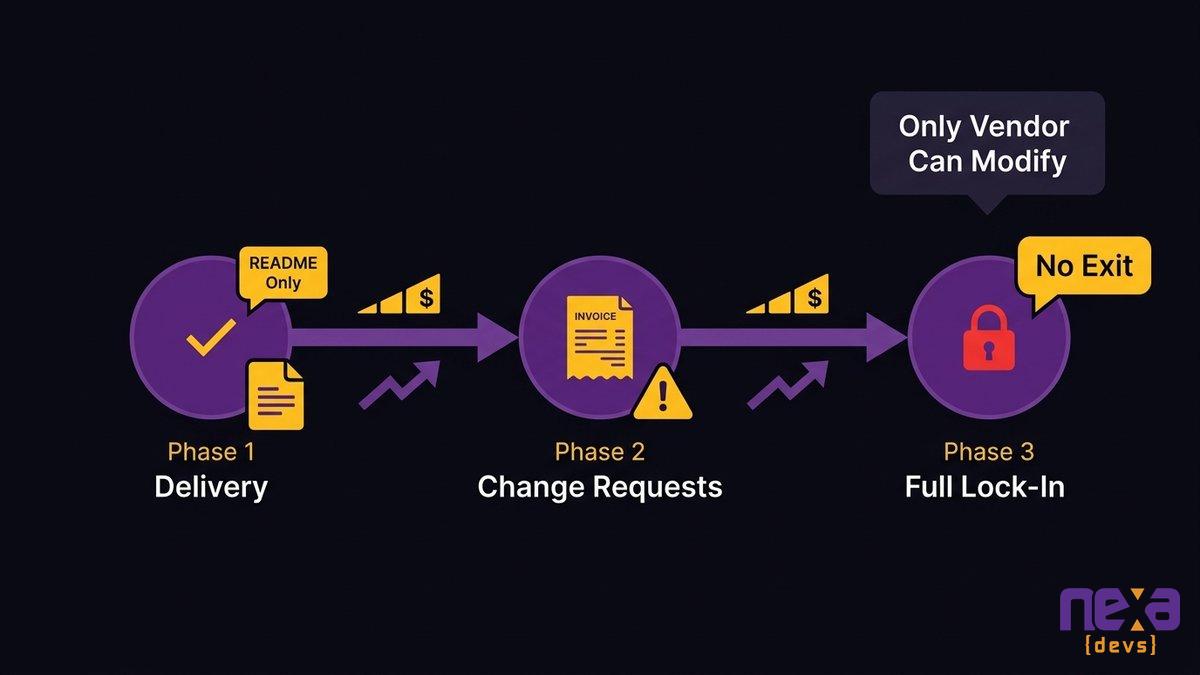
Three-phase progression of knowledge hostage dependency: initial delivery, first change requests, full lock-in
Phase 3: The system becomes unmaintainable without them
By the third year, the situation has shifted from expensive to structural. The original developer has moved to a new company, or the agency has been acquired, or the key engineer who built your system is now billing at a rate your budget can’t absorb on a regular basis. You can’t replace them without a months-long handover process. You can’t hire internally because no developer wants to inherit a system with zero documentation. You can’t rebuild because the business depends on the current system staying live.
This is where Dreamix’s research on vendor transitions lands: documentation gaps, undocumented dependencies, and lost configuration details create expensive problems months after transition completion. The timeline on that phrase is significant. The problems don’t arrive when the vendor leaves. They arrive when you try to move without them.
Warning Signs Your Current Vendor Relationship Creates Lock-In
You don’t need a technical background to spot these. They’re business signals.
Undocumented architecture decisions that only the original developer knows
Ask your current vendor for the architecture decision records for your system. If they’re unfamiliar with the term, or if the answer is “that’s all in the developer’s head,” you have your answer. If a new engineer joined tomorrow, how long would it take them to understand why the system was built the way it was? Days is acceptable. Weeks is a warning. Months is a hostage situation.
No repository access or infrastructure credentials in your name
Your source code repository should be in your name. Your infrastructure credentials, hosting accounts, and deployment configurations should be accessible to you without requesting access from the vendor. If you’d need to ask your contractor for permission to log in to the platform your system runs on, you’re not in control of your own software.
Scope creep that only the original vendor can scope
When you need a change, can any qualified developer estimate the work? Or does every quote require your original vendor because only they understand the system well enough to scope it? If competitive pricing is impossible because no outside firm can evaluate the work, your vendor dependency is already structural. You’ve lost negotiating leverage without noticing.
What Vendor Lock-In Is Actually Costing You
The cost isn’t a one-time switching expense. It’s recurring.
The hourly billing that never ends
Contractors who retain system knowledge bill for every access to that knowledge. Every change. Every question. Every “can you just check why this is happening?” support request. ClearlyAcquired’s research on key-person replacement costs shows that high-level technical talent, when lost, costs 150 to 400 percent of the salary equivalent to replace, with projects delayed 6 to 12 months during the transition.
Your external contractor is in a stronger position than an employee with that kind of knowledge, because they have no employment relationship to end. They can raise rates. They can deprioritize your requests. They can decline future work entirely while leaving you with a system you can’t modify without them.
The migration budget you will eventually pay
At some point, the relationship becomes untenable. The rates increase past what your budget can absorb, or the contractor becomes unavailable, or the system needs a level of change that requires outside input. At that moment, a migration becomes unavoidable, and the migration budget is inflated precisely because documentation was never transferred.
Without architecture records, runbooks, and decision histories, the first phase of any migration project is reverse-engineering what was already built. You’re paying twice for the same understanding: once when the system was built, and again when you need to document it to move.
The innovation you can’t pursue because the system can’t change
This is the cost that doesn’t appear on any invoice. Your competitors are adding features. They’re integrating AI capabilities. They’re modifying their operational systems to respond to changing market conditions. You’re doing none of those things, because every change to your system requires a negotiation, a quote, and a payment to someone who holds the only map.
Data migration projects exceed budgets by an average of 30 percent due to undocumented complexity, according to IDC research. That figure is for planned migrations. Unplanned ones, the kind forced by a vendor relationship becoming untenable, run higher.
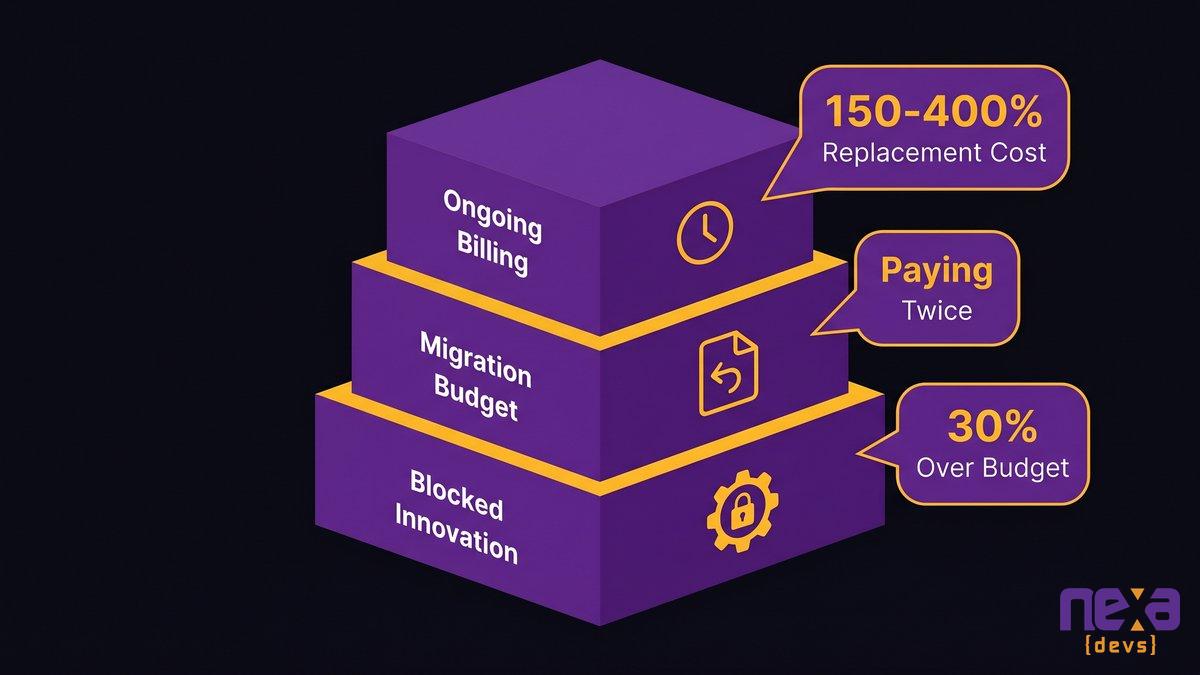
Three cost layers of vendor lock-in: ongoing hourly billing, eventual migration cost, and opportunity cost of blocked innovation
Why IP Ownership Clauses Don’t Protect You From This
Most CEOs believe their contracts protect them. Specifically, most believe that an IP ownership clause, a work-for-hire provision, or a full transfer of rights means they’re protected from vendor dependency.
They’re not.
You can own the code and still be hostage to the person who understands it
Owning the source code gives you the right to use it, modify it, and have others work on it. It does not give you the knowledge of how it works. Those are separate things. When the contract says you own all intellectual property created under the engagement, it transfers ownership of the artifact, not the understanding.
You might own the blueprint for a custom-built machine and still require the original machinist to explain which parts are load-bearing. Ownership is not comprehension.
What “full IP transfer” really means, and what it leaves out
A full IP transfer clause typically covers: source code ownership, license rights, and the right to modify and redistribute the deliverable. It does not typically cover: architecture decision records, runbooks for operational tasks, onboarding guides for new developers, deployment configuration details, or the reasoning behind structural choices made during development.
The gap between what IP clauses cover and what you actually need to operate the software independently is exactly the gap that makes contractor knowledge so valuable to the contractor and so damaging to you.
Vendor lock-in in software development
The fix isn’t a better IP clause. Ownership of the source files without a transfer of the documentation that makes them navigable leaves you in the same position.
The Fix Is Contractual, Not Technical: Requiring Documentation Transfer at Delivery
Documentation transfer as a delivery condition is the structural prevention mechanism. Not a process improvement. Not a vendor relationship guideline. A contract requirement, with payment held until it’s met.
What mandatory documentation transfer looks like in a statement of work
In a statement of work, documentation transfer should appear as a distinct deliverable with acceptance criteria, not as a goodwill gesture at project close. The language should specify what must be delivered, in what format, and that final payment is withheld until the documentation passes review by an independent technical party.
This removes the vendor’s incentive to withhold. Documentation retained after delivery is leverage. Documentation required before final payment is just part of the job.
Architecture decision records, runbooks, and onboarding guides: what to require
Three categories of documentation are non-negotiable for operational independence:
Architecture Decision Records (ADRs): Written explanations of why the system was built the way it was. Not what was built, but why specific choices were made, what alternatives were considered, and what trade-offs were accepted. A new developer reading an ADR should understand a major structural decision in 15 minutes.
Runbooks: Step-by-step instructions for operational tasks. How to deploy a new version. How to troubleshoot the three most common failure modes. How to restore from backup. How to add a new user with the appropriate permissions. Runbooks convert operational knowledge from “the developer knows how” into written procedures anyone can follow.
Onboarding guides: Documentation that lets a new developer get productive on the codebase in a defined timeframe. The target is one week to basic competency, not one month to minimal function.
These are standard deliverables in any engagement model where the client actually owns the outcome. If your current or prospective vendor presents these as premium add-ons, treat that as diagnostic information about the relationship they’re offering.
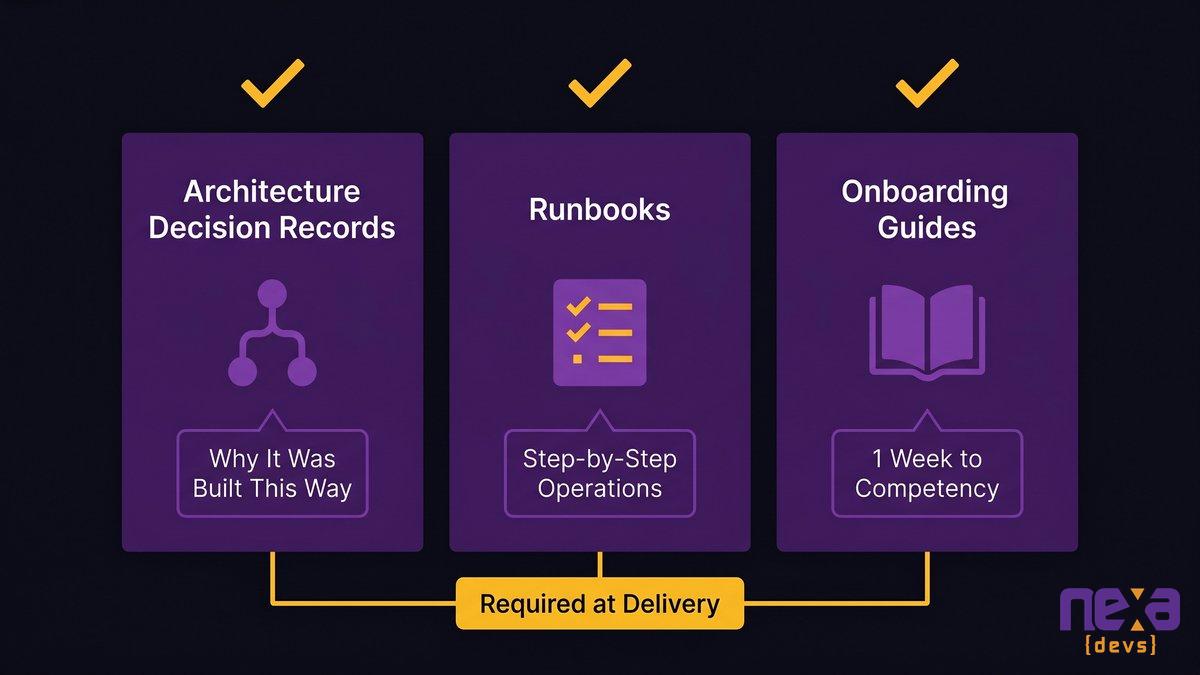
Three-category documentation framework: Architecture Decision Records, Runbooks, and Onboarding Guides as the components of complete documentation transfer
How to verify delivery before the final invoice
Verification doesn’t require a technical background. Ask a developer you trust, or a qualified third party, to perform a 90-minute test: give them only the documentation provided and ask them to map the system architecture, identify the three most important operational procedures, and estimate how long a new developer would need to get productive. If they can’t do those three things from the documentation alone, the documentation hasn’t been transferred in any meaningful sense.
Withhold the final invoice until this test passes.
How Mid-Market CEOs Can Audit Their Current Vendor Exposure
If you’re already in a vendor relationship, prevention isn’t available. But assessment is.
Five questions to ask your current development vendor today
These five questions require no technical knowledge. The answers will tell you exactly where you stand.
1. Can you send me our architecture decision records?
The expected answer is a document, not a conversation. If the answer is a phone call or a meeting, the ADRs don’t exist in written form. That’s a documentation gap.
2. Where is our source code repository, and who has admin access?
The expected answer names a platform (GitHub, GitLab, Bitbucket) and confirms your organization has admin-level access. If the vendor controls the repository, you don’t fully own your software yet.
3. If your team were unavailable for 30 days, could someone else make a change to our system?
This question directly tests the bus factor of your vendor relationship. The expected answer is yes, with a reference to existing documentation. An honest “probably not easily” confirms the dependency.
4. Do we have the deployment credentials and hosting configuration in our name?
Your system should run on infrastructure you control. If your vendor controls the deployment environment, you need them operational to keep your system running, not just to change it.
5. What would a handoff to a new vendor require, and how long would it take?
A vendor with complete documentation can answer this question concretely and quickly. “We could hand off in four weeks with two weeks of overlap” is a good answer. “It would be complex” is diagnostic.
What to do if the answer to any of them is “only they know”
If any of these answers confirm a dependency, the conversation with your vendor should start immediately. Request a documentation sprint, scoped and priced as a standalone engagement. The purpose of that sprint is to produce the three categories of documentation above, in a form that lets an independent developer navigate the system without guidance.
If your vendor resists this request, or quotes a figure that feels disproportionate to the size of the system, you have further confirmation of the dependency. The resistance itself is information.
Outsourcing software development documentation
What a Vendor Relationship Built Around Knowledge Ownership Looks Like
The engagement model that eliminates the knowledge hostage pattern has one structural characteristic: documentation transfer is built in from the start, not offered at the end.
In practice, this means three things.
Architecture decision records are written in real time, as decisions are made, not assembled at project close. The ADR for a major architectural choice is written the week that choice is made, reviewed by the client’s technical representative, and stored in a repository the client owns. By the time the project closes, the ADRs are current because they were never deferred.
Documentation is a delivery condition, not a project artifact. Every sprint has a documentation task alongside the feature work. Runbooks are written when procedures are established, not when the project is ending. Onboarding guides are tested against a real new developer, not declared complete by the team that wrote them.
And the ongoing relationship is structured around knowledge accumulation, not knowledge retention. A vendor partner who earns recurring revenue through documented, transferable work (system evolution, feature development, SLA-based support) has no incentive to retain knowledge as leverage. Their value is in what they build next, not in controlling access to what they built before.
This is the difference between a development partner and a gatekeeper. One makes you less dependent with each engagement. The other makes you more dependent, by design.
As Ashwin Ballal, CIO at Freshworks, observed: adding vendors and consultants often compounds the problem, bringing in new layers of complexity rather than resolving the old ones. The pattern Ballal describes is the vendor dependency cycle: each new engagement is supposed to solve the last vendor’s lock-in, and instead creates its own.
The structural solution isn’t finding a better vendor relationship to be locked into. It’s requiring documentation transfer as a non-negotiable condition of doing business, so the relationship becomes genuinely yours to exit, continue, or evolve on your terms.
Work with a Partner Who Doesn’t Keep the Map
Vendor lock-in in custom software development is a structural problem with a structural fix. It doesn’t require a better vendor personality or a more trusting relationship. It requires a contract that makes documentation transfer a condition of payment.
Nexa Devs delivers complete documentation packages to every client at project completion: architecture diagrams, system design documents, API references, and test coverage reports. All of it is unconditionally transferred and client-owned. That’s not a premium tier. It’s how every engagement works.
If you’re currently in a vendor relationship and want to assess your exposure, we’re happy to walk through the five-question audit with you directly. Schedule a Consultation
FAQ
How to deal with vendor lock-in?
Address it contractually before the engagement starts. Require documentation transfer as a delivery condition, with final payment held until architecture decision records, runbooks, and onboarding guides pass independent review. For existing relationships, commission a documentation sprint to produce what should have been delivered at project close.
What are the disadvantages of vendor lock-in?
Three compounding costs: ongoing hourly billing for every change (you’re paying for retained knowledge, not just labor); an inflated migration budget when the relationship ends; and blocked innovation as change requests become financially prohibitive. The third cost typically exceeds the first two combined.
What does ‘lock-in’ mean in a custom software context?
In custom software, lock-in doesn’t require a proprietary platform. It requires one condition: the people who built your system retained the understanding of how it works and never transferred it. You own the code. They own the map. Every time you need to navigate it, you pay them.
What are examples of lock-in contracts?
In custom software development, lock-in often doesn’t appear in the contract at all. It lives in what the contract doesn’t require. Contracts without mandatory documentation transfer clauses, without client-owned repositories from day one, or without acceptance criteria tied to deliverable completeness routinely produce vendor dependency even when they include full IP transfer language.
How do you protect your company when working with an outside software contractor?
Require three things in writing before signing: a client-controlled source code repository from day one, documentation transfer as a named deliverable with acceptance criteria, and final payment contingent on independent verification that documentation meets operational completeness standards.
What contract clauses prevent a consultant from holding your software knowledge hostage?
Documentation-transfer clauses with acceptance criteria, milestone-linked payment tied to knowledge transfer at each phase, and a definition of ‘complete documentation’ that references architecture decision records, runbooks, and onboarding guides specifically. Generic IP ownership clauses without these additions do not prevent knowledge hostage.