

Table of Contents
AI-Assisted Technical Documentation for Black-Box Systems
You have a system running your business that nobody fully understands. It processes orders, handles billing, manages the data your operations depend on every day. And somewhere in your organization, maybe in one person’s head, maybe nowhere at all, lives the knowledge of how it actually works.
AI-assisted technical documentation is the process of using AI analysis tools alongside human engineering judgment to reconstruct that knowledge. It maps dependencies, infers business logic from code behavior, and produces usable documentation from systems that have none. For mid-market companies running undocumented legacy platforms, it’s the difference between a system you own and a system that owns you.
The System Nobody Dares Touch
You know the one. Touching it makes everyone nervous. Changes go through one specific person because everyone else is afraid of what they might break. The system works. Until it doesn’t.
That’s the defining characteristic of a black-box legacy system: operational dependency without operational understanding. The business relies on it. Nobody can safely modify it. And the knowledge of how it functions lives in exactly one or two places, neither of which is a document.
A developer stares at an undocumented legacy codebase, the kind of system AI-assisted technical documentation is designed to decode.
When the only person who understood it left
Martin Fowler’s team documented a real case: a legacy system with 650 database tables, 1,200 stored procedures, roughly 350 user screens, and 45 compiled DLLs. Zero surviving documentation. The company had to issue a formal RFP for a six-month discovery and reconstruction effort just to understand what they owned.
This isn’t a rare edge case. A GenericDE consultant describes a client who discovered their core software was maintained by an 82-year-old retired developer, working part-time from retirement, because he was the only person who still understood it. The CEO learned this during a system crisis.
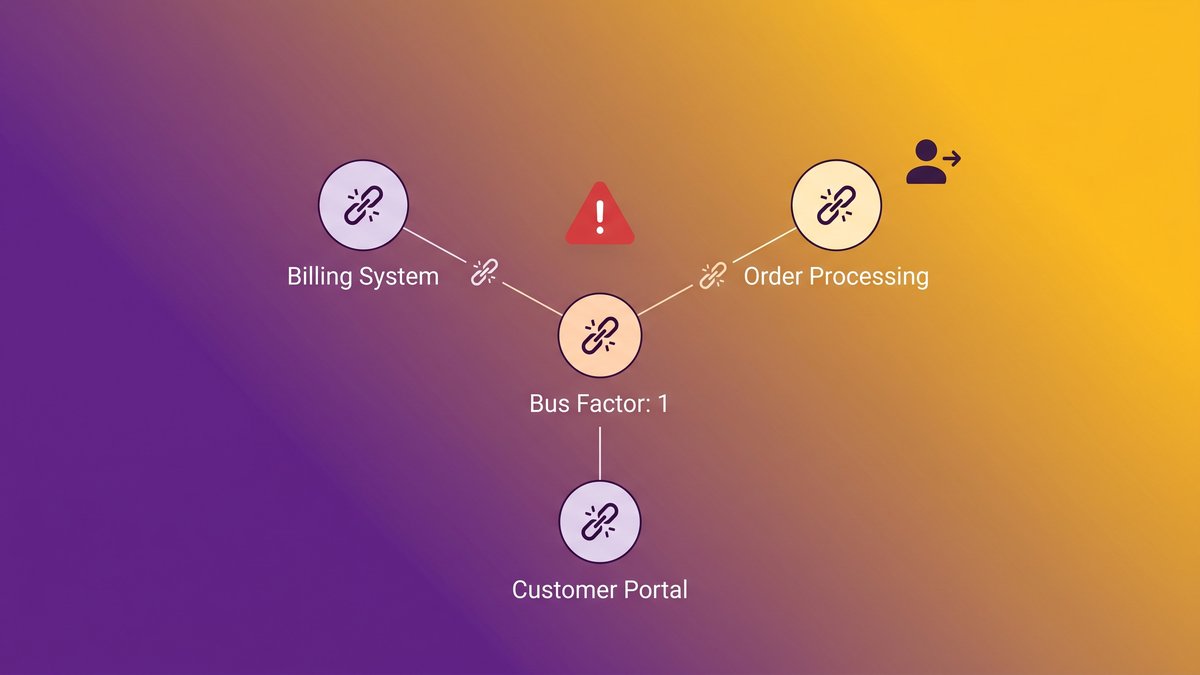
The bus factor in these situations isn’t low. It’s one. And when that person gives notice, or has a health event, or simply stops picking up calls, the organization discovers how fragile its operational foundation really is.
Why mid-market companies are disproportionately exposed
Enterprise organizations have IT departments, architecture review boards, and documentation standards written into vendor contracts. They still accumulate black-box systems, but they have more layers of protection when something breaks.
Mid-market companies built their systems under different conditions: limited budget, a small developer team (sometimes a team of one), and pressure to ship features rather than write documentation. What started as pragmatic technical debt compounds over years into a system nobody dares touch.
A SpeakWise 2024 knowledge management study puts it starkly: 62% of organizations identify poor knowledge-sharing as a direct cause of project failures. For a 200-person company where the operations manager, the billing system, and the customer portal all depend on the same undocumented codebase, that failure rate isn’t abstract. It’s a live operational risk every sprint cycle.
What “Undocumented” Actually Costs You
{#what-undocumented-actually-costs-you}
The cost of an undocumented system isn’t what you pay to recover it. It’s what you lose every week while it stays that way.
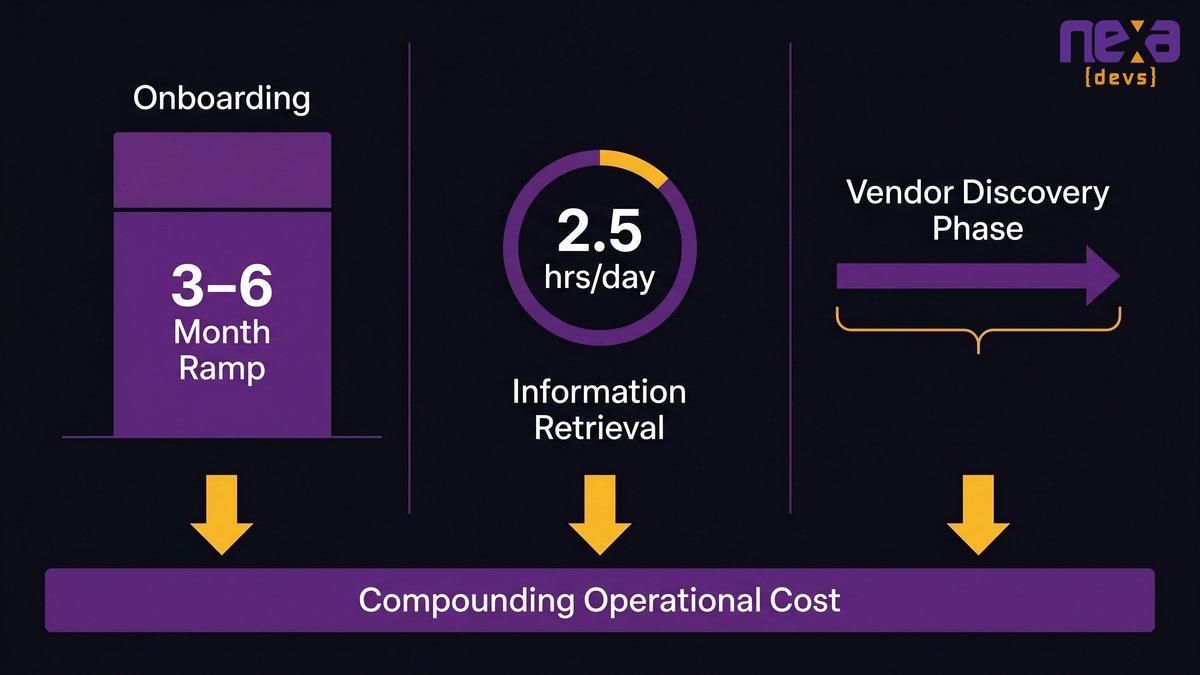
Every new developer you hire needs three to six months before they can safely touch the system. Every bug fix takes longer because the engineer has to reverse-engineer behavior before they can understand what changed. Every vendor conversation starts with a caveat: “We’d need a discovery phase first.”
The compounding cost of undocumented legacy systems: slower feature delivery, expensive onboarding, and frozen vendor transitions.
The hidden tax on every new hire and vendor onboarding
Knowledge workers spend approximately 2.5 hours per day on information retrieval activities, searching for answers that should already be documented. SpeakWise’s 2024 analysis, which likely traces to IDC research, puts that figure at roughly 30% of the workday. Applied to engineering teams working on undocumented systems, that 30% isn’t general information retrieval. It’s engineers re-discovering behavior that was known once and written down nowhere.
The onboarding math is blunt. A new developer joining a team with clean, current documentation gets productive in weeks. A developer joining a team with a black-box system spends their first three months learning, mostly by reading code, watching what breaks, and asking the one person who knows. If that person is busy, or unavailable, or gone, the onboarding timeline stretches further.
Vendors face the same friction. A new development team hired to maintain or extend an undocumented system will tell you upfront: “We need a discovery phase.” That phrase, in practice, means two to four weeks of your engineers’ time, plus the new vendor’s time, plus a significant chunk of budget before a single feature gets built. Multiply that by every vendor transition and every new developer hire over five years, and the cost of not having documentation becomes concrete.
What happens when the system becomes a compliance or audit liability
In regulated industries (healthcare, financial services, insurance), undocumented systems don’t just slow down onboarding. They create audit exposure.
An auditor asks: “Show me how this system processes this transaction.” Without documentation, the answer is: “We’ll have to trace through the code.” That answer works once, with a generous auditor, in a low-stakes context. It fails in due diligence. It fails in compliance reviews. It fails in M&A, where an acquiring company’s technical team will walk away from a deal, or demand a significant price reduction, when system documentation doesn’t exist.
The compliance case for documentation isn’t about regulatory perfectionism. It’s about whether your system is acquirable, auditable, and defensible when scrutiny arrives.
Why Traditional Documentation Methods Break Down on Black-Box Systems
The most common approach to documenting a legacy system is to assign it to the development team as a sprint task. Put it on the backlog. Document when there’s time.
There is never time.
This isn’t a discipline failure. It’s a structural problem. Documentation competes with feature delivery, and feature delivery wins every sprint, every quarter, every year. The documentation backlog grows while the system evolves. Eventually the system is so far ahead of any documentation attempt that starting feels impossible.
The documentation sprint that never gets done
Even when organizations allocate dedicated time for documentation, the effort stalls. The developer assigned to document a system they didn’t build spends most of their time reading code they don’t fully understand, making inferences, and being uncertain about whether those inferences are right. Without the original developer in the room, every hour of documentation produces output that might be wrong.
Wrong documentation is often worse than no documentation. A new developer who reads a spec that incorrectly describes system behavior will build toward the spec, break the system, and spend days debugging before realizing the documentation was the problem.
Institutional knowledge loss in software development
When tribal knowledge walks out the door
The one person who understands the system isn’t just a knowledge holder. They’re a single point of failure. When they leave (and at some point, they will), their knowledge doesn’t transfer. It evaporates.
Replacing senior technical talent costs between 150% and 400% of annual salary, and projects face delays of six to twelve months after departure, according to ClearlyAcquired’s 2026 research. Those numbers assume the departing person left documentation behind. When there’s no documentation, the delay isn’t six months. It’s as long as it takes to rebuild the knowledge from scratch, which can take longer than the original system took to build.
Traditional documentation methods don’t solve this problem. They assume time, they assume the original developers are available, and they assume the documentation will stay current as the system evolves. None of those assumptions hold for most mid-market legacy systems. The methods fail because the conditions they require don’t exist.
How AI Reconstructs What Was Never Written Down
{#how-ai-reconstructs-what-was-never-written-down}
AI code analysis tools approach undocumented systems as a reverse-engineering problem, not a documentation task. They don’t ask “what should this do?” They ask “what does this actually do?” And they infer the answer from the code itself.
That distinction matters. Traditional documentation starts from intent. AI-assisted technical documentation starts from behavior. What comes out is grounded in what the system actually does, not what someone remembers about what it was supposed to do.
AI code analysis maps dependency chains, data flows, and business logic in undocumented legacy codebases, the foundation of AI-assisted technical documentation.
Dependency mapping and data flow inference
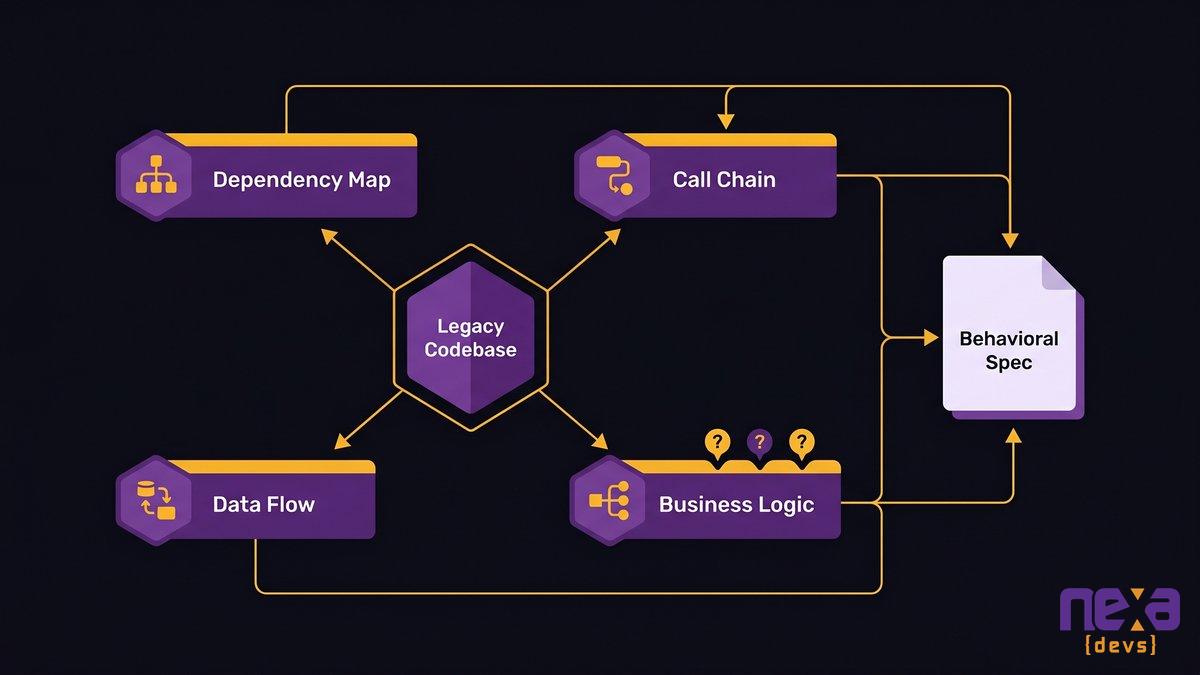
The first thing AI tools do well is map what connects to what. A codebase with 650 tables and 1,200 stored procedures looks unnavigable to a human reading files sequentially. An AI tool scans the entire codebase simultaneously, identifies call chains, traces data flow between modules, and produces a dependency graph that no human could build manually in the same timeframe.
That dependency graph is the foundation. It tells you which parts of the system are tightly coupled (change one thing, three others break), which modules are isolated (safer to modify), and which components haven’t been touched in years (potential dead code vs. rarely-used-but-critical paths). None of that structure was documented. Code analysis surfaces all of it.
Business logic extraction from code behavior
Dependencies tell you what the system connects. Business logic tells you what it decides.
AI tools analyze conditional logic, exception handling, and edge-case branches to identify what the system is doing and why. A billing module that adjusts pricing under specific customer account conditions contains business rules that were probably agreed in a meeting five years ago, implemented by a developer who has since left, and never written into any specification document. The rules are in the code. AI analysis surfaces them.
Results aren’t always clean. Inferred business logic sometimes reflects bugs rather than intent, accumulated workarounds for edge cases the original developer never fully resolved. Human engineers have to distinguish between “this is how the business works” and “this is a patch that was never cleaned up.” AI accelerates the discovery; humans make the judgment calls.
Building the spec from outputs and edge cases
The third layer is behavioral documentation: what does the system produce under what conditions? AI tools can generate test coverage maps from existing code, identify untested branches, and flag areas where the system’s behavior under edge cases is unknown.
That behavioral output becomes the foundation of a working specification. Not a spec written from memory, but one derived from observed behavior. For teams preparing to hand off a system to a new vendor (or to onboard a new developer), this behavioral spec is often more valuable than any intent-based document would have been.
“As David Burg, Cybersecurity Leader at Ernst & Young Americas, states: ‘The documentation of architecture, interoperability, and dependencies was likely never documented. When they were built, developers were working with the institutional knowledge that existed at that time.'” The AI-assisted approach closes this gap retroactively, recovering the context that should have been captured during development but wasn’t.
Where AI Hits Its Limits (And Where Humans Have to Take Over)
AI tools accelerate documentation recovery. They don’t complete it. The two hard limits (context window constraints and hallucination risk) aren’t quirks to work around. They’re places where human engineering judgment can’t be substituted.
Context window constraints on large codebases
Most AI code analysis tools process code in chunks. A 650-table database with 1,200 stored procedures and a decade of accumulated business logic won’t fit in a single context window. The tool sees a section of the codebase at a time, infers relationships within that section, and produces output that may be accurate locally but miss cross-system dependencies that span sections.
In practice, large codebases require scoped passes. Engineers must guide the AI through the system in logical segments, aggregate the per-segment findings, and synthesize a whole-system view manually. That’s architecture work. It requires someone who understands software systems to decide how to segment the analysis, what to look for in each pass, and how to reconcile conflicting inferences across passes.
The AI does the heavy lifting on code reading. The human does the architecture work. Neither replaces the other.
The hallucination problem in undocumented systems
AI language models infer. When code is ambiguous, when a variable name is meaningless, when a stored procedure does three things that seem unrelated, when an exception handler catches every error and logs nothing, the AI will produce an explanation. Sometimes that explanation is accurate. Sometimes it’s a plausible-sounding reconstruction that doesn’t match what the code actually does.
In a documented system, hallucinations are easy to catch: the output contradicts the spec. In an undocumented system, there’s no spec to check against. The only verification mechanism is a human engineer reading the AI’s output, tracing the relevant code, and confirming whether the inference is correct.
Validation can’t be skipped. Teams that treat AI-generated documentation as immediately trustworthy will publish specs that contain errors, onboard developers against those errors, and spend months debugging systems they thought they understood. That verification step is the cost of accuracy, and there’s no way around it.
The Documentation Sprint: A 30-Day Playbook for Mid-Market Teams
{#the-documentation-sprint-a-30-day-playbook-for-mid-market-teams}
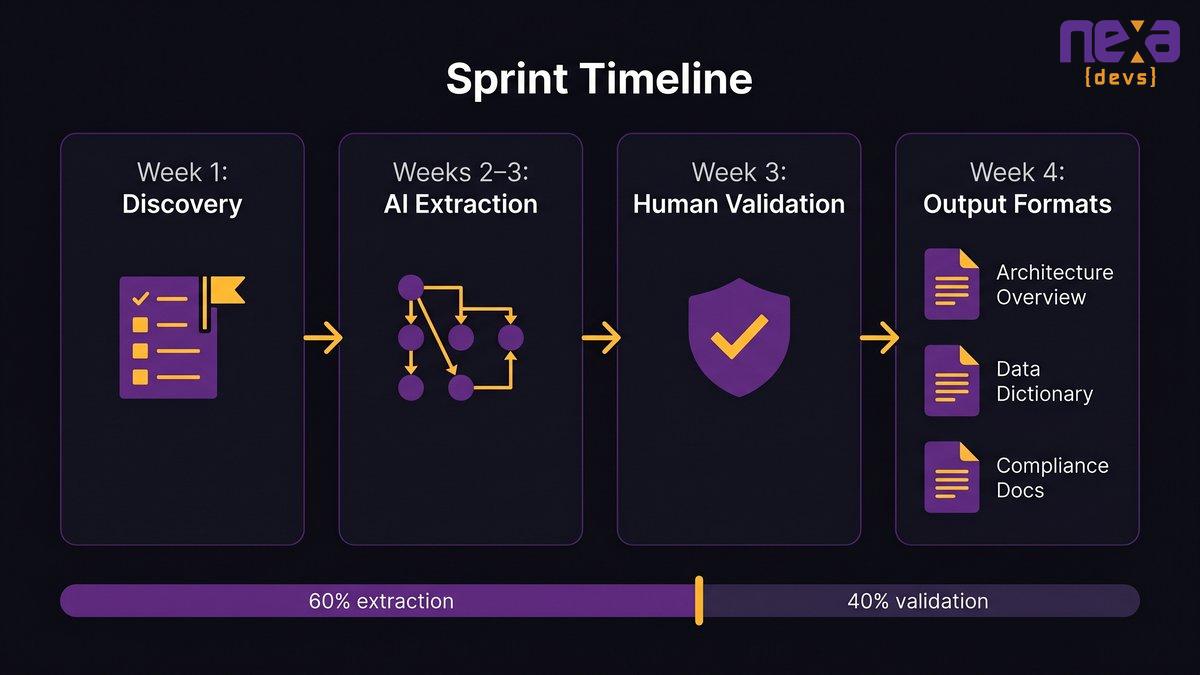
A 30-day documentation sprint is enough time for a mid-market team to move from no documentation to a usable system blueprint, if the sprint is structured correctly. Here’s what that looks like in practice.
The four-week documentation sprint: from system discovery and scope triage through AI extraction, human validation, and final output formats.
Week 1: System discovery and scope triage
The first week isn’t about AI tools. It’s about figuring out what you actually have.
The goal is a system inventory: every database, every service, every external integration, every place data enters and leaves the system. This requires access to the production environment, access to the code repository, and at least one person who has worked with the system recently enough to know what the components are called.
From the inventory, the team does scope triage: which parts of the system are business-critical and opaque (high priority for documentation), which parts are well-understood even without formal docs (lower priority), and which parts appear dormant (flag for verification before investing documentation effort there).
Week 1 produces three things: a system inventory, a priority map, and an explicit decision about what the sprint will document. Without this scoping work, the AI-assisted extraction in Weeks 2 and 3 has no north star. The team documents everything and finishes with a mass of output nobody knows how to use.
Weeks 2 and 3: AI-assisted extraction and human validation
Weeks 2 and 3 are where the actual recovery happens. AI tools run against the scoped codebase: dependency analysis, business logic extraction, data flow mapping, behavioral documentation.
The output from each AI pass goes immediately to a human reviewer, an engineer with enough architectural experience to distinguish accurate inferences from plausible-but-wrong ones. Every flag, every uncertain inference, every “this might be doing X” output gets marked for validation against the actual code.
The ratio that works in practice: AI produces a draft, human reviews for accuracy, AI refines with corrections, human approves. This loop takes more time than some teams expect. Budget 60% of the two weeks for AI extraction and 40% for human validation. Teams that underestimate the validation load hit week 3 with a large backlog of unverified AI output, which defeats the purpose of the sprint.
Week 4: Output formats that actually get used
Documentation that doesn’t get used isn’t documentation. It’s a file.
The final week converts the validated extraction output into formats that serve the system’s next users. What those formats are depends on who uses them:
- A new development team joining for ongoing maintenance needs a system architecture overview, a module guide, and a data dictionary.
- A compliance auditor needs transaction flow documentation and a record of how data is processed.
- A developer onboarding to make specific changes needs component-level specs for the modules they’ll work in, not a full-system overview.
One documentation sprint, three different output formats, each shaped for the person who’ll use it. That shaping work is what turns extracted knowledge into something useful. Skip it,its and you have 30 days of AI output sitting in a folder nobody opens.
From Documentation to Handoff: Setting Up the Next Team for Success
Recovered documentation isn’t the end state. It’s the prerequisite for everything the business needs to do next: transition to a new vendor, bring in a new developer, respond to an audit, or modernize the system into something that can handle AI integration.
What a new vendor needs before day one
A development team that inherits an undocumented system will spend their first weeks in discovery: reading code, asking questions, building context. That discovery period doesn’t produce features. It produces understanding, which the team then uses to produce features.
Give a new vendor a system blueprint, an architecture overview, and a behavioral spec on day one, and their ramp time compresses. Instead of three weeks of discovery before first sprint, they’re contributing in sprint one. You’re paying a development team to build, not to learn.
The teams at Nexa Devs see this gap consistently. Mid-market companies that come in with documented systems move faster from the start. A system blueprint handed off on day one isn’t just a formality. Every team that follows benefits from it.
Outsourcing software development documentation
Making documentation a living artifact, not a one-time project
A documentation sprint recovers what was lost. It doesn’t prevent future loss.
The structural problem with most legacy documentation efforts is that they happen once, produce a static output, and immediately begin to decay as the system evolves. Six months after the sprint, the system has changed and the documentation hasn’t. Twelve months in, the docs are already misleading. Two years later, you’re back where you started.
The fix is architectural: documentation maintained alongside code, not written after the fact. Architecture Decision Records (ADRs) capture why decisions were made, not just what was decided. AI-assisted documentation tools integrated into the development workflow generate and update specs as code changes. The sprint produces the foundation; the process keeps it current.
Nearly 55% of mid-sized companies plan to adopt knowledge management systems within the next 24 months, according to SpeakWise’s 2024 data. The companies that treat that investment as a continuous engineering practice, not a one-time project, are the ones that stop accumulating new black-box systems while they’re recovering from old ones.
The goal isn’t just documentation. It’s system ownership. When you understand how your system works, when that knowledge is captured and current, and when a new team can onboard in days rather than months, the system works for you. Not the other way around.
Ready to Recover What Was Never Written Down?
If you’re running a system that nobody fully understands, the risk isn’t in the future. It’s live right now, in every hire who takes months to ramp, every vendor conversation that starts with “we’d need a discovery phase,” every audit question you answer with uncertainty.
Book a system documentation assessment
A 30-day documentation sprint starts with a scoping conversation. Talk to the Nexa Devs team about what your system looks like and how long it would take to recover its documentation.
FAQ
How do you integrate AI into legacy systems without disrupting existing operations?
AI documentation tools analyze your codebase without modifying it. They read, they don’t write. The integration risk is near zero. Documentation recovery happens in a parallel environment, not in production. Changes to the live system only follow after documentation confirms what’s safe to touch.
Can AI rewrite or modernize legacy code automatically?
Not reliably, and not without significant human oversight. AI tools can suggest refactored code and flag candidates for modernization, but automatic rewrites on production systems carry serious risk. Documentation recovery (understanding what the system does before changing it) is the necessary first step before any modernization work begins.
Why do legacy systems become undocumented in the first place?
Documentation is always a lower priority than shipping. Teams under pressure to deliver features consistently defer documentation, and it never catches up. Over years, as developers leave and systems evolve, the gap between what exists and what’s written down compounds until the system is effectively a black box.
What is the business risk of running a system only one person understands?
Single-point-of-failure knowledge is an operational risk most mid-market CEOs underestimate until it triggers. When that person leaves, everything requiring system changes stops or slows dramatically. ClearlyAcquired’s 2026 research puts replacement cost for senior technical talent at 150% to 400% of salary, with six to twelve months of project delays.
Is AI documentation of legacy code accurate enough to trust for production changes?
Not directly. AI-generated documentation requires human validation before any production team uses it as a basis for changes. The documentation sprint model exists precisely for this reason: AI produces the draft, engineers verify the inferences, and only validated documentation enters the system record.