Table of Contents
Vendor Lock-In in Software Development: Do You Own What You Paid For?
You funded it. You approved every invoice. Your team ran the discovery calls, the QA sprints, and the launch week. The product ships. And then, six months later, you need to change something, or move to a different partner, and you find out the answer is no.
Not “difficult.” Not “expensive.” No.
The code runs on the vendor’s infrastructure. The architecture lives in their engineers’ heads. The tooling they used to build it requires their proprietary platform to modify. The credentials for deployment sit in their cloud accounts. You paid for delivery. What you didn’t get was the title.
Vendor lock-in in software development is not a technical failure. It’s a structural one, and it’s often fully legal. This guide explains how it happens, what your contracts actually need to say, and what real ownership requires from a development partner.
How documentation protects ownership
What It Actually Means to “Own” Software You Paid to Build
Paying for delivery is not the same as holding title. Custom software ownership isn’t automatic. Your contract defines it, and most buyers don’t scrutinize that language until the relationship breaks down.
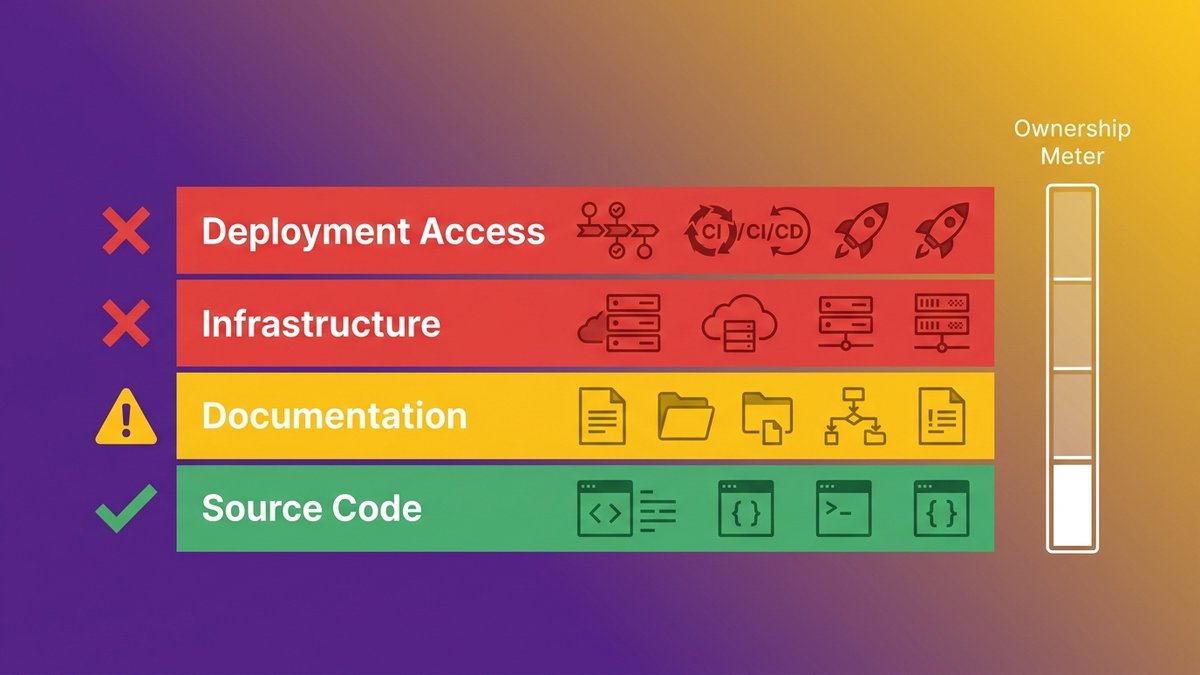
Four layers of software ownership: most buyers receive the code, but nothing else.
Paying for delivery is not the same as holding title
You paid for a result. The invoice was satisfied. The product works. None of that transfers legal ownership of the intellectual property.
Under most standard contract language, the developer retains copyright to the code they write unless the contract explicitly assigns it to you. This is not a loophole vendors exploit in bad faith. It’s the legal default. Copyright attaches automatically to whoever writes the code and remains with that author unless explicitly transferred. The Agile Alliance describes the underlying principle directly: copyright attaches to the creator of a sufficiently original work, and that creator is the developer, not the person who paid for the project.
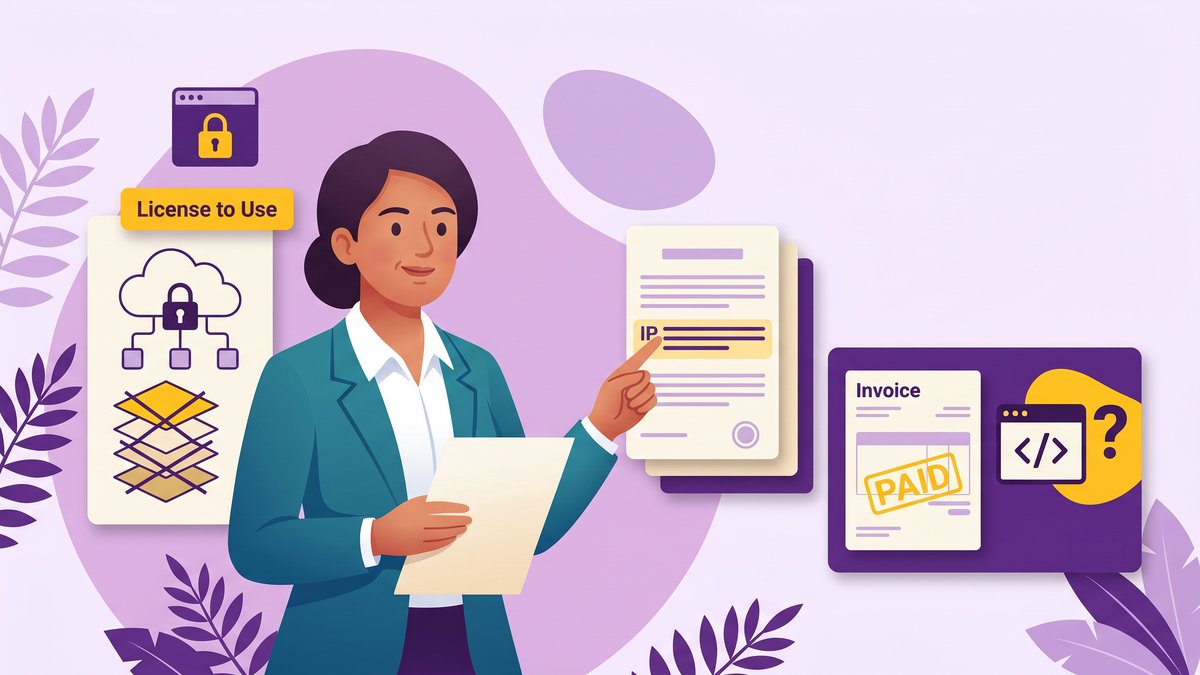
If your contract says “license to use” rather than “assignment of rights” or “work-for-hire,” you probably don’t own it. You’ve purchased permission to run it on the vendor’s terms.
The four layers of software ownership: code, documentation, infrastructure, and deployment access
Most buyers think ownership means the code. It doesn’t, not fully. Practical ownership requires control across four distinct layers:
Source code. Can you download the full repository, build it, and run it independently? Not just read it, but actually compile and deploy it without the vendor’s involvement.
Documentation. Are there complete architecture documentation, API references, deployment runbooks, and system design records that enable a new team to understand and modify the system without contacting the original vendor?
Infrastructure. Do you hold the cloud accounts, domain registrations, SSL certificates, CI/CD pipeline credentials, and DNS configurations? Or does the vendor control those accounts and provision access to you?
Deployment access. Can your team or a new vendor independently push a code change to production? Or does every release require the original vendor’s involvement?
Controlling two of these four layers is common. Controlling all four is rare, and it only happens when you specify it in the contract before the project starts.
How Vendors Build Dependency Without Ever Writing a Bad Contract
Vendor lock-in in software development rarely happens because a vendor is dishonest. It happens because development shops are optimized for delivery, and delivery doesn’t require them to think about your independence after the project closes.
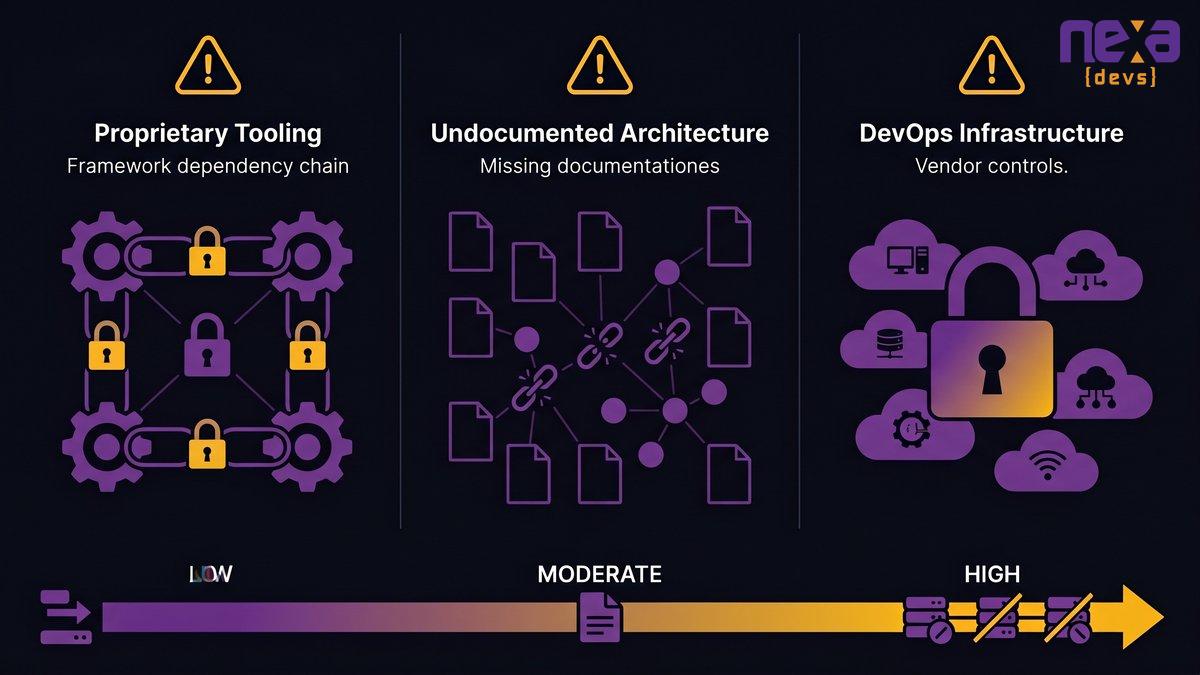
Three dependency mechanisms that survive even well-intentioned vendor relationships.
Proprietary tooling and frameworks that only the vendor understands
Many development shops build using internal frameworks, scaffolding tools, code generators, or deployment automation they’ve built in-house. These tools make their team faster. They also make the delivered product dependent on knowledge that lives only with the vendor.
When you try to bring another engineer onto the codebase, they spend weeks trying to understand a build system that isn’t documented anywhere. The choices made in the framework aren’t arbitrary. They reflect years of the vendor’s internal decisions, conventions, and workarounds. An outside engineer can read the code. They cannot understand the system without context, nor does any documentation capture.
Undocumented architecture that lives in the team’s heads
Architecture decisions don’t write themselves into the codebase. The choice to use a specific caching layer, the reason an API endpoint works the way it does, and the integration pattern chosen to connect two legacy systems. These decisions live in the engineers’ heads unless someone deliberately writes them down.
Dreamix’s research on vendor transitions describes this pattern directly: “Documentation gaps, undocumented dependencies, and lost configuration details create expensive problems months after transition completion.” Most vendors don’t withhold documentation out of malice. They never created it in the first place, because documentation doesn’t ship in the demo.
DevOps infrastructure controlled by the vendor’s accounts
Cloud accounts, CI/CD pipelines, container registries, monitoring dashboards, staging environments: vendors typically provision these under their own organizational accounts during development and never transfer them. It’s faster for the vendor to provision them that way. By the time the project ends, you’re running production software on accounts you don’t control.
This is the most invisible form of lock-in. The code may be legally yours. The documentation may exist. But if the vendor controls the infrastructure, they control your releases. Every deployment requires their involvement. Every outage requires their credentials.
The Contract Clauses That Determine Whether You Own What You Paid For
The contract determines ownership. Two engagements can produce identical software through identical processes, and one buyer walks away with complete ownership while the other walks away with a license. The difference is one sentence.
Why vendor relationships need ownership terms
Work-for-hire vs. license: the clause that changes everything
A work-for-hire clause under U.S. copyright law designates the commissioning party (you) as the legal author of any work created under the agreement. The developer has no residual rights. You own the copyright from the moment the code is written.
A license to use means the vendor retains copyright and grants you permission to operate the software under specific conditions. Those conditions might include geographic restrictions, usage limits, the right to sublicense, restrictions on modification, or continuation tied to the ongoing relationship.
The gap between those two outcomes is enormous. Work-for-hire gives you an asset. A license gives you access, which the vendor can limit, revoke, or renegotiate.
Daeryun Law’s guidance on outsourcing contracts clearly frames the underlying principle: IP provisions must distinguish between background IP each party brings to the engagement and foreground IP created during delivery. The foreground IP, meaning everything built specifically for your project, should transfer to you unconditionally, while the vendor retains rights to their background IP (their proprietary frameworks and tools). Mixing these two categories in a single vague “license to use” clause is how buyers end up renting their own product.
What a real IP transfer looks like (and what “license to use” actually means)
A real IP transfer clause looks like this:
- “All work product, deliverables, and intellectual property created by Vendor in connection with this Agreement shall be considered work-for-hire and shall be owned exclusively by Client upon delivery.”
- “To the extent any work product does not qualify as work-for-hire under applicable law, Vendor hereby irrevocably assigns all right, title, and interest in such work product to Client.”
- The assignment is unconditional. Not conditional on final payment. Not conditional on the relationship continuing. Not subject to the vendor’s approval for modifications.
A license-to-use clause looks like this:
- “Vendor grants Client a non-exclusive, non-transferable license to use the software.”
- “Client may not modify, distribute, sublicense, or create derivative works of the software without Vendor’s prior written consent.”
- “This license is effective only while Client maintains an active services agreement with Vendor.”
That last sentence is the one that matters. If your license depends on maintaining the relationship, you don’t own the software. You’re subscribing to it.
Source code escrow: protection or a warning sign?
Source code escrow arrangements put the codebase in the custody of a neutral third party. If the vendor goes out of business or fails to maintain the software, you can retrieve the code from escrow.
Escrow is better than nothing. It’s not ownership.
An escrow arrangement protects you against vendor insolvency. It doesn’t protect you against a vendor who is solvent but uncooperative. It doesn’t give you the documentation, the infrastructure credentials, or the deployment access you need to actually run the software independently. In most escrow agreements, the release conditions are narrow: a vendor has to formally default before you can access the code, and the definition of default is usually written by the vendor’s lawyers.
When a vendor proposes escrow instead of full IP assignment, ask why. A vendor confident in the quality of their work has no reason to retain the intellectual property. Escrow is often a signal that the vendor wants ongoing leverage.
The Real Cost of Discovering You’re Renting
The practical problem with post-delivery lock-in is that it’s invisible until it isn’t. You run the software for months, maybe years. Then something happens: the vendor raises rates, the relationship sours, a key engineer leaves, or you need a change, and the vendor quotes at ten times your expectation. The dependency surfaces.
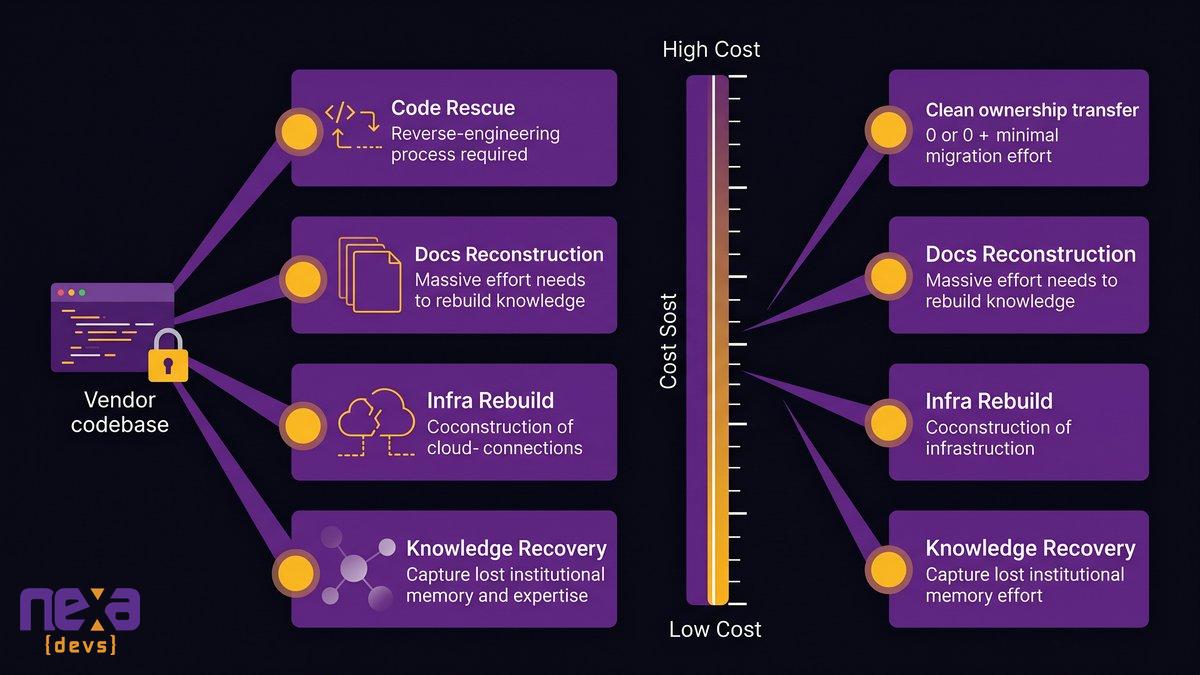
The cost of a vendor migration is almost always higher than the cost of negotiating ownership terms upfront.
What a rescue or migration actually costs
Software migrations from locked vendor relationships don’t resemble normal development projects. They involve:
- Reverse-engineering architecture that was never documented
- Rebuilding the deployment infrastructure from scratch, because the original is inaccessible
- Identifying and replacing proprietary tooling dependencies embedded throughout the codebase
- Reconstructing system knowledge from whatever the vendor’s team can recall or agrees to share
Industry cost benchmarks for this type of rescue engagement are wide. The specifics depend on the size and complexity of the codebase, but the pattern is consistent: the cost of a rescue migration is nearly always higher than the cost of a parallel development project started from scratch, because a new project starts with a clean surface and a locked codebase starts with unknown depth.
There is also a timeline asymmetry. A locked codebase can’t be rescued quickly, because each dependency hides until something forces it into view. Every week of the migration reveals new constraints. Project timelines for vendor migrations routinely extend beyond the original estimate, not because the development team is slow, but because the architecture reveals its true complexity only under pressure.
The institutional knowledge problem: what leaves when the vendor does
The costliest part of a vendor transition isn’t the code. It’s the knowledge that wasn’t written down.
The choices baked into the architecture, why the database schema looks the way it does, why an API behaves differently from its documentation, why a specific third-party integration was built as a workaround rather than a direct connection, exist only in the memory of the engineers who made them. When the vendor relationship ends, that knowledge walks out with them.
This is not a failure of good intentions. Most development teams intend to document more than they do. Under delivery pressure, documentation falls off the list. The result is a codebase that technically belongs to you but practically requires the original vendor to explain.
The Pragmatic Coders research on vendor lock-in in custom software development makes this distinction explicit: legal ownership and practical control are not the same thing, and the gap between them is where most mid-market buyers get stuck.
Why Most Mid-Market Buyers Don’t Discover the Problem Until It’s Expensive
You’re not alone in missing this. Most software development engagements are structured to keep ownership questions invisible until after the contract is signed.
The delivery illusion: working software that you cannot change
Working software feels like ownership. The app is live. Users are logging in. Reports are generating. The system does what it was built to do.
The illusion holds until you need it to do something different.
Mid-market companies hit this wall at predictable moments: a workflow changes and the system can’t accommodate it, a regulatory requirement demands a new data structure, or a new market opportunity requires a feature the current system wasn’t designed for. You bring the request to the vendor. The quote comes back at a figure that makes no commercial sense for the scope of the change. And you realize, for the first time, that the working software you thought you owned has an owner, and it isn’t you.
At that point, your options are: pay what the vendor asks, attempt a migration that may cost more and take longer than the original project, or absorb the constraint and accept that your software now limits your business rather than enabling it.
Questions almost no one asks before signing the SOW
The contract conversation at the start of a software engagement is almost always about scope, timeline, and cost. These are the questions everyone asks:
- What will be built?
- When will it be delivered?
- How much will it cost?
These are the questions almost no one asks:
- Who owns the intellectual property created during this engagement, and what specific clause in this contract establishes that ownership?
- What documentation will be delivered alongside the code, and what standard does “complete documentation” mean in this agreement?
- Under whose accounts will cloud infrastructure, CI/CD pipelines, and deployment environments be provisioned?
- What is the process for transferring all credentials and infrastructure access at project completion, regardless of whether the relationship continues?
- If I need to engage a different vendor to maintain or modify this system after delivery, what would prevent them from doing so?
None of these questions are adversarial. A vendor who builds clean, well-documented, ownership-ready software has straightforward answers to all of them. The difficulty of the answer tells you something about the nature of the dependency being created.
What Structural Ownership Actually Requires From a Development Partner
Structural ownership isn’t a disposition. It’s a set of contractual and delivery requirements. These aren’t best practices. They’re prerequisites.
What complete documentation transfer looks like
Unconditional IP assignment: what the clause must say
The IP clause needs to be explicit and unconditional. “Upon completion” is not enough, because completion can be disputed. “Upon final payment” is not enough, because payment disputes create leverage. The assignment should be unconditional and irrevocable, covering all work product created under the engagement regardless of project status at any point.
The clause also needs to address AI-generated code. In March 2025, the D.C. Circuit ruled that AI-generated code without meaningful human authorship carries no copyright protection, meaning code generated primarily by AI tooling without human editing may not be copyrightable by anyone. Your contract should spell out how AI-assisted work product is handled and whether any AI-generated sections of the codebase affect the ownership transfer. A vendor using Claude Code, GitHub Copilot, or comparable tools at scale should be able to tell you specifically how human authorship is embedded in their delivery process.
Complete documentation as a co-equal deliverable
Documentation is not a bonus deliverable. It’s a co-equal one. Each documentation item should appear in the SOW by name, with the same specificity you’d apply to a feature:
- Architecture Decision Records (ADRs) for every major design choice
- System design documentation, including data models and integration maps
- API reference documentation (Swagger/Postman or equivalent)
- Deployment runbooks with step-by-step infrastructure setup
- Test coverage reports
- Sprint documentation and user story libraries
“We’ll document as we go” is not a commitment. Ask for a documentation standard and a delivery checklist. If the vendor can’t produce one, the documentation won’t exist.
Infrastructure handoff: access, credentials, and deployment independence
Every infrastructure component needs to be provisioned under your accounts from day one, or transferred to your accounts at project completion with a documented handoff process:
- Cloud accounts (AWS, GCP, DigitalOcean, or equivalent) in your organization’s name
- Domain registrations under your control
- CI/CD pipelines with credentials your team holds
- Container registries and artifact storage under your accounts
- Monitoring and alerting dashboards that your team can access independently
- All third-party service credentials (email delivery, payment processing, external APIs)
A vendor who builds under their own infrastructure accounts is creating a dependency, whether they intend to or not. The handoff checklist should be in the contract, not a conversation for the last week of the project.
How to Audit Your Current Vendor Relationship for Ownership Risk
You don’t have to wait until the next engagement to evaluate your exposure. If you’re mid-relationship with a development partner right now, these questions give you a current picture.
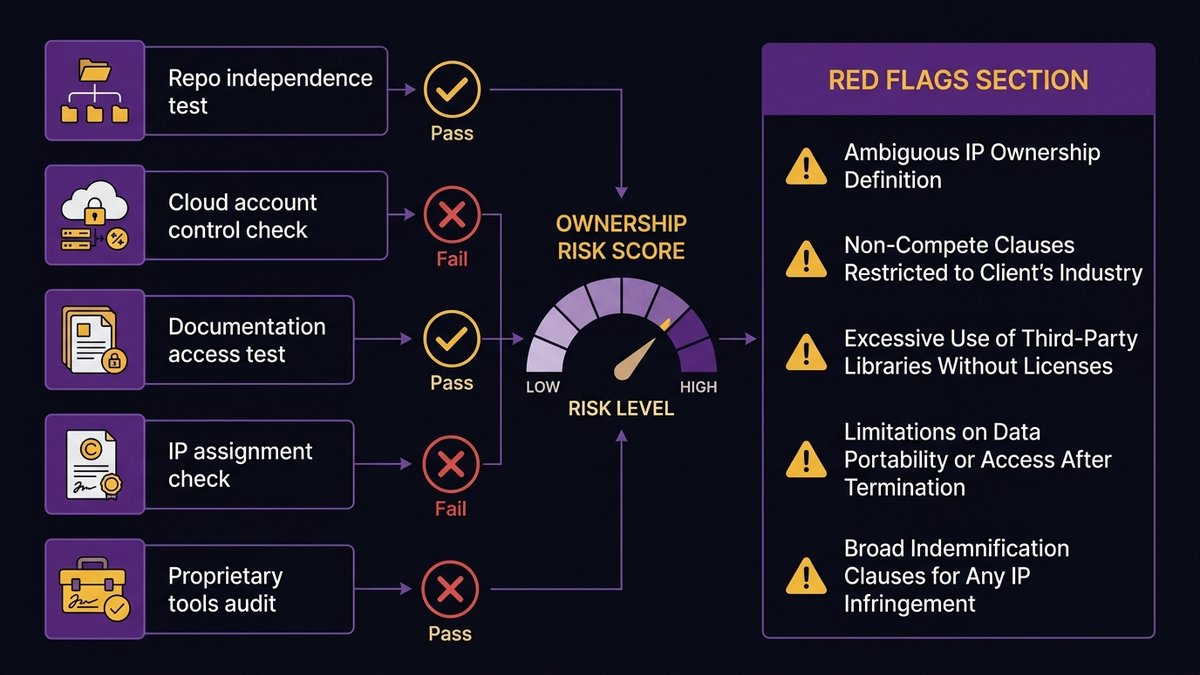
Run this audit before the relationship changes, not after.
Five questions to ask your current development partner today
1. If I send my repository to a new engineering team today, can they build, run, and deploy this system independently?
A confident vendor says yes and can walk you through the process. A vendor with a dependency problem also says yes, but can’t explain how without landing on tools or knowledge that only their team has.
2. Where are the cloud accounts, CI/CD credentials, and deployment keys provisioned?
They should be under your organization’s accounts. “We manage those on your behalf,” or “we have them in our system,” means you don’t have infrastructure independence. You have access on the vendor’s terms.
3. What documentation exists, and where is it stored?
You should be able to open it right now, without submitting a request. If the answer is “we have it internally” or “we can export it for you,” the documentation isn’t yours yet.
4. Does the current contract include an unconditional IP assignment or a license to use?
Pull the contract before you ask. If you can’t locate a work-for-hire clause or an unconditional assignment, you’re most likely operating under a license.
5. What proprietary tools or internal frameworks does your team use in this codebase?
Every tool that’s proprietary to the vendor is a potential constraint. They should be able to name each one and explain what moving away from it would take.
Red flags in contract language to surface with your legal team
Contract language to bring to your attorney immediately:
- “Client receives a license to use the software” without any corresponding assignment clause
- “Vendor retains all intellectual property rights” in the background IP section, without explicitly carving out foreground IP created for your project
- “Source code will be held in escrow” as a substitution for, rather than a supplement to, IP assignment
- “Modifications to the software require Vendor’s prior written approval.”
- Any clause making the license conditional on maintaining an active services agreement
- IP assignment language tied to “final payment” without specifying what constitutes final payment
None of these is automatically disqualifying in every context. Some are standard in platform licensing arrangements. But in a custom software development agreement, where you’re paying to build something specific to your operations, each one represents a category of control you’re not receiving. Your legal team needs to see them before you sign, not after you need to change vendors.
You Paid for It. Now, get the Title
Working software and owned software are two different things. You can have one without the other, and most mid-market buyers do for years before the distinction surfaces in a moment that’s expensive.
The fix isn’t complicated. It’s contractual. Before the next project starts, or the next renewal conversation happens with your current partner, get specific about what ownership means. Pull the IP clause. Ask about the infrastructure accounts. Ask for the documentation standard. A vendor who builds software you actually own has clear answers to all of these. A vendor who doesn’t want you to leave has reasons to keep those answers vague.
Nexa Devs transfers complete IP, documentation, and infrastructure access unconditionally at project close, before the question is ever asked. What structural ownership looks like in practice.
Ready to own what you build? Talk to our team about your current engagement or next project.
What is the IP clause in an outsourcing contract?
An IP clause defines who owns the intellectual property created during the engagement. It either assigns ownership to the client (work-for-hire or unconditional assignment) or grants the client a license to use software that the vendor retains copyright over. In custom software development, you want an unconditional assignment clause, not a license.
What is an IP transfer agreement?
An IP transfer agreement is a contract provision that legally moves intellectual property ownership from the creator to the commissioning party. In software development, it means that all code, documentation, and work product created during the project transfer to the client at completion, unconditionally, not tied to ongoing payment or continuation of the relationship.
Who owns the source code after a software project is delivered?
Whoever the contract says owns it. Under U.S. copyright law, the developer automatically holds copyright in code they write unless the contract contains a valid work-for-hire clause or an unconditional IP assignment. Without an explicit transfer clause, the vendor likely retains copyright and your right to use the software is governed by a license.
Who owns the code created by AI during a development project?
AI-generated code is legally uncertain. The D.C. Circuit ruled in March 2025 that purely AI-generated code without meaningful human authorship is not protected by copyright. Your outsourcing contract should address how AI-assisted work product is attributed and whether it falls under the IP assignment clause.
What is vendor lock-in in software development?
Vendor lock-in in software development occurs when a delivered system becomes practically dependent on the original vendor despite legal ownership. It comes from four sources: proprietary tooling in the codebase, undocumented architecture, DevOps infrastructure controlled under the vendor’s accounts, and contract language that limits your ability to modify or move the software.
What is the IP clause in a contract?
The IP clause in a software development contract specifies who owns the intellectual property rights to any work product created. It should define foreground IP vs. background IP, whether foreground IP is assigned or licensed to you, and whether that is conditional or unconditional. If the clause is absent or vague, ownership defaults to the developer under copyright law.