Table of Contents
Agentic AI Governance: The Ops Team’s Blindspot
Your operations team didn’t ask permission. They rarely do. Someone needed to automate a contract review, so they built a quick agent in Zapier AI or Make. Another person wired up a notification agent to flag overdue invoices. A third connected your CRM to an AI workflow that reroutes support tickets without any human in the loop. None of it went through IT. None of it is documented. And all of it is now load-bearing infrastructure.
This is the agentic AI governance problem, and it’s not a future risk. It’s already running in your business.
The question isn’t whether AI agents will get into your operations. They already have. The real question is whether the systems they’re wired to were built to be transparent and auditable, or built fast and then forgotten.
The Agents Are Already Inside Your Operations
AI agents entered ops teams the same way spreadsheets did in the 1990s: one department at a time, without a formal approval process, because they solved an immediate problem faster than any official pathway could.
A mid-sized logistics company we worked with had seventeen active AI automations running across their operations function. Their IT team knew about two. The other fifteen had been built by operations coordinators, finance analysts, and one very productive project manager who learned to use an AI workflow builder on a weekend. Some of them touched sensitive vendor contracts. One of them sent automated payment reminders to clients without a human review step.
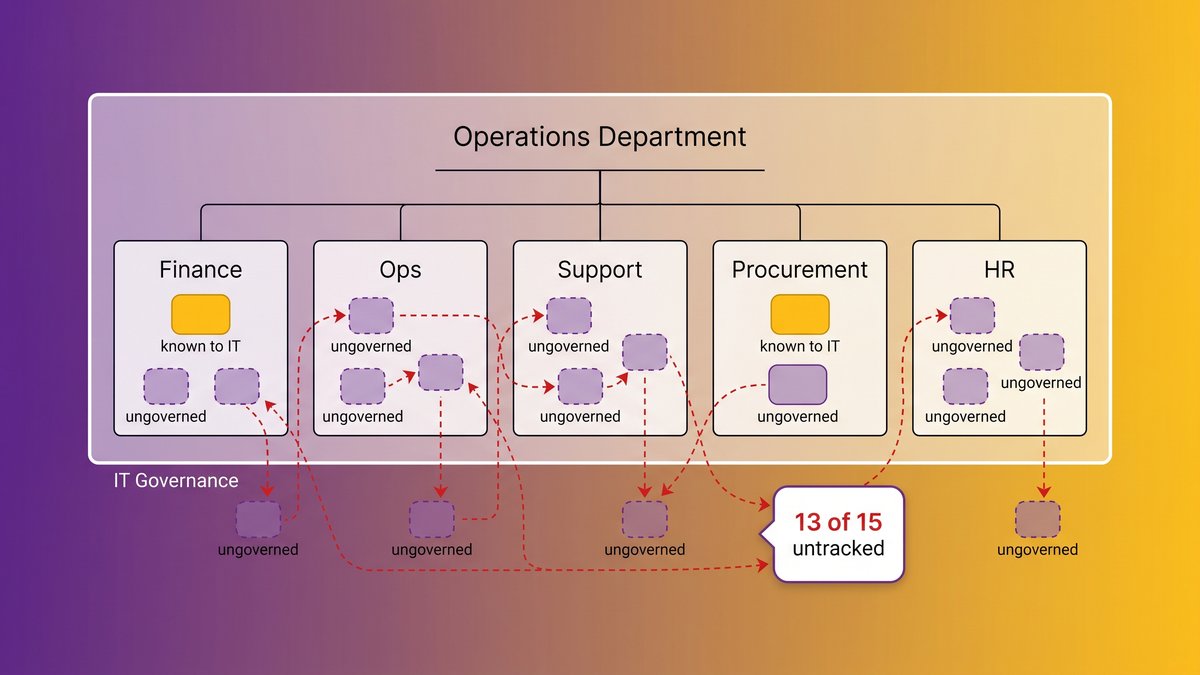
An operations team with agents running across multiple functions, most invisible to the IT governance layer.
This isn’t a story about rogue employees. It’s a story about how agentic AI tools are designed: low barrier to entry, immediate value, no friction, no documentation requirement. The people building these agents aren’t acting maliciously. They’re solving real problems. But the result is a governance gap that’s compounding by the week.
Shadow AI is what analysts call it when employees use AI tools without IT approval or oversight. CIO.com reports the pattern has now evolved past individual tool usage into what they’re calling “shadow operations”: entire automated workflows running outside any sanctioned governance layer.
The scale is harder to ignore than it used to be. Gartner published data this week showing that by 2028, the average Fortune 500 enterprise will have more than 150,000 AI agents in use, up from fewer than 15 in 2025. The gap between “agents in production” and “agents under governance” is not closing. It’s accelerating.
Why This Is an Operational Continuity Problem, Not Just a Security Problem
Security teams talk about shadow AI as a data exposure risk. That’s real, but it’s not the frame that keeps COOs up at night.
The operational continuity problem is this: when an undocumented agent fails, breaks, or behaves unexpectedly, nobody knows what it does well enough to fix it. And if the person who built it leaves, the organization is in exactly the same position as when a key developer walks out the door holding all the institutional knowledge of a system in their head.
You’ve seen that film before. The developer who built the custom billing system on a Friday afternoon five years ago and documented nothing. The one retirement that triggered a six-month scramble to reverse-engineer a codebase nobody else understood. The consultant who vanished with the architecture in their head.
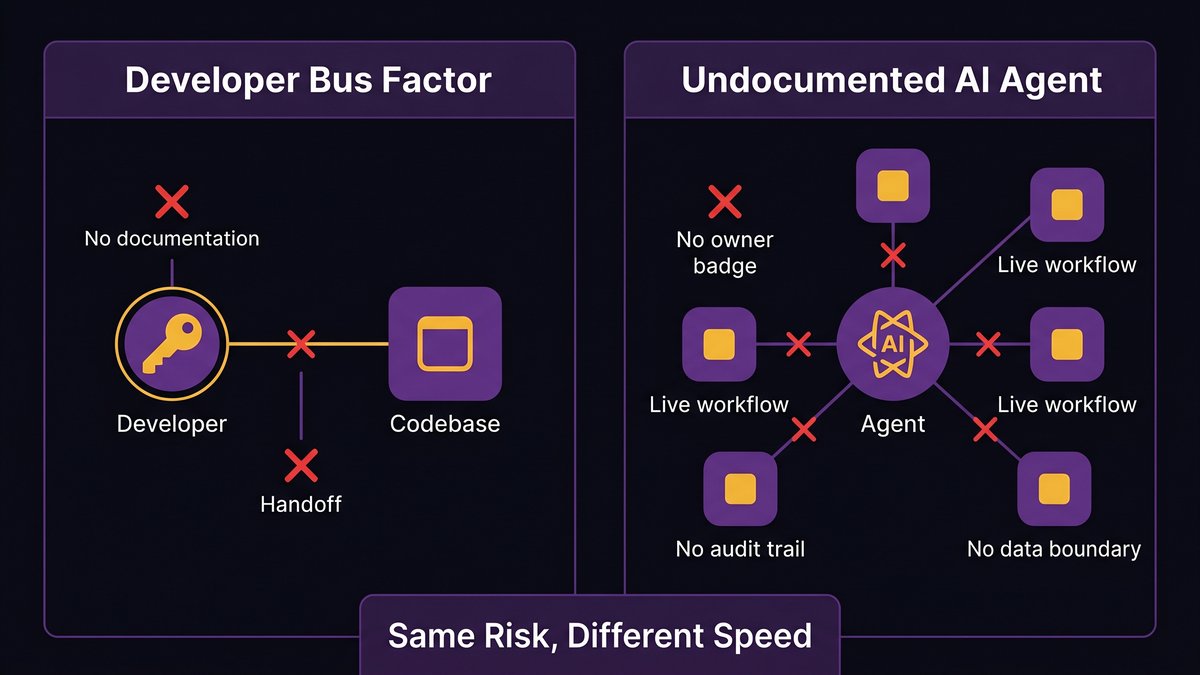
The bus-factor problem isn’t limited to human developers. An agent with no owner and no documentation creates the same single point of failure.
Agentic AI produces the same exposure, but faster and at wider scale. One developer leaving creates a bus factor crisis. A team of five operations staff, each building and maintaining their own agents, creates five of them simultaneously. All invisible to leadership. All is quietly critical to the workflows they’ve been threaded through.
Deloitte’s 2026 Tech Trends research shows that 35% of organizations still have no formal agentic AI strategy at all. That figure is not a measure of companies that haven’t adopted AI agents. It’s a measure of companies where agents are running, and nobody is in charge of them.
That’s an operational continuity problem. It’s the same class of risk as deferred infrastructure maintenance: invisible until something fails, catastrophic when it does.
What Ungoverned Agent Sprawl Actually Looks Like in Practice
Agent sprawl is the uncontrolled proliferation of AI agents across an organization without centralized tracking, inventory, or governance. It doesn’t announce itself. It accumulates.
Here’s what it tends to look like at the 18-month mark in a mid-market B2B company:
Duplicate agents are doing the same job. Three different people built three different agents to handle variations of the same customer onboarding step. None of them knows the others exist. Two of them send emails to the same clients, sometimes on the same day.
Agents running on tools the company no longer officially supports. The workflow was built on a platform that got acquired, repriced, or deprecated. The agent still runs because nobody noticed, until the API breaks.
No ownership when something goes wrong. A payment reminder agent sends the wrong amount to a client. The operations team opens a ticket. IT says they didn’t build it. The person who built it left six months ago. The agent runs on a personal API key that’s now orphaned. Nobody can stop it without also breaking three other processes that depended on the same key.
Gartner’s new data is blunt about this: only 13% of organizations believe they have the right AI agent governance in place. That number, published today in a press release identifying six steps to manage AI agent sprawl, reflects what most operations leaders already feel when they try to answer basic questions like “how many agents are we running right now?”
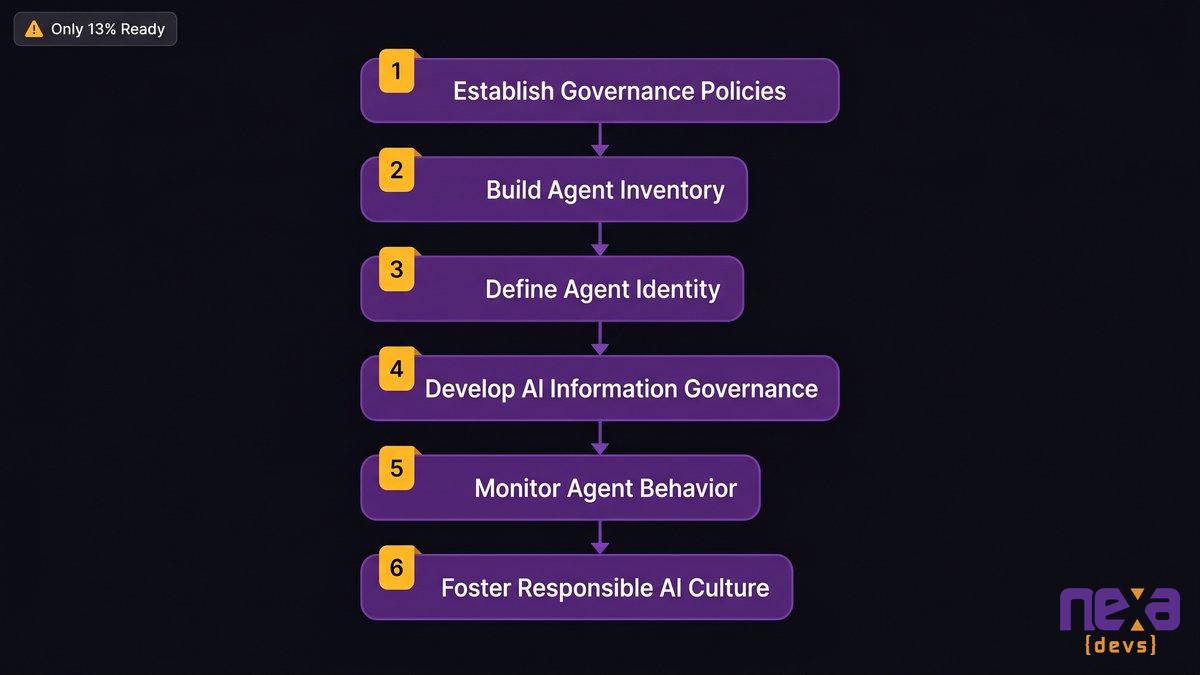
Gartner’s six-step framework for managing AI agent sprawl was released on April 28, 2026.
The governance problem compounds with scale. A single undocumented agent is a nuisance. Fifty undocumented agents, spread across five departments, each touching different data sources and triggering different downstream actions, is a liability.
Why Existing Governance Frameworks Weren’t Designed for Operations-Led AI
Most organizations already have an AI governance policy. IT or Legal wrote it. It covers the approved procurement of tools and data handling. And it has zero operational teeth when the agents in question were never procured through any formal process.
IT-centric governance frameworks work well for controlling what the technology function purchases and deploys. They don’t work for operations-led AI because the building happens entirely outside IT. No procurement request, no vendor review, no security assessment. Someone opens a free-tier account on a no-code automation platform, connects their work email, and starts building.
The gap isn’t in the policy language. It’s in the actor. IT governance assumes IT builds the systems. When operations staff build agents directly, which is increasingly the default and not the exception, IT governance can’t see the activity until it’s already embedded in live workflows.
Okta’s research on agentic AI governance makes this structural problem explicit: existing governance frameworks fall short because they weren’t designed to account for “exponential complexity and attack surfaces” created by agents that act autonomously across multiple integrated systems. The accountability and attribution challenges become severe when you can’t answer who owns the agent, who approved its access, or what data it’s touched.
This isn’t an argument for stripping operations teams of their autonomy. They built these agents because they work. It’s an argument for recognizing that the governance model that made sense for software procurement doesn’t map cleanly to a world where your finance analyst can wire up an autonomous agent before lunch without writing a single line of code.
What a Governable Agent System Actually Requires
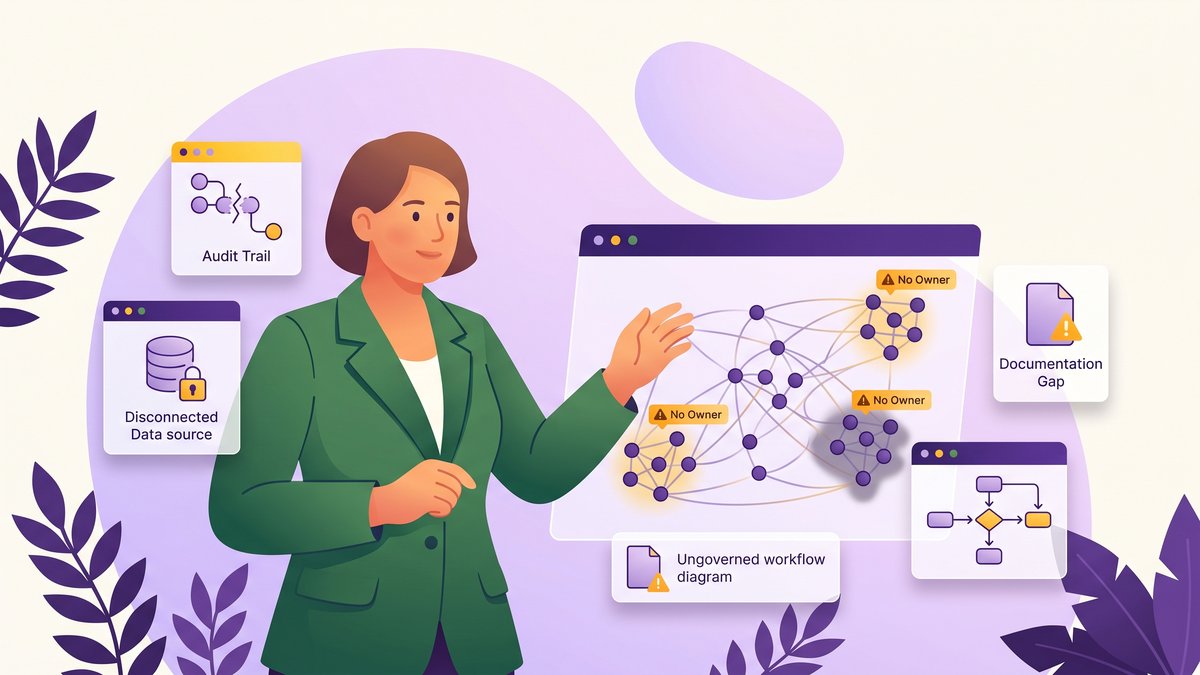
Governing agentic AI in an operations environment requires three things. They’re not complicated. They are consistently missing.
1. Agent identity: Every agent has a named owner and a defined scope.
Every agent needs a responsible person: not a team, not a department, but a specific individual who is accountable for what it does. That person knows what data the agent accesses, what it triggers, what systems it connects to, and what happens if it fails. The agent’s scope is documented in terms a non-technical stakeholder can read and verify.
Without this, “Who owns that agent?” has no answer. And when something goes wrong at 11 pm on a Friday, the absence of an answer is the crisis.
2. Audit trail: Every decision the agent makes is logged and retrievable.
When your agentic workflow system makes a decision, that decision needs a record. Routes a ticket, sends a payment, approves a discount: all of it logged. Who triggered it, what data it processed, what action it took, and when. Not just for security reasons: for operational accountability. If a client claims they were billed incorrectly and an automated agent handled the billing run, you need to be able to reconstruct exactly what happened.
3. Defined data boundaries: what the agent can touch, and what it can’t.
The agent that handles invoice reminders doesn’t need access to HR records. The agent that routes support tickets doesn’t need access to financial forecasts. Least-privilege access isn’t just a security principle. It’s an operational one. Agents with unnecessarily broad permissions create exposure that grows invisibly as the agent evolves.
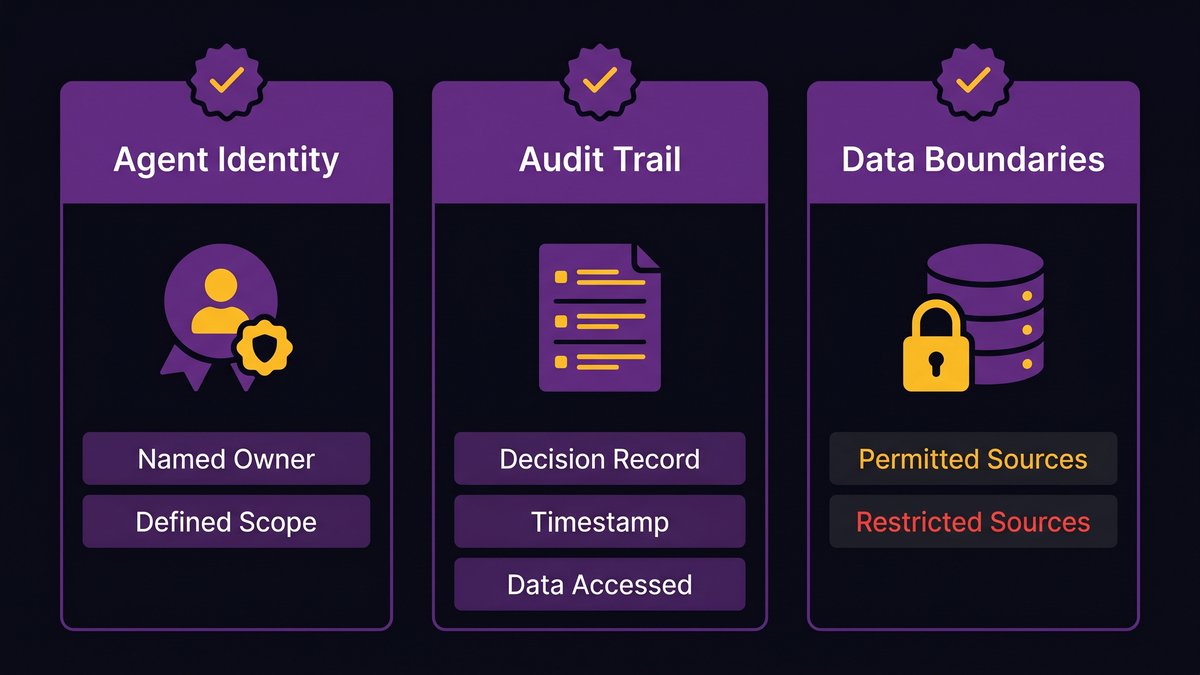
The three requirements for a governable agent system are identity, auditability, and defined access scope.
These three requirements aren’t technically demanding. They’re architecturally demanding. A system built quickly by a non-technical operator on a free-tier workflow platform almost certainly doesn’t have them. A system built by a development team with governance as a design constraint will.
For each agentic use case in an organization’s AI portfolio, tech leaders should identify and assess the corresponding organizational risks, and, if needed, update their risk assessment methodology.
The Difference Between Built Fast and Forgotten and Documented Architecture
Most operations-led AI agents share the same birth story: someone with a real problem, a low-code platform, an afternoon to spare, and no time for documentation. The agent works. It gets used. Other workflows start depending on it. The documentation never happens, because a working system always feels less urgent to document than whatever problem is next in the queue.
This is the “built fast and forgotten” pattern. The agent exists. It runs. Nobody except the original builder understands it, and sometimes not even them, six months later.
The alternative isn’t slower. It’s structured.
When a development team builds an internal agentic system with governance as a design constraint, the output looks different. An architecture document exists from day one. The data flow diagram shows what the agent touches and what it doesn’t. API integrations are scoped to what the agent actually needs. A handoff document means whoever inherits the system can understand it without reverse-engineering it from scratch.
This is what Nexa Devs builds when organizations come to us after discovering their operations are running on a layer of undocumented AI automations that nobody fully controls. Not a governance policy. A governable system, one where the operational map exists from day one.
The distinction matters because retrofitting governance onto undocumented agents is significantly harder than building governable agents in the first place. You can’t audit what was never logged. You can’t set access boundaries on integrations that were never scoped. The documentation debt compounds the same way technical debt does: invisibly, until it’s expensive.
Getting the Operational Map You’re Currently Missing
If your organization is in the majority (Deloitte found that only 11% of organizations are actively using agentic AI systems in production with any formal strategy), the starting point is an inventory.
Conducting a shadow agent audit:
Start with the question: what automated workflows are running right now that IT didn’t build? Ask operations managers, not IT. The IT team knows what they own. Operations teams know what they built.
A practical audit runs through three inventories: platforms (which no-code and AI automation tools are connected to company data?), integrations (which company systems have active API connections to third-party tools?), and outputs (which automated emails, notifications, or data writes are firing without a human trigger?).
That audit will surface agents that nobody in the governance chain knew existed. Some of them will be genuinely load-bearing. Some will be dormant. A few will be actively creating compliance exposure.
Before any new agent goes into production:
Require three things before an agent goes live: a named owner, a plain-language description of what the agent does and what data it accesses, and a test scenario that documents expected versus actual behavior. This doesn’t require a formal approval board. It requires a one-page record that lives somewhere retrievable.
The organizations that will handle the transition to agentic operations cleanly aren’t the ones that blocked agents. They’re the ones that built systems where agents are visible, owned, and auditable. That starts with knowing what’s already running.
If you’re ready to replace your layer of undocumented automations with a purpose-built, governable internal system, contact Nexa Devs to discuss a shadow agent audit and custom build assessment.
FAQ
What is agentic AI governance?
Agentic AI governance is the structured management of autonomous AI agents that act on behalf of an organization. It defines who owns each agent, what data it can access, what actions it can take, and how its decisions are logged. Without governance, agents multiply and create accountability gaps that are difficult to reverse.
Why is agentic AI governance an operations problem, not just an IT problem?
Operations teams are now building AI agents directly, without IT involvement, using no-code workflow platforms. IT governance frameworks don’t see these agents because they were never procured through official channels. The governance gap lives where agents are built, in operations, and not where IT can easily monitor them.
What is AI agent sprawl?
AI agent sprawl is the uncontrolled proliferation of AI agents across an organization without centralized inventory, ownership, or oversight. Gartner projects Fortune 500 companies will operate over 150,000 agents by 2028, up from fewer than 15 in 2025.
How do you govern AI agents that are already running in production?
Start with an inventory by asking operations managers what automated workflows they’ve built. Then require three things for each agent: a named owner, a description of what data it touches, and a log of its decisions. For undocumented agents, the options are to document retroactively, replace with a governable system, or retire.
What’s the difference between shadow AI and agent sprawl?
Shadow AI is any unsanctioned use of an AI tool. Agent sprawl is more specific: it’s the uncontrolled accumulation of autonomous AI agents wired into live operational workflows. Agent sprawl is shadow AI that has become load-bearing infrastructure.