
Table of Contents
AI Layoffs and Institutional Knowledge: The Cost Nobody Warned You About
The call comes six weeks after the layoff is final. Your operations director finds you before the Monday standup. Three words land: “Nobody knows how.”
The developer you cut was the only person who understood the custom integration your order management system runs on. Not the only person who wrote it. The only one who knew why a specific database trigger fires at 3 am, why staging behaves differently than production, and what happens if you change the API endpoint it depends on. You didn’t know any of that when you approved the layoff. Neither did HR.
1. AI layoffs don’t just cut headcount. They destroy system knowledge that lives exclusively in the departed developer’s head.
2. Forrester Research found 55% of companies already regret AI-driven layoffs, and half will quietly rehire at higher cost.
3. When a developer who built your internal system leaves, that system becomes unmaintainable. This is true regardless of whether any code was removed.
4. Bus factor measures how many people must leave before a system breaks. For most mid-market companies, it’s one.
5. The structural fix isn’t documentation software. It’s an embedded team model that builds knowledge continuity into every delivery.

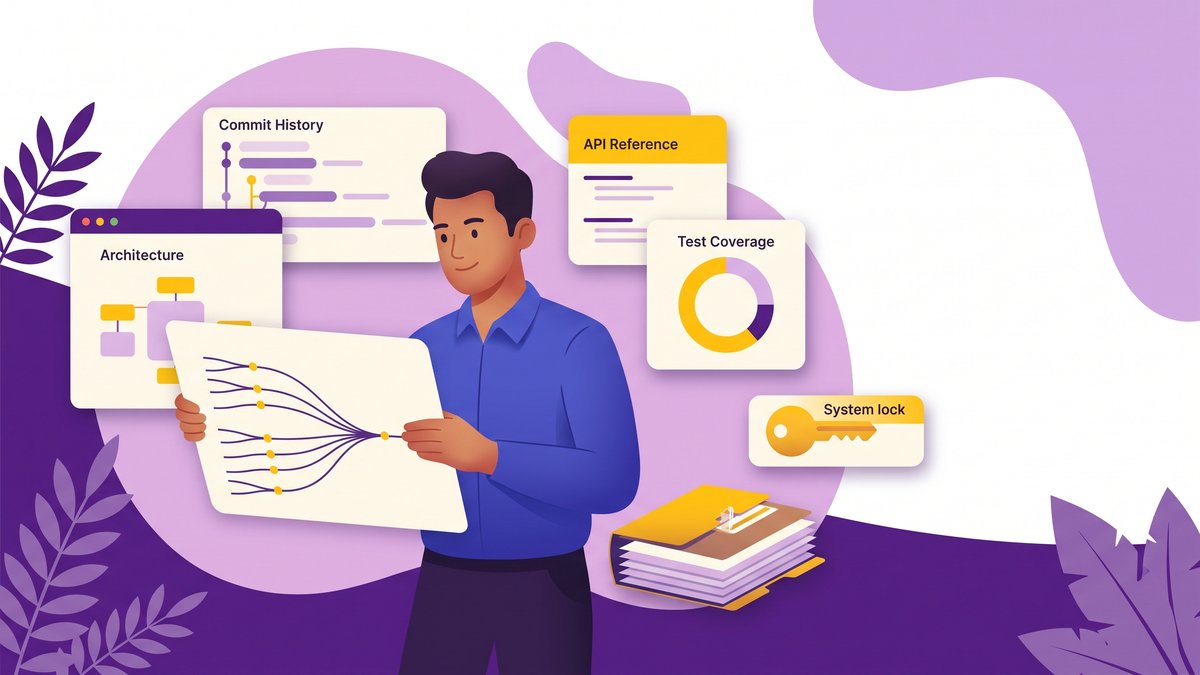
A scene that plays out in mid-market companies after AI-driven layoffs: critical internal systems become unmaintainable when the developer who built them is gone.
You Approved the Layoff. Then the System Broke.
It doesn’t announce with sirens. Six months later, someone investigates a report that shows incorrect numbers and types in the team Slack: “We can’t find anyone who knows how this works.”
It’s not a dramatic failure. No alarms fire. The system doesn’t collapse in a cloud of error messages. What happens is quieter: a feature stops working, a report shows numbers that look slightly wrong, an integration starts behaving inconsistently. When your team investigates, they find code nobody can read, architecture nobody can explain, and decisions nobody remembers making.
This is the AI layoffs institutional knowledge crisis in mid-market software systems. It doesn’t announce itself. It accumulates.
Mid-market companies (those in the 50-to-500-employee range) have a specific vulnerability that enterprise organizations don’t. At enterprise scale, redundancy exists almost by accident: multiple developers work on the same systems, documentation practices get enforced through process and compliance, and knowledge gets distributed across teams. At mid-market scale, you often had one developer, maybe two, who understood your custom reporting pipeline, your internal CRM integration, your homegrown order management workflow. That’s not a management failure. It’s a resource reality.
When AI-driven workforce reduction hits, the math changes fast. The developer who knew the system goes. The system stays. The knowledge doesn’t.
The call no one prepares for: “We can’t find anyone who knows how this works.”
The specific scenario that blindsides CEOs isn’t the system breaking on day one. It’s the system breaking at month three, after a minor configuration change, after a routine update, after a new hire tries to add a feature. Nobody realizes the knowledge is gone until someone needs it.
One case study published by Lazorpoint, an IT services firm, describes a CEO who grew frustrated with her head of IT. She realized, too late, that he was the only person who knew how everything worked. “IT operations people often had to call on that head of IT directly just to keep the business running.” When he gave notice and refused to assist with the transition, the business faced an operational crisis it hadn’t anticipated.
Why mid-market software systems carry a hidden single point of failure
Your internal custom software was almost certainly built by a small team, with limited documentation, optimized for shipping speed rather than knowledge transfer. When headcount shrinks, the knowledge margin shrinks with it. In many mid-market environments, that margin was already at one person before the layoff list was drafted.
The AI Layoff Math That Doesn’t Add Up
The labor cost savings looked clean on the spreadsheet. Headcount reduced, payroll trimmed, productivity maintained. The actual numbers tell a different story.
Tech shed nearly 80,000 jobs in Q1 2026: half attributed to AI
The tech industry laid off nearly 80,000 employees in Q1 2026, with almost 50% of the affected positions attributed to AI-driven restructuring, according to Tom’s Hardware’s industry-tracking data.
The scale matters for context. This isn’t a handful of companies making cautious cuts. It’s a sector-wide pattern, driven by the same thesis: AI tools can replace certain categories of work, so the humans doing that work can go. The thesis holds until the work turns out to be more complex than the AI can handle. Or until the knowledge embedded in the human’s head proves irreplaceable by the tool.
55% of companies already regret cutting: what Forrester found
Forrester Research’s Predictions 2026 report found 55% of employers already regret their AI-driven layoffs. The report, cited by HR Executive, also predicts that half of AI-attributed layoffs will be quietly rehired, typically at lower salaries or offshore, which introduces its own complications. Lost productivity and knowledge gaps are named as the primary drivers of regret.
A majority of companies that cut are already wishing they hadn’t. Not because AI failed as a concept, but because the humans they cut carried something AI couldn’t carry: context about systems that were never documented.
The rehiring boomerang: why it costs more the second time
Rehiring isn’t a clean undo. A developer who understood your integration layer doesn’t return at the same cost, under the same terms, with the same institutional knowledge intact. If they’re available at all, they’re coming back at a premium. They know their leverage. And the weeks they were absent weren’t idle: configurations changed, other team members made undocumented decisions, the system evolved in ways the returning developer must now relearn.
ClearlyAcquired’s analysis of key-person replacement costs puts the figure at 150 to 400% of annual salary, with new hires needing 16 to 20 weeks to reach full productivity. The cost isn’t just the premium salary. It’s the ramp-up time, the knowledge reconstruction, and the decisions made incorrectly during the gap.
Institutional knowledge loss in software development

The rehiring boomerang: companies that cut developers to save money frequently spend more bringing back equivalent expertise, often at a premium over the original salary.
What “Institutional Knowledge” Actually Means for Internal Software
Most CEOs have heard “institutional knowledge” in an HR context. It’s the phrase used when a long-tenured executive retires and takes 30 years of industry relationships with them. That loss is real. It’s also recoverable.
Software institutional knowledge is different. It doesn’t recover the same way. And the gap is wider than most people expect.
The documentation black hole: why 74% of organizations have no formal method for capturing technical knowledge
74% of organizations lack a formal method of capturing and retaining technical knowledge, including system knowledge, according to research cited by CAST Software.
The directional reality is consistent with what any mid-market CEO who has asked their IT team for documentation already knows: it doesn’t exist, or it’s out of date, or it covers what the system does but not why it was built the way it was.
The difference between HR institutional knowledge and system knowledge: why software is worse
When a senior sales director leaves, you lose their client relationships, market instincts, and internal influence. All recoverable. A new hire can rebuild client relationships. Overlapping experience approximates market instincts.
When the developer who built your internal CRM integration leaves, you lose accumulated decisions baked into code. Why does that API use a non-standard endpoint? Because the standard one had a rate limit that caused failures in 2023, and the fix was never documented. Why does the nightly sync run at 3 am? Because when it ran at 11 pm, it conflicted with a backup process that no longer exists, but changing the schedule broke something else. Why does staging behave differently from production? A temporary config change was applied in production during a crisis and never properly recorded.
None of that lives in a readme. It lives in a person.
What walks out the door when the developer leaves
What actually walks out: the reasoning behind architectural decisions (not just what the decision was); knowledge of which parts of the system are fragile and what triggers failure; an understanding of which “temporary” workarounds became permanent load-bearing infrastructure; awareness of integrations that don’t appear in any diagram; and the mental model of how all of it connects.
Research from docs.bswen.com on developer knowledge management puts the split at approximately 90% tacit and 10% documented. The 90% is what disappears when the developer’s last day comes.
Bus Factor: The Metric Your IT Team Knows and You Don’t
Your engineering team probably knows what bus factor means. It’s the dark-humor metric from software development: how many developers need to get hit by a bus before the project collapses? Morbid framing aside, it’s a genuine risk measure. For most mid-market software systems, the answer is one.
What bus factor means and why a score of 1 is a CEO-level risk
The bus factor quantifies the concentration of knowledge in a software system. A score of 1 means one person holds enough critical knowledge that their departure renders the system unmaintainable. A score of 2 means two must leave before the system becomes inaccessible to everyone remaining.
JetBrains’ Bus Factor Explorer analysis, published by LinuxSecurity.com in March 2026, found that major open-source databases like MySQL and PostgreSQL sit at a bus factor of 2. Already classified as high-risk. Enterprise teams managing internal custom systems typically do worse. For your custom operations tooling, your integration layer, and your homegrown reporting pipeline, the bus factor is often 1.
This is a CEO-level risk because it determines the minimum viable headcount for your critical systems. Below that threshold, you don’t have a staffing problem. You have a continuity problem.
72% of companies have at least one person whose departure would significantly disrupt operations
A 2023 SHRM study found that 72% of companies report having at least one employee whose sudden departure would significantly disrupt operations. In software system terms, that disruption isn’t just organizational. It’s technical. The HR director leaving takes relationships. The developer leaving takes the system’s interpretability.
How AI-era layoffs are systematically reducing bus factor to 1
Before recent AI-driven layoffs, many mid-market teams operated with bus factors of 2 or 3 for their most critical internal systems. Not great, but survivable. When a 5-person team shrinks to 3, and the cut positions include the two developers with the deepest system context, you don’t just lose headcount. You remove the safety margin entirely.
AI tools are genuinely useful for certain development tasks. They aren’t able to explain why a specific trigger condition exists in a legacy codebase that was never documented. The code itself doesn’t contain the reason. The developer who wrote it did.

Bus factor collapses as AI-driven layoffs shrink engineering teams: a marginally safe bus factor of 2 becomes critical exposure at bus factor 1 after one or two cuts.
The True Cost: What Happens in the 90 Days After the Developer Leaves
The financial case isn’t abstract. It plays out on a timeline in two phases that most companies don’t anticipate until they’re already in both.
Immediate losses: the systems that break, the integrations that fail
Within the first 90 days, the losses are operational. A deployment fails because nobody knows the environment-specific configuration that the departed developer managed manually. A data sync stops because an API token wasn’t renewed. Nobody knows which account held it. A report returns wrong numbers because a calculation change applied six months ago wasn’t reflected in any documentation.
Each incident costs time. More significantly, they erode your team’s confidence in the system and your confidence in their ability to manage it. The system that was running fine becomes the system nobody wants to touch.
Delayed losses: the features you can’t add, the compliance you can’t prove
The delayed losses are worse. From 90 days to 18 months out, you start running into the hard ceiling of what a team can do with systems they don’t fully understand.
A potential client asks for a compliance audit. You can’t produce the documentation. A regulatory change requires a modification to your data handling. Nobody knows which components to change without risking cascading failures. A growth initiative requires extending your internal tooling. The estimate comes back at three times the expected figure, because every change requires extensive reverse-engineering before the first line of new code gets written.
These aren’t edge cases. They’re the standard delayed consequences of knowledge loss from developer turnover in custom software environments.
The $72M figure: what knowledge loss from turnover costs organizations annually
An organization with 30,000 employees can expect to lose $72 million annually in productivity from knowledge loss caused by employee turnover, according to a figure cited by ProcedureFlow, attributed to Panopto’s workplace survey.
Scale that to a mid-market company. The proportional impact, even for a 200-person organization, is still measured in millions. That’s before accounting for the specific compounding cost of undocumented custom software systems.
Why the Fix Isn’t Documentation Software
When CEOs confront the AI layoffs institutional knowledge gap, the instinctive response is: “Let’s document everything.” Buy a wiki. Assign someone to write it all down. Mandate a documentation sprint before any developer leaves. This is logical. It doesn’t work.
The “we’ll write it down” trap: why documentation efforts fail without ownership
Documentation efforts fail for a structural reason: nobody owns their ongoing maintenance. A wiki gets written during a project and becomes outdated within 90 days. A runbook covers the process as it existed when it was written, not as it has evolved through six months of incremental patches. Architectural diagrams reflect the initial design, not the production reality after two years of workarounds.
Accurate documentation requires the person who understands the system to maintain it continuously. Writing it once at departure is not the same thing. A developer with two weeks’ notice has no time and no incentive to produce documentation that would take months to write accurately.
What actually transfers knowledge in a software handoff
Genuine knowledge transfer in software requires three things: time, overlap, and accountability. Time means weeks of paired work, not a two-week notice period. Overlap means the incoming developer works alongside the outgoing one on live systems, not just reads documents. Accountability means someone verifies that the knowledge was actually transferred, not just that the documentation was filed.
Most departing-developer handoffs fail all three conditions. The time isn’t there. The overlap can’t happen because the replacement wasn’t hired in advance. And nobody audits whether the knowledge is transferred until the system breaks three months later.
The misplaced faith in AI to understand undocumented systems
In 2026, the response in some organizations is: “We’ll use AI to read the codebase and generate documentation.” AI coding tools are useful for annotating functions, identifying patterns, and producing basic descriptions. They can’t explain why decisions were made, which assumptions the system depends on, or which parts of the codebase are safe to modify.
AI reads the code as written. The institutional knowledge crisis is about what wasn’t written: the context, the history, the reasoning behind choices now baked in as constraints. No tool, AI-assisted or otherwise, reconstructs what was never captured.

Documentation tools create the appearance of coverage. The tacit knowledge that actually runs the system stays undocumented until something breaks and everyone realizes it wasn’t there.
What Mid-Market CEOs Are Doing Instead
Companies navigating AI-era workforce reduction without catastrophic knowledge loss have something in common: they didn’t treat documentation as a post-departure activity. They built knowledge continuity into the way the work is delivered.
The embedded team model: documentation as a deliverable, not an afterthought
An embedded development team maintains ongoing context about the systems it manages. When a developer cycles off, their replacement receives a structured handoff from colleagues who have been working on the same systems in parallel. Knowledge transfers through direct overlap, not documentation written under departure pressure.
This structural difference is decisive. Knowledge doesn’t live in one person’s head because the team has been building and maintaining it collectively. Architecture decision records get written as decisions are made, not reconstructed from memory six months later.
The resulting documentation belongs to the client company. Unconditionally. Not vendor-held records. Not knowledge accessible only through a portal. Complete technical documentation: UML diagrams, API references, architecture decision records, system design documents. Transferred to and owned by the client at project completion, regardless of whether the engagement continues afterward.
“As Ashwin Ballal, CIO at Freshworks, states: ‘When you add vendors, you are not reducing complexity. You are just moving it somewhere else, and often adding new dependencies on top of old ones.'” The same principle applies to knowledge: when documentation remains with the vendor rather than being transferred to the client, you’ve traded one knowledge dependency for another.
How nearshore AI-augmented development builds knowledge continuity into the engagement
An AI-augmented development process systematically produces documentation as a byproduct of delivery, not as an end-phase deliverable nobody has time to write. Architecture decision records, API documentation, and system design artifacts exist because the process requires them, not because someone remembered to prioritize documentation at a developer’s departure.
Nearshore teams operating in the U.S. time zone alignment maintain the communication continuity that documentation-as-process requires: real-time collaboration, daily standups, and code reviews that include documentation reviews. These are the practices that keep knowledge accessible and up to date, without relying on any individual developer’s memory.
For mid-market companies already managing knowledge gaps from completed AI-driven layoffs, this model also addresses system rescue: taking over and stabilizing internal software in poor condition, reverse-engineering the current state, and returning the system to a maintainable baseline with full documentation transfer.
Three questions to audit your internal systems’ bus factor before the next headcount decision
Before you approve any further AI-driven headcount reductions, ask these three questions about each of your internal custom software systems:
Question 1: If the developer who knows this system best leaves tomorrow with two weeks’ notice, could any remaining team member deploy a change to production without their guidance? If the answer is no, your bus factor is 1, and the system is at immediate risk.
Question 2: Does complete, current documentation exist for this system’s architectural decisions, integration dependencies, and environment configurations? Not “we have a wiki.” Documentation that a new developer could use to understand the system without interviewing anyone who worked on it.
Question 3: If this system went down at 3 am on a Saturday, who would you call? If the honest answer is someone who no longer works at your company, you have a knowledge continuity problem that the last round of layoffs made structurally worse.
Most companies skip this audit. Then run it in crisis mode after the system breaks.
How to protect institutional knowledge in software development
The Decision You Make Before the Next Layoff
There’s a version of this that goes well. Headcount gets reduced where AI genuinely covers the gap. The people whose knowledge is irreplaceable stay until that knowledge is transferred. Documentation gets built into the delivery process, not crammed into the final two weeks before someone leaves. The bus factor is audited before the reduction list is approved, not after.
That version requires asking the hard questions before the spreadsheet is finalized. Not after the call comes six weeks later, when nobody knows how the system works.
If you’re already past that point, if the layoff happened and the knowledge gaps are now visible, the structural fix is the same. An embedded development partner with documentation-as-deliverable as a contractual standard can take over systems in poor condition and return them to a maintainable state. The goal isn’t to recreate the knowledge that was left. It’s to build a structure where that failure mode can’t happen again.
Ready to audit your systems’ knowledge continuity before the next headcount decision? Talk to Nexa Devs, we work with mid-market companies on exactly this problem.
FAQ
What is the hidden cost of AI layoffs for companies?
The hidden cost is institutional knowledge loss: specifically, the system knowledge held by developers who built and maintained internal software. When those developers leave, the system becomes difficult or impossible to maintain. Forrester Research found that 55% of companies already regret AI-driven layoffs, primarily due to lost productivity and knowledge gaps that neither remaining staff nor AI tools could fill.
How do companies lose institutional knowledge when developers leave?
Developers carry tacit knowledge, architectural decisions, integration dependencies, and undocumented workarounds that are rarely written down. Research puts approximately 90% of organizational knowledge in the tacit category. When the developer leaves, that 90% disappears. Systems become unmaintainable, deployments fail, and new hires spend months reconstructing what the departing developer understood intuitively.
What is bus factor risk, and how does it affect software teams?
Bus factor measures how many team members must leave before a project becomes unmaintainable. A bus factor of 1 means one departure breaks the system. A 2023 SHRM study found 72% of companies have at least one employee whose departure would significantly disrupt operations. AI-driven layoffs systematically reduce bus factor, sometimes removing the safety margin entirely without management realizing it.
What happens to internal software systems when the developer who built them leaves?
The system remains operational initially, then becomes progressively harder to modify or extend. Every change requires reverse-engineering undocumented configurations. ClearlyAcquired’s research shows replacing high-level technical talent costs 150 to 400% of annual salary, with new hires needing 16 to 20 weeks to reach full productivity.
How do you protect institutional knowledge before laying off developers?
Three steps make a structural difference: audit your bus factor before deciding who to cut; require overlap-based handoffs with incoming developers rather than departure documentation; and build documentation into your ongoing development process. An embedded team model where multiple developers maintain shared current knowledge is structurally more resilient than individual developer arrangements.
What percentage of companies regret AI-driven layoffs?
Forrester Research’s Predictions 2026 report found 55% of employers already regret AI-driven layoffs. People Matters Global, citing Careerminds research, reported 32.9% of HR leaders said their organizations lost critical skills after AI-driven restructuring, and only 8.4% would repeat their approach unchanged.