
Table of Contents
Legacy System AI Barrier: Why Your Stack Blocks AI (And How to Break the Deadlock)
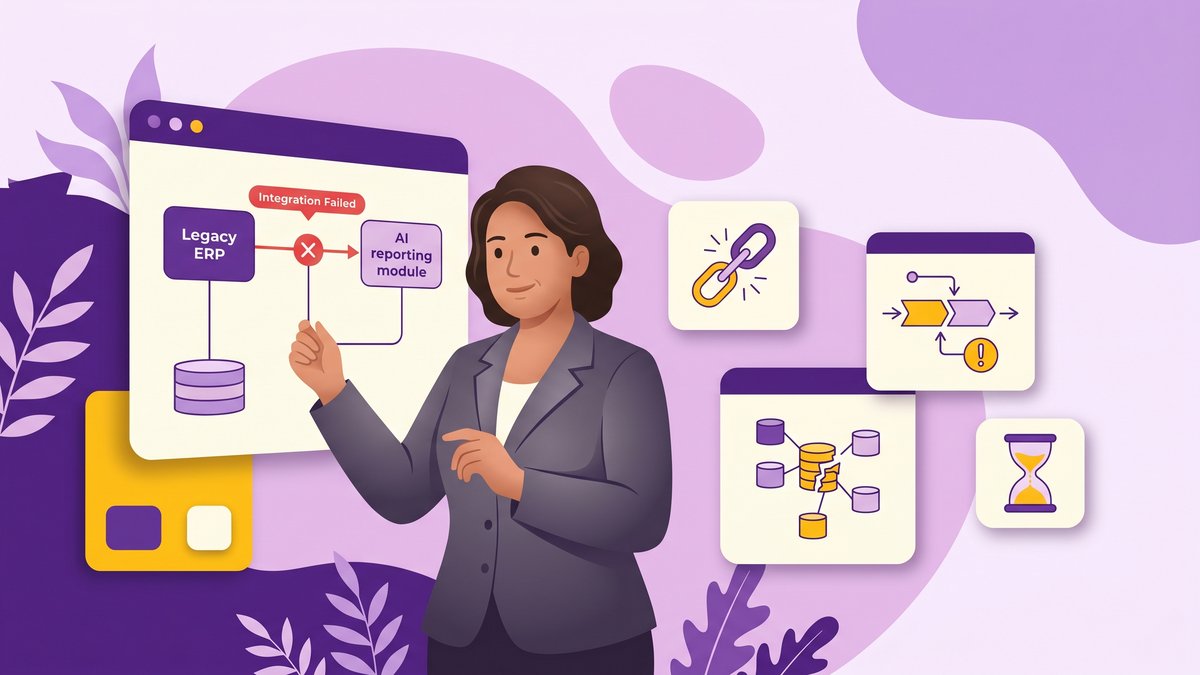
Eighteen months. That’s how long one mid-market operations team spent trying to connect their AI tools to a legacy ERP before giving up. They weren’t missing the budget. They weren’t missing talent. What they were missing was a foundation on which AI could actually run.
The moment they modernized the underlying system, AI-assisted reporting was up and running in the first sprint. Same team. Same AI tools. Completely different result.
That’s not a coincidence. The legacy system AI barrier is structural, and most AI vendors have no incentive to tell you about it before they sell you a seat.
You’ve Tried AI. It Didn’t Work. Here’s the Part No One Told You.
The AI pilot ran for six months. The demo worked. The vendor was responsive. Then you tried to connect it to real data, and the integration broke. Or the outputs were unreliable because the underlying data was fragmented. Or it worked in isolation but couldn’t talk to the three other systems that would have made it useful. So the pilot wound down quietly, categorized as “not the right moment.”
That pattern, across thousands of mid-market companies right now, isn’t bad luck. It’s architecture.
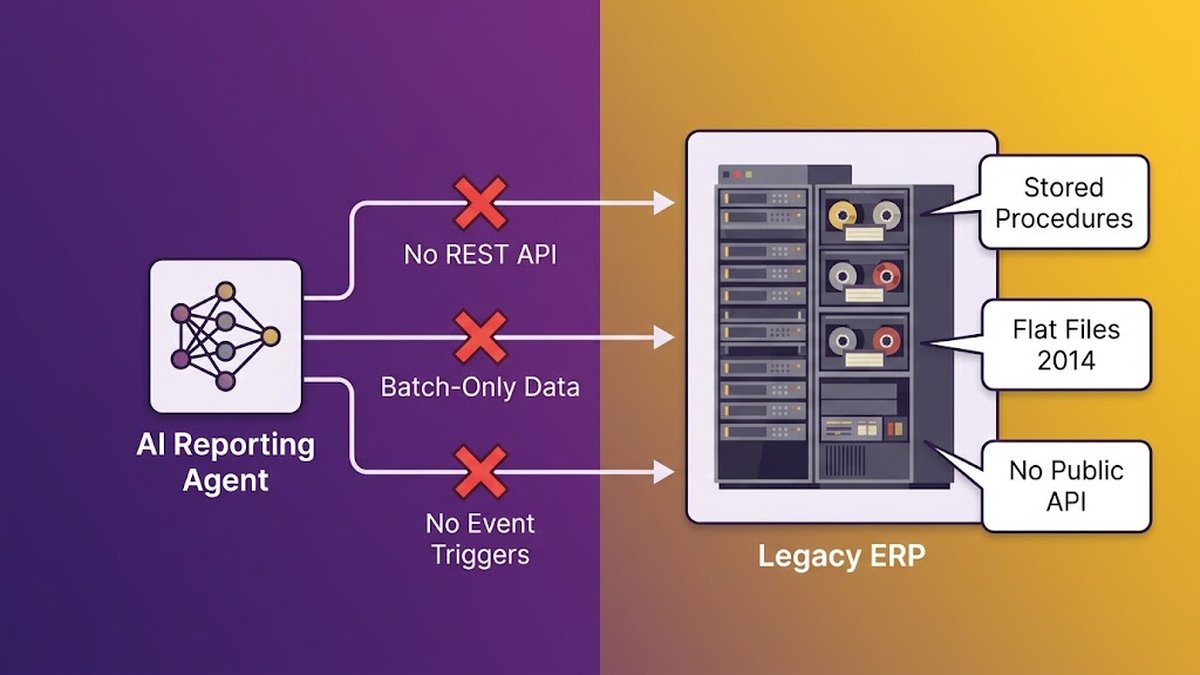
A familiar scene in mid-market operations: a pilot that worked in the demo environment hits the wall of legacy integration.
The pilot that never made it to production
AI tools are built to run on specific conditions: clean, accessible data in near-real time; APIs that accept and return structured responses; and an architecture that allows an event in one system to trigger an action in another. When those conditions exist, AI works. When they don’t, it can’t, regardless of how good the model is.
A mid-market company running a 12-year-old ERP typically lacks those conditions. Data sits in siloed tables with no public API. Business logic is buried in undocumented stored procedures. Reports are generated by querying flat files that were last redesigned in 2014. An AI agent dropped into this environment doesn’t fail because the AI is bad. It fails because the environment physically can’t give it what it needs.
The AI vendor won’t tell you this on the first call. Their demo environment is clean. Their integrations point at structured test data. By the time you discover the gap, you’ve already bought the license.
Why AI vendors don’t lead with the uncomfortable truth
AI tool vendors sell features and capabilities. Telling a prospect “your infrastructure might need 18 months of work before you can use this” is not a sales accelerator. So they don’t say it. They describe “integrations” that require your system to have an API endpoint. They show dashboards that assume your data is already normalized. They talk about “connecting your existing stack” as if that connection is trivial.
For a modern, cloud-native stack, it often is trivial. For a legacy system that pre-dates API conventions, it isn’t. The legacy system AI barrier isn’t a feature gap. It’s an architectural prerequisite the tool can’t provide for itself.
What Your Legacy Stack Is Actually Costing You (In Numbers)
Before talking about AI, there’s a more immediate number worth examining. Organizations allocate 70% of IT budgets to maintaining legacy systems, according to data confirmed by Ideas2it, leaving almost nothing for new capabilities. Not 20%. Not 40%. Seventy percent.
For a mid-market company with a $2M annual IT budget, that’s $1.4M a year spent keeping an existing system running. The remaining $600K has to cover security, upgrades, new tools, and any innovation the business actually wants to pursue. It’s not a development budget. It’s a maintenance contract.
The maintenance tax: 70-80% of IT budget going nowhere
That 70% figure isn’t a ceiling, it’s often a floor. At the higher end of legacy-heavy environments, the ratio shifts to 80%. Ray Forte, an executive at Analog Devices, described his situation plainly: the calculation came back “in the low 80s” when he asked what percentage of IT spend was simply keeping the lights on.
This is what we call the maintenance tax. It’s not interest on a loan you can pay off. It’s a permanent structural levy on your ability to invest in the business. Every sprint your engineering team spends patching an aging codebase is a sprint they didn’t spend building something that compounds in value.
Feature velocity: when 2-week releases become 12-week releases
The maintenance tax has a secondary consequence that CEOs feel even more acutely than CFOs: features slow down.
One unnamed CEO client of a mid-market software modernization firm described it this way: “Features used to take two weeks to push three years ago. Now they’re taking 12 weeks. My developers are super unproductive.” That’s not a performance management problem. That’s what a tightly coupled codebase does to a team over time: every new feature requires understanding the blast radius of touching a system where nothing is documented, and everything is connected to everything else.
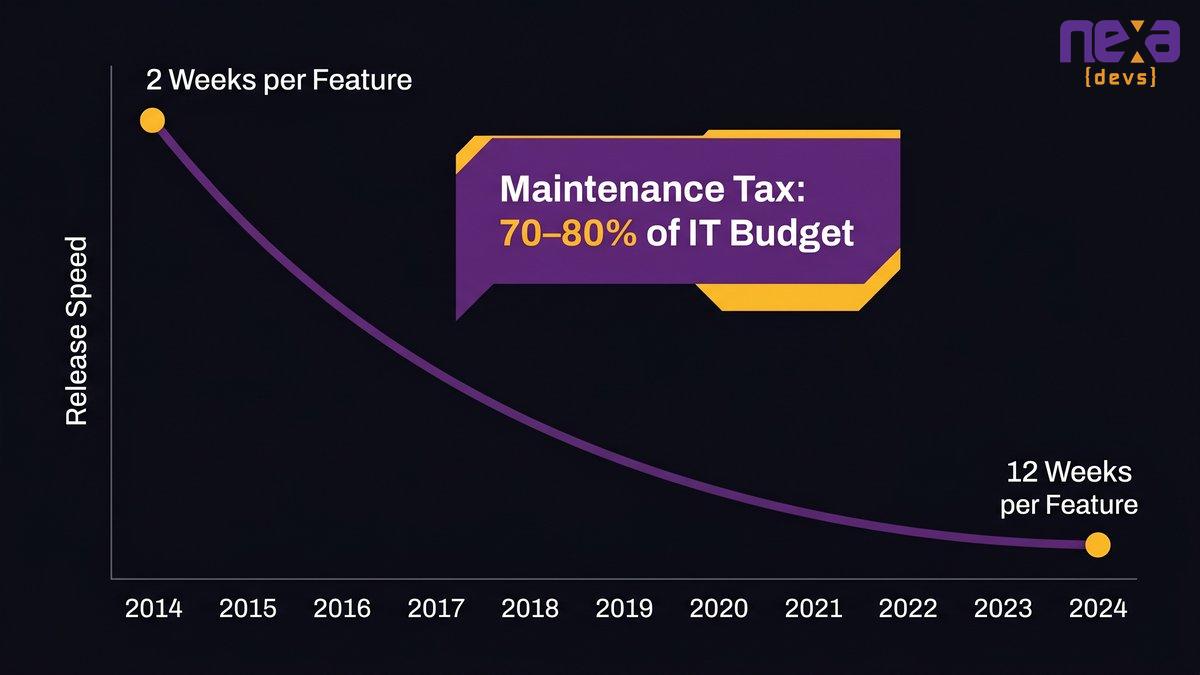
Feature velocity doesn’t decline linearly. It compounds downward as the codebase accumulates dependencies.
The compounding cost of delay
Here’s the dynamic that makes this genuinely dangerous: every quarter you don’t address the underlying architecture, both costs go up. The maintenance burden grows as the gap between the legacy system and modern tooling widens. The feature tax grows as developers spend more time navigating an increasingly complex codebase. And the AI readiness gap compounds independently on top of both of those curves.
Waiting is not a neutral choice. It’s an active cost decision made by inaction.
Why AI Cannot Run on a Foundation It Was Never Built For
Deloitte’s 2026 Tech Trends report found that nearly 60% of AI leaders view legacy-system integration as the primary barrier to agentic AI adoption. Not insufficient budget. Not missing talent. The infrastructure itself.
This isn’t a soft barrier. It’s a hard technical incompatibility.
What agentic AI actually needs: real-time data, APIs, event-driven architecture
Agentic AI, the kind that automates workflows, generates reports, monitors operations, and makes decisions, requires three things from the underlying system it connects to:
Real-time data access. An AI agent that queries a database replicated once per day isn’t actually intelligent; it’s working with yesterday’s information. For agentic workflows (automated anomaly detection, dynamic reporting, AI-assisted approvals), the data layer must be live or near-live. Legacy ERPs built on batch-processing architectures weren’t designed for this.
Callable API endpoints. AI agents interact with other systems by calling endpoints and reading structured responses. If your ERP doesn’t expose modern REST or GraphQL APIs, the agent has no legal way to get data out or push decisions in. Some integrators work around this using screen scraping or RPA tools, but those are bridges, not solutions. They break whenever the UI changes and accumulate their own maintenance burden.
Event-driven triggers. The most useful AI agents don’t wait to be asked; they respond to events. A new order is created. A threshold is crossed. A document is submitted. Legacy systems built around polling architectures and batch jobs can’t fire events because they were never designed to. They produce data; they don’t announce that data has changed.
Why your legacy ERP is the integration wall, not the AI tool
When an AI integration fails, the instinct is to blame the AI tool. Wrong direction. The AI tool is usually working exactly as documented. What failed is the contract between the AI tool and the legacy system, and that contract requires the legacy system to provide something it structurally cannot.
This is why API wrappers only solve part of the problem. A wrapper can expose read access to legacy data through a modern API endpoint. It can’t give you real-time events from a batch-processing system. It can’t clean fragmented, inconsistent data at the source. The underlying architectural constraints remain.
The 60% barrier: when integration is the primary blocker, not skill or budget
The 60% figure from Deloitte deserves examination as a signal rather than just a statistic. These are AI leaders at companies with the budget, the strategy, and presumably the talent, yet they’re still blocked. What’s blocking them isn’t something they can hire their way out of. It’s architectural. The systems their AI needs to integrate with weren’t built for it.
Mid-market companies face this problem with fewer resources than the enterprises Deloitte surveyed. The constraint is sharper, the margin for error smaller, and the window to address it is shorter.
The 18-Month Trap: Why Mid-Market AI Pilots Never Reach Production
92% of mid-market AI strategies stall at the architecture phase, not the model selection phase, not the talent phase, not the budget phase, according to CetDigit’s analysis. The architecture phase. The part where you discover that the AI tool you bought can’t actually reach the data it needs.
This is the 18-month trap. Companies cycle through it in predictable stages.
From isolated experiment to structural barrier
Month one: the vendor demos the product. Data flows beautifully in the demo environment. The use case is compelling. The contract gets signed. Months two and three: your team starts the integration. They discover the legacy ERP doesn’t have an API for the data the AI tool needs. They built a workaround. Months four through eight: the workaround works in staging but fails under load, or produces inconsistent data, or breaks when the ERP vendor pushes an update. Months nine through twelve: a third-party integration consultant is brought in. They built a more robust bridge. It costs more than the AI tool license. Month eighteen: the pilot is still in staging, the original use case has drifted, and the team is quietly deprioritizing it for Q3.
That’s not a failure of execution. That’s a structural barrier presented as a project problem.
Data that can’t talk to itself can’t talk to AI
The specific bottleneck in most mid-market AI failures is data fragmentation. The customer record in the CRM doesn’t match the customer record in the ERP because they were entered separately and never reconciled. The inventory data in the warehouse system uses a different SKU schema than the finance system. The operational data from the field is collected in spreadsheets that get uploaded manually twice a week.
An AI tool can’t reconcile this fragmentation. It can only report on it or fail against it. Before AI can generate useful output, the data it reads has to mean the same thing across systems, and in most mid-market legacy environments, it doesn’t.
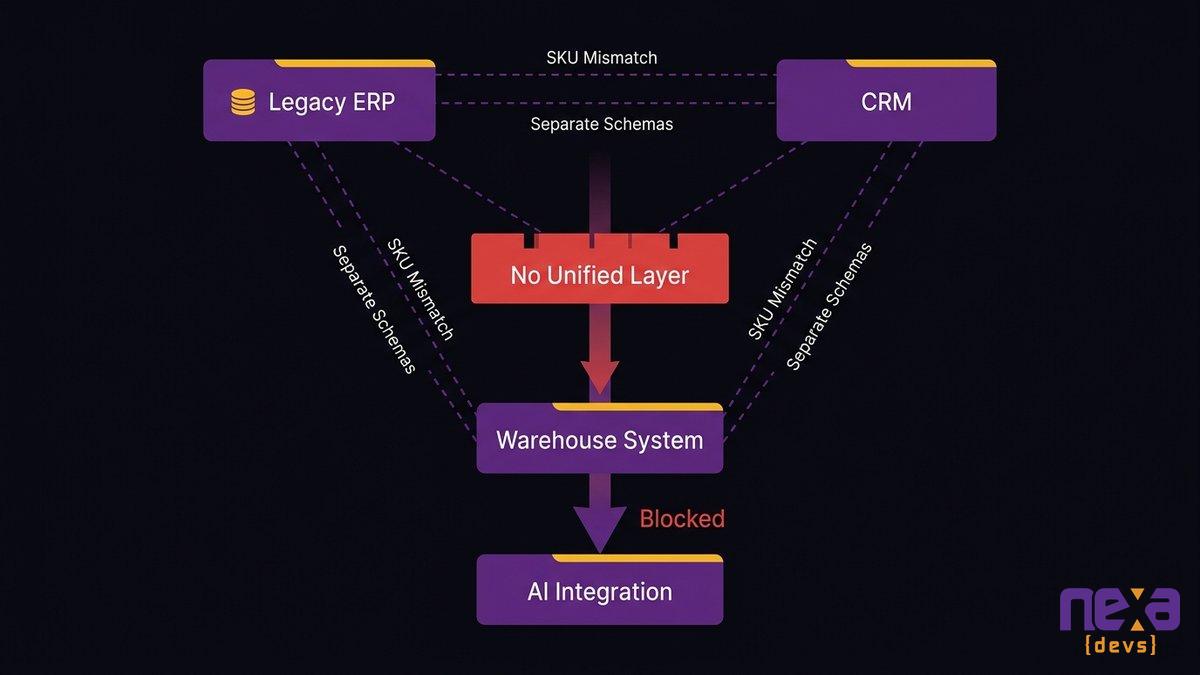
Most mid-market environments have three or more systems with separate data schemas and no unified layer for AI integration.
Why 92% of mid-market AI strategies stall at the architecture phase
The 92% figure from CetDigit is specific: the stall happens at the architecture phase. Not later. Not during model fine-tuning. At the point where teams realize the underlying system can’t support what they’re trying to build.
This pattern is the clearest evidence that the problem isn’t AI readiness in the abstract sense. It’s infrastructure readiness in the very specific sense: does your system have the APIs, the data quality, and the architectural patterns that AI integration requires? For most mid-market companies running systems built before 2015, the answer is no.
The RSM 2025 AI Survey found that 53% of middle market firms feel only somewhat prepared to implement AI, with another 10% not prepared at all. These aren’t companies that don’t understand AI. They’re companies that understand, accurately, that their infrastructure isn’t ready for it.
What Breaking the Deadlock Actually Looks Like
When a mid-market team acknowledges the architecture problem, they typically see two options. Neither one works particularly well in isolation.
The problem with “AI first, modernize later.”
Some companies try to run the AI layer over the existing system using API wrappers, middleware connectors, and RPA bridges. This works, partially, temporarily. You get some AI capability at the cost of a fragile, expensive integration layer that needs its own maintenance budget. Every legacy system update risks breaking the bridge. Every new AI use case requires another round of custom integration work.
More fundamentally, this approach doesn’t fix the underlying problem. The data quality issues remain. The batch-processing architecture remains. The lack of event-driven triggers remains. You’re not building AI capability; you’re building infrastructure to approximate AI capability while deferring the real work.
The problem with “modernize everything, then add AI.”
The alternative, modernize the full system before touching AI, sounds more logical, but it has its own failure mode. Full modernization projects for mid-market systems typically run 18 to 36 months and cost far more than initial estimates. Gartner reports 70% of legacy modernization programs exceed budget by 30% or more.
By the time the modernization is complete, the AI landscape has shifted. The use cases you designed for in year one are different from the ones that matter in year three. The AI tools your team evaluated during scoping may have been superseded. You’ve spent 30 months building the runway and the planes have changed.
The third path: modernize the foundation and embed the AI in the same engagement
The approach that actually breaks the deadlock is neither of those. It’s treating modernization and AI integration as a single engagement rather than two sequential projects.
This is how it works in practice: you don’t modernize everything first and then add AI. You identify the specific architectural barriers blocking the AI use cases that matter most, modernize those components incrementally, and build the AI integration directly into the newly modernized layer as you go. Each modernization phase unlocks a new AI capability. Nothing gets built twice.
The operations team we described at the start of this post went through exactly this process. They didn’t spend 18 months modernizing their ERP before touching AI. They worked with a partner who identified the specific integration wall, the reporting module, modernized that layer, and had AI-assisted reporting running in the first sprint. The rest of the ERP modernization continued in parallel, each phase unlocking the next AI capability on the roadmap.
That’s the model. Not AI-first-then-modernize. Not modernize-everything-then-add-AI. Both outcomes, delivered in one engagement, sequenced by what the AI roadmap actually needs.
Incremental Modernization vs. Full Rewrite: The Decision Getting Mid-Market CTOs Wrong
Most CTOs facing a legacy modernization decision frame it as binary: modernize incrementally, or rewrite completely. The right answer is almost always incremental. A full rewrite is rarely the correct choice for a mid-market system, and when it is, the reasons have nothing to do with AI readiness.
The strangler fig pattern explained for non-developers
The strangler fig is the canonical pattern for incremental legacy modernization. The name comes from a tree that grows around an existing structure, gradually replacing it without ever requiring the original to go offline. In software terms, you build new, modern components alongside the legacy system and route traffic to them as they’re validated, without ever taking the legacy system down for a full replacement.
For a mid-market CEO, the practical implication is this: your team keeps shipping, your operations keep running, and the legacy system is progressively replaced by modern architecture. No big-bang cutover. No six-month development freeze. No single catastrophic risk event.
What incremental modernization actually costs and how long it takes
Incremental modernization for mid-market core systems typically requires 3 to 6 months per major component and costs significantly less than a full rebuild. The timeline depends on component complexity, data migration scope, and the degree of undocumented dependencies, the last of which is almost always higher than initial estimates suggest.
The relevant comparison isn’t “how much does incremental modernization cost” but “how much does it cost relative to continuing to pay the maintenance tax while the AI opportunity compounds.” At a 70% maintenance budget allocation, the question becomes: how many quarters does the current situation have to continue before it costs more than the modernization?
When a full rewrite is the right answer (and when it’s not)
A full rewrite makes sense in three specific situations: when the existing system is so deeply undocumented that incremental modernization would require rebuilding it to understand it; when the technology stack is genuinely end-of-life with no incremental migration path; or when the business model has changed so completely that the existing system shares no meaningful logic with what needs to be built.
In mid-market software, those conditions are rare. Most legacy systems can be modernized incrementally. The CTO’s instinct toward a full rewrite is often driven by the frustration of working in a poorly documented codebase, which is real and understandable, but not a sufficient reason to accept the financial and operational risk of starting from zero.
The big-bang rewrite is the riskiest path. For mid-market organizations, it’s almost never the right one.
How to Know If Your Stack Is the Real Barrier (A Self-Audit for CEOs and CTOs)
Before engaging a vendor or budgeting a modernization, you can diagnose the problem yourself. The following five questions don’t require a technical audit, they require honest answers from the people who work in the system daily.
The self-audit takes an afternoon. The answers will tell you more than a vendor’s discovery phase.
Five questions that reveal your AI readiness gap
1. If you wanted to show a live dashboard of today’s operational data, how long would it take to build?
If the answer is “weeks” or “we’d need to write a custom script,” your data layer isn’t accessible enough for AI. Real-time AI reporting requires real-time data access. If you can’t build a basic live dashboard, you can’t build AI-driven analytics.
2. When your CRM or ERP vendor releases an update, do integrations break?
If the answer is “sometimes” or “we have to check,” your integrations are brittle. AI tools can’t operate on brittle integrations; they need stable, predictable data contracts. Brittle integrations aren’t an IT operations problem. They’re an architectural signal.
3. Can your developers add a new data field to a core object without fear of breaking something else?
If the answer involves phrases like “we have to trace all the dependencies first” or “we usually do it at night in case something breaks,” your codebase is tightly coupled in ways that will make AI integration significantly more expensive than any vendor’s estimate suggests.
4. Is there documentation that would allow a new developer to understand the system’s architecture in a week?
No documentation means no AI. Literally: AI-assisted development tools work on documented, navigable codebases. But more practically, the lack of documentation means the AI integration work will cost significantly more because every step requires archaeological work. If the team doesn’t know what they have, neither will the AI tool.
5. Have you tried to connect any AI tool to your core systems in the last two years? What happened?
If the answer involves “we’re still working on the integration” or “we deprioritized it,” you’ve already hit the legacy system AI barrier. The pilot didn’t fail because the AI was wrong. It failed because the foundation wasn’t ready.
Red flags in your current architecture
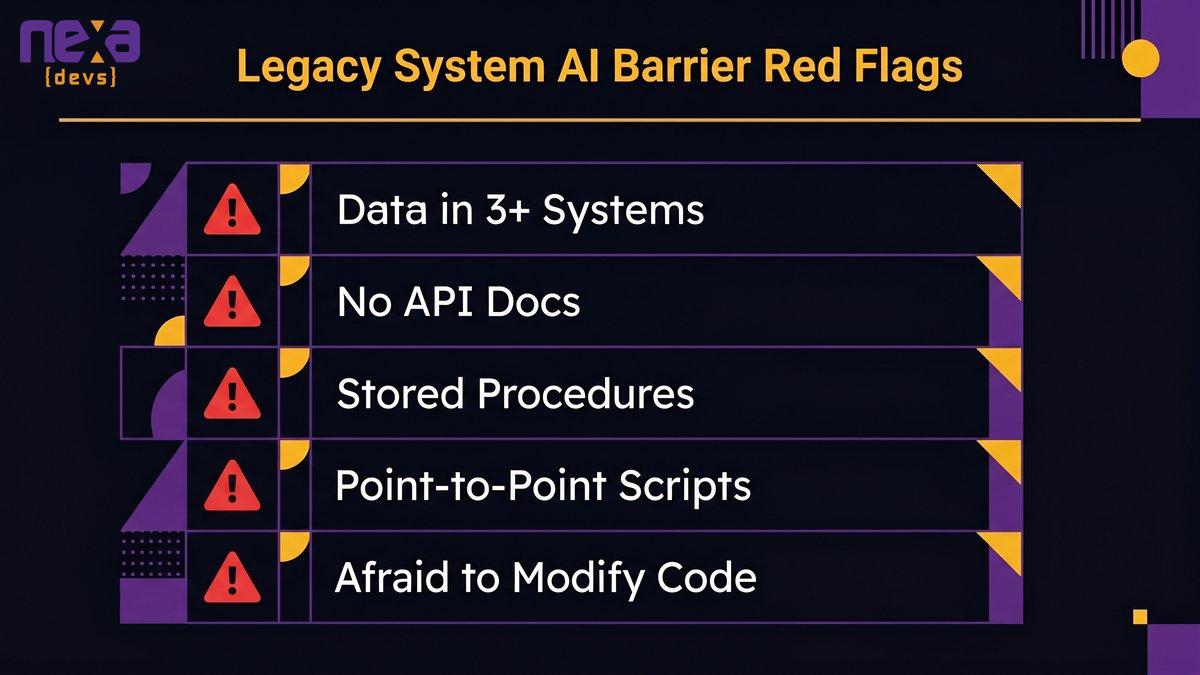
Any of the following conditions indicates a legacy system AI barrier requiring architectural work before AI integration will succeed:
- Data split across more than three systems with no master data management layer
- Core business logic embedded in database stored procedures that nobody has reviewed in five years
- Integrations built as point-to-point custom scripts rather than through an integration layer
- No API documentation for core systems (or no APIs at all)
- Developers who are afraid to modify certain parts of the codebase
What readiness looks like at mid-market scale
AI readiness doesn’t require a complete cloud migration or a microservices rewrite. At mid-market scale, readiness means: your core data is accessible through a modern API, your key entities are consistent across systems, and your architecture can accept an event-driven trigger without a custom build for every new use case. That’s achievable incrementally, without disrupting operations, in a reasonable timeframe.
[INTERNAL_LINK: anchor text “AI readiness assessment” → /blog/ai-readiness-assessment-guide]
The Two-Year Window You Can’t Afford to Miss
As Skylar Roebuck, CTO at Solvd, stated in The Tech Panda: “Traditional modernization tends to over-index on protecting how things work today rather than building for what’s next. AI capability is compounding rapidly, and the real risk for mid-market companies is delay.”
That statement has a specific mathematical implication. AI capability compounds. Your legacy system’s value doesn’t.
The competitive gap that opens when AI-native competitors move first
The companies that are modernizing now aren’t doing it because they have excess budget. They’re doing it because they understand the competitive dynamic. When an AI-native competitor can ship a new feature in two weeks and your team needs twelve, the gap isn’t just operational, it’s directional. They’re compounding in the right direction.
Gartner predicts 40% of agentic AI projects will be canceled by 2027 due to infrastructure constraints. The companies that survive that cancellation rate won’t be the ones with the best AI strategy. They’ll be the ones whose infrastructure could support the AI they tried to deploy.
The mid-market companies that break the legacy-AI deadlock in the next 24 months will exit that window with compounding AI capability and a modernized architecture. The ones that don’t will enter that same window, having watched competitors capture market share with capabilities that their stack simply couldn’t support.
Why delay compounds: each quarter deferred raises modernization cost
The modernization cost calculation gets worse with time, not better. Every quarter that passes, the gap between your legacy system and the modern tooling it needs to integrate with grows wider. Dependencies accumulate. Undocumented logic compounds. Engineers who know the system move on. The contractor who built the 2012 ERP customization retires. The knowledge required to modernize safely becomes thinner and more expensive to reconstruct.
Waiting twelve months doesn’t defer a fixed cost. It raises the cost by 15–25% while simultaneously narrowing the window of competitive opportunity.
What “AI-ready” looks like by 2028, and what happens if you’re not there
By 2028, the competitive baseline in most mid-market industries will include AI-assisted operations as a standard capability, not a differentiator. Companies that are running AI-assisted reporting, automated exception handling, and AI-accelerated development workflows will treat those capabilities as table stakes. Companies still running batch-processing ERPs from 2012 won’t be competing on AI strategy, they’ll be competing on cost, and losing.
The window to make the foundational investment at a manageable cost is the next 24 months. After that, the modernization becomes more expensive, the AI gap becomes more pronounced, and the competitive cost of delay becomes structural rather than recoverable.
The Foundation Is the Decision
Your AI strategy isn’t blocked by the AI tool you chose or the consultants you hired. It’s blocked by the infrastructure that those tools have to run on. Two weeks per feature became twelve weeks because the stack accumulated a decade of undocumented complexity. The AI pilot ran for eighteen months and never reached production because the ERP couldn’t provide what the AI tool required.
The fix isn’t another AI vendor conversation. It’s an architectural one.
The companies winning the AI race right now aren’t the ones with the most sophisticated models. They’re the ones whose underlying systems can actually run them. That’s an achievable state for mid-market organizations, but not with an off-the-shelf AI layer bolted onto a legacy ERP. It requires fixing the foundation first, and fixing the foundation while building the AI capability on top of it.
Both outcomes are one engagement. That’s the path through.
Read how a mid-market operations team eliminated the AI readiness gap
Ready to find out if your stack is the real barrier? Schedule an architecture assessment with Nexa Devs to map your legacy system against your AI roadmap, and see exactly which components need to change before your next pilot.