

Table of Contents
Your developers are busy. Your IT budget keeps growing. Yet your roadmap keeps slipping, your competitors keep shipping faster, and your board is asking why you haven’t deployed AI yet. You haven’t been mismanaging the business. You’ve been paying a tax you didn’t know had a name.
Technical debt cost is the most expensive line item not on your P&L. It shows up as engineering hours that disappear into maintenance. As features that take 12 weeks instead of two. As AI pilots die in staging because the underlying systems can’t support them. And it compounds, quietly, every quarter, while you’re focused on everything else.
This isn’t an IT problem. It’s your problem. And it’s solvable.
Technical Debt Isn’t an IT Problem. It’s a Business Problem.
Technical debt is a CEO-owned strategic liability, not a developer housekeeping task. You’re carrying it on your balance sheet right now; you just don’t have a line for it.

The Financial Analogy That Finally Makes It Real
The term “technical debt” was coined by software developer Ward Cunningham in 1992. His analogy was precise: writing fast, imperfect code to ship quickly is like taking out a loan. You get the speed now. But you pay interest later, in every feature that takes longer to build because the foundation is fragile, in every engineer who spends Fridays patching rather than creating, in every system integration that fails because no one documented how the pieces connect.
The problem with debt analogies is that most CEOs hear “debt” and think it’s recoverable. Standard debt sits on your balance sheet. You know what you owe, you know the interest rate, you can plan payoff. Technical debt doesn’t work that way. It’s invisible. It doesn’t appear on any report you review. And its interest compounds faster than most leaders realize, because the people best positioned to quantify it, your engineering team, are often the ones most reluctant to surface it to leadership.
When “We’ll Fix It Later” Becomes “We Can’t Build Anything New”
There’s a progression every CEO with legacy technology eventually hits. Phase one: the system works, but it’s slower to change than it used to be. Phase two: new features take three times as long as they should because every change risks breaking something else. Phase three: engineers stop proposing new ideas because they know the system can’t support them. Phase four: a competitor ships an AI feature your customers want, and your team tells you it would take eighteen months to build the same thing.
An unnamed CEO client of software modernization firm Corgibytes described the inflection point precisely: “Features used to take two weeks to push three years ago. Now they’re taking 12 weeks. My developers are super unproductive.”
That CEO wasn’t mismanaging their engineering team. They were running a system in which every change carried the full weight of every shortcut that came before it.
What Technical Debt Is Actually Costing Your Business Right Now
The technical debt cost for a mid-market company is not theoretical. It’s quantifiable, and the numbers are larger than most CEOs expect when they first see them.
The $5.4–$10 Million Annual Drain Most Mid-Market CEOs Don’t Know They’re Carrying
According to zazz.io’s cost modeling for mid-market enterprises, the realistic annual cost of unmanaged technical debt sits between $5.4 million and $10 million per year. That range accounts for engineering capacity consumed by maintenance, delivery delays, security remediation, and talent attrition. It does not include the cost of missed market opportunities or deferred AI investments, those multiply the number further.
Zoom out to the macro level, and the scale becomes staggering. According to Accenture, technical debt consequences cost US businesses $2.41 trillion every year, a figure so large it’s hard to map to your own P&L, until you realize what’s sitting inside it: millions of mid-market companies paying the same compound interest you are.
Gartner estimates that technical debt now represents 20 to 40 percent of the total value of technology estates across enterprise organizations. That’s not a rounding error on your balance sheet. It’s a structural liability.
The Four Budget Lines Where Technical Debt Is Already Showing Up
Most CEOs can feel the cost of technical debt without being able to point to it. Here’s where it lives:
Engineering salaries are spent on maintenance, not creation. According to The New Stack (cited by vFunction), up to 87% of an application’s budget goes to maintaining accumulated technical debt, leaving only 13% for new capability. Your engineers are not unproductive. They’re underwater.
Delivery timelines that cost you deals. When a competitor can ship a product update in two weeks and yours takes twelve, that gap is visible to your customers before you are. Delivery velocity is a revenue variable, not a technical one.
Security exposure from systems that can’t be patched. The IBM Cost of a Data Breach Report 2024 puts the average breach cost at $4.88 million. Organizations running outdated, under-maintained systems report materially higher breach costs. Your legacy codebase isn’t just a productivity drag, it’s an unbooked liability.
Talent you can’t hire or retain. Senior engineers choose their next role partly based on the stack they’ll work in. A legacy codebase populated with undocumented workarounds is a recruiting liability. It’s also a retention liability for the engineers already on your team.
The Four Places Technical Debt Bleeds Money
Technical debt cost isn’t concentrated in one line item. It bleeds across four distinct operational areas, each of which maps to a business outcome you’re already tracking.
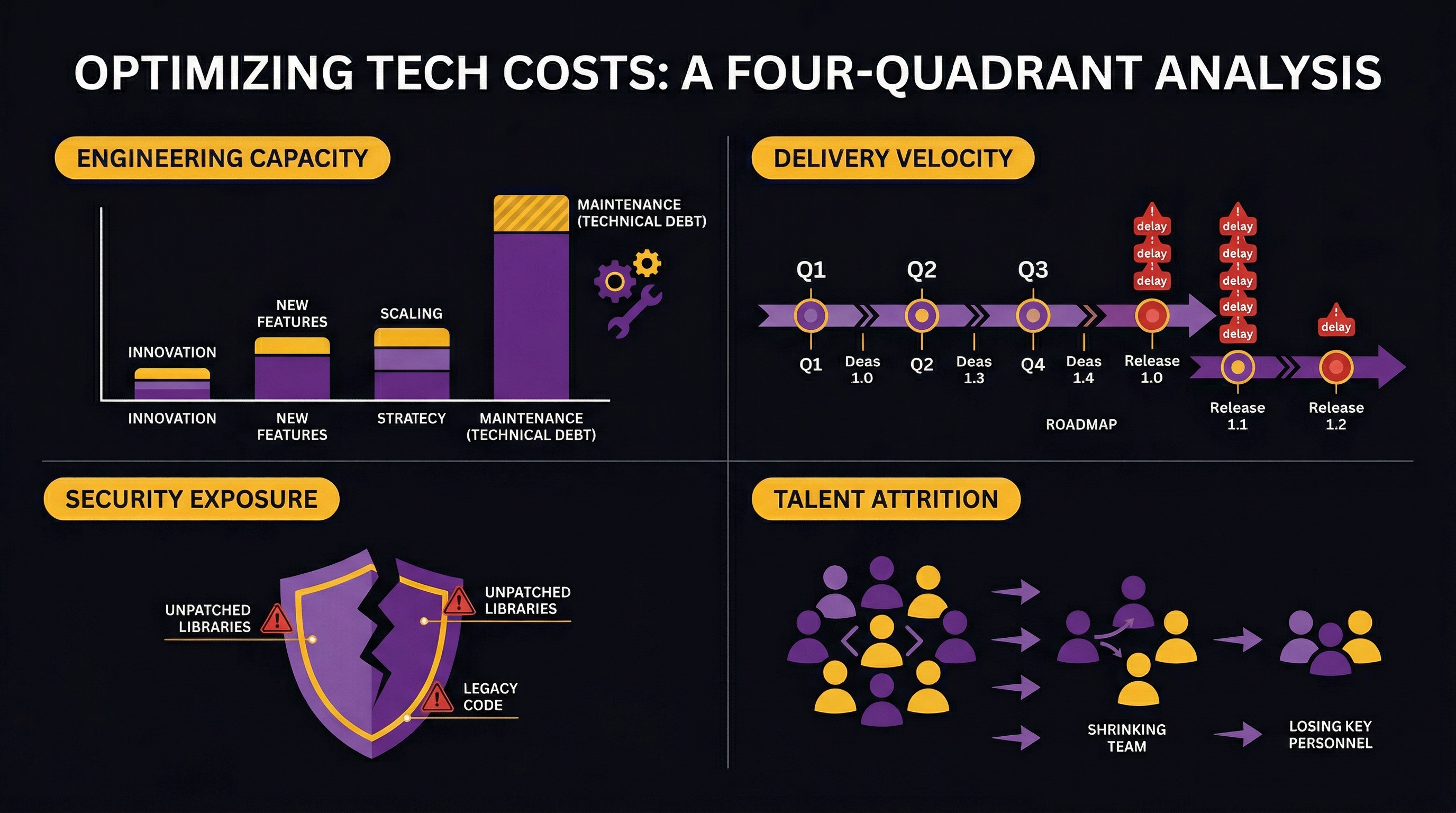
Engineering Capacity: 25–40% Spent Maintaining the Past, Not Building the Future
Engineering teams in high-debt environments spend 25 to 40% of their total capacity managing the consequences of existing debt rather than building new capability, according to zazz.io’s cost analysis. Think about what that means in dollar terms. If your engineering team costs $3 million per year in fully loaded labor, you’re burning $750K to $1.2M annually on work that produces zero new business value. Every sprint. Every quarter.
This isn’t a performance management problem. You won’t fix it by hiring more engineers or changing project managers. You fix it by reducing the base cost every engineer carries before they write a single line of new code.
Delivery Velocity: Why Your Roadmap Always Runs Behind
A technical debt-laden codebase doesn’t just slow individual features. It slows everything, simultaneously, in ways that are hard to attribute directly to debt. An engineer estimates it will take three days for a change. It takes two weeks because the systems they’re touching have dependencies no one documented three years ago. Multiply that across every feature on your roadmap and you have a systematic execution gap that no amount of project management will close.
As Cesar DOnofrio, CEO and co-founder of Making Sense, put it: “We see the ROI floor drop out when organizations spend 80% of their budget on bespoke middleware just to get fragmented systems to talk to each other. At that point, you aren’t investing in intelligence; you are paying a legacy tax to keep the lights on.”
That’s not an abstract observation. It describes the exact condition most mid-market technology stacks are operating in today.
Security Exposure: Unpatched Legacy Is an Unbooked Liability
Legacy systems accumulate security debt alongside technical debt. Unpatched vulnerabilities. End-of-life dependencies. APIs that haven’t been updated since the software was first written. None of this shows up as a liability on your books until a breach makes it real.
The IBM 2024 data is clear: the average data breach costs $4.88 million. For organizations running high proportions of outdated systems, that number climbs. Your cybersecurity insurance may cover some of it. It won’t cover the reputational cost, the regulatory exposure, or the customer trust you lose.
Talent Attrition: The Hidden Multiplier Nobody Models
A senior engineer who leaves because the codebase is unmaintainable costs you their salary, plus 50–200% of that salary in recruiting and onboarding time for their replacement. That replacement then spends six months trying to understand a system with no documentation, during which their productivity is a fraction of what you’re paying for.
According to an OutSystems survey cited by Forbes, 86% of technology executives have been impacted by technical debt within the previous 12 months. Most of them report talent attrition as one of the primary downstream effects. The engineers who leave first are almost always the best ones, the ones with options.
Technical Debt Is Now an AI Readiness Problem
This is the angle no competitor covers, and it’s the one that matters most in 2026. Technical debt doesn’t just cost you engineering capacity. It blocks your AI strategy entirely.
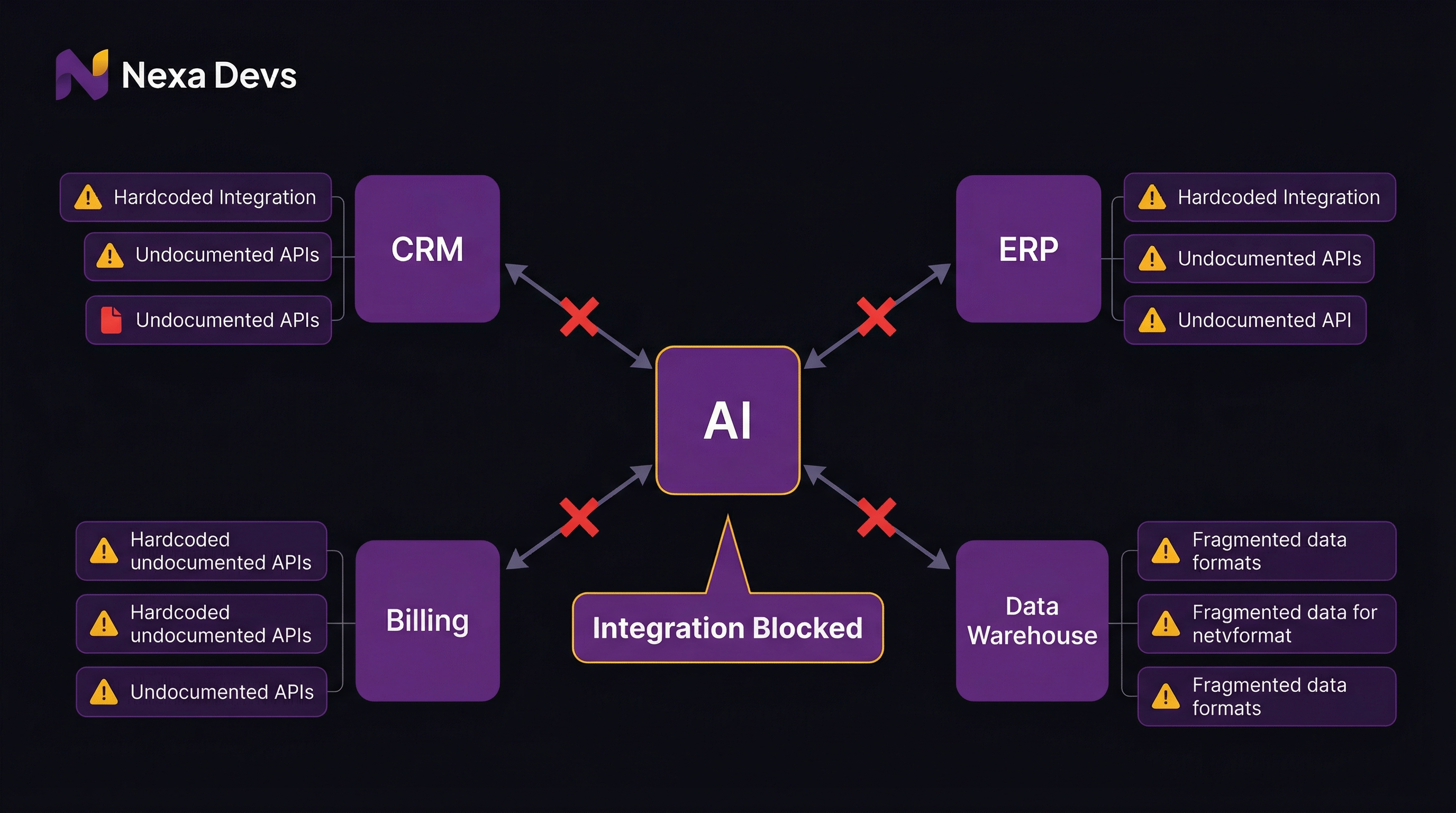
Why Legacy Codebases Can’t Support the AI Investments Your Board Is Asking About
AI systems don’t work in isolation. Every meaningful AI capability, whether that’s a workflow automation, an intelligent recommendation engine, or a natural language interface for your internal tools, requires access to your systems of record. It needs clean, structured data. Callable APIs. Loosely coupled architecture that can absorb new integrations without cascading failures.
Your legacy codebase probably has none of that. It has hardcoded integrations that break when you touch them. Databases that store the same field in five different formats across three different tables. Middleware written in 2014 that nobody on your current team fully understands.
The real constraint for AI is not intelligence; it’s integration. AI cannot generate measurable ROI if it operates outside the core systems of record. That’s the architectural reality most AI strategy conversations skip.
According to a McKinsey-cited figure reported by Devox, 80% of organizations need to modernize their legacy environments to achieve the AI-driven efficiency gains their boards now expect. Your AI pilot didn’t fail because the technology isn’t ready. It failed because your infrastructure isn’t ready for the technology.
Every Quarter of Delay Widens the Gap Between You and Your AI-Enabled Competitors
Here’s the dynamic that makes the technical debt cost problem genuinely urgent in 2026, not just expensive: your competitors aren’t waiting.
A competitor that has already modernized their core systems is running AI features today that your team can’t replicate for eighteen months, not because of budget, and not because of engineering talent, but because their foundation can support it and yours can’t. Every month they operate AI-enabled and you don’t, they’re compressing delivery cycles, automating decisions, and creating customer experiences you can’t match.
The gap compounds. And it compounds faster than the underlying debt does, because AI capability is not a linear improvement, it’s an exponential one. Getting there six months later than a competitor doesn’t mean arriving six months behind. It means arriving with two years’ worth of compounded disadvantage to overcome.
Why Waiting Costs More Than Fixing
Every CEO instinct says “wait until we have budget clarity” or “tackle this after the current roadmap clears.” Those instincts are wrong here, and the math explains why.
The Compounding Nature of Technical Interest
Standard financial debt charges you a fixed interest rate on a fixed principal. Technical debt is different, both the principal and the interest rate grow as the debt ages. A system with six months of accumulated shortcuts is painful to work in. A system with six years of accumulated shortcuts is an engineering emergency that requires specialist intervention just to understand what’s there before you can fix anything.
The interest compounds because the people who understand the system leave. Documentation doesn’t get written. New features get built on top of broken foundations, adding their own shortcuts to the pile. Each engineer who joins the team inherits everything that came before them, and each one makes rational local decisions, “I’ll patch this rather than rewrite it, there isn’t time”, that add to the global debt load.
Ray Forte, an executive at Analog Devices, described finding that their infrastructure cost was “in the low 80s” as a percentage of budget. They knew it. They’d been living with it. The question was whether to act now or wait for a cleaner moment that never arrived.
What the Math Looks Like One Year from Now vs. Today
Here’s the capital allocation reality: the cost of remediating technical debt increases the longer you wait, because the debt itself grows and because the market context changes around it.
Delay one year at $7 million in annual technical debt cost, and you’ve spent $7 million more than you needed to. But that’s the conservative case. The realistic case includes the AI competitive gap that opened during that year, the security incident you didn’t have budget to prevent, and the two senior engineers who left because they didn’t want to spend their careers debugging a system built in 2011.
According to Devox’s 2026 research, organizations that complete modernization with AI-augmented methodologies report productivity gains of 20–30% and cost reductions up to 15%. Those gains begin accruing the day the work is done. Every quarter of delay is a quarter those gains don’t compound for you, while your competitors capture them.
What Modernization Actually Looks Like on the Other Side
The fear that stops most CEOs from acting on technical debt isn’t the cost of fixing it, it’s the fear of what fixing it might break. The answer to that fear is specifics, not reassurance.
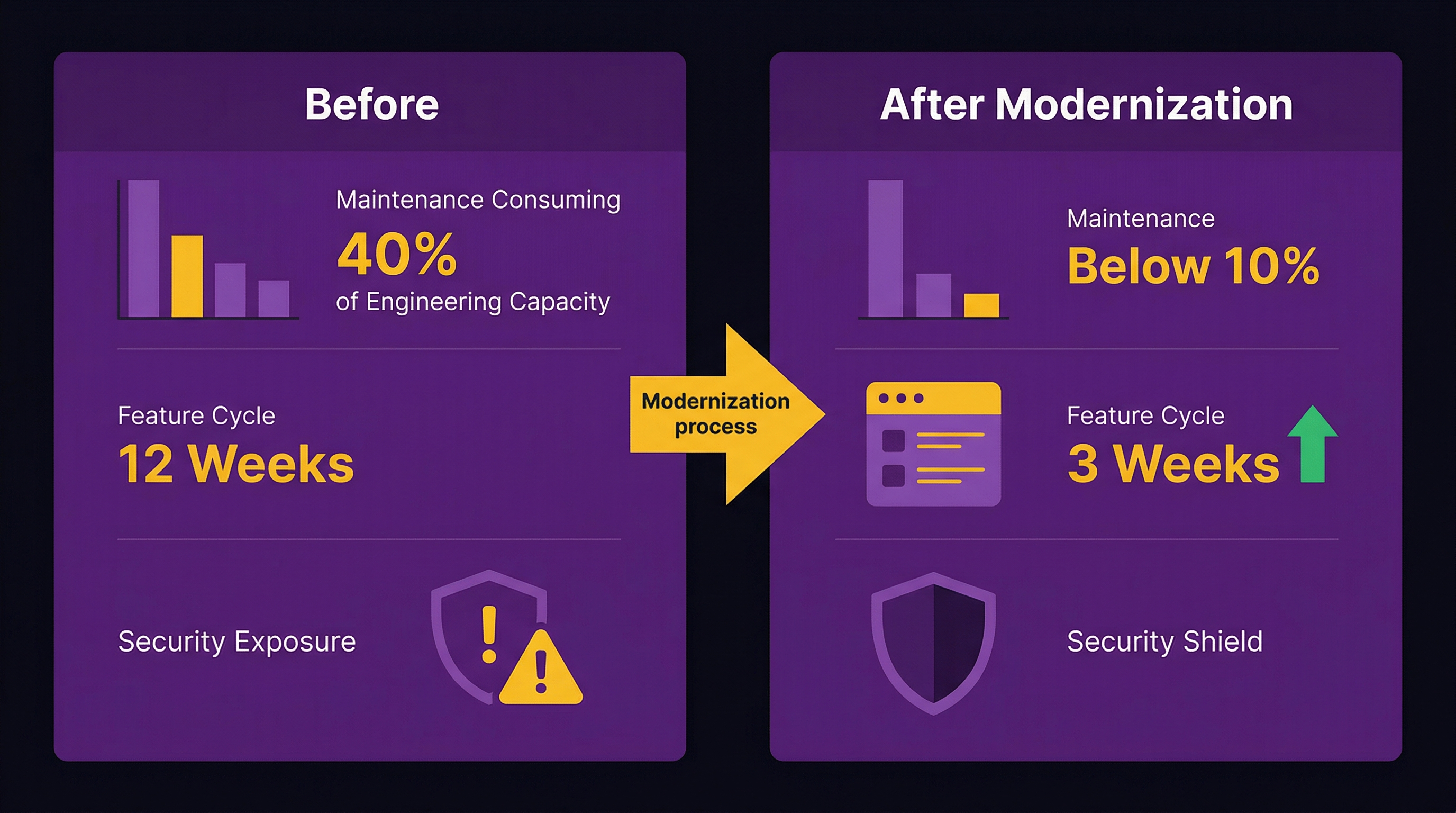
What Organizations Report After Completing Modernization
The pattern across organizations that complete modernization is consistent. Engineering teams that previously spent 25–40% of their capacity on maintenance work find that number drops below 10%. Feature delivery cycles compress; changes that took twelve weeks take three. Security surface area shrinks because the codebase is documented, current, and patched.
The less obvious outcome is organizational. Engineers who were burning out on legacy maintenance become productive again. Recruitment conversations change when you can tell candidates they’re joining a modern, AI-native codebase. And the CEO walks into board meetings with a technology story that’s about capability, not containment.
Devox’s 2026 Legacy Modernization Report documents the trend across organizations that have completed modernization: productivity gains of 20–30% and cost reductions up to 15% through AI-augmented delivery models. These aren’t ceiling numbers, they’re what organizations report at the start of the compounding curve.
Why AI-Augmented Modernization Changes the ROI Math
Traditional modernization projects have a deserved reputation for running long and expensive. A three-year migration that creates a new set of dependencies isn’t a solution, it’s a different version of the same problem. That reputation is why most CEOs, when they hear “modernization,” mentally price it at 18 to 36 months of disruption and uncertainty.
AI-augmented modernization changes the economics. When AI is applied across the entire SDLC, requirements analysis, architecture design, implementation, testing, documentation, the process is faster, more thoroughly documented, and less likely to create new technical debt as it clears the old. Organizations don’t emerge from the project with new black boxes they can’t maintain. They emerge with systems they own, architectures they understand, and documentation their own engineers can work from.
At Nexa Devs, AI across the full SDLC isn’t a feature, it’s the delivery methodology. Systems we build or modernize come with complete documentation packages: UML architecture diagrams, API references, test coverage reports, and architecture decision records. That documentation transfers to you unconditionally at project close. You own it. Full stop. No new vendor dependency to replace the old one.
That’s the exit from the hidden tax, not a migration project that runs forever, but a modernization engagement that ends with you in control.
Five Questions Every CEO Should Be Able to Answer About Their Technical Debt
If you can answer these five questions confidently, your technical debt is being actively managed. If you can’t, you’ve likely been paying the hidden tax longer than you realize.
1. What percentage of your engineering capacity goes to maintenance vs. new capability?
If you don’t know, your engineers do, and they’re probably uncomfortable with the answer. The benchmark for a healthy codebase is under 20% on maintenance. Most mid-market legacy systems run 25–40%. Some run higher.
2. How long does it take to ship a feature from approved to deployed?
If the answer has gotten longer over the past three years without a corresponding increase in feature complexity, that’s technical debt compounding. It’s not a team performance problem.
3. When did your core systems last receive a full security audit?
Not a scan, an audit. If the answer is “more than 18 months ago” or “I’m not sure,” you have unquantified security liability in your technology stack.
4. If your two most technical people left tomorrow, what would break?
Key-person risk in a technology context is technical debt risk. If critical system knowledge lives in someone’s head rather than in documentation, that’s as real as any code-level debt, and typically more dangerous.
5. Can your current codebase support the AI integration your board is asking about?
If your CTO or VP of Engineering can’t give you a confident “yes” to this question, the answer is almost certainly no. And the gap between where you are and where you need to be is the most urgent version of technical debt your business is carrying.
If you can’t answer three or more of these confidently, you’re not alone, and this is exactly what a structured technical debt assessment is designed to surface.
Technical debt cost is real, it’s large, and it’s compounding right now. You don’t need to boil the ocean to fix it, but you do need to know what you’re carrying before you can make a capital allocation decision that makes sense.
The first step is understanding the scope. Nexa Devs runs structured architecture assessments that quantify your technical debt in financial terms, map it against your AI readiness requirements, and produce a modernization roadmap your leadership team can evaluate against your actual business priorities, not a generic framework.
Ready to see what your technical debt is actually costing you?
Book a no-commitment architecture assessment with the Nexa Devs team. We’ll give you numbers, not generalities.
FAQ
What are the 4 types of technical debt?
Technical debt falls into four categories: deliberate (shortcuts taken knowingly to ship faster), accidental (poor design decisions made without recognizing the long-term cost), outdated (code that aged as technology and business needs changed), and environmental (dependencies on third-party systems that have degraded). Most mid-market companies carry all four simultaneously.
What does technical debt actually cost a mid-market business?
According to zazz.io’s cost modeling, the realistic annual cost for a mid-market company with unmanaged technical debt runs between $5.4 million and $10 million per year, covering lost engineering capacity, delivery delays, security remediation, and talent attrition. This excludes opportunity costs from blocked AI initiatives.
How does technical debt block AI adoption?
AI systems require clean data, callable APIs, and loosely coupled architecture. Most legacy codebases lack all three. AI pilots succeed in sandboxes but fail to connect to the actual systems of record where business data lives. Modernizing the underlying codebase is the prerequisite for AI, not optional prep work.
How do you fix technical debt without disrupting live operations?
Incremental modernization, not a big-bang rewrite, is the right approach for mid-market companies. Each phase targets a specific component, runs in parallel with live operations, and produces both cleaner architecture and new capability. AI-augmented delivery accelerates each phase while generating documentation that makes future changes safer.
What’s the difference between technical debt and a legacy system?
A legacy system is old software. Technical debt is accumulated shortcuts, missing documentation, and deferred maintenance, it can exist in a five-year-old system as readily as a twenty-year-old one. Most mid-market companies have both: aging systems with compounding debt. That combination is what makes modernization urgent.